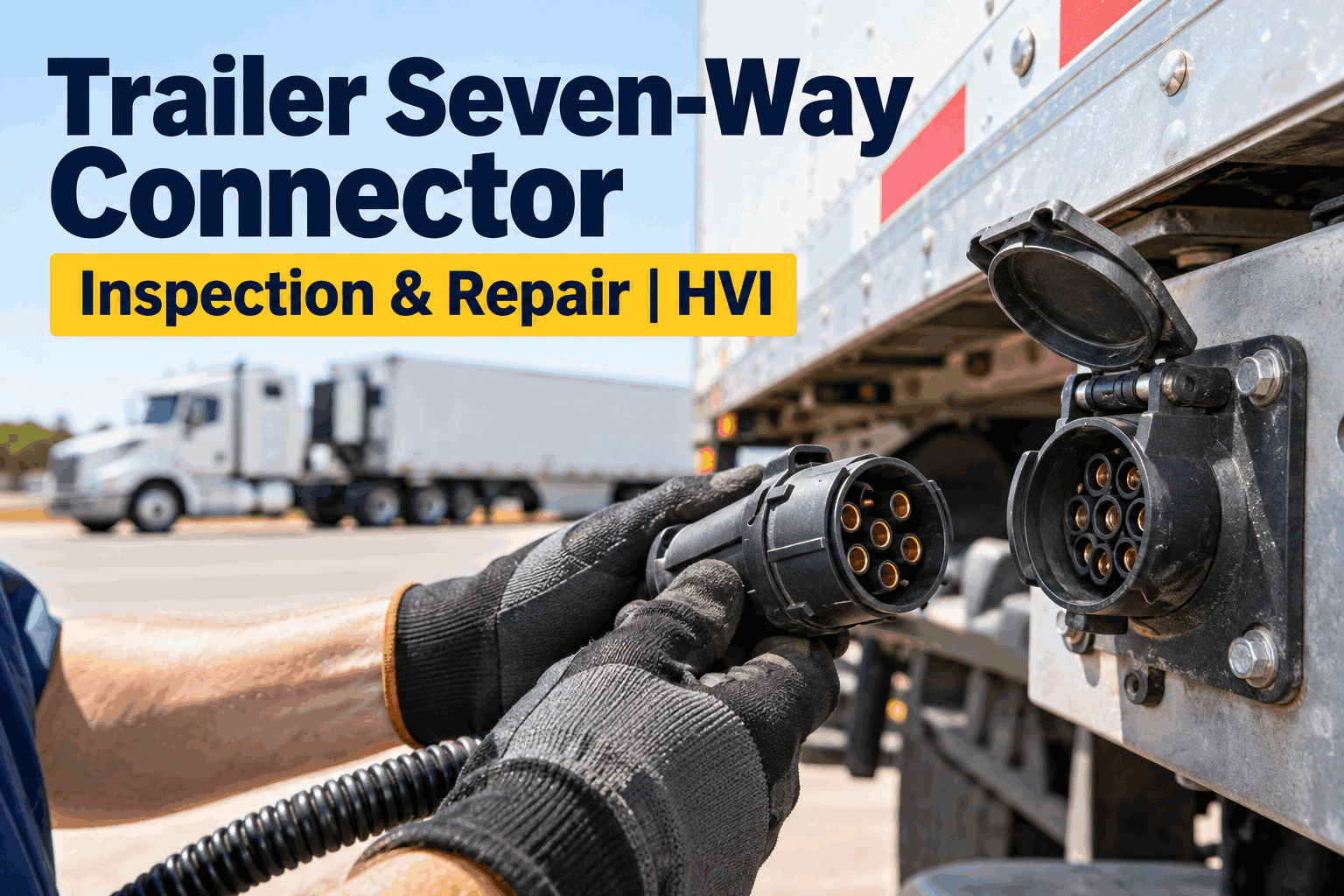
A trailer's seven-way connector is a small part with an outsized job: it carries every electrical signal between tractor and trailer — lights, brakes, ABS, and power. When it fails, the truck doesn't limp; it stops, because a trailer with dead brake lights or a live ABS fault isn't legal to roll. A proper seven way connector inspection catches the corrosion, worn pins, and damaged wiring behind those failures while they're still a five-minute fix. This guide walks how to inspect the pins, socket, cord, and wiring, diagnose the intermittent faults, and know when to clean versus replace. Book a demo to see connector defects documented by asset.
One Corroded Pin, and the Trailer Goes Dark
The seven-way carries lights, brakes, and ABS between tractor and trailer — and it lives in the worst spot for it: moisture, road salt, debris, and a plug pulled apart every trip. Catch the corrosion and pin wear early, or find them as a roadside failure.
- Corroded pins
- Sound contacts
The seven-way connector cycles open and closed every time a trailer is coupled, sits exposed to weather and road spray between trips, and takes constant mechanical movement on the road. Nothing else on the trailer's electrical system lives a harder life — which is exactly why it's the most common source of trailer electrical faults, and the first place to look when the lights act up.
Why the Connector Is a Single Point of Failure
Every electrical function on the trailer runs through this one plug. That makes it efficient — and it makes it the choke point where a small amount of corrosion or a single worn pin takes out something safety-critical.
Tail and marker lights, turn signals, brake lights, stop lamps, auxiliary power, and ABS all pass through the seven pins. Lose contact on one and you lose that function completely.
Inoperative brake lights, a dead turn signal, or an ABS fault are out-of-service conditions. A connector problem doesn't slow the truck — it can legally stop it at a roadside inspection.
Connectors rarely die outright. They flicker, drop out over bumps, and work when you test them cold — which is what makes the fault so maddening to chase without a systematic inspection.
That intermittent behavior is the trap: by the time a light is reliably dead, the connection has been marginal for a while, quietly failing over bumps and in the wet. Catching it at the inspection — before it's a no-light violation on the shoulder — is the whole point of checking the connector on every pre-trip. Book a demo to see connector checks in the pre-trip template.
Corrosion: The Number One Enemy
If a seven-way connector is giving trouble, corrosion is the first suspect. The white or green powdery deposit that builds on the pins is oxidation, and it's an electrical insulator — it puts a barrier between the pin and the socket that blocks the signal.
Moisture and road salt reach the contacts through a plug that's cycled open every trip and stored facing the weather. Over time the metal oxidizes, and the connection degrades — worse in coastal and winter-salt environments.
It starts subtle: a flickering brake light, an intermittent turn signal, a light that works until you hit a bump. As corrosion deepens, the minor faults become dead circuits — and a safety failure.
Clean the deposit off with a contact cleaner and a small brush, then apply dielectric grease to seal moisture out of the pins. Regular inspection catches it early, while cleaning still restores the connection.
The reason corrosion deserves top billing is that it's both the most common connector fault and the most preventable. A connector inspected, cleaned, and greased on a schedule rarely reaches the failure stage — while one left alone until a light dies has usually been marginal for weeks. Prevention here is a few minutes; the failure is a breakdown. Start free and log connector cleaning against each trailer.
Inspecting the Pins and Socket
Corrosion is the common fault, but the pins and socket themselves wear and fail in ways cleaning won't fix. A thorough inspection checks the metal condition, not just the surface deposit.
Pins that are worn short or recessed below the housing face don't make solid contact. Check each pin sits proud and clean, not eaten back or flattened.
Pins spread, bent, or pushed sideways from rough coupling won't seat correctly. They cause intermittent contact and can damage the mating socket.
Darkened, melted, or discolored pins and housing signal a high-resistance connection that's been overheating — a sign of a bad contact drawing too much heat.
The socket contacts should grip the pins firmly. Loose, sprung, or spread socket terminals lose tension and drop the connection over road vibration.
The pin condition tells you whether this is a cleaning job or a replacement. Surface corrosion cleans up; worn, spread, or heat-damaged pins and sprung socket tension don't — those mean the connector or terminal is at the end of its life and cleaning it just delays the inevitable failure. Knowing which you're looking at is the difference between a fix and a false fix. Book a demo to see pin condition photographed on the record.
Beyond the Pins: Cord, Strain Relief & Wiring
Plenty of connector faults aren't at the connector at all — they're in the cord and wiring behind it, where a broken conductor inside intact insulation hides the real problem. A connector inspection has to follow the wire.
The cord & jacket
Check the coiled cord for cracks, cuts, chafe, and abrasion where it rubs the frame or catches. Damaged insulation lets water into the conductors and starts corrosion inside the cable.
Strain relief
Where the cord enters the connector takes the most flex and pull. A failed strain relief lets the wires flex right at the terminals, breaking conductors internally over time.
Internal conductor damage
A wire can look fine and be broken inside. Flexing the cord while testing, or checking continuity end to end, finds the hidden break that causes a fault that comes and goes with movement.
This is why the classic "works when I wiggle it" fault is so common — a conductor broken inside the jacket or at the strain relief makes and breaks contact as the cord moves. It won't show on a static look; it shows when you flex the cord or test end to end. Chasing the connector face alone leaves that fault in place. Start free and record cord and wiring findings too.
Diagnosing Intermittent Light & ABS Faults
The payoff of understanding the connector is fast diagnosis: because each pin drives a specific function, the symptom points you straight at the circuit. Match the fault to the pin and you've narrowed the search before you pick up a tool.
The ground pin deserves special attention: because every circuit shares it, a corroded ground shows up as multiple weird, dim, or intermittent faults at once — and technicians chase individual lights for hours when one bad ground is behind them all. A tester confirms the pin, but the pin function narrows it first. Always verify wiring against the applicable standard for your equipment. Book a demo to see the fault logged to the pin and asset.
Clean, Replace, and Repair Right
Once you've found the fault, the fix is either restore the contact or replace the part — and doing it durably means the repair lasts, not fails again next month. Here's how the calls break down.
Surface corrosion with sound pins: clean with contact cleaner and a brush, restore the metal, and seal with dielectric grease. The right fix for the most common fault, when the pins are still good.
Worn, spread, heat-damaged pins or sprung socket tension: replace the connector. Cleaning a failed contact only delays the failure — a new connector restores solid contact for real.
For wiring repairs, make sound electrical connections — proper terminals, solid crimps or solder — and protect them against moisture. A weak repair reintroduces the corrosion path you just fixed.
A few connector spares in the truck — a replacement plug, terminals, dielectric grease, and contact cleaner — turn a roadside connector failure into a repair instead of a tow. And documenting the repair against the trailer means the next tech sees what was done, so a chronic connector isn't rediscovered from scratch every time. Start free and keep the repair history on the trailer.
How HVI Documents Connector Defects by Asset
A connector fault chased and cleared but never recorded is a fault you'll chase again. Three capabilities turn each connector check into data that compounds instead of disappearing.
Connector check in the pre-trip
The seven-way inspection is a step in the pre-trip template — pins, corrosion, cord, and function — so the connector gets checked every trip, with a photo of any defect against the trailer.
Defect routing & repair records
A flagged connector routes to a work order and the repair is logged against the asset — so the fix, the photo, and the history live on the trailer's record, not in someone's memory.
Repeat-fault analytics
Trend connector defects across the fleet and per trailer — so a unit with recurring electrical faults stands out, pointing you at a chafe point, a bad ground, or a wiring issue behind the repeat.
The result is that trailer electrical faults stop being a game of whack-a-mole. Every connector check is on the record, every repair is tied to the trailer, and the repeat offenders surface as data instead of frustration — so you fix the cause, not the same symptom on the same unit every month. Book a demo to see it on your trailer fleet. Start free and put connectors on the record.
From a shop foreman who stopped rechasing the same plug
We had one trailer come back four times in two months for lights — a different tech each time, each one cleaning the plug and sending it out. Turned out the cord was chafed through on the frame and wicking water into the connector; nobody saw the pattern because nobody had the history. Once every connector defect was logged to the trailer with a photo, that repeat jumped right out. The data found what four cleanings couldn't.
Frequently asked questions
How do you inspect a seven-way trailer connector?
Open the connector and check the pins for corrosion (white or green deposit), wear, recession below the housing, spreading or bending, and heat discoloration. Check that the socket contacts still grip the pins firmly. Then follow the wiring: inspect the cord for cracks and chafe, the strain relief where the cord enters the connector, and test for internal conductor breaks by flexing the cord or checking continuity end to end. Finally, test function — a seven-pin tester or multimeter confirms each circuit. Corrosion cleans up; worn or heat-damaged pins mean replacement.
Why do seven-way connector pins corrode?
Because the connector is cycled open every trip and stored exposed to weather, moisture and road salt reach the metal contacts and oxidize them. The white or green powdery deposit that forms is an electrical insulator, so it blocks the connection. Corrosion is worse in coastal and winter-salt environments, and certain pins can corrode faster than others depending on use and how the plug is stored. Cleaning with contact cleaner and a brush, then applying dielectric grease to seal out moisture, both restores and helps prevent it.
Why do my trailer lights work intermittently?
Intermittent trailer lights almost always trace to the seven-way connector or its cord. The usual causes are corroded or worn pins making marginal contact, sprung socket tension that drops the connection over vibration, or a conductor broken inside the cord or at the strain relief that makes and breaks as the cable flexes. That's why the fault often "works when you wiggle it." Because each pin drives a specific function, the affected light points to the circuit; a bad shared ground pin causes multiple dim or intermittent faults at once.
Should I clean or replace a corroded connector?
It depends on the pin condition. If the pins are structurally sound and only carry surface corrosion, clean them with contact cleaner and a brush and seal with dielectric grease — that restores the connection. If the pins are worn short, recessed, spread, bent, or heat-damaged, or the socket has lost its grip tension, replace the connector, because cleaning a failed contact only delays the next failure. The inspection tells you which: a surface deposit is a cleaning job, damaged metal is a replacement.
Can inspection software help with trailer electrical faults?
Yes — the value is in documenting connector defects by asset and spotting repeat faults. A platform like HVI puts the seven-way check in the pre-trip template with photo capture, routes a flagged connector to a repair work order, logs the repair against the specific trailer, and trends connector defects across the fleet. That repeat-fault data is what identifies the trailer with a recurring electrical problem — a chafed cord, a bad ground, a wiring issue — so you fix the underlying cause instead of cleaning the same plug over and over.
Turn Every Connector Check Into Data That Finds the Cause
Put the seven-way inspection in the pre-trip, capture defects by asset with a photo, route repairs to work orders, and trend repeat faults across the fleet — so a corroded pin is caught before a roadside failure and the trailer that keeps eating connectors finally shows itself. Live in under two weeks, trusted by 25,000+ users worldwide.
No credit card · No hardware · Trailer inspection templates ready on day one