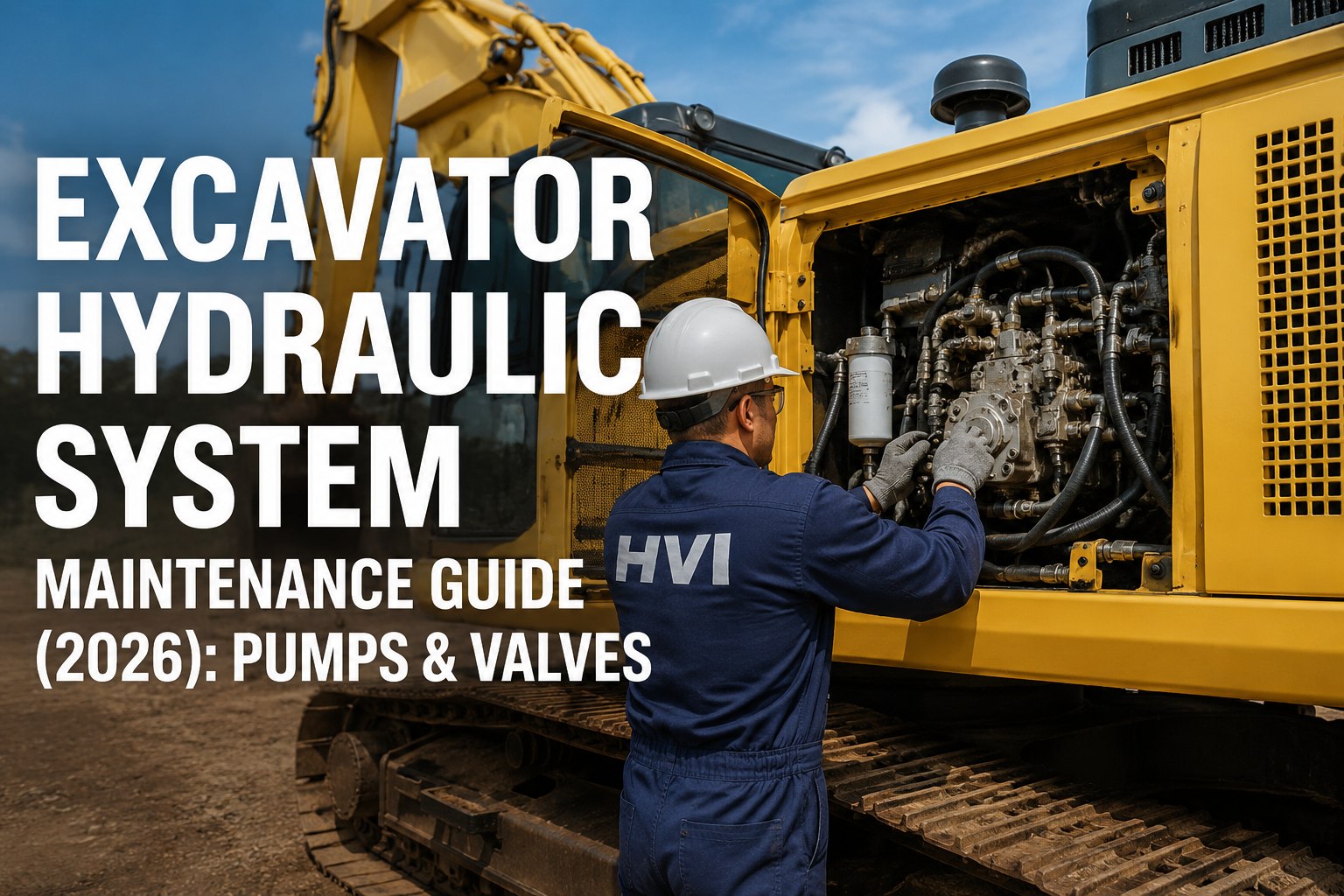
A blown main pump on a 20-ton excavator is a $22,000 to $40,000 repair before you add downtime. A dropped cylinder seal is $3,500. A contaminated hydraulic system that eats its own components over 500 hours is priceless in the wrong way. The single throughline: book a 15-min HVI demo or work the excavator hydraulic maintenance playbook in this guide — because every one of these failures shows warning signs weeks before it strikes, and every one is catchable on a walkaround.
The Hydraulic Anatomy of a Working Excavator
Six zones that fail. One inspection route that catches them all before they take the machine down.
Excavator hydraulic maintenance covers seven systems: the main pump (pressure and flow every 250h), the main control valve (spool response every 500h), boom / stick / bucket cylinders (drift test every shift), hoses and fittings (visual every walkaround), hydraulic oil (ISO cleanliness sample every 500h), filters (return 500h, pilot 1,000h, suction 2,000h), and system pressure testing (calibrated gauge annually). Miss any one and the others start failing in sympathy.
A hydraulic system on an excavator moves 60–100 gallons per minute at 3,000 to 5,000 PSI. When one component drifts out of spec, the entire circuit compensates — heat rises, pressure sags, cycle time creeps up, and the operator adapts. That's the compounding failure loop. Catch the first drift and the loop breaks. Every deep-dive below traces one component from healthy to failed, and lays out the exact check that sees it coming.
Hydraulic Pump — Zone 02The most expensive component to lose, the most preventable to fail
The main pump is the heart of the hydraulic system — and the most expensive component on the machine when it fails catastrophically. Nearly every pump failure traces back to contamination or fluid starvation, both catchable weeks before the pump seizes. A worn pump whines, gets hot, and drags cycle times up before it lets go.
- Case drain flow (baseline vs. current)
- Output pressure at pump test port
- Housing temperature vs. reservoir
- Audible whine or knocking at high load
- Metal debris in return line filter
Slow cycle times under load (5–10% degradation), rising oil temperature (10–20°F above baseline), audible pump whine at RPM, reduced breakout force, or metallic sheen on return filter media. Two to six weeks of warning before catastrophic failure.
Case drain flow test every 250h — increase above 15% of baseline means internal wear. Sample oil every 500h. Keep suction strainer clean — a starved pump destroys itself in under 100 hours.
Main Control Valve — Zone 03The traffic cop of the whole system
The control valve routes pressurized fluid to every function on the machine. Worn spools cause erratic movement; blown seals cause cross-port leakage showing up as function drift. Valve wear degrades over months, and the operator adapts until it's severe enough to see on a spec sheet.
- Spool return under pilot pressure release
- Pilot line pressure at each function port
- External seal weep at spool ends
- Function response lag (control input to motion)
- Cross-port leakage — cylinder drift test
Erratic or jerky function movement, function that starts before or after the control is centered, one function slower than the others, elevated pilot pressure requirement to actuate, or visible fluid weep at spool end caps.
Contamination is the primary killer — keep ISO cleanliness code below 20/18/15 on this circuit. Replace pilot filters at 1,000h regardless. Rebuild spool seals at 6,000h before external weep appears.
Hydraulic Cylinders — Zones 04–06Boom, stick, bucket — three cylinders, one drift test
The three main cylinders take the highest load on the machine and show wear first at the rod seal. Rod pitting from jobsite dust ruins seals faster than anything else. The drift test — load the cylinder, lock the machine, watch how much it settles in 10 minutes — is the single most useful hydraulic diagnostic on an excavator.
- Extend cylinder fully with load
- Shut engine down, cylinders locked
- Measure rod extension at 0 and 10 min
- Under 5mm/10min: healthy
- 5–10mm: rebuild scheduled
- Over 10mm: rebuild now
Look for pitting, scoring, or chrome flaking on the chrome plating. Any surface defect on the rod destroys the wiper seal in under 200 hours. Polish or replace the rod — do not run a scored rod through fresh seals.
Grease mount pins every shift. Wallow at the pin bore is the second-largest source of cylinder-related noise. Pin wear over 0.5mm requires bushing replacement in pairs — never one side.
Hoses & FittingsThe 90% of the system nobody looks at until it sprays
Hose failure is the most common hydraulic incident on any excavator, and the most dangerous to work around. Hydraulic fluid at 3,500 PSI can inject through skin without breaking it. Every hose weep is a potential hospital visit. The walkaround check is 90 seconds and non-negotiable.
- Fresh oil weep at any fitting or coupling
- Cracked outer jacket (bend and inspect)
- Rubbed spots where hose contacts frame
- Kink or twist beyond bend radius
- Braid exposure — retire immediately
Never trace a leak with a bare hand. Use a piece of cardboard, held at arm's length. Fluid injection injuries look like a small red mark that heals in a day and lands the person in the ER 48 hours later with tissue necrosis and often amputation.
Replace crush washers and O-rings whenever a fitting is opened — never reuse. Torque to spec, not by feel. Anti-seize on threads only, never on sealing surfaces. Contamination introduced at a fitting reaches the pump in under 20 minutes.
Hydraulic Oil — The Whole System's BloodstreamISO cleanliness code · The one number that predicts every other failure
Hydraulic oil doesn't wear out from time — it wears out from contamination. Water, dust, and metal particles work their way in through breather caps, seals, and every open fitting. The ISO 4406 cleanliness code is the single best predictor of remaining hydraulic system life.
Start free — log every ISO code per machine and trend contamination against hours, so the pattern is visible before the pump feels it.
Filters — Return, Pilot, SuctionThree filters, three intervals, three ways to kill the pump if skipped
Every filter has a job, an interval, and a specific failure mode when neglected. The return filter catches everything the system generates; the pilot filter protects the tiny orifices in the control valve; the suction strainer prevents debris from reaching the pump.
The return filter's differential pressure (DP) is the most useful hydraulic gauge on the machine. A rising DP at operating temperature is the earliest warning of contamination somewhere in the system — typically from pump or cylinder wear. Book a demo to see filter DP trended against operating hours automatically.
Pressure Testing — The Annual Baseline30 minutes with a calibrated gauge that pays for itself in one caught problem
Every hydraulic circuit has a spec pressure and a test port for measuring it. An annual pressure survey benchmarks the whole system against manufacturer numbers and creates the trend line every future test is compared against.
-
01Warm the system to operating temperature
Run all functions for 15–20 minutes until hydraulic oil reaches 130–160°F. Cold-oil pressure readings are 5–15% high and not reliable for baseline.
-
02Connect calibrated gauge to pump test port
Use a gauge rated at least 20% above expected pressure. Digital gauges hold peak readings. Confirm the port is at the pump housing, not downstream of the main relief.
-
03Deadhead the pump against relief valve
Run engine at rated RPM, hold a function at end-of-stroke to force flow across the main relief valve. Peak pressure reading is the main relief setpoint — compare to service manual spec.
-
04Test each function's pressure independently
Boom raise, boom lower, stick out, stick in, bucket curl, bucket dump, swing left, swing right. Each has its own port relief setting. Record all values against baseline.
-
05Log every reading against machine hours
The reading in isolation isn't useful; the trend over 500–2,000 hours is where wear becomes visible. Pressures drifting 5%+ below baseline point to specific components losing efficiency.
Component-by-Component PM TableEvery part, every interval, every failure mode, on one page
| Component | Inspection Interval | Common Failure Mode | Preventive Action |
|---|---|---|---|
| Main Pump | Case drain 250h · Rebuild 8,000–12,000h | Internal wear, cavitation, contamination damage | Case drain flow test; keep ISO code below 20/18/15 |
| Pilot Pump | Pressure test 500h | Output pressure decay, seal leak | Verify 20–25 L/min flow rate at spec |
| Main Control Valve | Response test 500h · Rebuild 6,000h | Spool wear, cross-port leak, spring fatigue | Function drift test; replace pilot filter 1,000h |
| Boom Cylinder | Drift test every shift | Rod pitting, wiper seal failure, mount wear | Grease mount pins; polish rod at first pitting |
| Stick Cylinder | Drift test every shift | Seal wear from side loading, dust ingress | Same as boom — drift test is the fastest tell |
| Bucket Cylinder | Drift test every shift | Rod damage from impact, seal blow-out | Watch for rod tip damage after rock strikes |
| Hoses & Fittings | Visual every walkaround | Chafing, weep, sudden burst | 90-second walkaround; replace fittings' O-rings |
| Hydraulic Oil | Sample every 500h · Change 2,000–4,000h | Contamination, additive depletion, water ingress | ISO code tracking; sealed breather cap |
| Return Filter | Change every 500h | DP rise, bypass activation | Track DP against operating temp |
| Suction Strainer | Every 2,000h or full oil change | Debris blockage, mesh damage | Clean/inspect at every full drain-and-fill |
Troubleshooting — Symptom to CauseThe operator says "it's slow." Now what?
The four symptoms below cover most of the calls that come in on a working excavator. Each has a probable-cause tree that starts with the cheapest check and works toward the expensive components.
- Check hydraulic oil temperature — over 200°F reduces viscosity
- Inspect return filter DP — over 25 PSI means bypass is open
- Pressure test main pump — low reading = internal wear
- ISO code sample — contamination attacks pump volumetric efficiency
- Drift test in isolation — measure per cylinder
- Rule out control valve cross-port leak — test with valve isolated
- Cylinder piston seal blown — rebuild kit under $400
- Load-holding check valve stuck open — separate diagnosis
- Bleed air from cylinder or line — often just trapped air
- Replace pilot filter — clogged filter causes stick-slip
- Check pilot pressure at each spool — compare left/right
- Main valve spool wear if pilot pressure is nominal
- Clean cooler fins first — solves 60% of cases
- Verify cooling fan operation and belt tension
- Check for internal bypass — case drain flow test
- Confirm correct oil grade for ambient temperature
Try HVI free to see this troubleshooting flow inside HVI — operators enter the symptom, the app guides them through the probable-cause tree and creates a work order with the diagnosis.
From a hydraulic tech running 60+ machines
The number that changed how I run PM was the case drain flow reading on the main pump. We started measuring it every 250 hours, logging it, and trending against the baseline the machine ran when new.
Every pump that failed catastrophically in the last three years showed 12–18% case drain increase in the six months before it let go. Every one. We flag any pump above 10% for immediate work order — and haven't had an unplanned pump-out since. The reading was always there. We just weren't looking at it against yesterday's number.
Frequently asked questions
How often should excavator hydraulic oil be changed?
Excavator hydraulic oil should be changed every 2,000 to 4,000 operating hours depending on conditions — 2,000–3,000 hours for severe duty (dusty jobsites, high-temperature environments, heavy sustained load) and 3,000–4,000 hours for moderate duty. But time-in-service is the wrong trigger. The right trigger is ISO 4406 cleanliness code sampled every 500 hours. A machine reading 20/18/15 or better can safely stretch to the top of the interval; a machine reading 22/20/17 or worse should be changed early regardless of hours. Water content above 500 ppm and TAN (Total Acid Number) rise above 2.0 also trigger early replacement. Buy oil analysis; skip the calendar.
What causes excavator hydraulic pressure loss?
Hydraulic pressure loss on an excavator has four probable causes, in typical frequency order. First, main pump internal wear (increased case drain flow, worn swash plate, piston bore wear) — verified by pressure test at the pump port. Second, main relief valve leakage (stuck open, contamination on seat, spring fatigue). Third, cross-port leakage in the main control valve. Fourth, external leaks at fittings or blown cylinder seals. Always start with the cheapest check — oil level and temperature — before moving to internal component diagnosis. A hot, low-viscosity oil supply mimics pump wear symptoms exactly, and it's a 5-minute fix instead of a pump replacement.
How do you inspect a hydraulic cylinder on an excavator?
A hydraulic cylinder inspection covers three areas. First, the drift test: extend the cylinder fully under load, shut the engine down, measure rod position at 0 and 10 minutes. Under 5mm of drift is healthy; 5–10mm means schedule a rebuild; over 10mm means rebuild now. Second, the rod condition inspection: look for pitting, scoring, or chrome flaking. Any surface defect destroys the wiper seal in under 200 hours and lets dust into the cylinder. Polish minor pitting; replace the rod for anything severe. Third, the mount and pins: grease every shift, measure pin wear at rebuild intervals, replace bushings in matched pairs. Pin wear over 0.5mm requires bushing replacement.
When should hydraulic filters be replaced?
Excavator hydraulic filters follow a three-tier schedule. Return filter: every 500 operating hours, or sooner if differential pressure exceeds 25 PSI at operating temperature. Pilot filter: every 1,000 hours, or sooner if erratic function response indicates fine debris in the pilot circuit. Suction strainer: every 2,000 hours or at every full oil change. Filter DP is the most useful gauge on the machine — a return filter DP that rises 30–50% over baseline at the same operating temperature indicates contamination generation, typically from pump or cylinder wear. Never bypass a filter change — a filter in bypass mode circulates unfiltered oil back through the pump, which is how a $200 filter neglect becomes a $30,000 pump replacement.
What causes excavator cylinder drift?
Cylinder drift — the slow settling of a boom, stick, or bucket cylinder under load when the machine is shut down — has three possible causes. First, a blown piston seal inside the cylinder, letting fluid pass from one side of the piston to the other. Second, cross-port leakage in the main control valve. Third, a stuck-open load-holding check valve at the cylinder. To distinguish: crack the hose from the cylinder rod-side port and cap it externally. If the cylinder still drifts, the piston seal is failed. If it holds, the valve is the source. Repair cost ranges from a $400 seal kit to a $12,000 valve rebuild depending on which diagnosis wins.
Related HVI guides
The hydraulic maintenance system your shop already runs — but digitized
HVI stores per-machine baselines for pump pressure, case drain flow, cylinder drift, ISO cleanliness, and filter DP. Trends against hour meter. Fires work orders on drift. Photos and readings tie to equipment history. Live in under two weeks.
Multi-brand · Mobile-first · Live in under two weeks