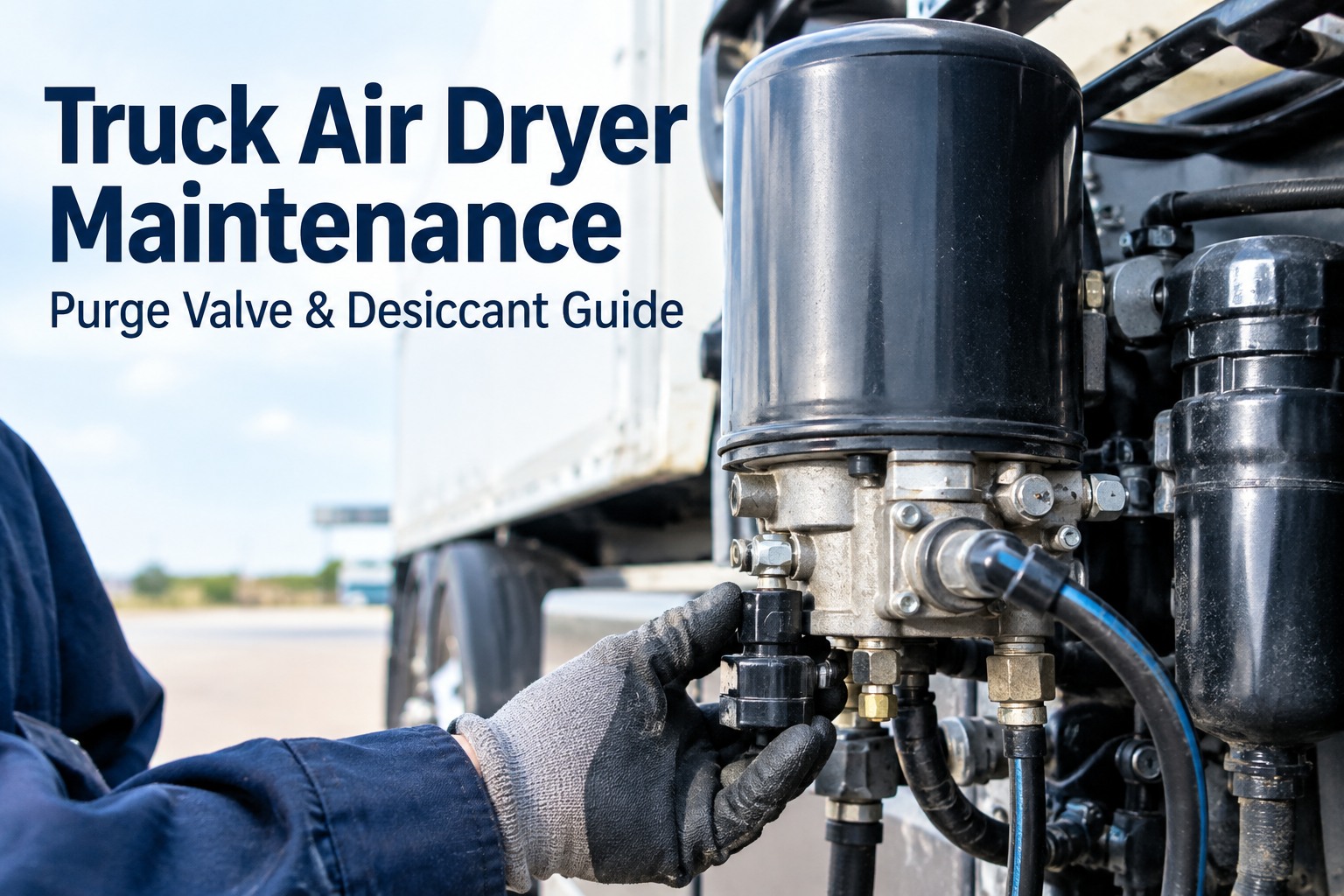
The air dryer is the part nobody thinks about until the air tanks are full of water and a valve freezes solid on a January morning. Sitting between the compressor and the wet tank, it is the truck's first line of defense against moisture and oil in the brake system — and when it quietly stops working, the damage spreads downstream to valves, tanks, and brakes you'll pay far more to fix. Good truck air dryer maintenance is cheap insurance against an expensive chain reaction. See dryer service scheduled per truck
One saturated cartridge can corrode your whole air system
The dryer pulls water and oil vapor out of compressed air before it reaches the tanks. When the desiccant saturates, wet air passes straight through — and moisture doesn't stop at the tanks. It's a small part guarding some very expensive ones.
Let the desiccant saturate and this guard fails — water reaches the tanks, valves, and brakes.
The frustrating part about air dryer failures is how preventable they are — and how often the "fix" doesn't hold. Below is how the dryer actually does its job, the symptoms that tell you it's failing, why a fresh cartridge sometimes solves nothing, and how to keep the whole air system dry through the coldest part of the year.
How the air dryer and purge cycle work
You can't diagnose an air dryer without understanding its cycle, because most "faults" are really a normal cycle behaving abnormally. The dryer does two jobs on a loop: it dries air on the way to the tanks, then cleans itself out. Here's the sequence.
-
1Compress & cool
The compressor pushes hot, wet air into the dryer. As it cools inside the housing, the water vapor it carries condenses out.
-
2Dry through the desiccant
Air passes through the desiccant cartridge, where granular material adsorbs the moisture and traps oil vapor. Dry air continues through a check valve to the tanks.
-
3Governor cuts out
When tank pressure reaches the governor's cut-out value, the compressor unloads and the dryer's purge port opens — the trigger for self-cleaning.
-
4Purge & regenerate
A blast of stored dry air flows backward through the desiccant, picking up the collected water and oil and blowing it out the exhaust. That short hiss you hear is a healthy purge — it means the cycle is working.
Two things follow from this. First, that hiss is normal — silence, or a constant leak, is not. Second, the desiccant has a finite life; every cycle it dries and regenerates, but over thousands of cycles it loses capacity and stops holding moisture back. Book a demo to see dryer service scheduled by cycle-life, not guesswork
Signs your air dryer or desiccant is failing
A dryer doesn't fail silently — it warns you, usually at the tank drains and the purge exhaust. The trick is knowing which symptom points where. Catch these early and you replace a cartridge; ignore them and you're rebuilding valves.
Water at the tank drains
An abnormal amount of water — or oil — when you drain the wet tank is the clearest sign the desiccant is saturated and letting moisture through. Repeated draining that never seems to clear it means the cartridge, not the drain, is the problem.
Frozen lines in winter
Moisture that reaches the lines freezes when temperatures drop, locking up valves and cutting air flow to the brakes. Frozen air lines are almost always a moisture problem that traces back to a dryer that stopped drying.
Abnormal or continuous purge
An unusually long purge, a purge that won't happen at all, or a continuous leak from the exhaust port all point to a purge valve or cycle problem — not the desiccant. Continuous air loss here also makes the compressor cycle far more than it should.
Slow air build-up
If the tanks now take three or four minutes to charge when they used to take one or two, something's leaking or restricted. A clogged cartridge restricts airflow; a leaking valve bleeds it off. Either way the compressor works harder and wears faster.
Notice the split: water and freezing point at the desiccant, while purge and air-loss symptoms point at the valve. Reading the symptom right is what stops you from replacing the wrong part. Book a demo to route each symptom to the right corrective action Book a demo to log these symptoms against the asset
Why replacing the cartridge alone often isn't enough
This is the mistake that turns a one-time repair into a recurring one. A truck comes in with water in the tanks, someone swaps the desiccant cartridge, and the problem is back in two months. The cartridge was a symptom, not the cause — and two culprits get missed more than any others.
The purge valve does the self-cleaning, and its seals wear out. A worn valve leaks, "pops" from intermittent sticking, or fails to purge — and if it sticks or fails inside the assembly it can take the whole dryer down with it. Manufacturers widely recommend replacing the purge valve assembly whenever you replace the cartridge, precisely because a fresh cartridge behind a failing valve solves nothing.
If you're finding oil — not just water — in the air system, the dryer isn't the source. Excessive oil carryover points upstream to a worn compressor pushing oil past its rings into the airstream. That oil contaminates the fresh desiccant and destroys its drying capacity fast. Replace the cartridge without fixing the compressor and you've just bought a very short-lived repair.
The rule that saves fleets money: fix the head of the chain, not just the link that failed. Recurring water usually means the purge valve or service interval; recurring oil almost always means the compressor. Chasing it with cartridges alone is how a cheap part becomes an expensive habit. Book a demo to flag recurring contamination before it repeats
Air dryer service intervals and the heater check
There's no single right interval — and that's the point. Cartridge life varies with duty cycle, climate, and how much oil the compressor sends its way. A truck running humid coastal routes saturates a cartridge faster than one in dry inland heat. The reliable approach is to follow the dryer manufacturer's specified schedule for the specific unit, then adjust based on what your drain checks and inspections actually show.
Draining the wet tank is the simplest field check you have: what comes out tells you the state of the whole system. A little water is normal; a lot of water, or any oil, is a flag worth acting on. Start free and put drain checks on the pre-winter PM list
The air dryer service checklist
This is the check that keeps water out of the air system — the service items plus the tests that tell you whether the cartridge is the fix or just the symptom. Use this air dryer checklist online free, so cartridge and heater checks land on a schedule per truck, not from memory.
From a shop foreman who chased water for a whole winter
We had a tractor that kept freezing up in the mornings. Drained the tanks daily, swapped the dryer cartridge twice, still had water. Everyone kept saying "bad dryer." It wasn't — the compressor was pushing oil, and that oil was killing every new cartridge within weeks. We were treating the symptom all winter.
Once we started logging what came out of the drains — water versus oil — against each unit, the pattern was obvious. Oil meant compressor, every time. Now the drain check is a recorded step, and if oil shows up we look upstream first. Saved us a stack of cartridges and one very cold roadside call.
Frequently asked questions
How often should a truck air dryer cartridge be replaced?
There's no universal interval — using a generic one is a common mistake. Desiccant cartridge life depends on duty cycle, climate, compressor condition, and oil carryover: a truck in humid, stop-start work saturates its cartridge far faster than a long-haul unit in a dry climate. Many fleets run annual replacement as a baseline, but the right answer is the manufacturer's interval adjusted for your conditions — tracked per truck, not from memory.
What are the symptoms of a failing air dryer?
They show up at two places: the tank drains and the purge exhaust. Water at the drains means the desiccant is passing moisture through. An oily discharge or a weak, wrong-sounding purge points to compressor oil carryover or a purge-valve fault. Also watch for a dryer that doesn't purge at all, or lines that freeze in winter — classic signs the cartridge has saturated.
Why does my air dryer keep letting water into the tanks after a new cartridge?
Because the cartridge was almost certainly a symptom, not the root cause — and the real problem is still there. The most common culprit is compressor oil carryover: worn compressor rings pass oil into the air, which coats and ruins the desiccant. Drop in a new cartridge and it saturates again in weeks. Fix the source (usually the compressor) or you'll keep replacing cartridges.
Does moisture in the air system really cause that much damage?
Yes — the dryer is a small, cheap part protecting expensive ones. When it fails, water and oil reach the tanks and travel to every valve and chamber in the system. It corrodes reservoirs from the inside, gums up valves, and freezes lines in winter — turning a routine cartridge swap into valve replacements, a rusted-out tank, or a roadside brake failure.
How do I prepare a truck's air system for winter?
Winter is when a marginal dryer becomes a roadside failure, so prep centers on keeping moisture out. Replace a due or suspect cartridge before the cold, drain the tanks to check for water (a warning sign), and verify the dryer's heater works — the heater keeps the purge valve from freezing, and a dead heater is a common cold-weather failure. Confirm the purge cycle sounds right.
The one habit I'd push on any shop is to look at what comes out of the drains, not just that you drained them. Water tells you one story, oil tells you a completely different one, and the guys who don't distinguish the two end up replacing dryer cartridges forever while a tired compressor quietly wrecks each new one. The dryer is almost never the villain — it's the part that shows you something upstream is wrong. Treat a saturating cartridge or a leaking purge valve as a symptom to trace, keep a record of what you find per truck, and you'll fix the actual problem once instead of the same one every couple of months. That's the difference between maintenance and just replacing parts.
Turn air dryer service into scheduled, documented PM
HVI puts air dryer service on each asset's PM schedule with its own interval, records drain-check results and inspection findings, attaches photos of what came out of the tanks, and keeps the full history so a recurring moisture or oil problem is a visible pattern — not a cartridge you keep replacing. Catch the failing purge valve or the tired compressor before winter does it for you. Live on your fleet in days.
No credit card · Asset-level PM scheduling · Air system history from day one