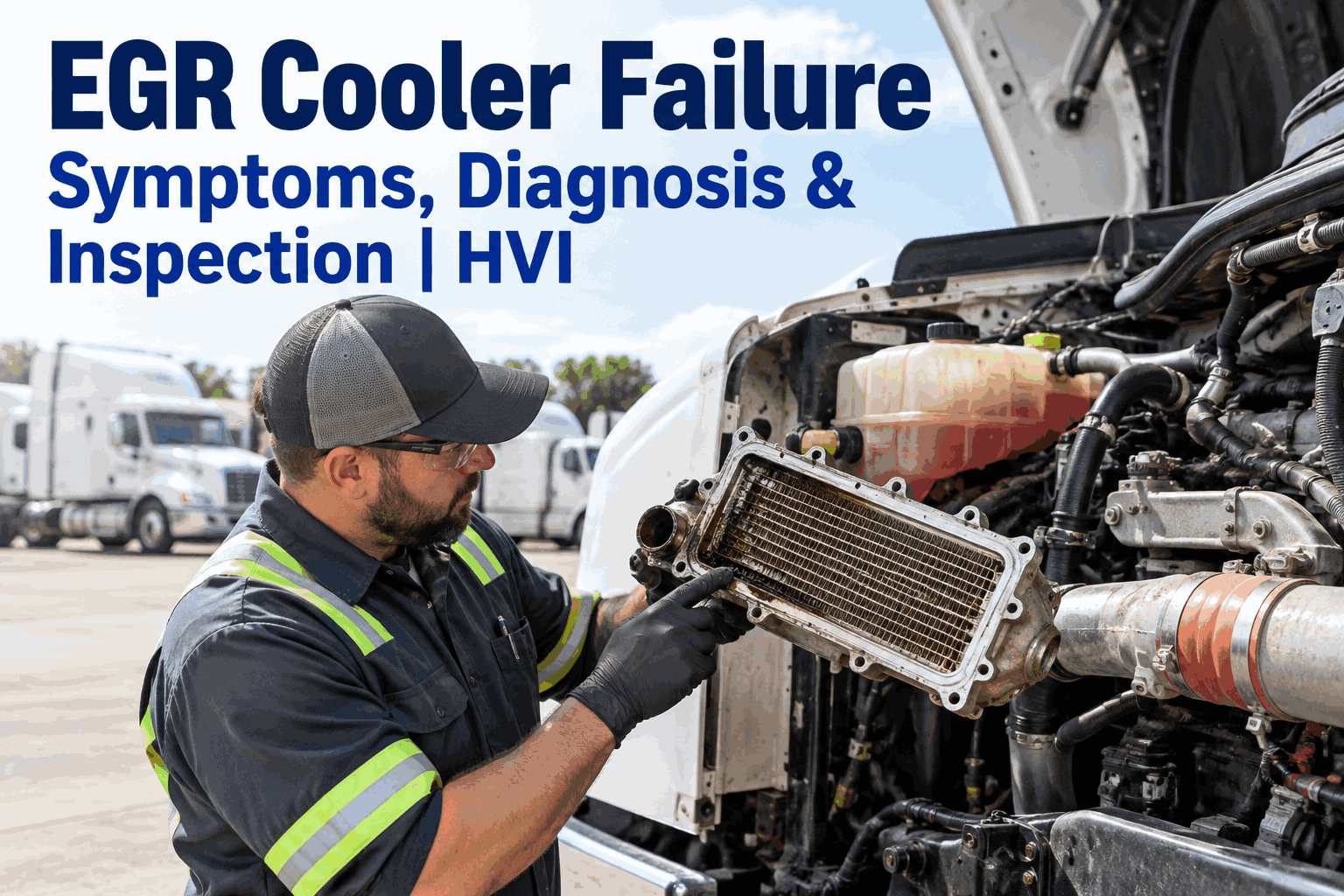
EGR cooler failure symptoms are easy to miss and easy to misread. A truck quietly drinks coolant with no puddle under it, throws white smoke on start-up, maybe flags an EGR fault code — and it gets blamed on a head gasket. But a cracked EGR cooler is feeding coolant straight into the exhaust, and left alone it takes the turbo and the engine with it. Book a demo to see it tracked.
Four Signs Your EGR Cooler Is Failing
On their own each looks minor. Together they point straight at an internal EGR cooler leak — the failure that quietly feeds coolant into the exhaust and ends at the turbo.
Coolant vanishing
The reservoir drops with no puddle underneath — it's going into the exhaust, not the ground.
Sweet white smoke
Thick white exhaust, worst at start-up or under load, with a sweet coolant smell.
EGR fault codes
Codes for EGR flow, EGR temperature or emissions performance start appearing.
Power & sluggishness
Reduced power, poor acceleration, sometimes a derate as the emissions system reacts.
Below is the full picture — how an EGR cooler actually fails, how to tell an internal leak from an external one, the pressure test that confirms it, and how HVI catches the pattern across a fleet before a cooler takes an engine with it.
Two ways it leaks — and they're not equalwhere the coolant goes decides everything
An EGR cooler passes hot exhaust through tubes surrounded by engine coolant, cooling the gas before it re-enters the intake. When it cracks — usually from thermal fatigue and soot loading over time — the leak goes one of two ways and which one changes both the symptoms and the danger.
Coolant → exhaust stream
A crack inside lets coolant into the exhaust side. It flashes to steam and blows out as white smoke, and the coolant just disappears with no external trace. This is the dangerous one — coolant and soot mix and travel downstream.
Coolant → onto the engine
A leak at the cooler's connections or a cracked housing weeps coolant outside, where you can see and smell it. Still a failure, but it announces itself — you get a puddle, a stain, a wet cooler body to trace.
The internal leak is the one that hides, which is exactly why the symptoms below matter — you're reading clues, not looking at a puddle. Book a demo to see coolant-loss trends flagged before the smoke starts
Read the symptom, know the causewhat each sign is really telling you
No single symptom confirms an EGR cooler on its own — several of these overlap with a head gasket or a cracked head. Read them together, and a pattern emerges that points at the cooler.
| What you see | What it means | Points to |
|---|---|---|
| Coolant drops, no external puddle | Coolant leaving through the exhaust | Internal cooler leak |
| Thick white smoke, sweet smell | Coolant flashing to steam in the exhaust | Internal cooler leak |
| "Steam-cleaned" patch on the EGR valve | Coolant vapor washing away soot | Strong cooler indicator |
| EGR flow / temp fault codes | Emissions system sensing abnormal EGR | Cooler or valve |
| Coolant in oil / milky oil | Could be cooler, could be head gasket | Needs a pressure test |
That last row is the trap — milky oil sends people straight to a head-gasket job. What milky engine oil really means is worth reading before you tear anything down. Confirm with the test below first.
Confirm it with a pressure testthe check that isolates the cooler from the head gasket
Before anyone orders a cooler — or worse, pulls a head — the leak has to be confirmed. A cooling-system pressure test is the cleanest way to prove an internal EGR cooler leak, because it shows the system losing pressure with nothing dripping outside.
Fit a cooling-system pressure tester
Attach the tester to the system and pressurize to the manufacturer's spec — no more, to avoid forcing a new leak.
Hold and watch the gauge
Let it sit and monitor for pressure loss. A steady drop with no external leak means coolant is escaping internally.
Inspect the EGR valve & intake
Look for a "steam-cleaned" patch where coolant vapor has stripped the soot — a strong sign the cooler, not the head, is the source.
Rule out the head gasket
If pressure holds and the intake is clean, look elsewhere — a block test for combustion gases in the coolant separates a gasket from a cooler.
An EGR cooler isn't field-repairable once it cracks internally — a confirmed internal leak means replacement, so confirming first saves a wrong teardown. Start free and attach the pressure-test result to the unit's record
Cooler or head gasket? Don't guessthe confusion that costs the most
White smoke and coolant loss describe both an EGR cooler and a blown head gasket — and the repair cost between them is night and day. Getting it wrong means either a needless head job or a cooler swap that doesn't fix the real fault. These are the differences that separate them.
Coolant loss with no oil contamination at first
"Steam-cleaned" soot patch on the EGR valve
EGR-specific fault codes present
Pressure drops, compression and oil look normal
Combustion gases detected in the coolant
Overheating, bubbling in the reservoir
Loss of compression, rough running
Oil and coolant mixing early and heavily
When the symptoms overlap, the pressure test and a block test settle it — cross-check against the J1939 fault codes the truck is actually reporting. Book a demo to see EGR codes captured against the unit history
What it costs to ignore ita small leak doesn't stay small
An internal EGR cooler leak isn't a "watch it" item. Coolant and soot mixing downstream is actively destructive, and the damage climbs fast from a cheap part to a catastrophic bill the longer it runs.
The cooler
Replace the cracked cooler — the cheapest this ever gets, and the only fix if caught early.
The turbo
Coolant and soot gum up and score the turbo, turning one part into two or three.
The engine
Coolant reaching the cylinders risks hydrolock and overheating — the catastrophic end of the line.
Every stage you catch it earlier is a fraction of the next one's cost — which is the whole case for spotting the leak on a schedule. An emissions-driven derate is often the truck's last warning before that escalation.
From a fleet maintenance manager
We chased a "head gasket" on a Cascadia for two weeks — mystery coolant loss, a bit of white smoke. It was the EGR cooler the whole time, and by the time we found it the turbo was scored too. What actually changed things was tracking coolant top-offs by unit; once we saw one truck adding coolant every few days, we caught the next two coolers before they took anything else with them.
How HVI catches it fleet-widecoolant trends, fault codes and repeat-failure history
Diagnosing one cooler is a shop job. Catching them early across a fleet is a data job — and that's where HVI's PM scheduling, telematics fault codes and unit records turn a symptom into an early warning.
Trend coolant loss by unit
Every coolant top-off is logged against the truck, so a slow, repeating loss stands out long before it smokes.
Surface EGR fault codes
Telematics fault codes for EGR flow and temperature come into the platform and attach to the unit's record automatically.
Spot repeat failures
A searchable history shows if EGR coolers keep failing on a model or duty cycle — so you fix the pattern, not just the part.
See how coolant tracking, fault codes and PM live on one screen inside HVI's preventive maintenance. Line it up in a quick demo
EGR cooler failure: quick answers
What are the main EGR cooler failure symptoms?
The classic set is unexplained coolant loss with no external puddle, thick white smoke with a sweet smell (worst at start-up or under load), EGR flow or temperature fault codes, and reduced power. A "steam-cleaned" soot-free patch on the EGR valve is a strong extra clue that coolant vapor is passing through.
How do I know if it's the EGR cooler or a head gasket?
They share symptoms, so you test. A cooling-system pressure test that drops with no external leak points to the cooler, especially with a steam-cleaned EGR valve and normal compression. A head gasket usually adds combustion gases in the coolant, overheating and heavier oil-coolant mixing — a block test separates the two.
How is an EGR cooler pressure-tested?
Fit a cooling-system pressure tester, pressurize to the manufacturer's spec, and watch the gauge. A steady pressure loss with nothing leaking externally indicates coolant escaping internally through the cracked cooler into the exhaust. Pair it with an inspection of the EGR valve and intake for coolant-washed soot.
Can a failing EGR cooler damage the engine?
Yes. An internal leak sends coolant and soot downstream, which can score the turbo and, if coolant reaches the cylinders, risk hydrolock and overheating. What starts as a cooler replacement can become a turbo and engine bill, which is why an internal leak is a repair-now item, not a watch item.
How does HVI help catch EGR cooler problems early?
HVI logs coolant top-offs against each unit so a slow, repeating loss stands out, brings EGR-related telematics fault codes into the truck's record, and keeps a searchable history that reveals repeat failures across a model or duty cycle. That turns a quiet internal leak into an early warning caught on a PM.
Turn mystery coolant loss into an early EGR warning
HVI tracks coolant top-offs by unit, surfaces EGR fault codes from telematics, and keeps the diagnosis and repair history in one place — so an internal cooler leak is caught on a PM instead of on the shoulder with a scored turbo. Live in under two weeks.
No credit card · Coolant & fault-code tracking on day one