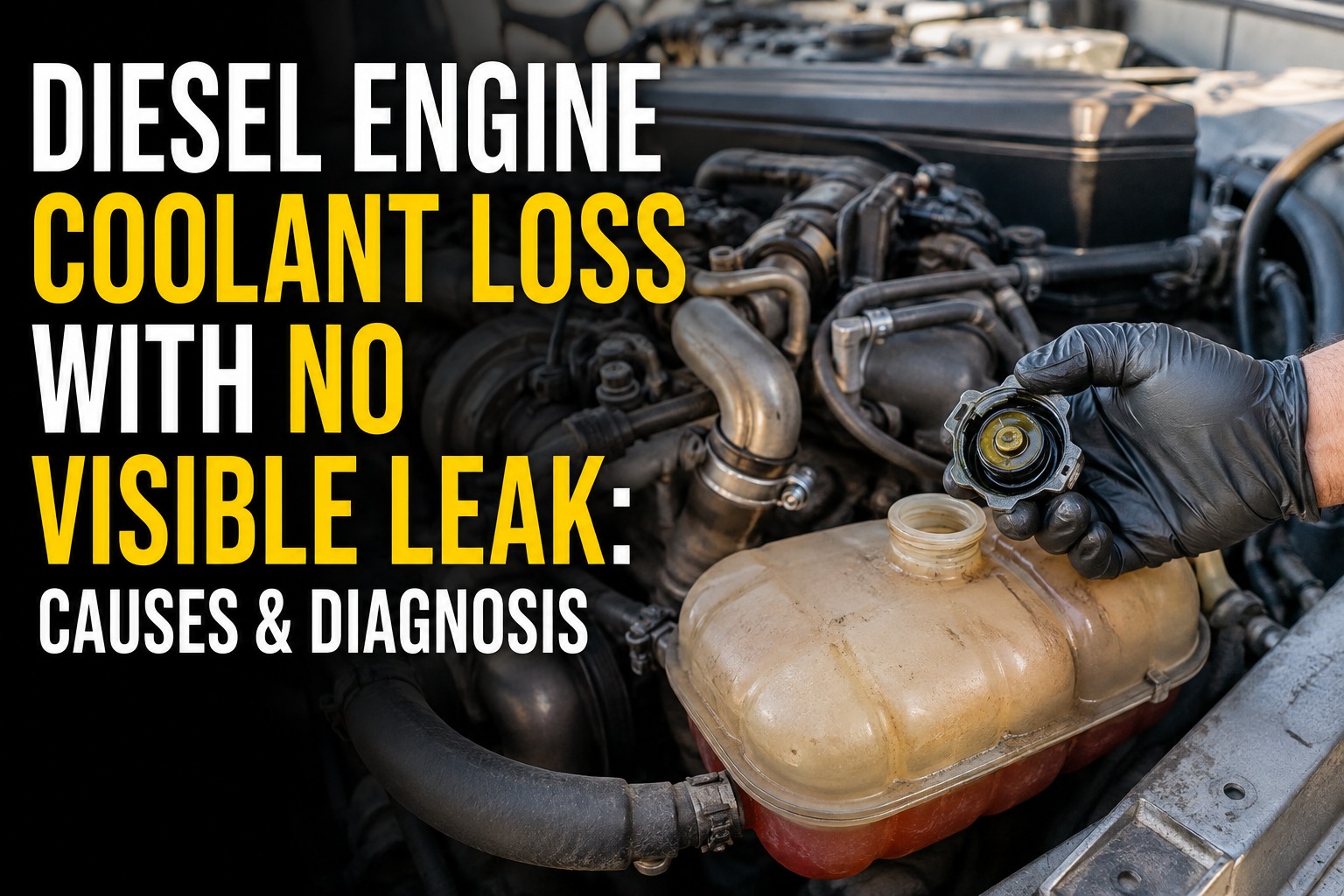
Coolant doesn't evaporate out of a sealed system for fun. So when a diesel is losing coolant with no visible leak — the reservoir keeps dropping, you're topping it off every few hundred miles, and there's not a drop on the ground — the fluid is going somewhere, and the two possibilities are very different in cost. Either it's leaking externally in a spot that only shows under heat and pressure, or it's escaping internally into the exhaust, the combustion chambers, or the oil. This guide walks the same structured diagnostic sequence a good diesel tech uses to force the system to reveal the failure mode, instead of throwing parts at it. Book a demo to document cooling-system diagnostics and repeat failures by asset.
Diesel Engine Coolant Loss With No Visible Leak
If it's not on the ground, it's going one of two places. Diagnosis starts by deciding which.
A leak that only weeps under heat and pressure, then dries on a hot surface before it drips. Water pump weep hole, a seam, a clamp, a turbo coolant line, the degas bottle.
Coolant escaping inside the engine: through the EGR cooler into the exhaust, past the head gasket into a cylinder, or past liner seals into the oil. No puddle because it's burned or mixed away.
General diagnostic guidance for qualified technicians — not a substitute for OEM service procedures. Test pressures, specifications, and repair steps vary by engine; always follow the manufacturer's service data for the specific VIN and engine.
The reason "no visible leak" is so frustrating is that it removes the easiest diagnostic clue — a puddle — and forces you to reason about where a sealed volume of fluid could disappear to. The good news is that the answer is almost never mysterious once you work the system methodically. Coolant that isn't on the ground is either weeping somewhere it evaporates before you see it, or crossing an internal boundary into the exhaust, combustion, or lubrication systems. Each of those paths leaves its own fingerprints, and a handful of cheap tests separates them quickly. The mistake that costs money is skipping the sequence and guessing — replacing a head gasket when it was a forty-dollar EGR cooler hose, or vice versa.
The diagnostic sequence, in order
Work it top to bottom. Each step either finds the leak or clears a suspect and points you deeper. Don't jump ahead — the cheap tests up front save the expensive guesses later.
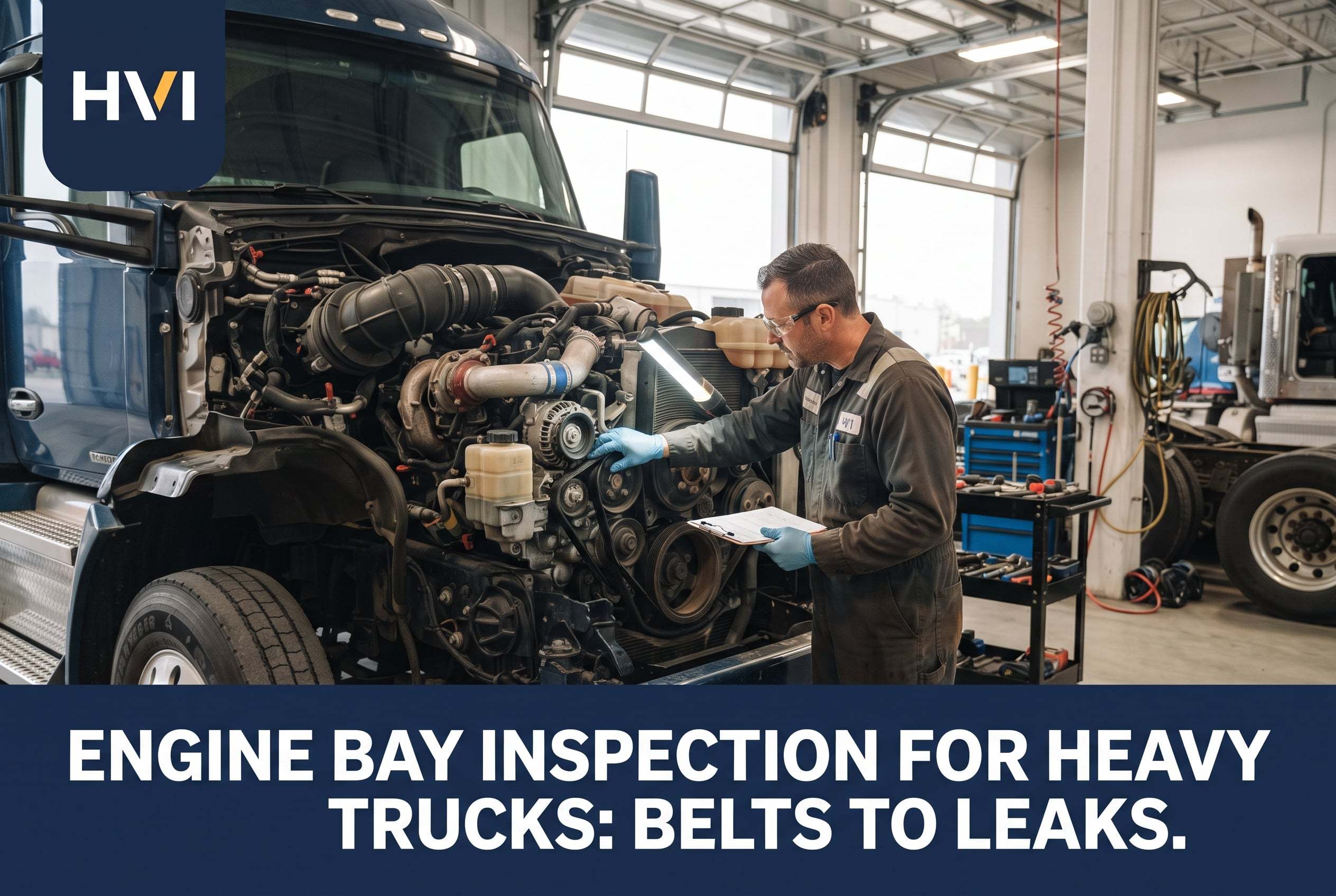
With a bright light and mirror, inspect cooler hoses and quick-connects, the degas/expansion bottle seam and cap, the water pump weep area, radiator tanks and seams, heater hoses, and turbo coolant lines. Clean suspected areas first so the first new wet spot stands out. Use UV dye only if it's approved for your coolant and equipment.
Attach a hand-pump tester to the reservoir or filler neck, cold, with the correct adapter, and pump only to the cap's rated pressure — read the cap and OEM service data for the specific engine, since ratings vary and are not universal. If pressure holds, keep looking externally. If it drops with no external wetness, internal-leak suspects move to the front of the line. Don't pump higher to force it.
The weep hole exists to reveal a failing pump seal. Persistent weeping, or a coolant trail down the lower radiator hose and block near the pump, points here. A weep-hole leak often dries quickly on a hot engine, which is exactly why it reads as "disappearing" coolant.
On a diesel, the EGR cooler is a prime suspect for vanishing coolant. An internal crack lets coolant into the hot exhaust stream, where it evaporates — no puddle, often worse under load or boost. Pull the EGR valve and read it: healthy diesels leave dry black soot, while a leaking cooler leaves the valve steam-cleaned or coated in wet, tarry slime. Note that fully testing the cooler often requires removing it to pressurize it in isolation.
Pull the dipstick and oil cap. Oil and coolant mixing produces a milky, mayonnaise-like sludge; the oil may look milky or over-full. This points to an internal path — head gasket, cracked component, or liner seal — and is more serious than an exhaust-side leak. Oil analysis is highly sensitive to coolant elements and can confirm it.
Draw vapor from the degas bottle or filler neck through the chemical test fluid. A color change indicates combustion or exhaust gas in the coolant. A positive result strongly suggests a head gasket or cracked head — but it does not, by itself, distinguish that from exhaust gas crossing a failed EGR cooler, so read it alongside your other findings.
On wet-liner engines, failed liner O-rings or seals let coolant seep into the crankcase — another route to coolant-in-oil with no external trace. If the oil shows coolant and the head checks out, liner sealing is a suspect on engines built that way.
A weak radiator cap that opens early lets coolant boil and vent, mimicking a "leak." Combustion pressure from an internal failure can also push coolant out the overflow. Review cap condition, overheating history, and coolant chemistry/contamination to close out the picture.
Notice how the sequence moves from cheap and external to serious and internal: you rule out the easy, inexpensive causes before you ever open the engine. That order is the whole discipline — it's what keeps a small coolant-loss symptom from turning into an unnecessary teardown. Book a demo to standardize this diagnostic sequence as a checklist
The big one: EGR cooler vs. head gasket
These two are confused constantly because they share almost every symptom — coolant loss, white sweet smoke, bubbles in the expansion tank. But the repairs differ enormously in cost and downtime, so separating them before you spend is critical. Here's what actually tells them apart.
| Clue | EGR cooler leak | Head gasket / cracked head |
|---|---|---|
| Engine oil condition | Usually stays clean | Often milky / mayonnaise sludge |
| When it shows | Often under load or boost | More persistent, worsens with heat |
| Overheating | May be mild or absent early | Frequently worse |
| EGR valve appearance | Steam-cleaned or wet, tarry | Not the defining tell |
| Combustion (block) test | Can be positive (gas crossover) | Typically positive |
| Relative repair scope | Smaller, lower cost | Major, long downtime |
This single distinction is where fleets save the most money — and where guessing costs it. A pressure test plus a block test plus an honest look at the oil separates the cheap fix from the expensive one before a wrench comes out. Start free on HVI to capture these test results against the specific asset.
Why you can't just keep topping it off
It's tempting to treat slow coolant loss as a minor nuisance — add a bit, move on. On a diesel, that's a gamble, because the internal paths tend to get worse and the failure modes downstream are catastrophic.
Dropping coolant reduces the system's ability to shed heat. Once temperatures climb, the damage accelerates fast.
An internal leak can send coolant into a combustion chamber — hydrolock risk and serious internal damage on a diesel.
Coolant in the oil degrades lubrication and can destroy bearings, the crankshaft, and cylinder walls — an engine-ending outcome.
The point isn't to alarm — it's that unexplained coolant loss is one of those symptoms where a cheap, prompt diagnosis is genuinely worth far more than it costs. A truck that's topping off coolant is, in the worst case, one bad run from a major engine repair. Catch it early and the fix is usually small. Book a demo to flag and escalate coolant-loss findings before they grow
From one-off repair to a maintenance signal
The best fleets treat coolant loss not as a series of unrelated top-offs but as a tracked signal per asset. That shift — from reactive to recorded — is what turns a recurring mystery into a solved root cause.
Check level, look for contamination, and record the reading every service — so a slow loss shows up as a trend, not a surprise.
Log pressure-test and combustion-test findings and coolant chemistry against the asset, so the next tech starts where the last one left off.
When one unit keeps losing coolant, asset history makes the pattern obvious — and turns "top it off again" into "find the root cause."
After a fix, re-test and record the result, so a "repaired" truck is actually confirmed sealed before it goes back in service.
None of this changes the diagnosis itself — but it changes whether the diagnosis actually sticks across a busy shop and a fleet of trucks. A documented cooling-system history is how a recurring coolant leak stops recurring. Start free to turn coolant-loss incidents into tracked, verifiable asset records.
From a shop foreman who stopped guessing
We had a truck that came in three separate times for low coolant, and three different techs looked at it — one topped it off, one replaced a hose clamp, one shrugged. Nobody had the other guys' notes. The fourth visit I pulled the EGR valve myself and it was steam-cleaned, wet and slimy. Cracked EGR cooler. It had been staring at us the whole time.
What fixed it for good wasn't the cooler — it was that we started logging every coolant check, every pressure test, every finding against the truck. Now when a unit shows up losing coolant, the tech sees it's the second or third time and goes straight to the internal checks instead of starting from zero. We catch the EGR coolers and the occasional head gasket way earlier now, before they cook an engine. The diagnosis was never the hard part. Remembering what we'd already found was.
The bottom line on vanishing coolant
Coolant loss with no visible leak feels like a mystery, but it yields quickly to a disciplined sequence. Here's the whole approach in three moves.
Pressure-test first. Holds and you keep hunting externally; drops with no wetness and the internal suspects — EGR cooler, head gasket, liner seals — move up.
Use the oil condition, EGR valve appearance, and a block test to tell an EGR cooler leak from a head gasket before spending on either.
Record every check against the asset, track repeat losses, and re-test after repair — so the fix is confirmed and the pattern is caught.
Work the sequence from cheap and external to serious and internal, separate the EGR cooler from the head gasket before you commit, and don't let a slow loss ride — because on a diesel, unexplained coolant loss is a symptom that occasionally hides an engine-ending failure and usually doesn't, and the only way to know which is to diagnose it. Keep the findings recorded against the truck, and the recurring mystery becomes a solved, verifiable repair. Always follow OEM service data for your specific engine. Book a demo to track engine cooling inspections and repairs in HVI.
Frequently asked questions
Why is my diesel losing coolant with no visible leak?
If a diesel is losing coolant with no puddle and no obvious external leak, the coolant is going somewhere specific — it does not evaporate from a sealed system — and there are two broad possibilities. The first is an external leak that only appears under heat and pressure and then dries on a hot surface before it can drip and be seen: common culprits include the water pump weep hole, a radiator seam, a hose clamp or connection, a turbo coolant line, or the degas/expansion bottle and cap. The second, and more serious, is an internal leak where coolant crosses into another system: through a cracked EGR cooler into the hot exhaust stream where it evaporates, past a failed head gasket or cracked head into a combustion chamber, or past failed cylinder-liner seals into the engine oil on wet-liner engines. On diesels specifically, the EGR cooler is one of the most common causes of unexplained coolant loss, and internal leaks often develop gradually with few early symptoms. The way to find the actual cause is a structured diagnostic sequence: careful external inspection, a cooling-system pressure test, water pump weep-hole inspection, EGR cooler evaluation, a coolant-in-oil check, and a combustion-gas (block) test — moving from cheap external checks toward the more serious internal ones. Because these paths can lead to overheating and major engine damage if ignored, unexplained coolant loss should be diagnosed promptly rather than repeatedly topped off, following OEM service procedures for the specific engine.
How do I know if it's the EGR cooler or the head gasket?
The EGR cooler and the head gasket are confused constantly because they share almost every symptom — coolant loss, white sweet-smelling exhaust smoke, and bubbles in the expansion tank — but a few clues separate them, and getting it right matters because the repair costs differ enormously. The most useful separator is the engine oil: an EGR cooler leak typically leaves the oil clean, because the coolant is going into the exhaust stream rather than the crankcase, while a head gasket or cracked head more often mixes oil and coolant into a milky, mayonnaise-like sludge visible under the oil cap or on the dipstick. Timing helps too — EGR cooler leaks often show up mainly under load or boost, while head gasket problems tend to be more persistent and worsen with heat, frequently with worse overheating. Pulling the EGR valve is informative: a healthy diesel valve carries dry black soot, whereas a leaking cooler leaves it steam-cleaned or coated in wet, tarry slime. A combustion-gas (block) test is important but has an important limitation: a positive result confirms combustion or exhaust gas in the coolant, which strongly suggests a head gasket or cracked head, but exhaust gas crossing a failed EGR cooler can also produce a positive, so it does not by itself distinguish the two. The reliable approach is to combine the pressure test, the block test, the oil check, and the EGR valve inspection before committing to a repair. Confirm findings against OEM diagnostic procedures.
How does a cooling system pressure test help?
A cooling-system pressure test is usually the single most valuable first step for coolant loss with no visible leak, because it pressurizes the system without engine heat and forces leaks to reveal themselves in a controlled way. To perform it, attach a hand-pump tester to the coolant reservoir or filler neck while the engine is cold, using the correct adapter, and pump only up to the cap's rated pressure — you must read the cap and the OEM service data for the specific engine, because rated pressures vary and there is no single universal test value. Then watch the gauge and inspect. The test does two things. First, it is excellent at confirming external leaks: if coolant appears at a hose end, a clamp, a radiator seam, the water pump weep hole, or a fitting while the system is held under pressure, the test has turned an invisible weep into a visible one. Second, if the pressure drops but no external wetness appears anywhere, that is a strong signal of an internal leak, and it tells you to move the internal suspects — EGR cooler, head gasket, liner seals — to the front of the diagnosis. What the pressure test cannot always do is prove which internal path is at fault; for that you follow up with a combustion-gas (block) test and a coolant-in-oil check. A key discipline is that if pressure falls, you locate the leak rather than pumping to higher pressure to force it, since over-pressurizing can cause damage. Always follow the manufacturer's specified test pressure and procedure.
Is coolant in the oil serious on a diesel?
Yes — coolant in the engine oil is one of the more serious findings in cooling-system diagnosis and should be treated urgently. When coolant mixes with oil it typically produces a milky, mayonnaise-like sludge visible under the oil cap or on the dipstick, and the oil may appear milky or read over-full. The significance is twofold. First, it points to an internal leak path that has crossed into the crankcase — most commonly a head gasket or cracked head, or on wet-liner engines a failed cylinder-liner seal — which is generally a more involved and costly repair than an exhaust-side EGR cooler leak. Second, and more importantly, coolant-contaminated oil is a direct threat to the engine itself: coolant degrades the oil's ability to lubricate, and sustained operation with coolant in the oil can destroy bearings, the crankshaft, and cylinder walls, potentially turning a repairable leak into an engine replacement. Oil analysis is highly sensitive to the elements found in coolant and can confirm contamination even at low levels. Because of the damage risk, a diesel showing coolant in the oil should generally be taken out of service for diagnosis rather than continuing to run, and the underlying internal leak identified and repaired before the engine is returned to service. Follow OEM guidance for the specific engine and consult a qualified technician.
How can maintenance software help with recurring coolant loss?
Maintenance software helps with recurring coolant loss by solving the problem that most often lets it persist: a lack of connected history across visits, techs, and shifts. Coolant loss frequently comes back not because it can't be diagnosed but because each visit starts from scratch — one tech tops it off, another replaces a clamp, and nobody sees that it's the same truck with the same symptom for the third time. A platform like Heavy Vehicle Inspection (HVI) addresses this by making cooling-system diagnosis an asset-level record. It lets a shop build the coolant-loss diagnostic sequence into a structured inspection checklist so the steps are performed consistently, and it captures the results — coolant level and condition, pressure-test findings, combustion-gas test results, EGR and oil observations, and overheating events — against the specific vehicle, with photos. That history means a recurring loss becomes visible as a pattern rather than a series of disconnected top-offs, so a tech can go straight to the internal checks on a repeat offender. It also tracks the corrective action through to a verified repair and lets the fix be re-tested and confirmed, so a truck isn't returned to service still leaking. What the software does not do is perform the diagnosis or replace a technician's judgment and OEM procedures; it provides the checklist, records, and asset history that make the diagnosis repeatable and the repair verifiable, which helps fleets catch serious internal failures earlier and reduce preventable engine downtime.
Track engine cooling inspections & repairs in HVI
HVI turns a recurring coolant-loss symptom into a documented, solvable workflow: build the diagnostic sequence into inspection checklists, capture pressure-test and block-test results against each asset, flag overheating events, track repairs through to a verified fix, and surface repeat failures by vehicle before they cook an engine. The diagnosis is the tech's job — HVI makes sure the findings, the history, and the verification are all in one place.
Cooling-system checklists · Pressure & block-test records · Overheating events · Repair verification