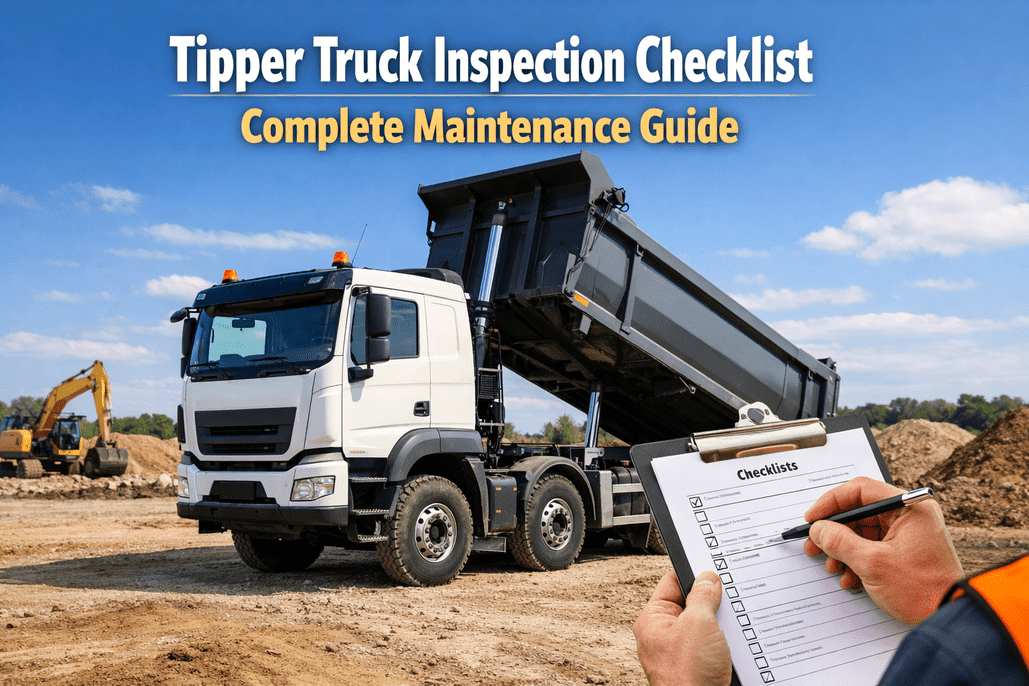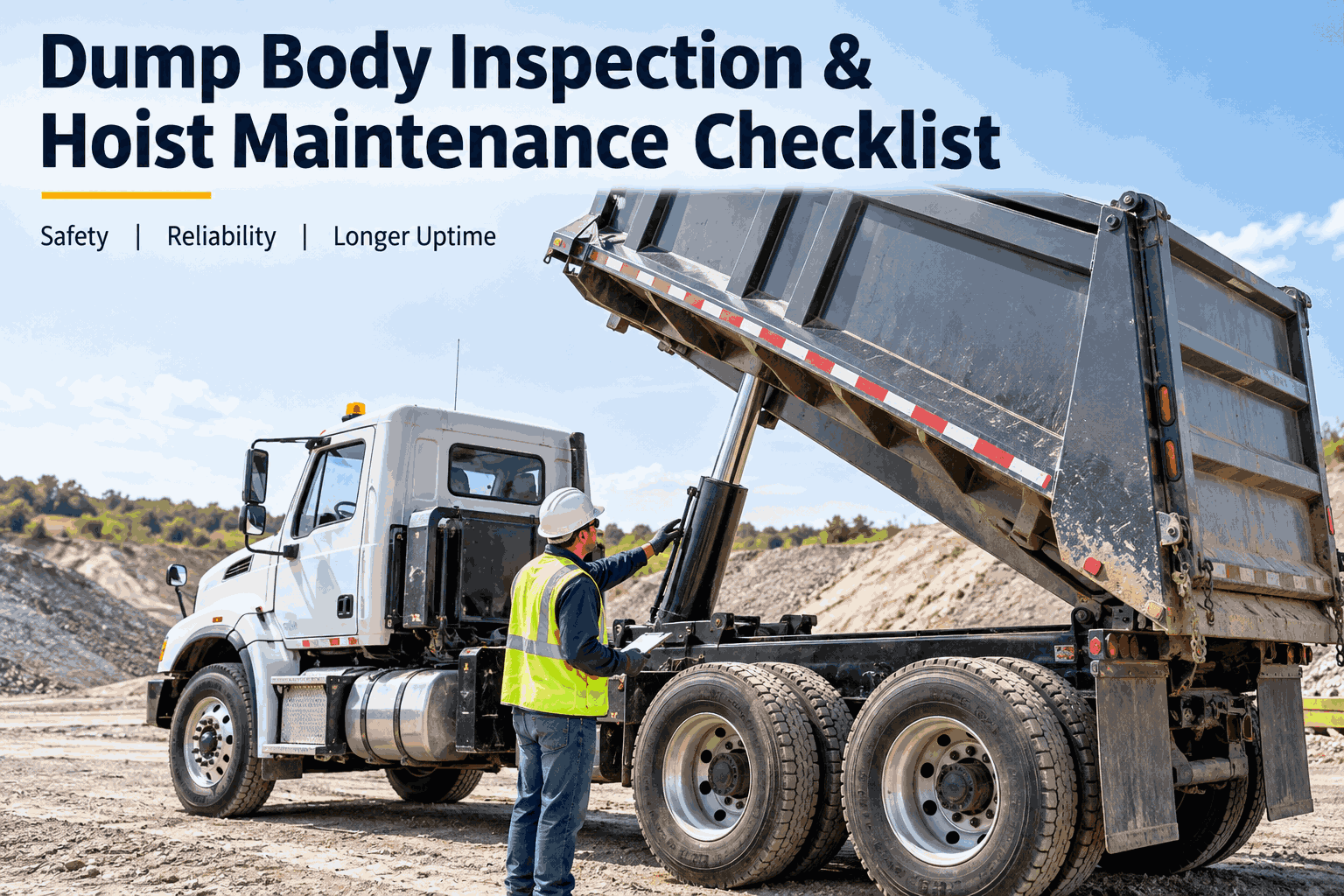
A raised dump body held up by nothing but hydraulic pressure is a crush zone waiting to close. That's the most important thing to understand before any dump body inspection: the hoist that lifts the body is not what should hold it up while you work underneath. Cylinders leak, seals drift, hoses burst — and a raised body drops without warning onto whoever's under it. The rule is absolute: deploy the mechanical body prop before anyone goes near a raised body, every time. This guide covers that safe-access discipline first, then how to inspect the hoist, body, pivots, and tailgate. Book a demo to run a dump-body inspection with the prop step built in.
Never Trust the Hydraulics — Prop It First
A raised body is held by the hoist, and the hoist can fail. Before anyone works under it, the mechanical body prop goes in — because a dropped body is fatal and a leaking cylinder gives no warning. Inspect the whole dump system, but start with the rule that keeps people alive.
A dump truck can pass a full road-safety inspection and still be lethal on site the next morning, because its most dangerous hazards — a multi-tonne raised body, pressurized hydraulic fluid, and a tailgate that can swing under load — aren't what a standard check is built to catch. A dump body inspection covers the body and the hoist as one system, and it does it under a safe-access discipline the rest of the truck never needs.
The One Rule: The Body Prop, Not the Hoist
Everything about working around a raised dump body comes back to one principle: the hydraulic hoist raises the body, but it must never be the thing holding it up while someone is underneath. Regulators are explicit — no one works under an unsupported dump body.
Hydraulics fail silently
A leaking cylinder seal, a burst hose, a bumped control — any of them lets a raised body drift or drop, and there's no warning before it does. Even the area outboard of the frame is deadly, because a descending body reaches beyond the chassis. Pressure is not support.
The mechanical body prop
Dump bed makers provide a strong, positive body prop for exactly this. It's mechanical support that holds the body up independent of the hydraulics — so a hoist failure doesn't become a fatality. Deploy it before anyone goes near a raised body, every single time.
This is why a dump-body inspection is different from every other inspection on the truck: the act of inspecting often requires the body to be raised, which puts a person in the crush zone. Get the safe-access step wrong and the inspection itself becomes the accident. The prop-first rule isn't a suggestion in the procedure — it is the procedure. Book a demo to see the prop step required before body access.
The Safe-Access Procedure — and the Prop's Limits
Deploying the prop is a defined sequence, and it has an important limitation most people don't know: a manufacturer's body prop supports the body at one angle only. Getting the procedure and its limits right is what keeps the safe step actually safe.
Raise the body with the truck on solid, level ground and the parking brake set — not on a slope or soft surface where the truck can shift.
Engage the manufacturer's body prop into its designed position. It's non-adjustable and supports the body at one set angle, close to full elevation — that's by design.
Confirm the prop is correctly seated and taking the load before anyone approaches or goes under the body. Never rely on a makeshift prop — a loose I-beam laid across the frame can be knocked out by any movement.
If work needs the body at an angle the prop doesn't provide, use additional or alternative positive support rated for the job — don't improvise around the prop's single supported position.
That single-angle limitation is where people get caught out: they see the prop as "the safe way to work under the body" and forget it only holds at one specific height. Work needed at a different angle needs its own engineered support — and never, ever the hydraulics alone. The prop is a mechanical guarantee at one point, not a general-purpose safety net. Start free and document the safe-access step on every body inspection.
Inspecting the Hoist and Hydraulic System
The hoist is the system whose failure is most dangerous, so it gets the closest inspection. Every part of it is checked for the leaks, wear, and damage that let a body drift or drop.
Rods, seals & mounts
Hoist cylinders for rod scoring and pitting along the full stroke, weeping at the rod seals, and secure pin connections at both the frame and body pivots. Leaking seals mean the body won't hold up — the exact failure the prop guards against.
Hoses, fittings & fluid
High-pressure lines for chafing, abrasion, and seepage at fittings; the reservoir for correct level and clean, non-milky fluid. Check for pinhole leaks with a piece of cardboard, never a bare hand — high-pressure fluid injection is a serious injury.
Drift test & PTO
Raise the body and hold it — watch for drift, which signals internal seal failure. Check the PTO engages and disengages smoothly with no grinding, and that the body-up warning indicator works.
The drift test is the tell that matters most: a body that slowly settles when held is a cylinder failing internally, and that's the exact condition that turns a routine job under the body into a crush event. Catch it on the drift test, tag the truck, and fix the cylinder before the failure finds someone. Book a demo to see the hoist and drift check on the record.
The Body: Pivots, Structure and Build-Up
The body itself carries and dumps the load, so its structure and the pivots it swings on take heavy, repeated stress. Inspection focuses on the points where that stress concentrates.
The rear body pivot pins, bushings, and retaining hardware for wear, play, and secure retention — the hinge the whole body rotates on.
The floor, sides, and front wall for cracks, dents, holes, and weld fractures — especially at corners, floor joints, and other high-stress points where fatigue starts.
The body-to-frame mounting bolts and points for torque and elongated holes — vibration and heavy loads loosen them over time.
Packed or frozen material in the body — it doesn't just reduce capacity, it shifts the center of gravity and raises tip-over risk on the next dump.
The build-up point is easy to dismiss as housekeeping, but it's a stability issue: a load that won't release cleanly, or material frozen high in the body, moves the center of gravity up and back at exactly the moment the body is raised and most vulnerable to tipping. A clean body isn't tidiness — it's rollover prevention. Start free and photograph body condition against the asset.
The Tailgate: Latches, Hinges and the Catastrophic Open
The tailgate is small compared to the body, but its failure modes are among the worst — a tailgate that opens when it shouldn't, or won't when it should, causes both road liability and rollover.
Latches lock, both positions
Tailgate latches must engage cleanly and hold under load in both closed and open positions. A latch that lets go under a loaded body on a public road is a catastrophic liability event.
Hinges & pins, no play
Hinges free and unbinding, pins without wear or play, and no cracks where the hinges attach. Worn pins let the tailgate swing in transit — the start of an uncontrolled open.
Clean release & chains
The release mechanism cycles fully and the load sheds cleanly; safety chains and pins intact. A tailgate that sticks at the top of the dump cycle is a classic rollover trigger.
That last failure is the deadly one: when a tailgate sticks and the load hangs up at the top of the cycle, the body climbs higher trying to shake it free, the center of gravity climbs with it, and the truck tips. A tailgate that releases cleanly every time isn't just convenience — it's the difference between a normal dump and a rollover. Book a demo to see tailgate defects flagged and routed.
Rollover Risk: Ground, Load, and the Raised Body
Most dump-truck rollovers happen with the body raised, because that's when the center of gravity is highest and the truck is least stable. The inspection can't control the site, but it can flag the conditions that make a tip-over likely.
Dumping on a slope, soft fill, or uneven ground lets the truck lean as the body rises — the leading cause of raised-body rollovers.
Material that won't release evenly shifts weight to one side or keeps it high, pushing the center of gravity past the tipping point.
A tailgate that fails to open traps the load, and the reflex to raise higher to free it is exactly what tips the truck.
These aren't inspection findings in the usual sense, but they belong in a dump program because the equipment condition and the operating condition combine: a worn tailgate latch plus soft ground plus a frozen load is a rollover looking for a moment. Flagging the equipment side — clean release, level dumping, no build-up — is the part a fleet controls. Start free and capture the conditions behind rollover risk.
How HVI Runs Dump-Body Inspection and PM
The dump body and hoist are exactly the systems a generic vehicle check skips — and the ones whose failure is worst. Three capabilities make them a tracked, safe, documented part of maintenance.
Dump-specific templates
A configurable body inspection with the prop step, hoist cylinders, hydraulics, pivots, tailgate, and structure as required items — the dump-specific systems a standard DVIR never covers, run on a phone.
Photo evidence & defect records
Photograph a cracked weld, a scored rod, or a worn tailgate pin against the asset, and route the defect to a work order — so a structural or hoist finding is documented and fixed, not noted and lost.
Recurring body PM & history
Schedule body and hoist maintenance on its own recurring cycle alongside the truck's PM, and keep the full inspection and defect history per asset — so the body gets a maintenance discipline, not just a glance.
The result is a dump body and hoist managed with the rigor their risk deserves: inspected under a safe-access rule, checked component by component, photographed and routed when something's wrong, and scheduled for recurring maintenance — all on the same asset as the truck. That's how the most dangerous system on the vehicle stops being the least managed. Book a demo to see it on your dump fleet. Start free and put the dump body on a schedule.
From a shop foreman who nearly lost someone under a bed
The closest call we ever had was a tech sliding under a raised bed to chase a hydraulic leak — no prop, "just for a second." The cylinder he was looking at was the one that was failing. We caught him before he was fully under, but it rattled everyone. Now the body prop is a required, signed-off step before anyone touches a raised body. The rule isn't paperwork — it's the reason that tech went home.
Frequently asked questions
Why must you use a body prop on a dump truck?
Because the hydraulic hoist that raises the body can fail without warning — a leaking cylinder seal, a burst hose, or a bumped control lets a raised body drift or drop — and anyone underneath is crushed. Regulators prohibit working under an unsupported dump body for exactly this reason. The mechanical body prop, provided by the bed manufacturer, holds the body up independently of the hydraulics, so a hoist failure isn't fatal. Hydraulic pressure is never a substitute for the mechanical prop. The prop must be deployed and confirmed seated before anyone goes near a raised body.
What should a dump body inspection include?
Both the body and the lifting system, under a safe-access procedure. It covers the body prop and safe-access step; the hoist cylinders (rod scoring, seal leaks, secure pins and mounts); the hydraulic hoses, fittings, pump and fluid; a drift test for internal seal failure; the PTO; the body pivot pins and bushings; the body structure for cracks, distortion, and weld fractures at stress points; body-to-frame mounting; material build-up affecting stability; and the tailgate hinges, latches, and release mechanism. It's distinct from a standard road-safety DVIR, which doesn't cover the hoist, body, or tailgate hardware.
How do you safely inspect a hydraulic hoist system?
Check the reservoir level with the body down first. Raise the body and watch for smooth operation and unusual noises, then hold it and watch for drift — drift indicates internal cylinder seal failure. Inspect high-pressure hoses for pinhole leaks using a piece of cardboard, never your bare hand, because high-pressure fluid can inject through skin. And critically, deploy the mechanical body prop before getting near or under the raised body — the inspection itself puts you in the crush zone, so the safe-access step is part of the inspection, not optional.
Why is the tailgate a rollover risk?
A tailgate that sticks or fails to open during a dump traps the load at the top of the cycle. The natural reflex is to raise the body higher to shake the load free — but that lifts the center of gravity even higher on an already unstable raised body, and the truck tips. A tailgate that releases cleanly every time keeps the dump controlled and the center of gravity coming down as the load sheds. Worn latches, hinges, and pins that let a tailgate hang or swing are therefore a stability and rollover concern, not just a mechanical annoyance.
Can a body prop support the body at any angle?
No — a manufacturer's body prop is non-adjustable and supports the body at one position only, close to full elevation. That's a common and dangerous misunderstanding: the prop is a mechanical guarantee at its one designed angle, not a general-purpose support for any body height. If maintenance requires the body at a different angle than the prop provides, additional or alternative positive support rated for that position must be used. Never improvise with a makeshift prop like a loose I-beam laid across the frame, which any movement of the body or truck can dislodge.
Inspect the Dump Body Safely — and Manage It Like It Matters
Run a dump-body inspection with the body-prop step required, the hoist and hydraulics checked component by component, photo evidence on every defect, and recurring body maintenance scheduled against the asset — so the most dangerous system on the truck is the best documented, not the most overlooked. Live in under two weeks, trusted by 25,000+ users worldwide.
No credit card · No hardware · Dump-body inspection templates ready on day one