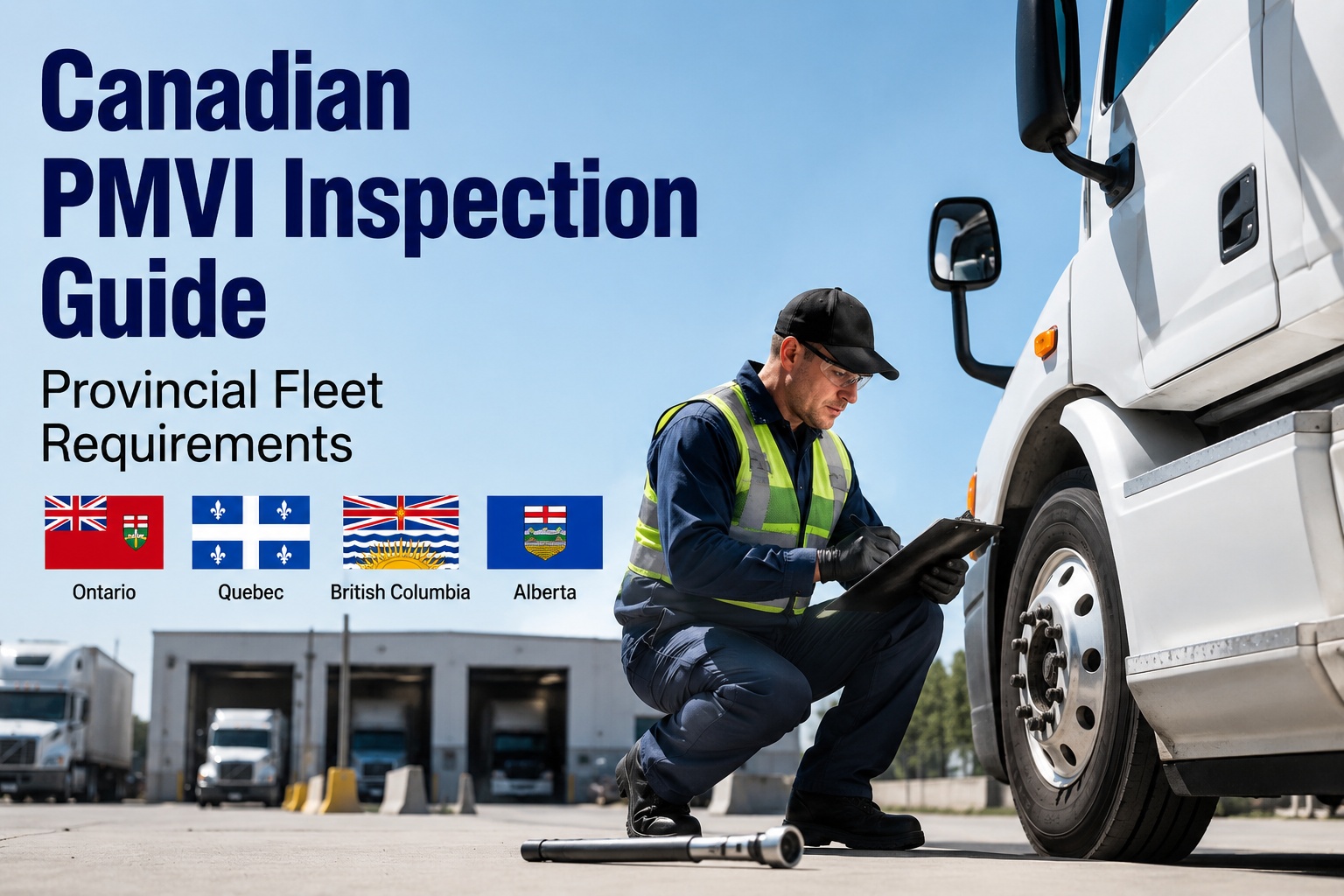
A Canadian fleet running trucks across Ontario, Quebec, BC, and Alberta operates under one national framework and four provincial rulebooks. NSC Standard 11B sets the baseline — annual PMVI for trucks and trailers over 4,500 kg, semi-annual for buses. But each province modifies it, sets its own inspection cycle triggers, and issues its own decals. This Canadian PMVI inspection guide walks through what NSC 11B requires and how multi-province carriers keep one clean audit trail across all of them. Book a demo
One national standard. Ten provincial rulebooks. One audit trail that has to hold up in every one of them.
Canadian PMVI compliance is not a single filing. It's a rolling program of inspection cycles, decal renewals, and record-keeping that has to satisfy the base jurisdiction, hold up on any roadside stop in any province, and pass the annual carrier audit. Multi-province fleets face this ten times over.
NSC Standard 11B — the baseline every province modifies
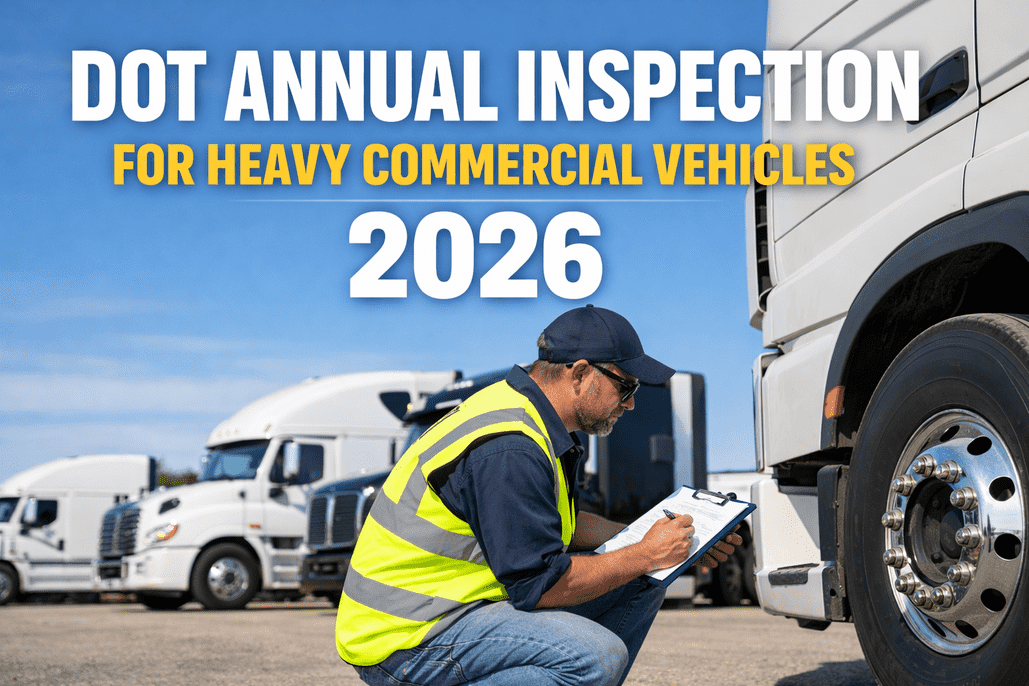
The Canadian Council of Motor Transport Administrators (CCMTA) publishes National Safety Code Standard 11, and Part B is the periodic motor vehicle inspection standard every Canadian jurisdiction adopts — with modifications. NSC 11B defines what an inspector checks, how each category is inspected, and what constitutes a "hazardous condition." The inspection covers ten major systems on every commercial vehicle: power train, suspension, brakes, steering, instruments and auxiliary equipment, lamps and reflectors, electrical system, body and chassis, tires and wheels, and coupling devices. When a vehicle passes, the authorized inspection facility issues a decal of compliance — that decal is what a roadside inspector or scale operator checks first.
Passing the inspection produces the decal. What varies from province to province is the cycle, the inspection facility licensing regime, the on-road enforcement approach, and how the base jurisdiction records the compliance history. Book a demo to see NSC 11B categories mapped into a digital inspection template
Province-by-province — what changes between Ontario, Quebec, BC, and Alberta
The four largest commercial-vehicle jurisdictions in Canada handle PMVI with meaningful differences. A fleet plated in Ontario running loads into Quebec, then out west through Alberta and BC, has to satisfy Ontario's rules for its own vehicles and the reciprocity rules for the others. Here's the practical difference at each border.
The differences look small on paper. In practice they trip up fleets constantly: a BC log trailer that missed its 6-month cycle sitting at an Ontario scale; an Alberta intra-provincial unit crossing into BC and getting flagged for missing PMVI decal; a Quebec-based fleet with English-only inspection records failing a francophone audit. Start free and configure per-province PMVI cycle tracking this week
Reciprocity — how one valid PMVI decal works across the country (and where it doesn't)
All Canadian jurisdictions accept each other's PMVI decals under the 1991 CCMTA Memorandum of Understanding on periodic motor vehicle inspections. This reciprocity is what makes cross-country operation possible without re-inspecting a Winnipeg-plated truck every time it crosses into Ontario. But reciprocity has boundaries, and they cause more compliance problems than the standard itself.
Reciprocity is generous but not absolute. The problem cases — BC log trailers, Alberta weight tiers, Quebec bilingual audit records — are what a multi-province compliance program has to plan for, not react to. Book a demo to see per-province cycle rules configured for a mixed fleet
The multi-province audit archive — what auditors actually ask for
The compliance question isn't whether the trucks are inspected. It's whether the fleet can produce the evidence when the carrier facility audit lands. Every base jurisdiction runs periodic carrier audits (MTO in Ontario, SAAQ in Quebec, CVSE in BC, Alberta's Carrier and Vehicle Safety) and every audit works from the same list of records — produced fast, produced complete, or produce them by the deadline with a warning attached.
An audit that takes weeks of file-pulling and photocopying signals disorganization — and disorganization is what auditors focus on next. An audit that produces a signed evidence pack in one export signals a compliance program that runs itself. HVI's compliance module is built for the second outcome, per province. Start free and get audit-ready record archives built into every inspection
From a Compliance Manager running 68 tractors across Ontario, Quebec, and Alberta
We're based in Mississauga, so Ontario is our home rule. Ontario compliance was straightforward once we had the CVOR discipline down. What got us into trouble was the multi-province piece — we'd send tractors and reefer trailers into Quebec on a regular loop, and about once a quarter our units would go out west to Calgary and back. The gaps caught us twice: once when a Quebec audit asked for our maintenance records in French and we had to scramble to translate, and once when an Alberta unit's PMVI decal expired two weeks after it left our yard because we were tracking cycles on a spreadsheet and the reminder never fired.
Consolidating everything into HVI changed how we run the compliance calendar. Per-province PMVI cycles, per-vehicle decal expiry alerts firing at 90/60/30 days, DVIR archived by driver and vehicle and searchable, roadside inspection reports uploaded and cross-referenced to maintenance closure. The Ontario MTO carrier facility audit last spring took our safety officer four hours to prep the whole evidence pack — used to take him three weeks and two long weekends. Clean audit, no follow-up. Same discipline running for the Quebec bilateral and the CVSA scores across the western operation.
Frequently asked questions
What is a Canadian PMVI inspection?
PMVI stands for Periodic Motor Vehicle Inspection (sometimes called Periodic Commercial Motor Vehicle Inspection or, in Alberta, CVIP for Commercial Vehicle Inspection Program). It's the mandatory recurring safety inspection that every commercial vehicle over 4,500 kg registered gross vehicle weight must pass on a defined cycle — annually for trucks and trailers, semi-annually for buses. The inspection standard is National Safety Code Standard 11 Part B, developed by the Canadian Council of Motor Transport Administrators (CCMTA) and adopted with modifications by every Canadian jurisdiction. The inspection covers ten major vehicle systems (power train, suspension, brakes, steering, instruments and auxiliary equipment, lamps and reflectors, electrical, body and chassis, tires and wheels, coupling devices), must be conducted by an authorized technician at a government-licensed inspection facility, and results in a decal of compliance affixed to the vehicle. A missing or expired PMVI decal is one of the fastest ways to fail a roadside inspection at any provincial scale, and produces cascading consequences on the carrier's safety record.
How often is a Canadian PMVI required and what does the cycle depend on?
For commercial trucks, truck-tractors, semi-trailers, trailers, and combinations exceeding 4,500 kg registered gross vehicle weight, PMVI is required every 12 months. For buses designed for the transportation of more than 10 passengers (including the driver), the cycle is every 6 months. British Columbia adds a category-specific rule: log trailers and dump trailers require inspection every 6 months regardless of the standard 12-month baseline, and this rule applies to visiting vehicles from other provinces operating in that category. Alberta uses a two-tier weight structure: extra-provincial vehicles over 4,500 kg require annual PMVI, while intra-provincial vehicles must exceed 11,794 kg to trigger the requirement. Quebec, though not an original signatory to the 1991 CCMTA MOU, has separate bilateral agreements with all other jurisdictions and applies annual PMVI to trucks and semi-annual to buses. The cycle is measured from date of last inspection, not calendar year — a truck inspected in August comes due the following August, not January. Fleets running multiple provinces need per-vehicle per-province cycle tracking to avoid decal expiry surprises at a scale hundreds of kilometres from base.
Does a PMVI decal from one province work in another?
Yes, with important boundaries. Under the 1991 CCMTA Memorandum of Understanding on periodic motor vehicle inspections, all Canadian jurisdictions accept PMVI decals issued by other jurisdictions party to the MOU. Quebec is not an original signatory but has bilateral reciprocity arrangements with every other province. In practice, this means a truck plated in Alberta with a current CVIP decal can operate in Ontario, Quebec, BC, and every other Canadian jurisdiction on the strength of that decal alone. The boundaries: BC's 6-month cycle for log and dump trailers applies to visiting vehicles operating in that category, so an Alberta log trailer with a 10-month-old CVIP decal is out of compliance the moment it starts hauling logs in BC. Alberta's intra-provincial exemption for 4,500-11,794 kg units doesn't travel — the exemption applies only inside Alberta, and the vehicle needs a valid PMVI the moment it crosses any provincial boundary. Roadside enforcement uses the common CVSA inspection standards across all provinces, so a Level 1 inspection in BC follows the same criteria as one in Ontario. The carrier safety profile (Ontario CVOR, Quebec's carrier registry, Alberta and BC equivalents) stays with the base jurisdiction, but out-of-service events from anywhere feed into the base profile.
What records does a Canadian carrier need to keep for compliance audits?
Provincial carrier facility audits (MTO in Ontario, SAAQ in Quebec, CVSE in BC, Carrier and Vehicle Safety in Alberta) look for six primary record categories. Signed PMVI reports: complete inspection report per vehicle per cycle, signed by the authorized technician at the authorized facility, retained minimum 2 years from date of inspection. Daily driver vehicle inspection reports (DVIR): pre-trip and post-trip inspection for every driver on every vehicle every operating day, with defects recorded and repairs signed off, retained 6 months. Maintenance and repair records: every scheduled service, unscheduled repair, and part replacement tied to specific vehicle and date, proving DVIR-reported defects were actually addressed. Roadside inspection reports: every CVSA roadside report from any jurisdiction the fleet operated in, with defect remediation documented per finding, retained minimum 12 months. Driver hours of service records: federal HOS records for extra-provincial operation, provincial HOS for intra-provincial, ELD or paper logs depending on operation type. Decal issuance and expiry tracking: per-vehicle log of PMVI decal issue date, expiry date, and renewal history — the record that answers "when was this vehicle last certified and by whom." Fleets that store these six categories in one auditable system produce evidence packs in hours rather than weeks, and materially reduce audit follow-up.
How does HVI support Canadian multi-province PMVI compliance?
HVI's regional compliance module is built for the Canadian multi-province reality. Per-vehicle PMVI cycle tracking runs per province, so a mixed fleet with Ontario-based tractors and BC-based log trailers gets the 12-month Ontario cycle on one and the 6-month BC log-trailer cycle on the other — automatically. Decal expiry alerts fire at 90, 60, and 30 days before expiration, routed to the fleet manager and the maintenance scheduler, so no vehicle rolls out of the yard on an expired decal. NSC 11B digital inspection templates cover all ten categories with hazardous-condition thresholds pre-loaded, so authorized inspectors record findings against the actual standard rather than a generic checklist. Signed PDF inspection records archive automatically, tied to vehicle VIN and searchable by driver, date, or facility for MTO/SAAQ/CVSE audit response. DVIR mobile app runs offline for remote operations, syncing back the moment connectivity returns. Roadside inspection reports upload directly to the vehicle record with defect closure tracking. When the annual carrier facility audit lands, the evidence pack exports in one click — the six audit-critical record categories, per vehicle, per province, signed and timestamped. For compliance managers like Christine L. running Mississauga-based fleets across Ontario, Quebec, and Alberta, the typical outcome is audit prep time reduced from weeks to hours, clean audit results, and zero follow-up findings. Book a demo to see multi-province PMVI compliance running live.
Ten Canadian jurisdictions. One clean compliance program. Every audit answered from one system.
HVI tracks PMVI cycles per vehicle per province, fires decal expiry alerts at 90/60/30 days, archives signed inspection records searchable by VIN and date, and produces MTO/SAAQ/CVSE/CVSA-ready audit evidence packs in one export. Live in under two weeks; typical result is carrier facility audit prep cut from weeks to hours.