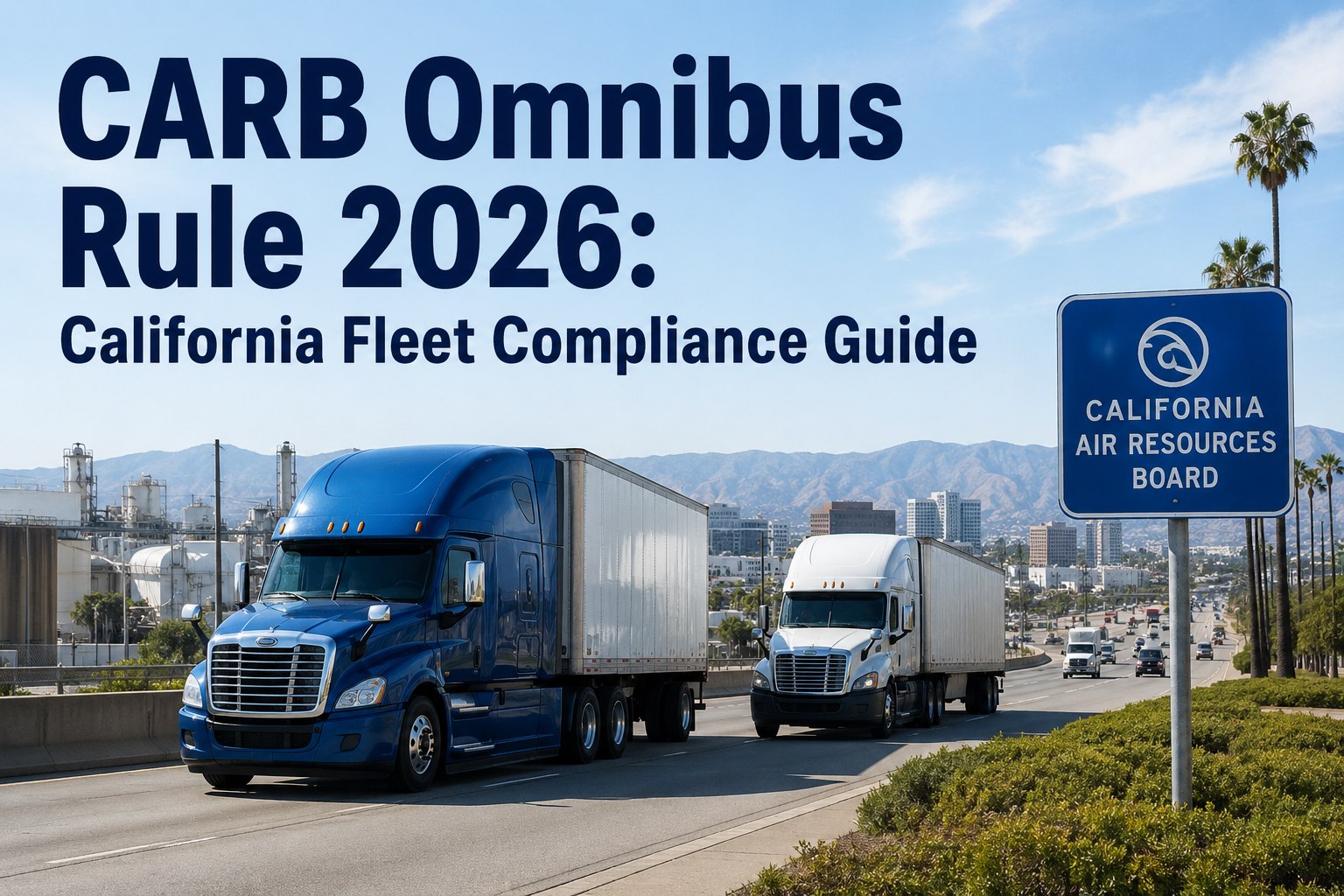
If you run diesel trucks in California, the CARB Omnibus Rule 2026 landscape is one you can't afford to skim. It tightened NOx limits for newer heavy-duty engines and, just as importantly, lengthened the warranty and useful-life obligations that ride with them. That second part is the quiet one: as engines are expected to stay clean for longer, your ability to prove they were properly maintained becomes part of the compliance picture. This guide explains the rule in plain language and how to document it. Book a demo to build an audit-ready emissions record in HVI.
CARB Omnibus Rule 2026: California Fleet Compliance Guide
A plain-language look at what the CARB Heavy-Duty Omnibus Regulation requires, which model years it affects, and why documentation matters more as useful-life obligations lengthen.
Educational overview — not legal advice. Regulations, dates, and thresholds can change and depend on your specifics. Verify current requirements directly with CARB (arb.ca.gov) and your state agency, and consult qualified compliance professionals.
The California Air Resources Board's Heavy-Duty Engine and Vehicle Omnibus Regulation — usually shortened to the Omnibus Rule or Omnibus Low NOx — was adopted in 2021 to sharply cut smog-forming nitrogen oxides from conventional heavy-duty engines. It does two big things at once: it tightens NOx and particulate standards for newer model-year engines, and it lengthens the emissions warranty and regulatory useful-life periods those engines must meet. For fleet operators, the practical takeaway isn't just "engines get cleaner" — it's that emissions-system performance is expected to hold up over a longer service life, which raises the stakes on maintenance and the records that prove it.
What the Omnibus Rule actually is
Before the details, the big picture. The Omnibus is a California engine-and-vehicle regulation, and understanding its structure makes the specific requirements far easier to follow.
It significantly lowers allowable NOx (and lowers particulate matter) for applicable new heavy-duty engines, phased by model year, with a further tightening for later model years.
It enhances the emissions warranty period and the regulatory useful life, so emissions systems are expected to perform correctly for longer than under prior rules.
It revamps in-use testing and strengthens durability demonstration, alongside enhanced warranty information and reporting requirements.
The regulation applies to engines used in vehicles above 10,000 pounds GVWR — medium- and heavy-duty. And a key milestone for its standing: in December 2024, the U.S. EPA granted California the Clean Air Act waiver for the Omnibus program covering 2024 and subsequent model years, the federal authorization California needs to enforce standards stricter than the federal baseline. Book a demo to keep emissions-system maintenance documented across your fleet
The key numbers — with their exact context
Emissions figures get quoted loosely and out of context all the time, which causes real confusion. Here are the core numbers with the model years and baselines they actually refer to — because a percentage or a threshold means nothing without them.
The NOx standard for 2024 through 2026 model-year engines — which CARB describes as a 75% reduction from the 2010 model-year standard of 0.20 g/bhp-hr.
A lower particulate-matter standard established under the rule — described by CARB as 50% lower than the 2010 model-year PM standard.
More stringent NOx standards apply from the 2027 model year onward, tighter than the 2024-2026 level — the subject of ongoing federal-alignment activity.
This is the discipline that keeps compliance planning honest: every emissions number carries a model year, a test procedure, and a baseline. When you see a bold headline figure, ask "compared to what, and for which model years?" — and verify it against CARB's current published requirements. Start free on HVI to tie emissions records to each engine's model year and history.
Engine certification vs. your in-use obligations
One distinction clears up most fleet confusion about this rule: the difference between what engine manufacturers must certify and what fleets are responsible for in day-to-day operation. They're related but not the same.
Engine makers must certify applicable new engines to the tighter NOx and PM standards, meet the enhanced testing and durability demonstrations, and provide the longer emissions warranty and useful-life coverage. This is largely built into the engines you buy.
As the operator, your role is to keep those certified emissions systems working as intended — maintaining DPF, SCR, and DEF systems, addressing faults, not tampering with controls, and being able to show the systems were properly maintained over their now-longer expected life.
Here's why the split matters for planning: the certification side shapes which trucks and engines you acquire, while the in-use side shapes your maintenance program and recordkeeping. As useful-life periods lengthen, that in-use responsibility stretches over more years and miles — which is exactly where disciplined documentation earns its keep. Book a demo to organize in-use emissions maintenance evidence
2026 status: what's final vs. what's still moving
This is the section to read most carefully, because 2026 has active, unsettled regulatory developments — and confusing a proposal for a final rule is how fleets make planning mistakes. Here's the honest state of play as of 2026.
- The Omnibus Regulation is adopted and effective, with tighter NOx and PM standards beginning at the 2024 model year
- The rule applies to applicable engines in vehicles over 10,000 lb GVWR
- EPA granted California the Clean Air Act waiver for the program covering 2024 and later model years (December 2024)
- Enhanced warranty and useful-life provisions are part of the adopted rule
- CARB agreed to align its 2027-and-later standards with the federal EPA NOx program (the Clean Truck Partnership), with amendments proposed
- At the federal level, EPA has proposed changes to its 2027 heavy-duty NOx rule — including to warranty and useful-life provisions — with a comment period and a final rule still pending
- Because the federal and California tracks are being harmonized, the outcome of federal proposals can affect the 2027-era picture
The practical guidance is simple: plan around what's final today — the 2024-onward standards and the longer useful-life obligations — while treating the 2027-era details as a moving target you re-check regularly. Do not make irreversible decisions on the basis of a proposal that hasn't been finalized. Because these developments are active and dates can shift, verify the current status directly with CARB and, for federal items, with the EPA.
Why aftertreatment maintenance matters more now
Tighter standards and longer useful-life obligations put more weight on the emissions-control hardware and on keeping it healthy. The three core aftertreatment systems each need attention — and each generates records worth keeping.
Traps particulate matter and regenerates to burn it off. Regeneration behavior and filter service history are worth documenting, especially as PM standards tighten.
Reduces NOx using a catalyst and DEF. Since the rule targets NOx specifically, keeping SCR faults diagnosed and repaired is central to staying compliant.
Feeds the SCR reaction. DEF quality and level issues and related work should be tracked, since they directly affect the NOx-control system's function.
The through-line: as emissions requirements and useful-life obligations get more stringent, preventive maintenance, fault-code monitoring, inspection records, and repair documentation stop being nice-to-haves and become the evidence that your emissions systems were maintained properly across their extended life. We cover the technical side of these systems in more depth in our related maintenance guides. Start free to log DPF, SCR, and DEF work against each vehicle.
The compliance record to build
If the theme of this rule is "prove your emissions systems stay healthy longer," then the practical response is a consistent, auditable documentation trail. Here's what belongs in it — captured as you operate, not reconstructed later.
Kept consistently and tied to each vehicle, these records let a fleet demonstrate that emissions-system problems were identified and addressed appropriately — rather than ignored or bypassed. That's the difference between a compliance story you can tell with evidence and one you can only assert. As useful-life windows lengthen, having that history searchable across years becomes genuinely valuable. Book a demo to build this searchable compliance record in HVI
Beyond California: the multi-state reality
California is the primary focus of this rule, but its influence doesn't stop at the state line — and here's where fleets need to be precise rather than assume.
The safe approach for any multi-state fleet: treat California as its own compliance environment, and for every other state you operate in, verify the current heavy-duty emissions requirements directly with that state's environmental authority rather than assuming they match — or don't match — California. The map changes, and it changes by state.
From a compliance officer at a California fleet
When the Omnibus standards started phasing in, my first worry wasn't the engines — the manufacturers handle certification. It was the in-use side: could I actually demonstrate, truck by truck, that we'd kept the emissions systems maintained? With useful-life periods getting longer, that's not a one-year question anymore.
We'd been keeping records, but they were scattered — some in the shop's system, some on paper, some in a technician's head. The shift that mattered was getting every emissions-related event into one searchable place: the fault code, the diagnosis, the DPF or SCR work, the parts, the verification. I'm not claiming it makes us automatically compliant — that's on us to actually do the maintenance. But if anyone ever asks how we handled a given emissions fault, I can show them, and that's a very different position than hoping I can find the paperwork.
Plan on what's final, document for what's ahead
The CARB Omnibus Rule 2026 picture rewards fleets that understand it precisely rather than react to headlines. At its core, the Heavy-Duty Omnibus Regulation tightens NOx and particulate standards for applicable engines — with the 2024 through 2026 model-year NOx standard of 0.050 g/bhp-hr representing a 75% reduction from the 2010 standard, and more stringent standards from 2027 — while lengthening emissions warranty and useful-life obligations for engines in vehicles over 10,000 pounds GVWR. It's adopted and in effect, and EPA granted California the federal waiver covering 2024 and later model years. At the same time, the 2027-era details are actively being harmonized with federal rules, and some federal proposals remain pending, so the right posture is to plan firmly around what's final today while re-checking the moving pieces and never treating a proposal as settled law. Every number in this space carries a model year and a baseline; confirm the specifics that apply to your engines against CARB's current requirements.
Underneath the regulatory detail is a practical shift that applies no matter how the 2027 questions resolve: as emissions systems must perform correctly for longer, the ability to prove they were properly maintained becomes central to a fleet's compliance posture. That's where HVI fits — as the operational documentation layer that connects inspection findings, defect records, emissions-related fault codes, DPF/SCR/DEF maintenance, repair orders, parts, technician notes, photos, warranty documentation, and repair verification into a searchable history that supports both fleet planning and audit readiness. To be clear on the boundaries: HVI helps you organize and retrieve records, but it is not legal or compliance advice, does not determine your regulatory status, and can't guarantee any outcome — the underlying obligations are yours. And because CARB requirements, dates, thresholds, and warranty provisions can change, and other states set their own rules, always verify current requirements directly with CARB and the applicable state authority, and consult qualified professionals on any enforcement matter. Do the maintenance, keep the proof, and stay current — and the Omnibus becomes a manageable part of operating in California rather than a source of uncertainty. Book a demo to build your CARB compliance record in HVI.
Frequently asked questions
What is the CARB Heavy-Duty Omnibus Regulation?
The CARB Heavy-Duty Engine and Vehicle Omnibus Regulation — often called the Omnibus Rule or Omnibus Low NOx — is a California Air Resources Board regulation adopted in 2021 to sharply reduce smog-forming nitrogen oxides (NOx) from conventional heavy-duty engines. It does two main things. First, it tightens emissions standards: it significantly lowers the allowable NOx for applicable new heavy-duty engines, phased by model year, and also lowers the particulate matter standard, with a further tightening of NOx standards for the 2027 and later model years. Second, it lengthens the emissions warranty period and the regulatory useful life those engines must meet, meaning emissions systems are expected to perform correctly for longer than under prior rules. It also revamps in-use testing and strengthens durability demonstration and warranty reporting requirements. The regulation applies to engines used in vehicles above 10,000 pounds GVWR — both medium- and heavy-duty. In December 2024, the U.S. EPA granted California a Clean Air Act waiver for the Omnibus program covering the 2024 and subsequent model years, the federal authorization California needs to enforce standards more stringent than the federal baseline. For fleets, the significance is twofold: it shapes which engines you acquire (through the certification requirements manufacturers must meet) and it raises the importance of maintaining emissions systems and documenting that maintenance over an engine's now-longer expected life. Because specifics can change, verify current requirements directly with CARB.
What model years does the Omnibus Rule apply to?
The tighter emissions standards under the Omnibus Regulation phase in by model year. The more stringent NOx standards begin with 2024 model-year engines: for the 2024 through 2026 model years, the NOx standard is 0.050 g/bhp-hr on the Federal Test Procedure, which CARB describes as a 75% reduction from the 2010 model-year standard of 0.20 g/bhp-hr. A lower particulate matter standard also applies. Then, for the 2027 and subsequent model years, more stringent NOx standards apply, tighter than the 2024-2026 level. It's important that this is model-year based: the standard an engine must meet depends on its engine model year, not simply the calendar year you're operating in, so a fleet running a mix of older and newer trucks will have vehicles subject to different requirements. The regulation broadly applies to applicable engines in vehicles over 10,000 pounds GVWR. One important nuance for 2026: while the 2024-onward standards are final and in effect, the details around the 2027 model year are the subject of ongoing harmonization between California and federal rules, and some federal proposals remain pending, so the 2027-era specifics should be treated as a moving target and verified against current CARB and EPA sources. Always confirm the exact requirements that apply to your specific engine model years directly with CARB.
How does the Omnibus Rule change warranty and useful life?
A central feature of the Omnibus Regulation, beyond the tighter emissions standards themselves, is that it enhances the emissions warranty period and the regulatory useful life for applicable heavy-duty engines. In plain terms, the emissions-related components and systems are expected to be warranted and to perform correctly for a longer period than under the prior requirements, which extends the window during which proper maintenance — and evidence of that maintenance — matters. However, it's important not to attach a single universal mileage or year figure to this, because the specific warranty and useful-life periods depend on the engine category and model year, and these provisions have also been the subject of ongoing regulatory activity at both the California and federal levels, including pending federal proposals that could affect warranty and useful-life provisions in the 2027 era. Rather than relying on a quoted number, confirm the exact periods that apply to your specific engines directly with CARB's current published requirements and with the engine manufacturer. What fleets can act on with confidence is the underlying direction: emissions systems are expected to stay compliant longer, which raises the value of consistent preventive maintenance and thorough documentation across an engine's extended life.
Do other states follow the CARB Omnibus Rule?
Not automatically or identically, and this is an area where fleets need to verify rather than assume. California is the state that adopted and directly enforces the Omnibus Regulation. Under the Clean Air Act, certain other states have the option to adopt California's motor vehicle emissions standards rather than the federal standards, and some states have adopted California heavy-duty emissions programs. However, whether a given state has adopted California-aligned heavy-duty requirements, which specific requirements it has adopted, and the timing of any such adoption all vary from state to state — you cannot assume that because you operate outside California you are either exempt from California-style requirements or subject to them identically. The requirements and their effective dates differ, and the regulatory landscape continues to evolve. The correct approach for any fleet operating in multiple states is to treat California as its own compliance environment and, for every other state in which you operate, to verify the current heavy-duty emissions requirements directly with that state's environmental or air-quality authority. Relying on a general assumption about which states "follow California" is a compliance risk, because the details are state-specific and subject to change. When in doubt, confirm with the applicable state agency and consider qualified compliance guidance for your specific operating footprint.
What records should a fleet keep for CARB emissions compliance?
As emissions standards tighten and useful-life obligations lengthen, maintaining a consistent, auditable documentation trail becomes increasingly valuable for demonstrating that emissions systems were properly maintained. The records worth capturing and keeping together, tied to each vehicle and engine, include: vehicle and engine information including the engine model year; inspection findings; emissions-related fault codes; diagnostic results; DPF and SCR maintenance records; DEF-related work; repair orders and parts replaced; technician notes and photographs; warranty documentation; and repair verification confirming the emissions system was returned to proper function. The value of assembling these consistently is that they let a fleet demonstrate emissions-system problems were identified and addressed appropriately rather than ignored or bypassed — the kind of evidence that matters as compliance expectations extend over an engine's longer useful life. When these records are scattered across shop systems, paper, and individual memories, they're difficult to produce when needed; when they're captured in a searchable history per vehicle, a fleet can readily show how any given emissions issue was handled. This is the role a dedicated inspection and maintenance documentation platform plays: it organizes these records into a searchable, retrievable trail that supports fleet planning and audit readiness. It doesn't replace the obligation to actually perform the maintenance or determine your compliance status, but it makes the evidence of your compliance efforts organized and available.
Build your CARB compliance record in HVI
As emissions systems must stay compliant over longer useful lives, HVI keeps your evidence organized: inspection findings, emissions-related fault codes, DPF/SCR/DEF maintenance, repair orders, parts, technician notes, photos, warranty documentation, and repair verification — connected into a searchable history per vehicle that supports fleet planning and audit readiness. HVI is your documentation layer, not legal or compliance advice. Start free, or book a demo to see it built around your fleet.
Free to start · Emissions & maintenance records · Searchable compliance history per vehicle