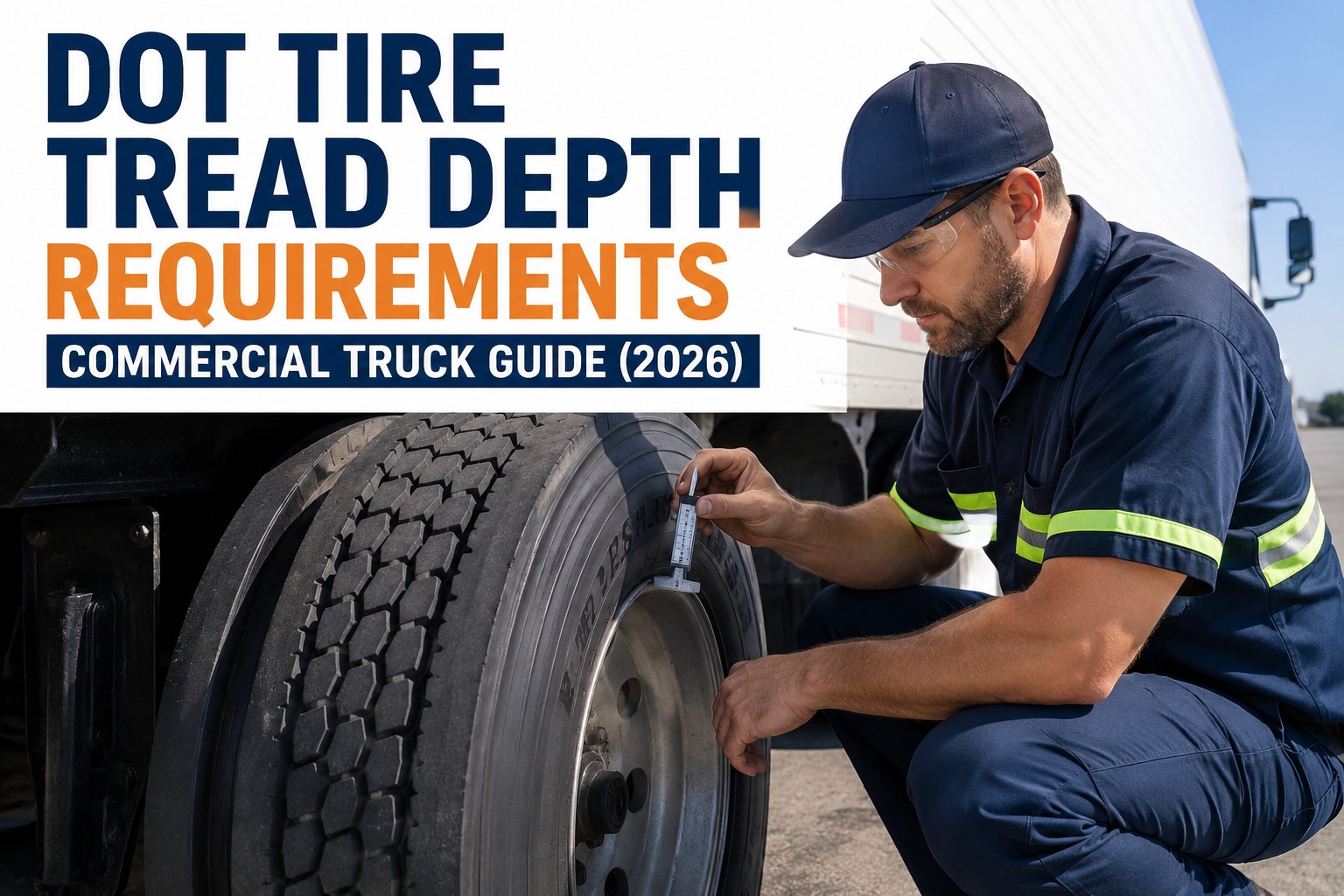
DOT tire tread depth requirements for commercial trucks in 2026 are simple in principle and consequential in practice: 4/32 of an inch minimum on any steer axle tire, 2/32 of an inch minimum on every other tire position, measured in any major tread groove. Fall below either threshold and the tire is Out-of-Service under CVSA criteria, the vehicle is grounded until replaced, the driver's CSA score takes an 8-point severity hit, and the fleet's inspection selection algorithm gets more punitive on future roadside encounters. Beyond the compliance floor, tread depth drives wet-weather stopping distance, hydroplaning resistance, and stability under load. This DOT tire tread depth guide walks the three minimum requirements by position, the four measurement methods, the wear rate math for planning replacements, the CVSA and CSA consequences of noncompliance, and the five mistakes fleets make with tread depth compliance. Book a demo after you see how digital tread depth tracking runs.
DOT Tire Tread Depth Minimums by Position
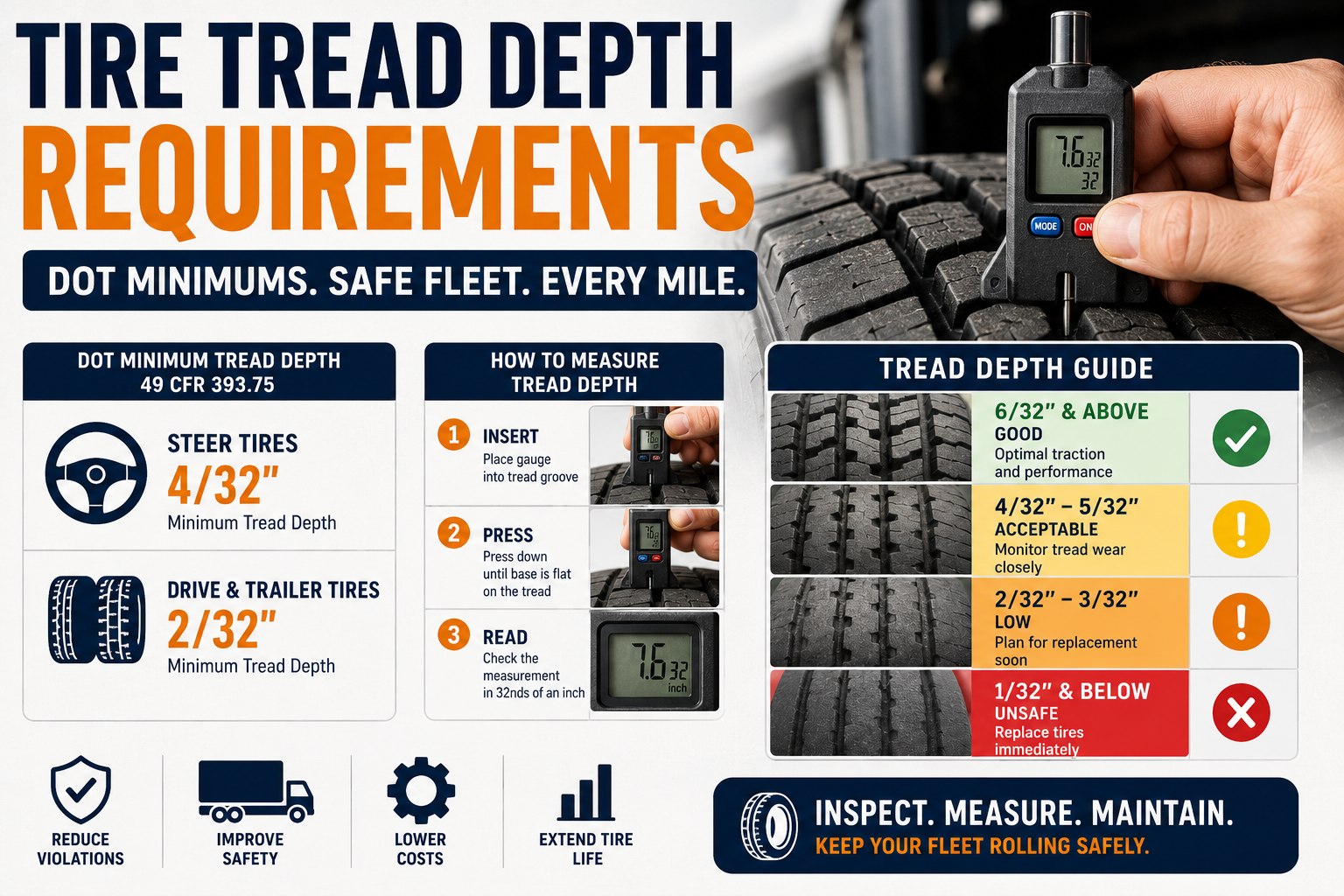
Three positions, two thresholds, one universally-applied rule: measure in any major tread groove. Anything below the number is automatic OOS.
Those three numbers govern every tread depth compliance decision on a commercial fleet. Below is the deeper view: why the minimums are set where they are, how to measure accurately, when to replace, and what happens when the numbers get missed.
Why 4/32" for steer and 2/32" for other positions?
The federal minimums weren't picked arbitrarily. FMCSA set the steer threshold higher because steer-tire failure has disproportionate consequences on vehicle control — a blowout at highway speed with an underperforming steer tire is functionally an accident waiting to happen. The 2/32" minimum on drive and trailer positions reflects a different physics problem: hydroplaning risk on wet roads. Four specific effects drive the numbers.
Wet stopping distance
A tire at 4/32" tread depth takes roughly 40% longer to stop on wet pavement than one at 8/32". Below 2/32" wet stopping distance nearly doubles versus new tires.
Hydroplaning resistance
Grooves channel water away from the contact patch. At 2/32" the groove volume is roughly one-fifth of a new tire — the threshold where water displacement fails and grip disappears.
Heat buildup at low tread
Thin tread runs hotter under load, accelerating tire aging and increasing blowout risk. Below minimum, the tire is degrading faster than it should be permitted to operate.
Steer position control
Steer tire tread affects directional stability, cornering response, and steering feel. Higher 4/32" minimum reflects the higher control consequences of degradation on the front axle.
The 2/32" threshold has a specific origin: it dates back to the introduction of "wear bars" molded into tire treads in the 1960s. When the tread wears down to the level of the bar, the bar becomes flush with the road contact patch — that's 2/32" of remaining depth. Every tread compliance inspection should reference both the bar and the actual measured depth. Book a demo to see tread depth tracked per position
4 tread depth measurement methods compared
There's no such thing as "eyeballing" tread depth in an audit-defensible way. Every inspection needs a real measurement. Below are the four methods commonly used, ranked by accuracy.
Digital tread depth gauge
Electronic probe with digital readout. Reads in 1/32" or metric increments to 2 decimal places. Highest accuracy, minimal user error. Cost: $30–$200.
Mechanical depth gauge
Sliding-scale probe with mechanical readout in 1/32" increments. Widely used across the industry. Reliable but requires calibration verification. Cost: $10–$30.
Coin test (penny or quarter)
Insert coin upside-down into groove. Penny (Lincoln's head) covered = above 2/32". Quarter (Washington's head) covered = above 4/32". Quick field check, not audit-defensible.
Automated depth scanning
Drive-over sensor or laser rig measures every tire simultaneously in seconds. Used at large fleet yards, DOT weigh stations, and truck stops. Highest throughput; capital investment.
Regardless of method, every measurement should be taken at three points per tire (center and both shoulders) and in any major tread groove. A single-point reading misses the uneven-wear pattern that indicates the tire is a replacement candidate before it hits legal minimum. Start free and add tread depth to inspection workflow
Wear rate math — when to plan tire replacement
Compliance is a floor, not a target. Fleets that wait until a tire is at 4/32" or 2/32" to replace it are managing to the OOS threshold — and one late replacement or one under-inflation event puts the fleet in violation. Planning replacement at 2–3/32" above legal minimum builds in operational safety margin.
Wear rate varies by duty cycle, load, road surface, and driver behavior — the numbers above are typical for long-haul operations. A fleet running heavy loads on rough roads can see wear rates 30–50% higher. Track actual wear rate per position and set replacement thresholds based on real numbers, not industry averages. Book a demo to see per-position wear tracking
CSA and CVSA consequences of insufficient tread depth
Consequences of falling below tread depth minimums are severe and layered — roadside, on the driver's record, on the carrier's CSA score, and on future inspection selection.
Vehicle Out-of-Service
Any tire below the minimum depth = automatic OOS. Driver cannot operate the vehicle until the tire is replaced. Road-service tire cost + labor typically runs $500–$1,500 per incident, plus cargo delay costs.
8 severity points per violation
Tread depth OOS violations score at the top of the CSA vehicle maintenance BASIC severity scale. Multiple violations across the fleet drive the carrier's percentile ranking upward and increase inspection selection probability.
Fines + insurance impact
State-level fines range from $100 to $1,000+ per violation depending on jurisdiction. Repeat violations trigger insurance premium increases and, in severe cases, insurer non-renewal at policy expiration.
Higher inspection selection rate
Carriers with elevated Vehicle Maintenance BASIC scores are selected for roadside inspection at 2–3x the rate of well-scored carriers. Compliance failure compounds into more compliance encounters over time.
Under the 2026 CSA "Driver Observed" split, tread depth violations that a driver should have caught during pre-trip inspection now create a distinct visible mark on the carrier profile — separate from mechanical defects — making driver-side inspection failures more visible to shippers and insurers reviewing carrier data. Book a demo to see compliance-defensible tread records
5 mistakes fleets make with tread depth compliance
Every fleet that fails a roadside tread depth inspection traces the gap to one of five recurring mistakes.
Relying on wear bars instead of measured depth
Driver glances at the wear bar and concludes the tire is "still good" without ever measuring. Bars indicate 2/32" universally — but that's the OOS threshold, not the replacement threshold, and steer tires need 4/32" not 2/32".
Measuring only the center of the tread
Single-point center reading passes the compliance check but misses shoulder wear from misalignment or overinflation. Tire looks compliant, gets pulled at CVSA roadside where inspector measures the worn shoulder.
Skipping trailer tire measurements
Focus on steer and drive tires, treat trailer tires as afterthought. Trailer tires are the #1 source of tread depth OOS violations because they're the least frequently inspected. Every trailer tire needs the same rigor as tractor tires.
Not tracking wear rate per position
Fleet knows current tread depth but not the rate of change. Replacement planning becomes reactive. Tires reach legal minimum during a run, forcing expensive roadside replacements instead of planned yard swaps.
Undocumented measurements that don't defend at audit
Technician measures tread depth but doesn't write it down. Truck fails a roadside inspection with tread depth violation. Fleet has no historical record showing prior measurements were compliant. CSA impact is the maximum severity because there's no documented due diligence.
Every mistake above traces back to informal inspection processes. The fix is the same in every case: measured depth documented per-position, per-inspection, per-tire — and wear-rate math running in the background. Start free and put per-tire tread depth tracking into workflow this week
From a fleet safety director after a CVSA International Roadcheck
Our worst CVSA Roadcheck week produced 11 tread depth violations across 52 tractors — a 21% roadside OOS rate on tires alone. Seven of the eleven were trailer tires. Two were steer tires below 4/32". Two were drive tires below 2/32". Every one was preventable with measurement discipline we didn't have.
We rebuilt the inspection program that quarter: digital gauges on every technician, mandatory three-point measurement per tire, per-position wear rate tracking, replacement thresholds at 5/32" steer and 3/32" drive/trailer. Next Roadcheck week: zero tread depth violations across 58 tractors. Insurance renewal came in 8% lower. The discipline paid for itself twice over.
Frequently asked questions
What is the DOT minimum tread depth for commercial trucks?
Under FMCSA 49 CFR 393.75, the federal minimum tread depth for a commercial motor vehicle is 4/32 of an inch on any steer axle tire and 2/32 of an inch on all other tires (drive axle and trailer positions). The measurement is taken in any major tread groove — any of the primary circumferential grooves designed for water evacuation. A tire that measures below the applicable minimum in any single major groove is Out-of-Service under CVSA criteria — the vehicle cannot be operated until the tire is replaced. These minimums apply to all commercial trucks, tractors, and trailers in interstate operation, and to both new and retreaded tires equally. Tread depth is measured with a mechanical or digital gauge; the penny and quarter tests are quick field checks but aren't audit-defensible.
Why is the steer tire tread depth minimum higher than other positions?
The steer axle 4/32" minimum reflects the disproportionate control consequences of steer-tire failure at highway speed. A steer tire blowout affects directional stability, cornering response, and steering feel in ways that a drive or trailer tire failure does not — the driver can typically maintain control after a drive or trailer failure but may lose control after a steer failure. The 4/32" threshold provides an additional safety margin on the position where degradation matters most. Beyond the federal minimum, industry best practice recommends replacing steer tires at 6–8/32" rather than running to the 4/32" floor, both for safety margin and because insurance underwriters favor fleets with conservative steer tire replacement policies. Some carriers go further and specify new (non-retreaded) tires on the steer position exclusively — federally optional but increasingly common at safety-focused fleets.
How do I measure commercial truck tire tread depth accurately?
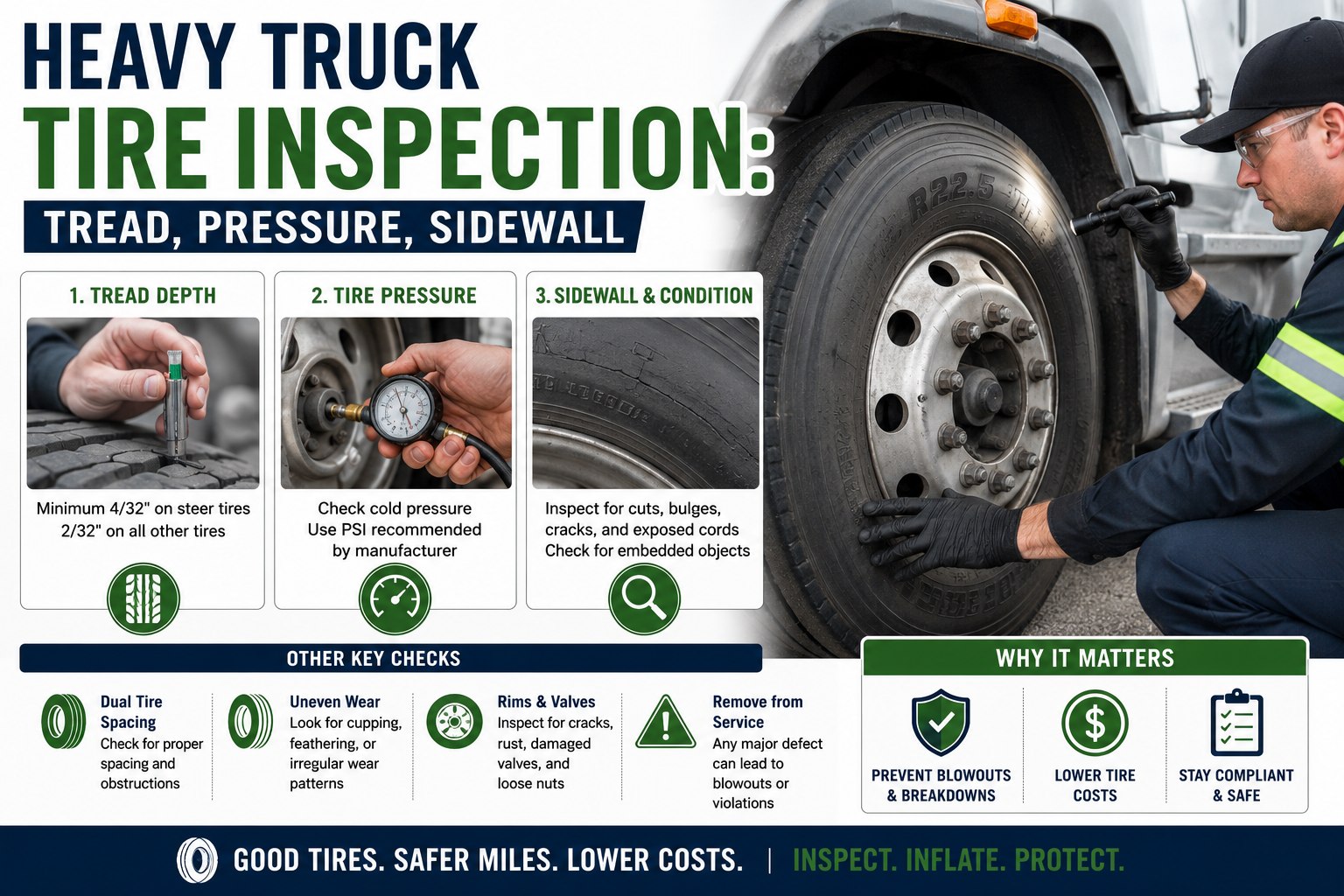
Use a mechanical or digital tread depth gauge for any audit-defensible measurement — not a coin test. Digital gauges cost $30–$200 and read to 0.01" accuracy; mechanical gauges cost $10–$30 and read in 1/32" increments. Insert the gauge probe into a major tread groove (not a sipe or wear indicator well) and record the reading. Take three measurements per tire: center of tread and both shoulders. The lowest of the three is the tire's compliance status. Any reading below the applicable federal minimum (4/32" steer, 2/32" other) is Out-of-Service. If shoulder wear reads significantly lower than center wear or vice versa, the tire has uneven wear indicating an alignment, balance, or inflation issue. Digital fleet inspection software captures depth measurements per tire, per position, per inspection date — building the wear rate history needed for predictive replacement planning.
What happens if my truck tire is below the minimum tread depth?
Any tire measured below the federal minimum tread depth is Out-of-Service under CVSA criteria. Consequences layer on top of each other. Roadside: the driver cannot operate the vehicle until the tire is replaced, typically $500–$1,500 for roadside service plus cargo delay costs. On the driver's record: a tread depth OOS violation counts against inspection history. On the carrier's CSA record: 8 severity points on the Vehicle Maintenance BASIC per violation, driving percentile ranking upward. Financial: state fines of $100 to $1,000+ per violation depending on jurisdiction. Downstream: elevated Vehicle Maintenance BASIC scores increase future roadside inspection selection probability by 2–3x, compounding the compliance burden. Under the 2026 CSA "Driver Observed" split, tread depth violations that a driver should have caught during pre-trip inspection are called out separately on the carrier's profile, making the failure more visible to shippers and insurance underwriters.
When should I replace commercial truck tires vs. running to the legal minimum?
Running commercial truck tires to the federal legal minimum is compliance to the floor, not to the target. Best practice: plan replacement 2–3/32" above legal minimum — roughly 6–8/32" for steer tires (vs 4/32" federal minimum) and 4–5/32" for drive and trailer tires (vs 2/32" federal minimum). This buffer accounts for wear rate variance, unexpected under-inflation events, and the risk of hitting minimum during a run. For a 100-tractor long-haul fleet, planning replacement at 5/32" drive rather than 2/32" typically costs an extra $30,000–$50,000/year in tire spend — but recovers multiple times that in avoided roadside failures, lower CSA scores, insurance premium reductions, and fewer emergency replacements. Wear rate math per position lets the fleet forecast exact replacement dates so tire changes are planned into normal maintenance windows.
Turn tread depth compliance from a monthly worry into a live dashboard
HVI captures tread depth at every inspection with timestamp, position, technician signature, and photo. Wear rate math per position runs in the background — the system flags replacement candidates before they hit legal minimum. Every reading builds an audit-defensible per-tire lifecycle record. Live in under two weeks.
No credit card · No hardware · Tread depth workflow ready day one