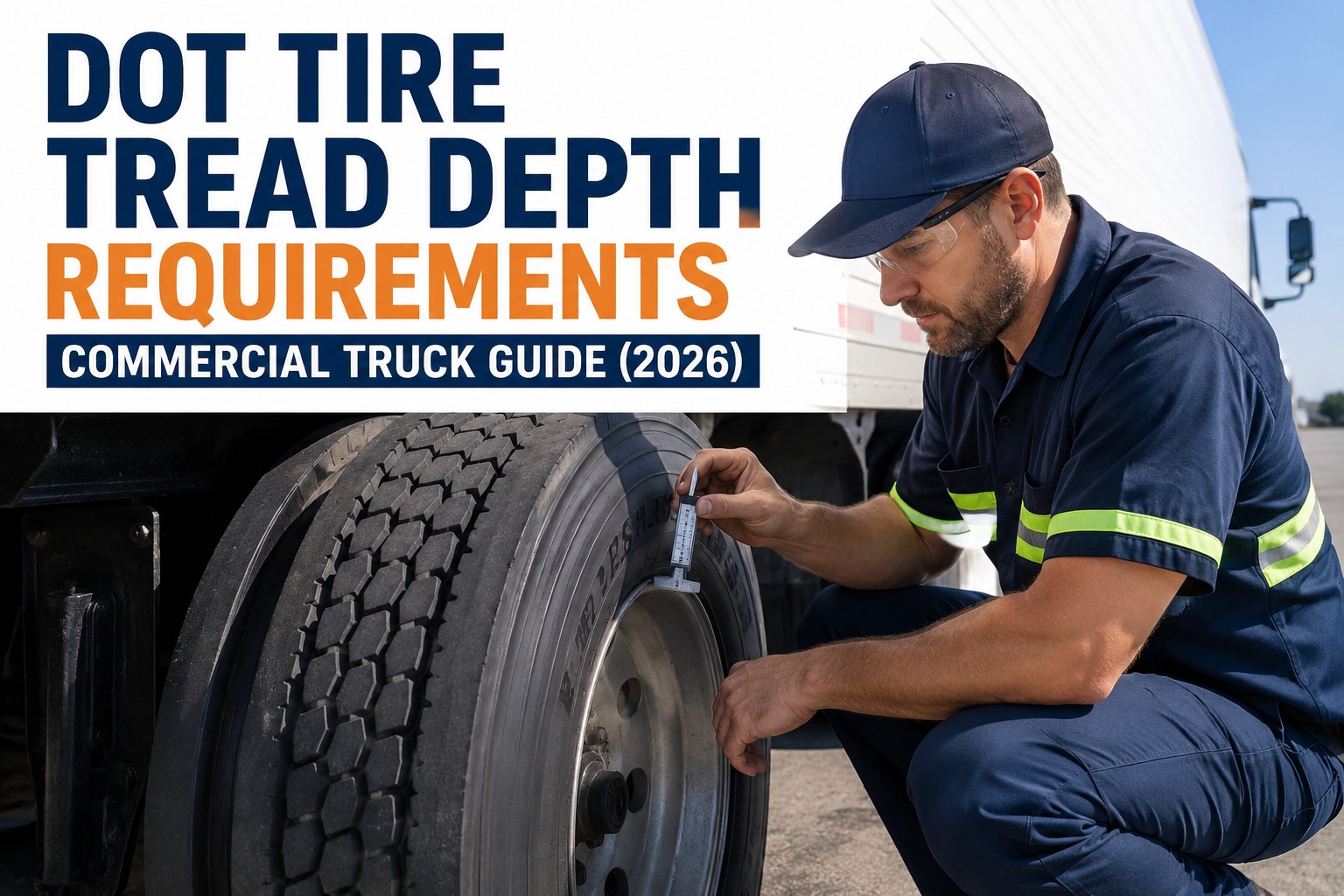
Tire tread depth requirements come down to two numbers that decide whether a truck rolls or gets grounded: 4/32 of an inch on the steer tires, 2/32 on everything else. Get below either and you're not just risking a blowout — you're looking at a roadside violation, and tread-depth citations run into the hundreds of thousands over a few years. The tricky part is that tread wears down a thirty-second at a time, invisibly, until the day an inspector's gauge says you're under. This guide lays out the exact DOT minimums under 49 CFR 393.75, the stricter out-of-service line the CVSA uses, how to measure tread three different ways, and where to replace before a legal tire becomes an illegal one. Book a demo to track tread depth per tire before it crosses the line.
Tire Tread Depth Requirements & DOT Minimums
The federal minimum tread depth for commercial tires, the stricter CVSA out-of-service line, how to measure it accurately, and where smart fleets replace to stay clear of both. Built straight from 49 CFR 393.75.
~446,000 tread-depth violations in five years
The whole subject lives on a scale measured in thirty-seconds of an inch. A new truck tire starts around 12/32", sometimes more. Every mile shaves a little off, and the tire stays perfectly legal right up until it isn't. The two federal minimums — 4/32" for steer, 2/32" for the rest — are the floor. But the smart place to act is above the floor, because the gap between "legal" and "out of service" is narrower than most fleets realize, and it closes without warning.
The two DOT minimum tread depths
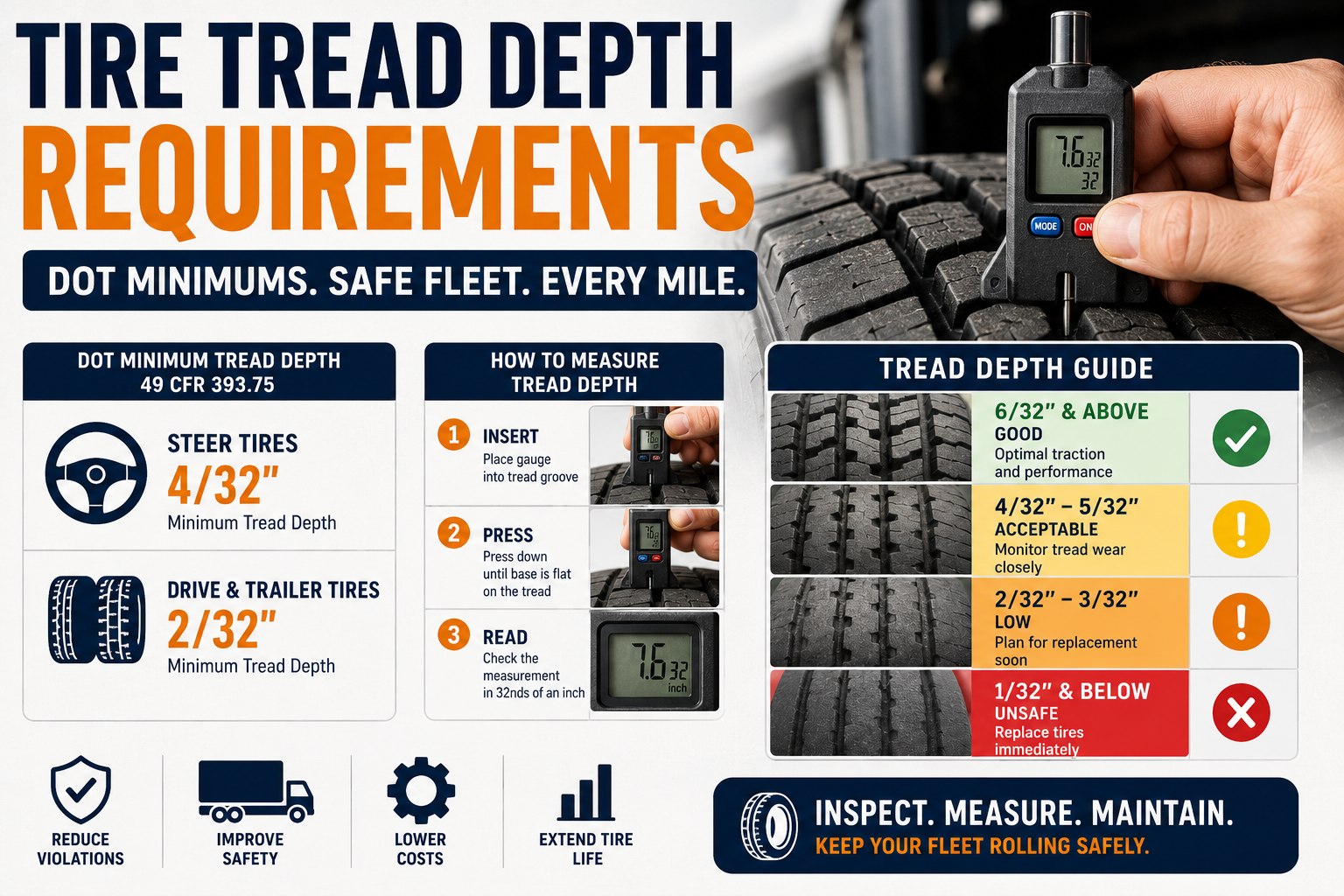
Under 49 CFR 393.75 there are exactly two numbers to know, and the difference between them is about where the tire sits on the truck. Steer tires carry steering and braking control, so they get the higher bar.
Steer tires
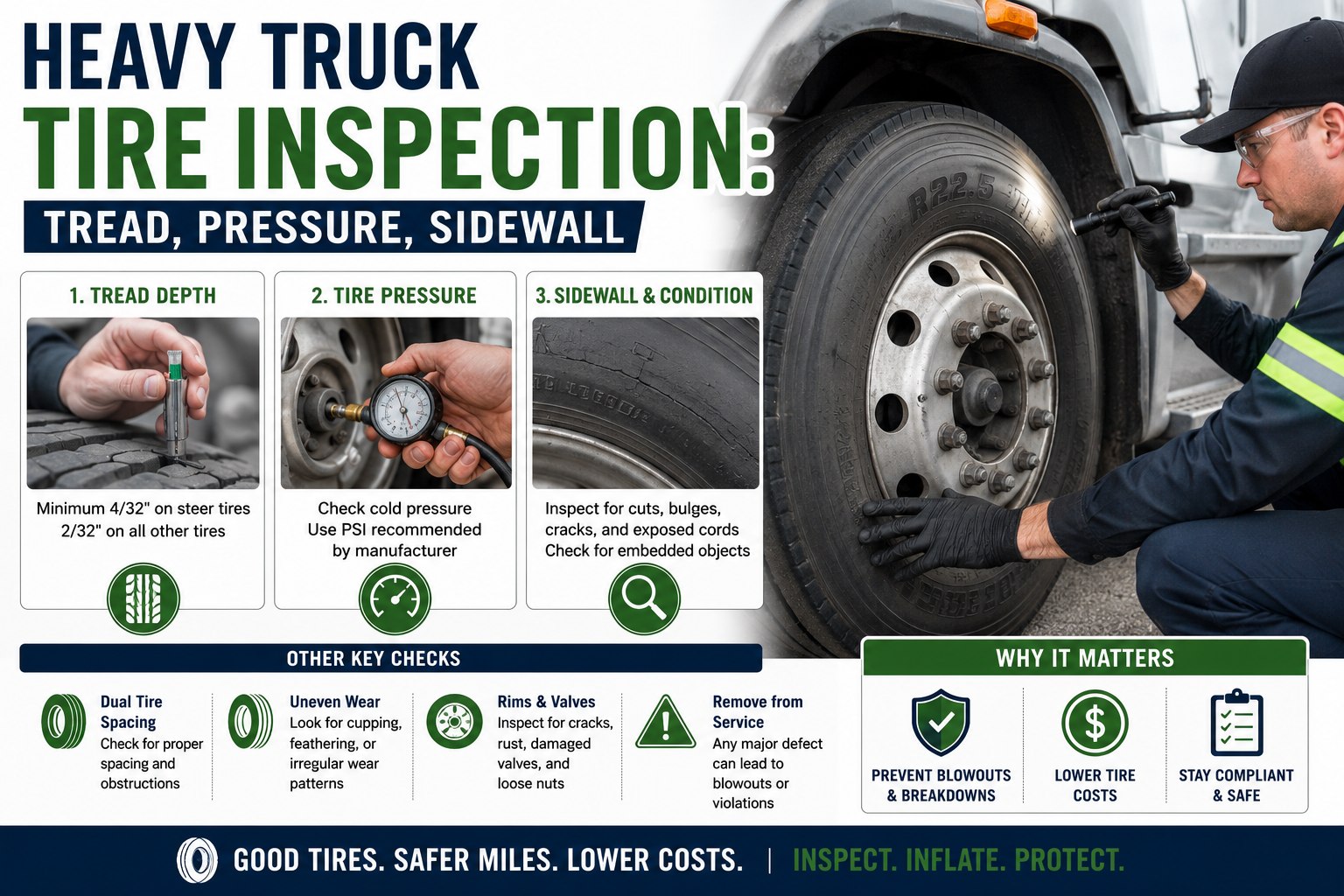
Any tire on the front wheels of a bus, truck, or truck tractor must have at least 4/32" of tread in any major groove, under 393.75(b). These tires control steering and stopping, so the higher minimum protects against a blowout or loss of grip that would be catastrophic up front.
All other tires
Every other tire — drive and trailer positions — must have at least 2/32" in a major groove under 393.75(c). It's a lower bar, but it's the one behind roughly 446,000 violations in five years, because there are far more of these tires and they're easy to overlook.
One measurement rule matters on both: the reading is taken in a major tread groove, never on a tie bar, hump, or fillet — those raised spots read shallow and aren't the true tread depth. See tread logged per tire position automatically
DOT minimum vs. CVSA out-of-service: the gap that catches fleets
Here's the nuance almost nobody explains clearly. The DOT minimum is the legal operating standard. The CVSA out-of-service criteria are stricter thresholds that pull a truck off the road on the spot. They are not the same number — and the space between them is where trouble hides.
- Tire position DOT minimum CVSA out-of-service
- Steer 4/32" 2/32"
- Drive & trailer 2/32" 1/32"
So a steer tire at 3/32" is already below the DOT minimum — a citable violation and CSA points — even though it hasn't hit the 2/32" out-of-service line yet. The lesson every experienced fleet learns: don't manage to the DOT floor, manage well above it. Major fleets commonly replace steer tires around 5/32" and drive or trailer tires around 3/32" to stay clear of both lines entirely. Start free and set replacement alerts above the minimums
How to measure tread depth three ways
You can't manage a number you don't measure. There are three common methods, from roughest to most precise — and only one belongs in a real inspection record.
Tread depth gauge
Most accuratePush the probe into a major groove until it stops and read the scale in 32nds. This is the only method precise enough for a compliance record — measure several points per tire to catch uneven wear from bad inflation or alignment.
The penny test
Quick checkPut a penny in the groove, Lincoln's head down. If you can see the top of his head, you're below 2/32" and the tire's illegal. Fast for a gut check, but it only tells you pass or fail at 2/32" — useless for the 4/32" steer line.
Built-in wear bars
Visual cueMost tires have raised bars set across the grooves at 2/32". When the tread wears flush with those bars, the tire has hit the legal minimum. A useful glance-check, but again it only flags the 2/32" line, not the steer requirement.
The takeaway: the penny and wear bars are fine for a quick "is it bald" look, but only a gauge reading — recorded, per position — stands up as proof you were compliant on the day the auditor asks. Book a demo to capture gauge readings in the inspection
Tread depth isn't the only way a tire fails
A tire can have plenty of tread and still be an automatic out-of-service. 393.75 and the CVSA criteria cover several conditions that ground a truck regardless of the gauge reading — and they're all things a real inspection catches.
-
Exposed ply or beltAny body ply or belt material showing through the tread or sidewall is an immediate out-of-service.
-
Under 50% inflationA tire inflated below half its maximum marked pressure is automatically out of service under CVSA criteria.
-
Cuts, bulges & separationSidewall cuts exposing cord, bulges, blisters, or tread/sidewall separation all take a tire out of service.
-
Regroove & retread limitsNo regrooved, recapped, or retreaded tires on bus front wheels; regrooved tires rated 4,920 lb or more are barred from truck steer positions.
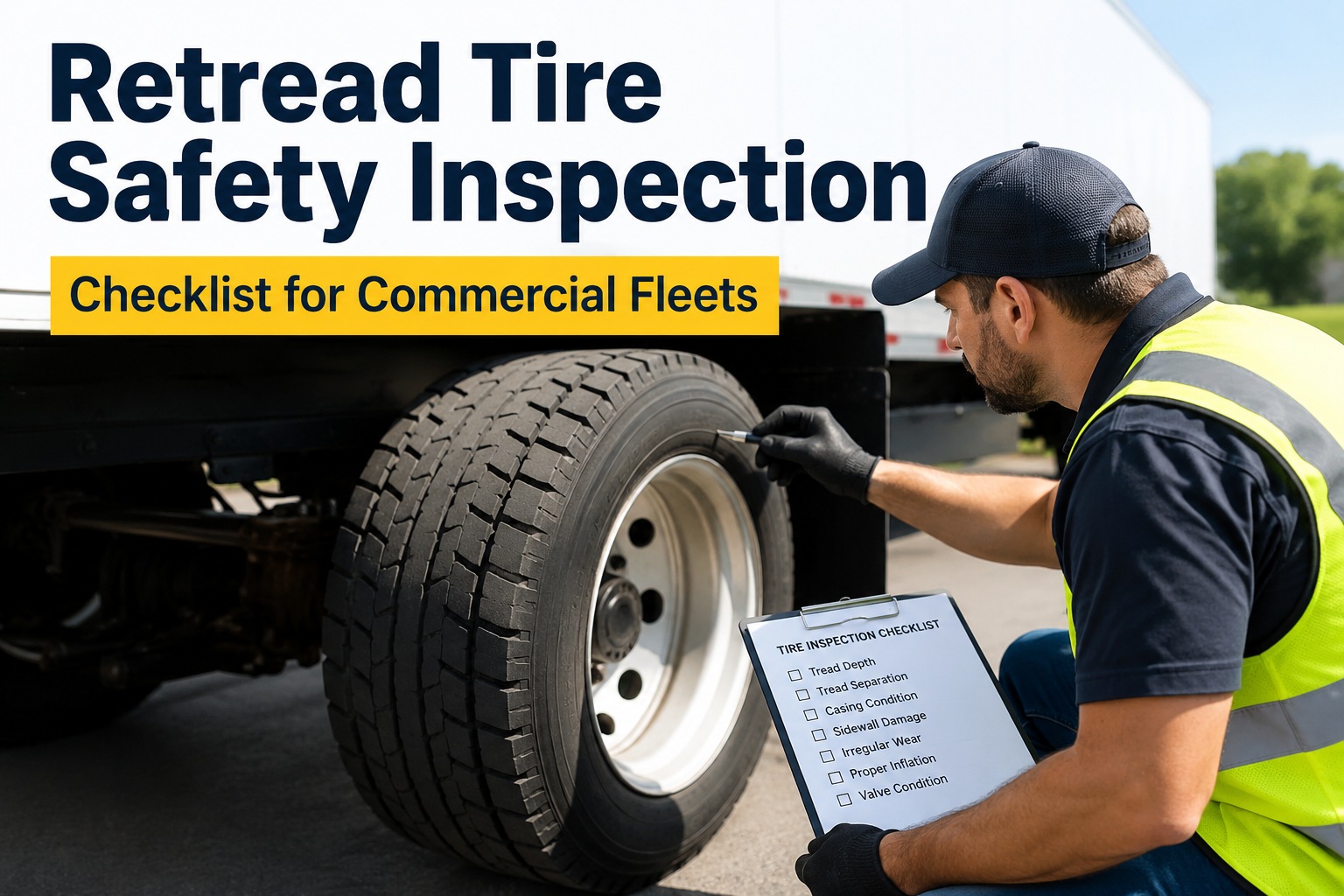
A complete tire inspection reads tread at every position and checks all of these — because the tire that grounds the truck is often the one with good tread and a sidewall problem nobody logged. Start free and inspect the whole tire, not just the tread
From the tire program
The steer tire is the one that scares me. Two-thirty-seconds is the out-of-service line, but the legal minimum is four, and drivers eyeball a steer tire and think it looks fine at three. It doesn't look any different at three than at six — that's the whole problem.
Once we started logging an actual gauge number at every position on every inspection, the guessing stopped. I get an alert at five thirty-seconds on a steer, I schedule it, and it never sees a scale house under the minimum. The tread was always measurable. We just weren't writing it down.
Frequently asked questions
What is the DOT minimum tire tread depth for commercial trucks?
Under 49 CFR 393.75, there are two minimums. Steer tires — any tire on the front wheels of a bus, truck, or truck tractor — must have a tread groove pattern depth of at least 4/32 of an inch, measured at any point in a major tread groove, per 393.75(b). All other tires, meaning drive and trailer positions, must have at least 2/32 of an inch in a major groove, per 393.75(c). The measurement must be taken in a major tread groove and not where tie bars, humps, or fillets are located, since those raised areas read shallower than the true tread depth. Steer tires carry the higher requirement because they control steering and braking, so a failure at the front is far more dangerous. A tire below its applicable minimum must be replaced before the vehicle operates.
What is the difference between the DOT minimum and the CVSA out-of-service tread depth?
The DOT minimum under 49 CFR 393.75 is the legal operating standard: 4/32 inch for steer tires and 2/32 inch for all other tires. The CVSA North American Standard out-of-service criteria are stricter thresholds that cause a vehicle to be removed from service immediately during a roadside inspection: 2/32 inch for steer tires and 1/32 inch for all others. The important consequence is the gap between them. A steer tire at 3/32 inch is already below the DOT minimum — a citable violation that adds CSA points — even though it is still above the 2/32 inch out-of-service line and would not be pulled off the road on the spot. This is why fleets are advised not to manage to the legal floor. Replacing steer tires around 5/32 inch and drive or trailer tires around 3/32 inch keeps a vehicle safely clear of both the violation line and the out-of-service line.
How do you measure tire tread depth correctly?
The most accurate method is a tread depth gauge: push the probe into a major tread groove until it stops and read the scale, which is marked in 32nds of an inch. Because wear is often uneven — from improper inflation, misalignment, or weight distribution — you should measure at several points across each tire and record the lowest reading, taken in a major groove rather than on a tie bar or wear indicator. The penny test is a quick field check: place a penny in the groove with Lincoln's head pointing down, and if you can see the top of his head the tread is below 2/32 inch. Built-in wear bars, molded across the grooves at 2/32 inch, give a visual cue when the tread wears flush with them. The penny test and wear bars only indicate the 2/32 inch line, so they can't verify the 4/32 inch steer requirement — for that, and for any inspection record, use a gauge and write the number down per position.
How much tread does a new commercial truck tire have?
A new commercial truck tire typically starts with 10/32 to 12/32 inch of tread, and some heavy-duty or drive-position tires start even deeper, around 14/32 inch or more, because the extra rubber is needed to grip under heavy loads and to give a usable service life. From there, tread wears down gradually with mileage. Understanding the starting point matters for planning: a steer tire beginning at 12/32 inch and required to be replaced by its 4/32 inch minimum has only about 8/32 inch of usable tread, and prudent fleets replace before the legal minimum to maintain a safety margin. Tracking each tire's tread depth over time — rather than checking only when a problem is suspected — lets a fleet forecast replacements, budget for them, and avoid both the safety risk and the compliance exposure of running a tire down to the wire.
Besides low tread, what tire conditions cause an out-of-service order?
Several tire conditions ground a vehicle regardless of tread depth. Under 49 CFR 393.75 and the CVSA out-of-service criteria, these include body ply or belt material exposed through the tread or sidewall, tread or sidewall separation, a flat tire or an audible air leak, cuts that expose the ply or belt material, and any tire labeled "Not for Highway Use." Inflation is another: a tire running below 50 percent of its maximum marked pressure is automatically out of service. There are also restrictions on regrooved, recapped, and retreaded tires — none are permitted on the front wheels of a bus, and regrooved tires rated at 4,920 pounds or more of load capacity are prohibited on the steer position of trucks and truck tractors. Because a tire with plenty of tread can still fail on any of these, a complete inspection checks the full tire — tread, inflation, sidewall, and condition — at every wheel position, not just the tread depth.
Put tread depth tracking on every tire, every inspection
HVI captures a gauge reading at every wheel position, tracks the wear trend per tire, and alerts you before it crosses the DOT minimum — with defect photos, automatic work orders, and audit-ready records. Steer at 4/32, everything else at 2/32, the CVSA line below that: HVI watches all of it so a worn tire gets replaced in your shop, not red-tagged at a scale house.
No credit card · No hardware · Live on your fleet in under two weeks