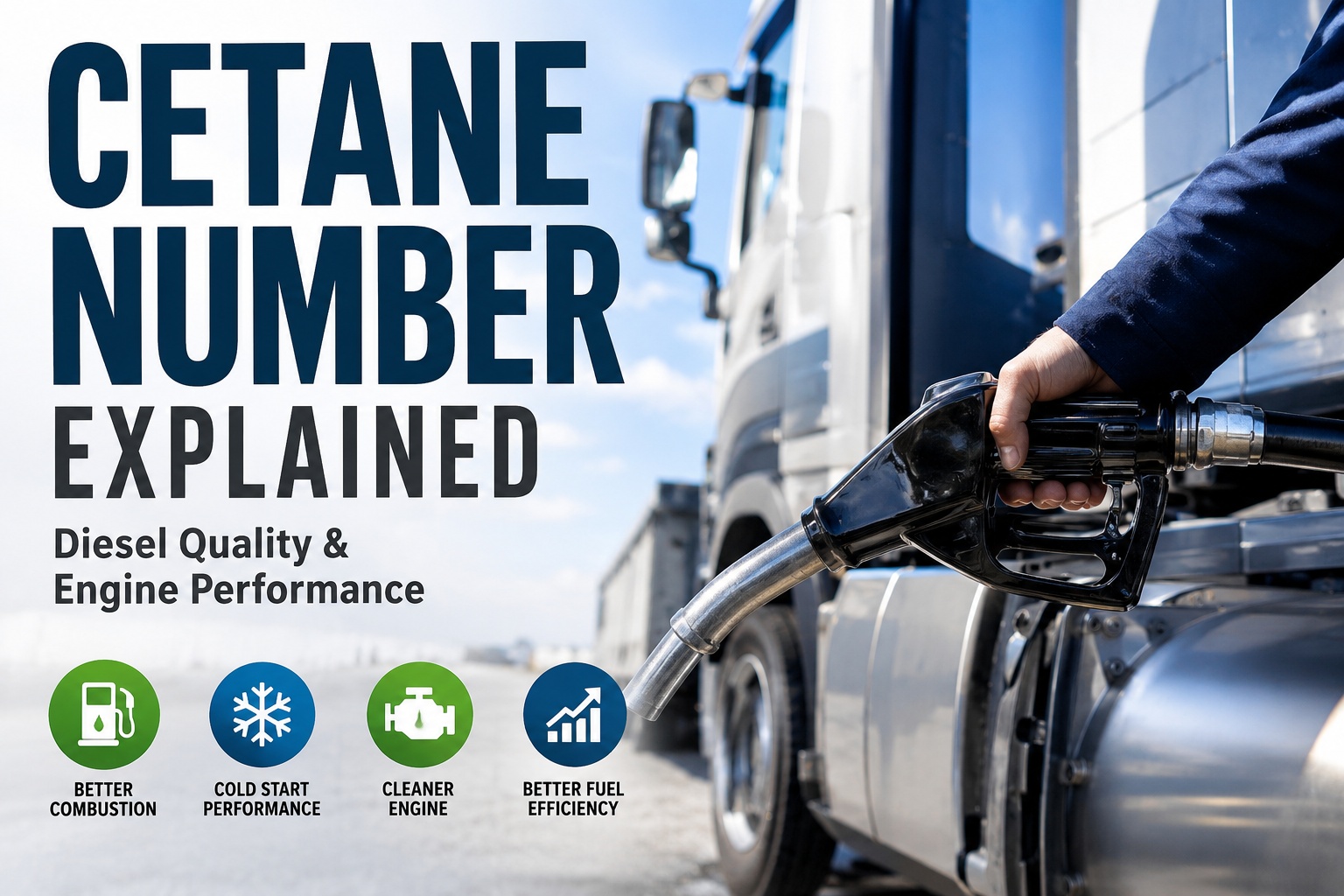
Cetane number is the diesel-equivalent of octane rating — but backwards. Where octane measures a gasoline fuel's resistance to auto-ignition, cetane measures a diesel fuel's willingness to auto-ignite. Higher cetane means quicker combustion, smoother running, easier cold starts, and lower engine wear. For fleet operators, the difference between a 40-cetane commodity diesel and a 55-cetane premium blend shows up on the MPG report, the injector rebuild schedule, and the winter cold-start complaints. Here's the technical picture. Book an HVI demo →.
The cetane number scale — where your fuel sits determines how your engine runs.
Every diesel fuel batch has a cetane rating between roughly 40 and 60. The number tells you how quickly the fuel auto-ignites under compression. Below is the spectrum, the zones, and where the world's major regulatory floors land.
high-cetane premium diesel
going from CN 40 to CN 55
modern fuel additives
What cetane number actually measures
Cetane number quantifies a diesel fuel's ignition delay — the time between when fuel is injected into the compressed hot air of the cylinder and when combustion actually begins. Shorter delay means higher cetane number and smoother combustion. Longer delay means lower cetane, rougher combustion, and the characteristic knock you hear from a poorly-tuned diesel.
The reference scale runs from 0 to 100. Pure n-cetane (a specific hydrocarbon that ignites almost instantly under compression) is defined as 100. Heptamethylnonane, which ignites very slowly, is defined as 15. All commercial diesel fuels fall between roughly 40 and 60 on this scale, blended and refined to meet regional regulatory minimums. The measurement is done in a standardized single-cylinder test engine (ASTM D613) or estimated from fuel density and distillation properties as the "cetane index" (ASTM D976 or D4737).
What matters operationally: cetane number is a pure measure of ignition quality, not fuel energy content. Two diesels with identical BTU per gallon can have very different cetane ratings and produce very different results in the same engine. A high-cetane fuel doesn't have more energy per gallon; it converts the energy it has into useful work more efficiently. Book an HVI demo to see per-truck fuel quality trended against MPG and injector service intervals.
Cetane vs octane — the fundamental difference
The two ratings measure opposite properties of two different fuels. Confusing them is one of the most common misconceptions in fleet maintenance conversations, and the confusion produces bad decisions on both fuel types.
The core insight: gasoline engines want fuel that resists ignition until the spark commands it. Diesel engines want fuel that ignites immediately when compressed. These are opposite properties measured by opposite scales. A gasoline engine running on high-cetane diesel would knock itself apart. A diesel engine running on high-octane gasoline would refuse to start reliably. The physics of each combustion cycle is different, and the fuel quality metric follows the physics. Try HVI free to log fuel-type and quality data alongside every service record.
How cetane number affects fleet performance
Cetane isn't a lab curiosity. It shows up in five specific operational areas that every fleet manager tracks or complains about, and each area gets noticeably better as cetane rises from the regulatory floor to premium territory.
The five effects compound. A fleet running consistently on 40-cetane fuel accumulates rougher combustion, worse MPG, dirtier injectors, and higher aftertreatment stress simultaneously. A fleet running on 50-55 cetane gets the opposite compounding effect. Over a year, the delta shows up on the fuel P&L and the maintenance P&L both. Book an HVI demo to see fuel-quality patterns correlated to maintenance events per truck.
Global cetane number standards reference
Diesel cetane minimums vary by region, and the variance is significant for cross-border operators. A truck fueling in the US and running loads into Canada operates on the same regulatory floor (40). A truck fueling in the US and running into Mexico or the EU crosses a meaningful quality boundary. Below is the 2026 reference table.
The gap between the US floor (40) and the EU/AU/IN floor (51) is significant. Fleet operators running mixed regions consistently report that engines running EU-spec diesel show cleaner injector tips, longer PM intervals, and better MPG than the same engines running US-floor diesel. The physics is the same; the fuel quality is different. Try HVI free to log fuel source and grade per transaction.
Cetane improvers and when premium diesel is worth paying for
Cetane number can be raised through two mechanisms: refining processes that produce higher-cetane base stock, or chemical additives (cetane improvers) that boost the rating post-refining. The most common commercial additives are 2-ethylhexyl nitrate (EHN) and di-tert-butyl peroxide (DTBP), both of which can add 3-8 cetane points to a base fuel.
Premium diesel from major branded suppliers combines both approaches: refined base stock at 45-48 cetane, boosted with cetane improvers and detergent additives to reach 50-55 delivered rating. The price premium versus commodity diesel typically runs 8-15 cents per gallon in the US market, or roughly 3-6% of the total fuel cost.
The economics work when: the fleet operates in winter climates where cold-start reliability matters, the fleet is heavy on stop-and-go duty cycles where injector deposits accumulate faster, the trucks are approaching the 400,000-mile mark where injector rebuilds become imminent, or the fleet has documented MPG variability tied to fuel sources. In these cases, the premium consistently pays back within 6-12 months through improved MPG, reduced injector service, and eliminated cold-weather no-start events.
The economics don't work when: the fleet operates exclusively in warm climates on steady-state long-haul duty, injector service is already well-managed on standard diesel, or the fuel P&L doesn't have room for an 8-15 cent premium. The right answer is fleet-specific, and it's a decision worth tracking rather than guessing at. Book an HVI demo to see the per-truck ROI on premium fuel decisions in your specific operation.
From a fleet maintenance director running 82 tractors on Midwest routes
We used to run all 82 tractors on whatever cheapest cardlock diesel was available. Winter of 2023 was brutal — 14 no-start events across the fleet in January alone, mostly on trucks parked overnight at customer yards. Every no-start was a service call, a delayed load, and a driver stuck in a cold cab.
Switched to a premium branded cetane-boosted winter blend for the December through March window in 2024. Total no-start events that following January: two. Fuel cost premium across the winter: about $28,000 across the fleet. Avoided service calls, missed loads, and driver detention pay: over $95,000. The math wasn't even close. Now we run premium winter blend region-wide from November through March as standard policy.
RHRyan H.Maintenance Director · Midwest regional carrier · 82 Freightliner + Peterbilt tractors
Frequently asked questions
What is cetane number in simple terms?
Cetane number is a rating that measures how quickly a diesel fuel ignites when compressed inside a diesel engine's cylinder. Higher cetane means the fuel ignites faster and burns more smoothly; lower cetane means slower ignition, rougher combustion, harder cold starts, and more engine noise. Commercial diesel fuels typically fall between 40 and 60 on the cetane scale. The regulatory minimum in the US is 40 (ASTM D975); the minimum in the EU, UK, Australia, and India is 51 (EN 590 or equivalent). Premium and additive-boosted diesels can reach 55-60. For most drivers, cetane number is the diesel equivalent of octane in gasoline — but they measure opposite properties, so the two ratings can't be compared directly.
Is a higher cetane number always better?
Higher is generally better, up to a diminishing-returns point. Moving from 40 to 50 cetane produces significant improvement in combustion smoothness, cold-start reliability, MPG, and injector cleanliness. Moving from 50 to 60 produces smaller marginal gains for most modern engines — the biggest benefits are in cold-weather starting reliability rather than warm-weather operational performance. Above 60 cetane, the incremental gain drops off further because modern common-rail direct-injection engines are optimized for the typical premium diesel range of 47-55. There's no operational penalty to higher cetane; the question is whether the price premium justifies the marginal benefit for your specific fleet duty cycle. For cold-climate winter operations and stop-and-go delivery fleets, the answer is usually yes.
What is the difference between cetane number and cetane index?
Cetane number is measured directly in a standardized single-cylinder reference engine per ASTM D613. It's the accurate, expensive test that requires specialized lab equipment. Cetane index is calculated from the fuel's density and distillation properties per ASTM D976 or D4737 — it's a cheaper, faster estimate that approximates the real cetane number. For most refined petroleum diesel, cetane index tracks cetane number closely enough for regulatory and commercial purposes. Where the two diverge is on fuels containing cetane improvers or oxygenates: additives raise cetane number without changing density or distillation, so the calculated index understates the actual number. The gap can be 2-5 points on additive-boosted fuels. Regulatory standards typically specify one or the other explicitly; ASTM D975 in the US accepts either measurement.
Do cetane improvers actually work?
Yes. Cetane improvers are chemical additives (most commonly 2-ethylhexyl nitrate or di-tert-butyl peroxide) that accelerate the auto-ignition reaction inside the cylinder. Both are well-studied and effective, typically raising cetane number by 3-8 points at standard dosing. The refining industry uses them routinely to bring lower-quality base stock up to premium spec, and aftermarket additive bottles sold at truck stops use the same chemistry. Effectiveness varies with the base fuel: they add more points to lower-cetane fuels than to already-high-cetane fuels (diminishing returns above 55). The important caveat: cetane improvers don't fix everything. They accelerate ignition but don't remove sulfur, clean injectors, improve cold-flow properties, or add lubricity. Detergent additive packages address those separately.
Does cetane number affect fuel economy?
Yes, but the effect is smaller than most drivers assume. Real-world MPG improvement from moving to premium high-cetane diesel typically runs 1-4% in field testing, with the higher end of that range showing up in cold-weather operation and stop-and-go duty cycles. The mechanism: higher cetane produces shorter ignition delay, which converts more of the fuel's chemical energy into useful crankshaft work and less into heat lost to the cylinder walls. Cleaner injectors compound the effect over months. However, the MPG gain rarely justifies the premium fuel cost on price alone — the economics work when you count avoided cold-start events, extended injector service intervals, and reduced aftertreatment stress alongside the MPG delta. The full economic picture typically shows 1.5-3x payback on the fuel premium across a fleet.
Track fuel quality, fuel usage, and maintenance with Heavy Vehicle Inspection.
HVI captures every fuel transaction with vendor, grade, price, and vehicle. Correlates fuel-quality patterns against MPG trends and injector service intervals per truck. Surfaces the specific fuel sources costing you money before the pattern shows up on the fuel P&L. Live for your fleet in 5-7 days.
Per-transaction logging · Vendor tracking · MPG correlation · Injector service history · SOC 2 Type II