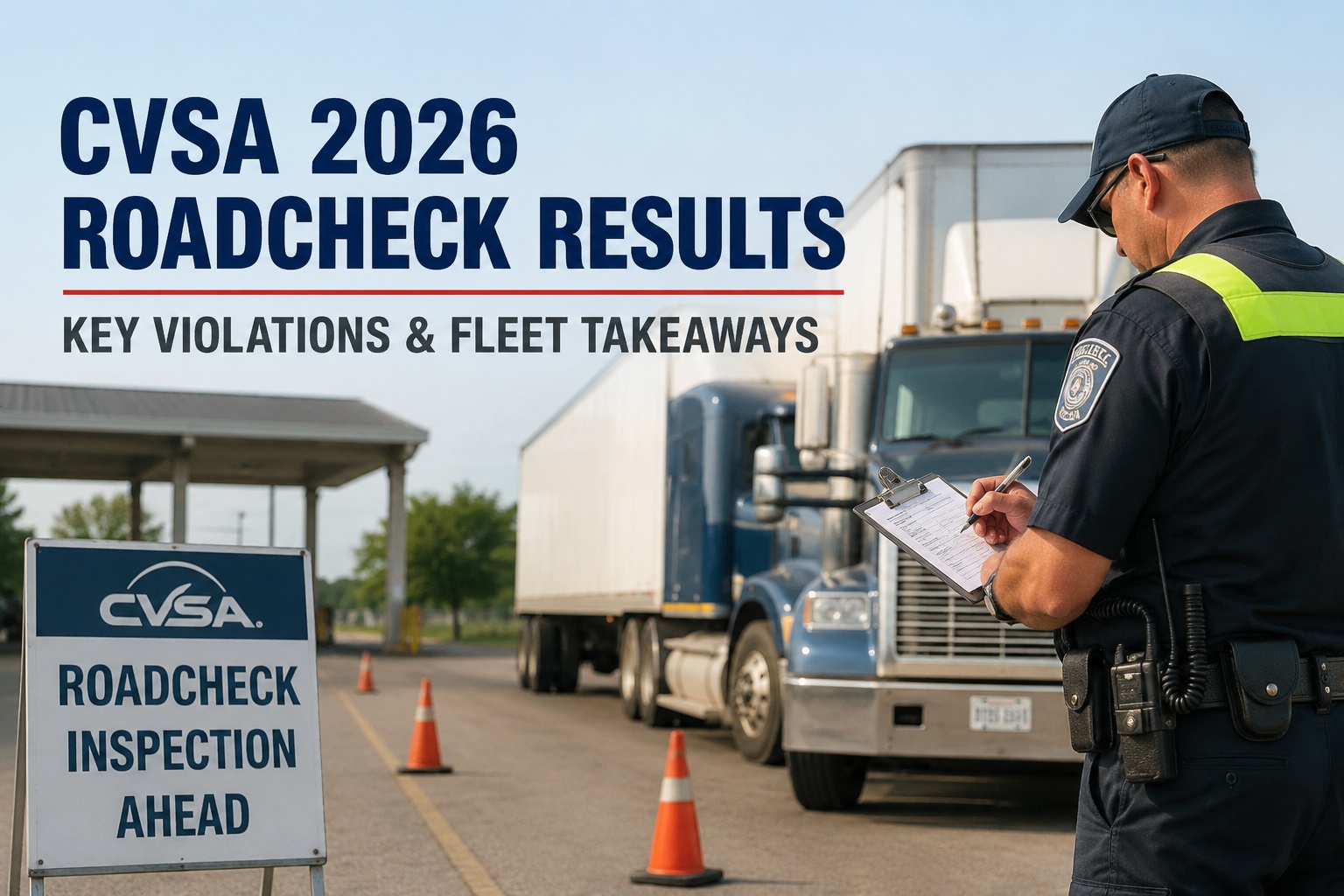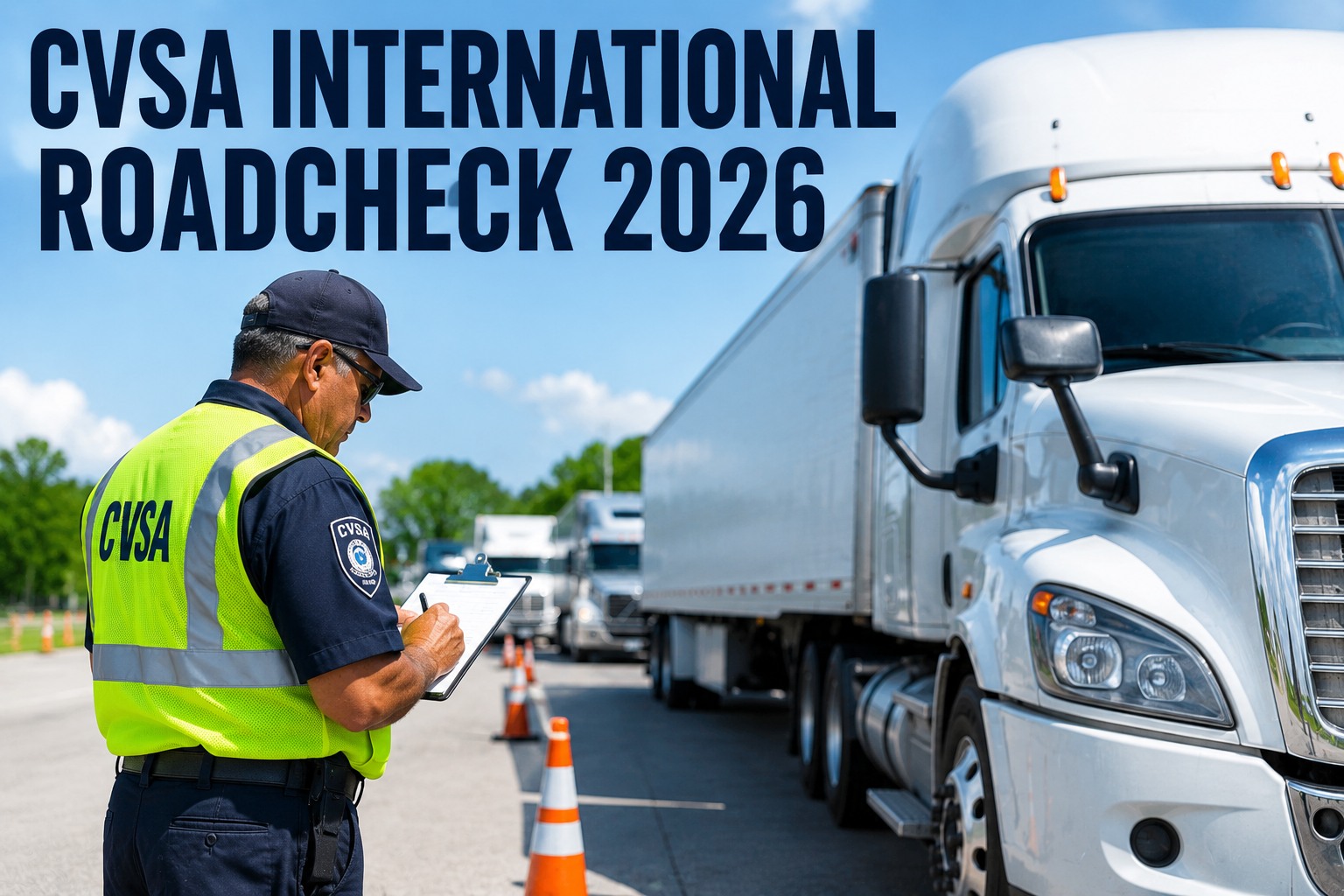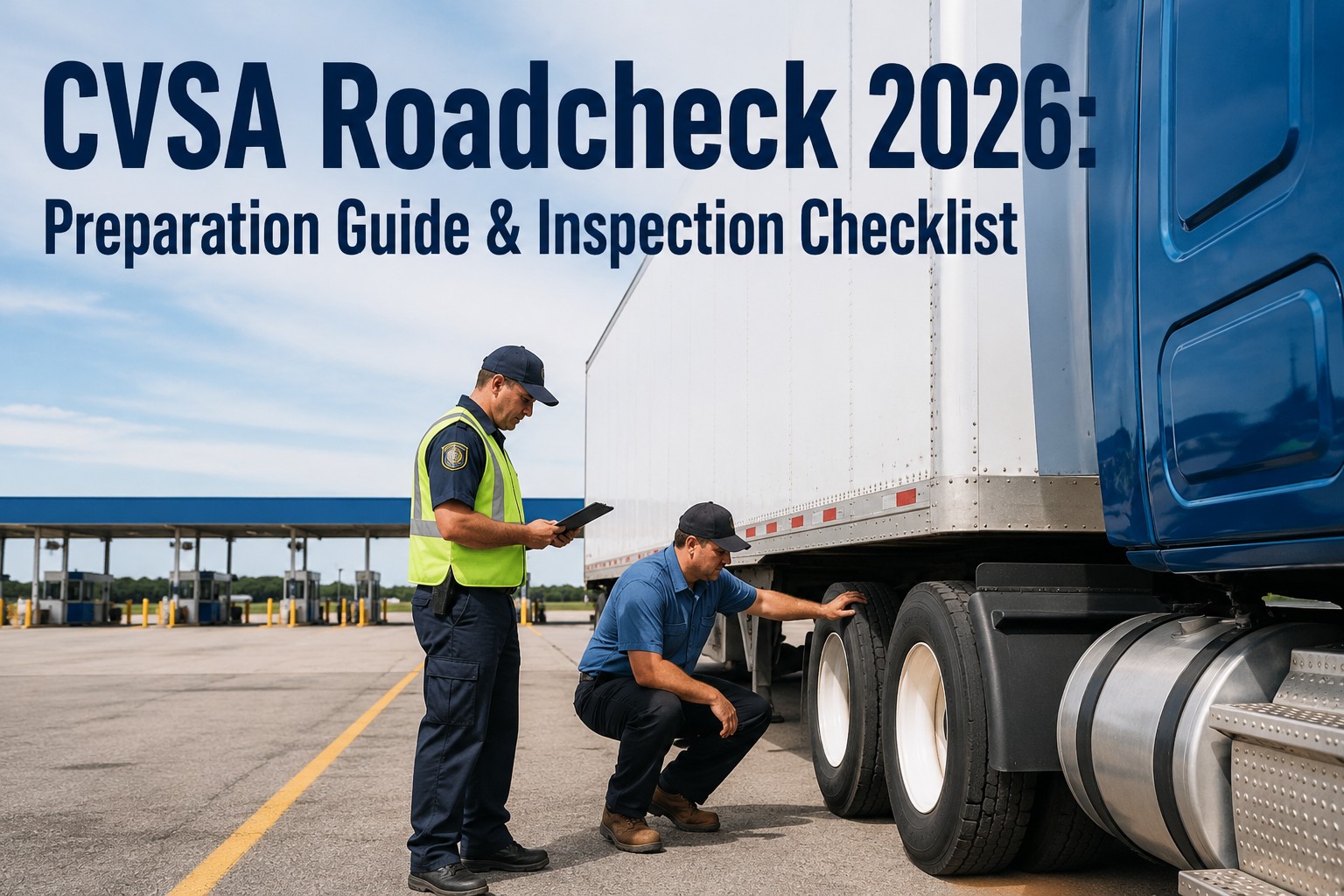
CVSA Roadcheck 2026 ran May 12–14 and produced Day 1 out-of-service numbers dramatically above last year. The 2026 focus was ELD tampering on the driver side and cargo securement on the vehicle side, but Level I inspections still ran the full 37 steps — and brakes still produced the largest share of vehicle OOS findings. This page covers what happened, what inspectors check, and how to run your own internal Roadcheck weeks before enforcement — book a demo to prep your fleet for the next inspection blitz.
The 2026 Numbers — and What They Change About Preparation
Three panels, three questions. When was it? What did they check? What are the odds a truck comes out clean?
The 2026 blitz & what's next
2026 focus areas
What Roadcheck 2025 & 2026 tell us
Any vehicle placed OOS is grounded until the defect is repaired. Any driver placed OOS is off the wheel. Every one of those violations posts to FMCSA's Safety Measurement System within days.
The rest of this page covers what inspectors physically examine, how to run the same check on your own fleet before enforcement week, and the recurring items that consistently produce OOS findings regardless of the year's named focus. Book a 30-minute demo to see a digital Roadcheck-readiness template.
The Level I inspection: 37 steps in about 45 minutes
Nearly every Roadcheck vehicle inspection is a North American Standard Level I — a 37-step procedure covering both driver operating requirements and vehicle mechanical fitness. Focus areas add scrutiny to specific categories but never narrow the scope. Inspectors still run the full checklist regardless of what the year's headline says. A completed Level I typically takes 30 to 60 minutes depending on vehicle complexity and how many defects surface along the way — and passing a Level I without critical violations may earn a CVSA decal valid for up to three months, which reduces the likelihood of pull-in at the next weigh station.
- CDL and endorsements (valid, correct class)
- Medical examiner's certificate or CDLIS MVR (CDL drivers, post-January 10, 2026)
- Record of duty status / ELD data with supporting documents
- Hours of service compliance
- Drug & Alcohol Clearinghouse status
- Seat belt use (observed at stop)
- Pushrod travel measured at each wheel
- Air leaks audible or measured at governor cut-out
- Slack adjuster condition and adjustment
- Brake hose and chamber condition
- ABS malfunction lamp status
- Parking brake application
- Tread depth minimum on each tire
- Cuts, sidewall damage, exposed cord or belt
- Inflation (any tire below 50% max is OOS)
- Missing or broken lug nuts (2+ on same wheel = OOS)
- Wheel or rim cracks through window area
- Wheel bearing condition and hub oil leaks
- Tiedown count meets working load limit calculation
- Tiedown condition — frayed webbing, rusted chain, cracked anchor
- Load can't shift forward/backward/sideways
- Flatbed freight blocked or secured against forward movement
- All dunnage, tools, tarps, spare tires secured
- Load doesn't leak, spill, blow, or fall
- Headlights, marker lamps, turn signals, brake lamps
- Required reflectors present and intact
- License plate lamp functional
- Trailer connections and pigtail condition
- Steering linkage play and condition
- Suspension components — springs, U-bolts, hangers
- Fifth wheel mounting, jaws, lock condition
- Kingpin condition and lubrication
- Safety chains or cables where applicable
Any critical violation in these categories per the North American Standard Out-of-Service Criteria places the vehicle or driver OOS. A single OOS condition can ground the entire unit until the defect is repaired and verified — and every OOS event feeds directly into the carrier's CSA score.
What actually gets checked in the 2026 focus areas
Focus areas don't narrow inspection scope — they direct additional scrutiny. Here's what specifically triggers a finding in each 2026 focus category, based on what CVSA-certified inspectors flagged during the May blitz.
ELD tampering, falsification & manipulation
What inspectors compare: logged driving time against fuel receipts, dispatch records, toll transponder data, weigh-station timestamps, and shipping paperwork. Discrepancies between the ELD record and supporting documents trigger deeper review.
What flags a violation: edited entries with no annotation, unassigned driving time attributed to "unknown driver," personal conveyance used outside legitimate scope, off-duty periods during clear commercial driving activity, and any ELD showing signs of physical tampering with the connection or the device itself.
OOS trigger: false record of duty status or falsified log — 332 driver OOS violations for this alone during 2025 Roadcheck (10% of all driver OOS findings). Under 49 CFR 395, a falsified log is grounds for immediate OOS placement.
Cargo securement
What inspectors check: tiedown count and rating against load weight, tiedown condition, load position and blocking, dunnage and loose equipment (tools, chains, tarps, spare tires), whether flatbed freight can shift forward under hard braking, whether loads can leak or spill.
Common findings: frayed webbing straps that pass working-load-limit math on paper but fail visual inspection; rusted or cracked chain links; too few tiedowns for the load weight; unblocked front-of-load with no forward-shift prevention; loose spare tires and chains stored unsecured under the trailer.
OOS trigger: load not adequately secured to prevent shifting; visibly degraded tiedown hardware; cargo leaking, spilling, blowing, or falling. 2025 data: 18,108 violations for "not secured to prevent leaking/spilling/blowing/falling"; 16,054 violations for unsecured vehicle components or dunnage.
Both focus areas produce OOS orders on the spot when the criteria are met — and both categories require systematic verification at loading (for cargo) or reconciliation against supporting documents (for ELD), not just a glance at the strap count or a hopeful "logs look fine." Book a demo to see cargo-securement and ELD-reconciliation templates built into HVI.
The pattern the focus area doesn't change: brakes still dominate OOS
Regardless of the year's named focus, brake system violations have accounted for the largest share of vehicle OOS findings in every recent Roadcheck. The pattern held in 2023 (ABS focus), 2024 (no brake-specific focus), and 2025 (tire focus). It will hold again in 2026. Fleets that treat brakes as a "not this year" category and prep only the headline focus area consistently underperform on the actual inspection.
| 2025 Roadcheck — Top vehicle OOS categories | Findings | Share of vehicle OOS | What's missed at pre-trip |
|---|---|---|---|
| Brake system violations | 3,304 | 24.4% | Pushrod travel exceeding limits, hidden air leaks, misadjusted slack adjusters |
| 20% defective brakes | 2,257 | 16.7% | Multiple wheels marginal but each individually "close to spec" |
| Tire-related | 2,899 | 21.4% | Sidewall damage, tread below 4/32" (steer) or 2/32" (drive/trailer), under-inflation |
| Cargo securement | 34,000+ combined | Substantial | Frayed straps that pass working-load math but not visual, unsecured loose equipment |
| Lighting | Consistent Top-10 | N/A | Inoperative marker lamps, unclean lenses, cracked reflectors |
The 41.1% combined brake share is down from roughly 43% the prior year but has held above 40% in every recent cycle. Brake prep is not seasonal — it's the baseline. Book a demo to see HVI's brake-focused pre-trip and PM templates covering pushrod travel logging, air-leak checks, and slack adjuster verification per wheel.
The 6-step internal Roadcheck sequence
Run this on every unit in the two weeks before any known enforcement event, and on rotating sample basis year-round. The point isn't to pass the inspection in May — it's to be inspectable any day of the year, which is the only durable answer to a stat like a Day-1 33% OOS rate.
-
1Pull DQF status & validate driver credentials5 min per driver
CDL valid, medical certification current (CDLIS MVR for CDL drivers post-January 10, 2026), Clearinghouse status clean, no HOS running-week violations flagged in the last 30 days. Pull, don't assume.
-
2Brake system pre-inspection at PM interval20 min per unit
Pushrod travel measured and logged at each wheel. Governor cut-out check. Slack adjuster verification. Air leak listen at 90 PSI. Any pushrod at or near limit — not "usually fine" — is a fail that must be addressed before the unit runs again.
-
3Tire & wheel-end sweep10 min per unit
Tread depth measurement at each tire (not visual). Sidewall condition, cuts, exposed cord or belt. Inflation verified with gauge. Lug nut visual for rust trails. IR-temp sweep on wheel ends. Any variance >50°F between adjacent wheels investigated.
-
4Cargo securement audit on loaded units15 min per load
Tiedown count against working load limit. Visual inspection of every strap, chain, hook, and anchor. Load blocking checked for forward shift prevention. Every piece of loose equipment (spare tires, chains, tarps, dunnage) secured or removed. Photo evidence attached to inspection record.
-
5ELD & RODS reconciliation10 min per driver-week
Compare last 30 days of ELD records against fuel receipts, tolls, dispatch, and shipping paperwork. Flag any discrepancies. Verify no unassigned driving time is unresolved. Coach drivers on personal conveyance boundaries and correct edit annotation.
-
6Document, assign corrective actions, restrict until cleared5 min per unit
Every defect gets a photo, a corrective action, an owner, and a deadline. Any OOS-level defect restricts the unit from dispatch until repaired and verified. The internal audit produces a permanent record — not a checklist that goes in a drawer.
Fleets running this quarterly instead of annually catch the vast majority of Roadcheck-triggerable defects at the shop rather than at the roadside. Start a free HVI trial to load a Level I-shaped inspection template and start the internal audit this week.
The mindset shift that separates prepared fleets from surprised ones
Roadcheck is a snapshot — inspectability is the goal
The fleets that consistently produce low OOS rates at Roadcheck aren't the ones that scramble for two weeks in April. They're the ones that treat every day as potentially inspectable and never fall out of a state where they'd pass a Level I. A pre-trip that includes real pushrod travel measurement, a PM interval that logs air leaks at the pressure the inspector will check them at, a cargo securement audit run at loading rather than at the roadside — these are habits, not seasonal exercises. The 2026 Day-1 OOS surge to roughly 33% is a signal about how few fleets have actually maintained that habit, not about how much stricter inspectors got. The inspection criteria haven't changed materially. What's changed is that the population being inspected has drifted further from the criteria between Roadchecks. Fleets that want their number to be the exception have to rebuild the daily-inspection discipline that produces the exception. That's not something a two-week April sprint can create. It's the six-step sequence above, run consistently, every quarter, every year, on every unit — whether or not Roadcheck is on the calendar.
A safety manager on the 2026 Day-1 surge
We watched the FMCSA feed on Day 1 and saw the OOS numbers coming in. It was ugly — nearly double the 2025 rate on the first day. We ran an internal check on our 47-truck fleet the morning of Day 2 using the same criteria the inspectors were flagging. Found three units that would have been placed OOS: two on cargo securement (chains stored loose under the trailer, unsecured dunnage), one on brake pushrod at the limit on a rear axle.
All three would have posted to our SMS. None of them did — we pulled them out of dispatch, fixed the defects, verified the repairs, and put them back on line the next day. That's the difference. Roadcheck isn't a lottery; it's whether you've done the check before they do it.
Frequently asked questions
When was CVSA International Roadcheck 2026?
CVSA's 2026 International Roadcheck ran May 12–14, 2026 — a 72-hour commercial motor vehicle inspection blitz conducted across the United States, Canada, and Mexico. Enforcement personnel worked from weigh stations, fixed inspection sites, and pop-up checkpoints, primarily conducting North American Standard Level I Inspections (37-step covering both driver credentials and vehicle mechanical fitness). During the event, inspectors conduct roughly a dozen inspections per minute across all participating jurisdictions. Two additional CVSA enforcement events are scheduled for later in 2026: Operation Safe Driver Week is expected July 12–18, 2026, focusing on risky driving behaviors for both commercial and passenger vehicles; Brake Safety Week is scheduled August 23–29, 2026, focusing on brake system condition and maintenance. Fleets that treat inspection readiness as a year-round discipline rather than a single-event scramble consistently produce the lowest out-of-service rates across all three events.
What are the 2026 CVSA Roadcheck focus areas?
CVSA designated two focus areas for the 2026 International Roadcheck. The driver focus was ELD tampering, falsification, and manipulation — inspectors compared logged records of duty status against supporting documentation (fuel receipts, dispatch records, toll data, weigh-station timestamps, shipping paperwork) looking for discrepancies, unassigned driving time, edited entries without proper annotation, personal conveyance used outside legitimate scope, and physical tampering with the ELD. The vehicle focus was cargo securement — inspectors examined tiedown count against working load limits, tiedown condition (frayed webbing, rusted chain, cracked anchors), whether loads were properly blocked to prevent forward shift under hard braking, and whether all loose equipment (spare tires, chains, tarps, dunnage) was properly secured. Focus areas add scrutiny to specific categories but do not narrow the scope of inspection — Level I inspections still run the full 37-step procedure covering brakes, tires, lighting, steering, suspension, coupling, driver credentials, hours of service, and everything else in the North American Standard.
What were the 2025 CVSA Roadcheck results?
CVSA's 2025 International Roadcheck (May 13–15, 2025) produced 56,178 commercial motor vehicle, driver, and cargo inspections across North America. Overall: 81.6% of vehicles and 94.1% of drivers had zero out-of-service violations and continued their routes. 17,047 total OOS violations were identified, resulting in the removal of 10,148 vehicles and 3,342 drivers from the roadway. The vehicle OOS rate was 18.1% and the driver OOS rate was 5.9% — nearly one in five vehicles inspected was placed out of service. Brake system violations produced the largest share of vehicle OOS findings, with 3,304 brake-system OOS violations (24.4% of vehicle OOS) plus an additional 2,257 for 20%-defective-brakes (16.7%), producing a combined 41.1% brake-related share. Tire-related findings produced 2,899 OOS violations. On the driver side, 332 driver OOS violations were for false records of duty status (10% of all driver OOS findings), directly informing the 2026 driver focus area on ELD tampering.
What is a Level I inspection and what does it cover?
A North American Standard Level I Inspection is a 37-step procedure covering both driver operating requirements and vehicle mechanical fitness — the most comprehensive of the six CVSA inspection levels. It's the inspection type used for the vast majority of Roadcheck stops. On the driver side, inspectors verify CDL and endorsements, medical certification (paper certificate for non-CDL drivers or CDLIS MVR for CDL drivers post-January 10, 2026), record of duty status and ELD data against supporting documents, hours of service compliance, Drug & Alcohol Clearinghouse status, and seat belt use observed at the stop. On the vehicle side, inspectors examine the brake system (pushrod travel per wheel, air leaks, slack adjusters, ABS lamp), tires and wheels (tread, sidewall damage, inflation, lug nuts, rims), lighting and reflectors, cargo securement, steering and suspension components, coupling devices (fifth wheel, kingpin, safety chains), fuel and exhaust systems, and frame. A Level I that passes without critical violations may result in a CVSA decal valid for up to three months.
How can fleets prepare for CVSA Roadcheck?
Effective Roadcheck preparation is a year-round discipline rather than a two-week April sprint. The strongest fleets run internal Level I-shaped inspections quarterly on every unit, with the following six-step framework: (1) pull driver qualification file status and validate credentials including CDL, medical certification, and Clearinghouse status; (2) conduct a brake system pre-inspection at every PM interval, measuring and logging pushrod travel at each wheel, verifying slack adjusters, checking for air leaks at 90 PSI; (3) run a full tire and wheel-end sweep including gauge-verified inflation, tread depth measurement, and IR-temp sweep on wheel ends; (4) audit cargo securement on loaded units against working load limit calculations with photo evidence attached; (5) reconcile ELD records against fuel receipts, dispatch, tolls, and shipping paperwork looking for discrepancies; (6) document every defect with a photo, corrective action, owner, and deadline, restricting units with OOS-level defects from dispatch until repaired and verified. Fleets running this quarterly consistently produce Roadcheck OOS rates well below the industry average.
Be Roadcheck-ready every day, not just the week before May
HVI ships digital inspection templates matched to the Level I categories, captures photo evidence at every defect point, flows failures into work orders automatically, and can restrict units with OOS-level defects from dispatch until repairs are verified. When enforcement week arrives, or an inspector shows up on any other day of the year, the fleet is inspectable. Live in under two weeks. No hardware. No credit card.
Trusted by fleets across North America · Ready on day one