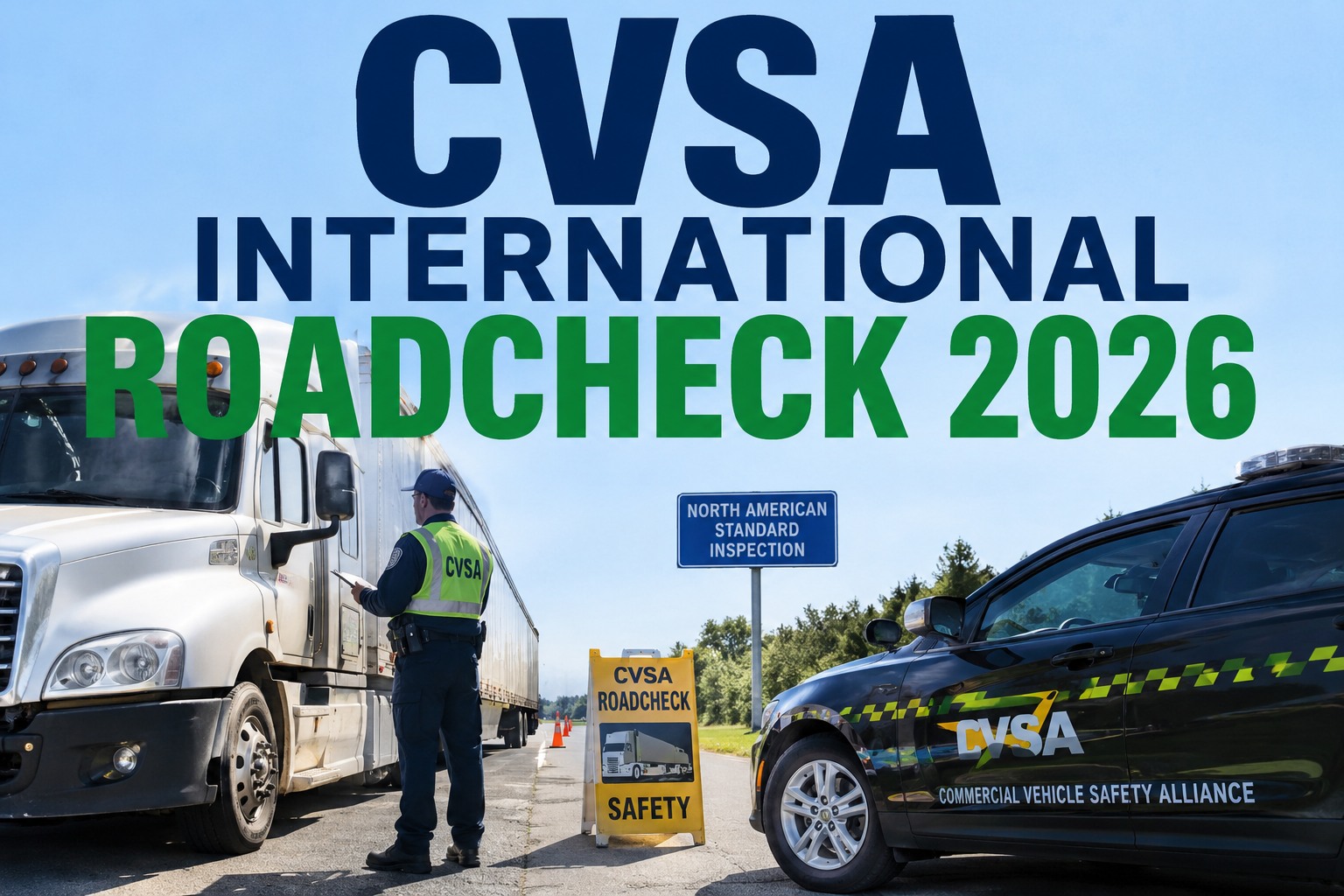
CVSA International Roadcheck 2026 runs May 12-14 across the United States, Canada, and Mexico — the largest coordinated commercial vehicle enforcement event in the world, averaging roughly 15 inspections per minute during the 72-hour blitz. This year's dual focus is Electronic Logging Device tampering on the driver side and cargo securement on the vehicle side. Fleets that prepare for the 2026 focus areas specifically — not just general compliance — consistently outperform peers on OOS rates. Book an HVI demo to get Roadcheck-ready before May.
Two focus areas. One 72-hour window. Zero margin for unprepared fleets.
- Record of Duty Status edits reviewed for false entries
- Suspicious log corrections near HOS limits
- Vehicle movement flagged while logged Off Duty
- Log transfer readiness verified at roadside
- Unassigned driving time reconciled with fleet
- Tie-down count, condition, working load limits
- Anchor point structural integrity
- Load distribution and center-of-gravity
- Blocking, bracing, and edge protection
- Commodity-specific securement requirements
Roadcheck 2026 — dates, scope, and what to expect
The 2026 CVSA International Roadcheck runs Tuesday May 12 through Thursday May 14 across every US state, Canadian province, and Mexican federal enforcement zone. Inspectors deploy to weigh stations, fixed inspection sites, and unannounced pop-up checkpoints. Most inspections will be North American Standard Level I — the full 37-step procedure covering both driver credentials and complete vehicle mechanical inspection. Passing a Level I inspection during Roadcheck earns the CVSA decal, which reduces re-inspection likelihood at weigh stations for approximately 3 months afterward.
Beyond the two named focus areas, inspectors continue enforcing every category they normally do. Brakes, tires, and lighting remain the top OOS violation categories regardless of what's specifically named as the annual focus — the pattern has held for years. Fleets that treat Roadcheck as a "focus-area-only" event get caught on the categories they didn't prepare for. Best practice: prepare specifically for the 2026 focus areas AND maintain your normal compliance discipline for everything else. Book an HVI demo to see 2026 focus-area templates ready for immediate deployment
Driver focus deep-dive — ELD tampering, falsification & manipulation
The 2026 driver focus responds to a specific enforcement pattern: falsification of Record of Duty Status was the second most-cited driver violation in 2025, with 58,382 violations recorded. Five of the top 10 driver violations that year were HOS or ELD-related. Some inaccurate ELD entries come from genuine misunderstanding of federal exemptions. Others are deliberate manipulation to conceal HOS violations. Inspectors in 2026 will focus on distinguishing the two.
Edits made to the last two entries before a duty-status change often signal manipulation to conceal a violation. Inspectors review edit metadata: who made the change, when, and whether the ELD's required annotation field was completed with a legitimate business reason.
ELDs record any vehicle movement, even without an assigned driver. Fleets are required to reconcile unassigned driving to specific drivers before the ELD data is submitted or reviewed. Persistent unassigned time is a red flag for movement while logged Off Duty.
Drivers must be able to transfer ELD records to inspectors on demand via web services, email, USB, or Bluetooth. Failure of the transfer function is a violation. Roadcheck 2026 will specifically test transfer readiness at inspection sites.
FMCSA has removed 56+ ELD devices from the registered list since January 2025, including HERO ELD in April 2026. Fleets using removed devices have 60 days to switch to a compliant unit or face enforcement. Verify your ELD is still on the FMCSA registered list.
ELD tampering exposure isn't just a Roadcheck problem — but Roadcheck is when concentrated enforcement finds it fastest. Fleets that audit driver records, verify edit patterns, and reconcile unassigned time in the weeks before May 12 significantly reduce their driver OOS rate during the blitz. Try HVI free to deploy ELD audit workflows before Roadcheck.
Vehicle focus deep-dive — cargo securement
Cargo securement is the 2026 vehicle focus for good reason: improperly secured cargo generates over 34,000 violations for unsecured components and leaking or falling cargo annually, and creates a disproportionate share of roadway incidents. Inspectors during Roadcheck 2026 will examine tie-down condition, count, working load limits (WLL), anchor point integrity, and commodity-specific securement compliance.
- Number of tie-downs meets commodity requirements
- Working Load Limit (WLL) marked and adequate
- No cuts, abrasion, corrosion, or knots
- Winches, chains, binders operating correctly
- Edge protection where straps cross sharp edges
- Anchor point welds and mounting intact
- D-rings, stake pockets undamaged
- Trailer floor and structure supports load
- Headboard and bulkhead in place
- Load contained within trailer sides
- Weight distribution within axle limits
- Center of gravity appropriate for load type
- Load-shifting prevention (blocking, bracing)
- Height and width within legal limits
- Overhang secured with warning flags/lights
- Logs: FMCSA 393.116 requirements verified
- Vehicles: FMCSA 393.128 tie-down count met
- Metal coils: FMCSA 393.120 method applied
- Roll-on/roll-off: FMCSA 393.106 general rules
- Hazmat placards and paperwork current
Cargo securement failures are almost always visible at pre-trip inspection when the driver actually checks. FMCSA rules also require re-inspection of load securement within the first 50 miles of dispatch and again during required rest stops — a step many drivers skip. Photo-documented securement checks create the audit trail that satisfies both roadside inspectors and post-incident claims investigators. Fleets carrying oversized or specialized loads (steel coils, logs, machinery, heavy vehicles) face additional commodity-specific rules under FMCSA 393.116-393.128 that inspectors will verify against the specific load being transported. Book an HVI demo to see commodity-specific securement templates deployed automatically per load type.
The violations that catch fleets regardless of focus area
CVSA's named focus areas guide inspector attention — but they don't limit it. Regardless of what's named as the annual focus, the same categories put trucks out of service year after year. Fleets that prepare only for the named focus areas leave themselves exposed to the categories that always fail.
Leads OOS every year regardless of named focus. Slack adjuster out of tolerance, brake stroke over limit, and air leak rates outside spec dominate. Measured, not eyeballed, at Level I.
Under-inflation, tread below legal limit (2/32 steer, 4/32 drive/trailer), sidewall damage, exposed cord. Almost always visible at daily walk-around.
Burned bulbs, damaged reflective tape, non-functional turn signals. Second-most-common visible defect after tires.
Beyond the 2026 ELD tampering focus, general HOS violations remain a top-5 driver OOS category every year. 5 of top 10 driver violations = HOS-related.
Fleets sometimes assume that preparing for the named focus areas is sufficient. Historical data shows otherwise: brakes have led vehicle OOS every year regardless of what focus is named. Preparation strategy that ignores the perpetual top-4 categories leaves 60-70% of your OOS exposure uncovered. Try HVI free to deploy templates covering both 2026 focus areas AND the perpetual top categories that catch every year.
Pre-Roadcheck preparation timeline
Roadcheck preparation isn't a Day-Of activity. Fleets that get results treat the 30 days before May 12 as a compliance sprint. Here's the timeline that maps to the 2026 focus areas.
Pull CSA percentile scores for every BASIC. Audit ELD records for the past 90 days: edit patterns, unassigned time, transfer readiness. Review cargo securement policies against FMCSA 393.100-393.128. Identify the 5-10 trucks most at risk of an OOS event and prioritize their prep.
Complete every open work order on Vehicle Maintenance items. Verify all drivers have current CDL, medical card, and Clearinghouse status. Retrain drivers on ELD annotation requirements and cargo securement verification within the first 50 miles.
Deploy 2026 focus-area DVIR templates with photo evidence on tie-downs, anchor points, and cargo distribution. Run mock inspections on trucks selected for high-lane exposure during the blitz. Confirm every driver knows their ELD transfer procedure.
Every driver completes photo-verified pre-trip DVIR before dispatch. Any defect triggers immediate work order — no dispatch with open defects. Real-time monitoring of inspection results from telematics; fleet managers see OOS events within minutes and can respond.
Fleets running this 30-day preparation timeline consistently post OOS rates 40-60% lower than industry average during Roadcheck. The compounding value of preparation shows up not just in that specific week but across the following 12 months of CSA scoring — every clean inspection during Roadcheck adds to your record with double the visibility of a random weigh-station stop, and CVSA decals earned during the blitz reduce re-inspection frequency for approximately 3 months afterward.
From an operations director running 210 tractors through 4 Roadcheck cycles
Our first Roadcheck cycle on paper DVIRs was rough — 34% vehicle OOS during the 72 hours. Second year we tried more training. 31%. Nothing moved. Fleets around us posting 15-18% rates had digital DVIR programs; we finally listened.
Deployed HVI ahead of the 2025 Roadcheck. Focus-area templates on tires (that year's vehicle focus) plus general Vehicle Maintenance discipline. 2025 result: 12% OOS during the 72 hours. 2026 we're deploying the ELD audit workflow ahead of May 12 and cargo securement photo templates for every driver. Roadcheck is no longer three sleepless nights — it's just another week where the fleet keeps running.
Frequently asked questions
When is CVSA International Roadcheck 2026?
CVSA International Roadcheck 2026 runs Tuesday, May 12 through Thursday, May 14, 2026 — a 72-hour continent-wide commercial vehicle enforcement blitz across the United States, Canada, and Mexico. It's the largest coordinated CMV enforcement event in the world, averaging approximately 15 inspections per minute over the 72 hours. Most inspections will be North American Standard Level I — the comprehensive 37-step procedure covering both driver credentials and full vehicle mechanical inspection. Some inspections will be Level II (walk-around), Level III (driver only), or Level IV (special study). Fleets typically see elevated inspection frequency in the days before and after the official dates as well, because inspector staffing rises for the event. Beyond the May 12-14 window, CVSA runs additional targeted enforcement throughout the year including Brake Safety Week (typically August) and Operation Safe Driver Week (typically July). Enforcement doesn't stop at the borders: Mexican Federal Police, Canadian provincial enforcement, and US state DOT officers all coordinate during Roadcheck to ensure consistent inspection standards. A truck operating in cross-border service should expect potential inspection in any of the three countries during the blitz.
What are the 2026 Roadcheck focus areas?
CVSA has designated two focus areas for Roadcheck 2026: ELD Tampering, Falsification, and Manipulation on the driver side, and Cargo Securement on the vehicle side. The driver focus responds to a specific enforcement pattern — falsification of Record of Duty Status was the second most-cited driver violation in 2025 with 58,382 violations, and five of the top 10 driver violations were HOS or ELD-related. Inspectors will review Record of Duty Status entries for false or manipulated data, examine edit patterns near HOS limits, reconcile unassigned driving time against fleet records, and test log transfer readiness at the roadside. The vehicle focus targets over 34,000 violations recorded in 2025 for unsecured vehicle components and leaking or falling cargo. Inspectors will examine tie-down condition and count, Working Load Limit adequacy, anchor point structural integrity, load distribution, blocking and bracing, edge protection, and commodity-specific securement requirements under FMCSA 393.100-393.128. Both focus areas can produce immediate out-of-service orders. Fleets should prepare for both focus areas specifically while maintaining their normal compliance discipline for brakes, tires, lighting, and other categories that consistently generate the highest OOS volume regardless of the named annual focus.
How do fleets prepare for CVSA International Roadcheck?
Effective Roadcheck preparation runs on a 30-day timeline before the May 12-14 blitz. T-30 days (approximately April 12): audit current CSA percentile scores per BASIC, review the past 90 days of ELD records for edit patterns and unassigned driving time, and identify the 5-10 highest-risk trucks in your fleet for prioritized attention. T-14 days (April 28): complete every open Vehicle Maintenance work order, verify every driver has current CDL, medical card, and Clearinghouse query status, and retrain drivers on the 2026 focus areas — specifically ELD annotation requirements and cargo securement inspection procedures including the FMCSA-required re-check within the first 50 miles of dispatch. T-7 days (May 5): deploy focus-area DVIR templates with photo evidence requirements on tie-downs and anchor points, run mock inspections on trucks likely to encounter high-inspection lanes during the blitz, and confirm every driver can execute the ELD transfer procedure correctly on their specific device. May 12-14 execution: every driver completes photo-verified pre-trip DVIR before dispatch; any defect triggers immediate work order preventing dispatch with open defects; fleet managers monitor real-time inspection outcomes via telematics and respond within minutes to any OOS event. Fleets that treat Roadcheck as a compliance sprint rather than a "we'll be fine" event consistently post OOS rates 40-60% lower than industry average.
Should drivers stay off the road during Roadcheck 2026?
Grounding trucks during Roadcheck week is a common but questionable strategy. Operating during Roadcheck and passing a Level I inspection earns the truck a CVSA decal, which reduces re-inspection likelihood at weigh stations for approximately 3 months afterward. That decal has genuine operational value: a truck with a current CVSA decal often gets waved through weigh stations that would otherwise stop it. Fleets that ground trucks during Roadcheck lose that opportunity. The counterargument: for a fleet with elevated CSA scores and known compliance gaps, the risk of an OOS event during Roadcheck outweighs the decal benefit. If your Vehicle Maintenance percentile is above 75th and you have known open defects, grounding during the 72 hours may be the right call. For fleets running clean compliance operations, running during Roadcheck and collecting decals is the better strategy. The best answer for most fleets: prepare specifically for the 2026 focus areas, fix all known compliance issues in the 30 days before May 12, and run normally during the blitz to collect CVSA decals. This turns Roadcheck from a threat into an operational advantage. Digital DVIR platforms with 2026 focus-area templates make this shift practical rather than aspirational.
What happens if my truck fails a Roadcheck inspection?
A Roadcheck inspection failure that produces an out-of-service (OOS) order has both immediate and long-term consequences. Immediate: the truck cannot operate until the defect is corrected. This means finding a mobile repair provider or towing to a shop, paying labor and parts at OOS-response rates, and losing the current load's revenue plus any customer penalties for late delivery. For loads that cannot tolerate delay (reefer, expedited, hazmat), the entire load may need to be re-worked at additional expense. Long-term: every OOS violation feeds the FMCSA Safety Measurement System with severity weight 2 — double the weight of non-OOS violations of the same category. That elevated weight stays on your CSA record for 24 months, increasing your percentile score across the affected BASIC, increasing your inspection-selection frequency at weigh stations, and increasing your insurance rates at renewal. Driver OOS orders produce similar consequences on the driver side of the record. Fines can reach $19,277 per violation under current FMCSA penalty schedules. The cost of a single OOS event during Roadcheck typically runs $5,000-$15,000 all-in when accounting for repair, tow, lost revenue, customer penalty, and CSA-driven insurance impact. Fleets with strong pre-Roadcheck prep programs avoid the cost entirely and often gain competitive advantage from CVSA decals earned during the blitz.
Roadcheck 2026 ready before May 12 — deployed in 5-7 days.
HVI ships with pre-built 2026 Roadcheck templates for both focus areas. ELD audit workflows check edit patterns, unassigned time, and transfer readiness. Cargo securement checklists with photo evidence on tie-downs, anchor points, and load distribution. Real-time inspection monitoring during the blitz. Live for your fleet in 5-7 days — still time to be ready before May 12.
CVSA-aligned · FMCSA 49 CFR 396.11 compliant · Photo evidence built-in · SOC 2 Type II