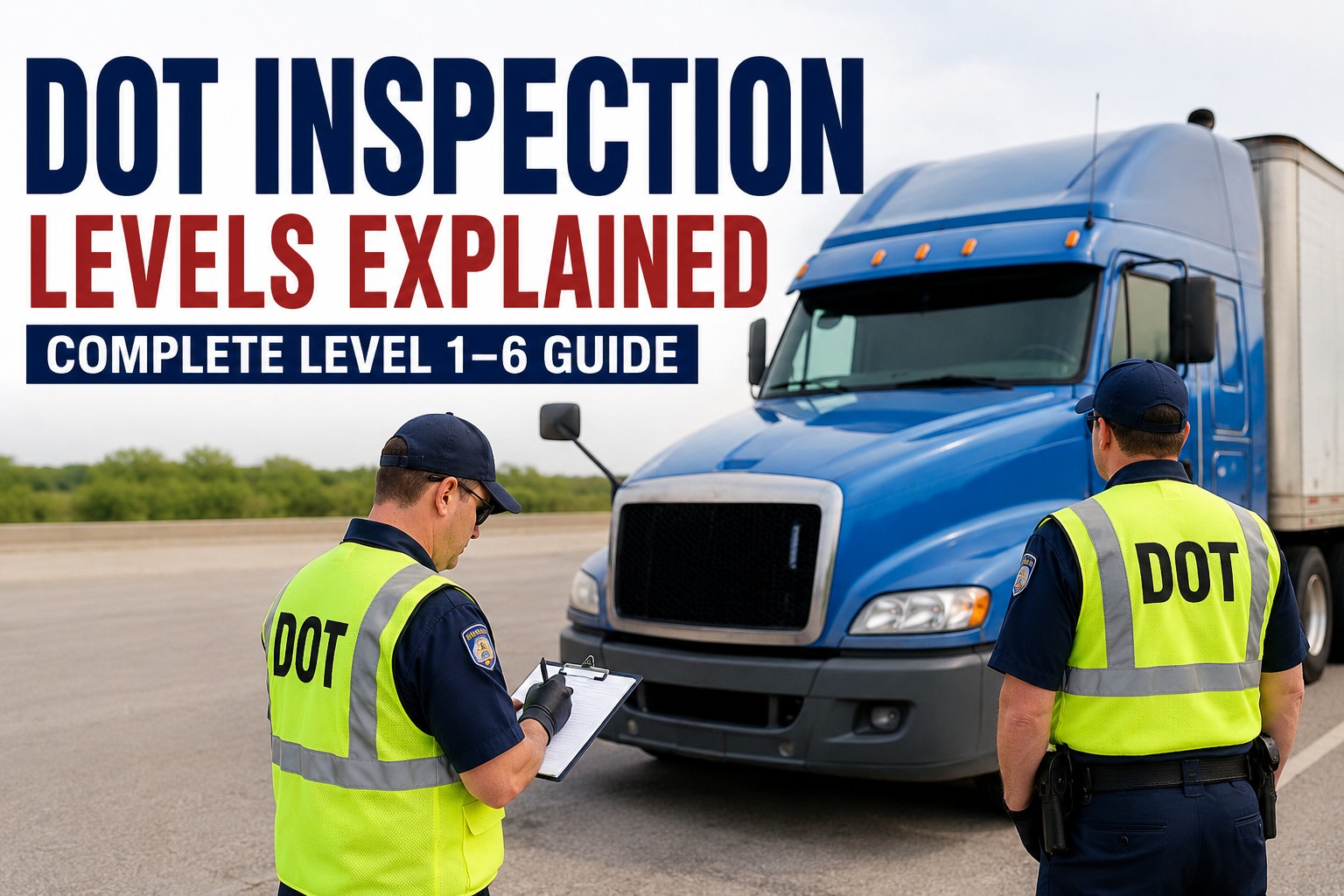
DOT roadside inspection levels 1-6 sit at the center of every US commercial fleet's compliance math. In 2025, CVSA-certified officers conducted approximately 4 million CMV inspections across North America — and 22.6% of vehicles inspected at the International Roadcheck were placed out of service on the spot. Every one of those inspections feeds directly into the FMCSA Safety Measurement System, and starting in 2026, a new CSA scoring split makes daily walk-around discipline visible in your carrier's public record. Book an HVI demo to see inspection-ready records live.
Six inspection levels. One compliance score. Zero surprises if you're ready.
Each CVSA level triggers a different scope and duration — but they all feed the same CSA scoring engine. Here's what each one covers, how long it takes, and what puts trucks out of service.
Complete driver + vehicle inspection including under-vehicle brake measurements. Issues CVSA decal if passed. Most comprehensive level.
All driver credentials + visible vehicle inspection. Inspector doesn't go under truck. Can escalate to Level I if defects visible.
CDL, medical card, HOS/ELD records, seat belt, drug/alcohol program status. No vehicle inspection. Fast but scoring-loaded.
One-item inspection for data study or targeted campaign. Brake Safety Day is annual Level IV. Unannounced enforcement possible.
Full vehicle inspection without driver present. Common at terminals, drop yards, motor carrier premises during audits.
Enhanced Level I plus radiation detection, additional documentation. Required for transuranic waste and highway-route-controlled quantities.
The 2025 numbers that should shape your daily discipline
Four data points from the 2025 CVSA International Roadcheck frame the current enforcement landscape and explain why "inspection prep" isn't a monthly task — it's a daily one. Roughly 1 in 5 trucks flagged for a Level I inspection failed. That's not an outlier fleet problem; that's the industry baseline. Beyond OOS rates, the top violation categories haven't shifted meaningfully in a decade — the same failures keep putting the same trucks out of service. Fleets that identify their exposure across these four categories and build daily discipline around prevention consistently outperform their peers on CSA percentile scores. Every OOS event carries a severity weight of 2 in the CSA math, meaning one OOS violation counts as much as two non-OOS violations of the same category. The compounding effect is real: fleets sitting at 85th percentile Vehicle Maintenance get inspection-selected more often, generating more violations, driving the score higher. Breaking that cycle starts with the four categories below.
Brake violations lead vehicle OOS every year without exception. Slack adjuster out of tolerance, brake stroke exceeding legal limits, air leak rates outside spec — all catchable at pre-trip if the driver actually measures.
Under-inflation, tread below 2/32 (steer) or 4/32 (drive/trailer), sidewall damage, exposed cord. Tire OOS violations are almost always visible at daily walk-around when the driver actually kneels down.
Burned bulbs, damaged reflective tape, non-functional turn signals. Second-most-common visible defect. Roadside inspector's first look after driver credentials.
18,108 unsecured cargo violations issued in 2025. CVSA has named cargo securement the 2026 Roadcheck vehicle focus. Expect increased scrutiny of tie-downs, load distribution, and securement devices.
Book an HVI demo to see how digital DVIR catches these categories before roadside enforcement does
Level-by-level prevention framework — what daily discipline stops what
The six inspection levels aren't equal in what they catch or what they weigh on your CSA. Understanding each level's failure surface lets you prevent violations at the specific point in your operation where they originate.
Level I checks brakes with actual measurement, drivetrain under the truck, coupling devices, exhaust system, frame, fuel system, lighting, cargo securement, steering, suspension, tires, wheels and rims, windshield wipers, and trailer floor. Every one of these fails at daily inspection first. Photo-verified DVIRs catch what walk-around habits miss. A passed Level I earns the CVSA decal — a 3-month "get out of jail" that reduces reinspection likelihood at every weigh station in North America.
Level II covers everything visible without going under the truck: lights, tires, coupling, load securement visible from ground level. Under the 2026 CSA split, all of these fall under "Driver Observed" — the new separately scored category. This is exactly where fleets with strong eDVIR programs gain a measurable CSA advantage. Fleets running photo-verified pre-trips typically see 60-70% reduction in Level II OOS rate within the first quarter.
Level III skips the truck entirely and focuses on driver: CDL and endorsements, medical certificate, HOS/ELD records, seat belt use, drug and alcohol program status, and Clearinghouse query results. Common failure: expired medical card, ELD violations from the current or prior 7 days, and DataQ-eligible clerical errors nobody caught. Duration averages 15-20 minutes; fleets with digital driver records complete under 12 minutes.
Level IV targets one item for a data study or enforcement campaign. Annual Brake Safety Day is the best-known example — typically held in August with results published quarterly. Unannounced Brake Safety Day happens too, with dates released only hours before enforcement begins. Fleets that meet Level I standards pass Level IV incidentally — but those cutting corners on brakes get caught in a very focused way, often with fines multiplied by focused-enforcement penalties.
Level V happens at your terminal, drop yard, or motor carrier premises — often during a compliance review. The driver isn't present. Vehicles get the full Level I mechanical scrutiny without any driver present to answer questions. Maintenance history documentation is central here: if the shop can't produce PM records, work orders, and defect corrections in seconds, the Level V review turns into a documentation nightmare.
Level VI applies only to transuranic waste and highway-route-controlled quantities of radioactive material. Enhanced Level I plus radiation detection, sealed source verification, and specialized documentation covering shipping papers, driver training, and emergency response certification. Zero tolerance for any defect. Very small subset of fleets, but non-negotiable when applicable — and inspection frequency runs significantly higher than commercial averages.
Every level feeds the same CSA scoring engine, but each has its own probability of finding the truck's specific weakness. Fleets that treat all six levels as one preparation standard — not six separate strategies — consistently maintain lower percentile scores across every BASIC. Book an HVI demo to see level-mapped inspection prep in action.
The 2026 CSA change that puts pre-trip on your public record
The 2026 CSA overhaul introduces a change that most fleets haven't fully absorbed yet: Vehicle Maintenance is now split into two separately scored categories. This changes the game for daily discipline.
Shop-detected defects requiring technician intervention: internal brake wear beyond spec, suspension component failure, transmission or drivetrain issues surfacing during PM. These are your shop's responsibility.
- Internal brake wear
- Suspension failures
- Drivetrain defects
- PM-detected issues
Walk-around items a driver should catch at pre-trip: lights, tires, coupling, visible leaks, cargo securement. Scored separately from shop items. Directly ties DVIR discipline to your public CSA record.
- Burned bulbs / lighting
- Tire condition / pressure
- Coupling engagement
- Visible fluid leaks
Under the split, OOS violations still receive severity weight 2 — twice non-OOS violations. But the Driver Observed category now makes visible which fleets have DVIR discipline and which don't. Clean inspections dilute past violations mathematically; more clean inspections means lower percentile scores across all categories. Fleets running eDVIR programs with photo evidence have a documented, measurable CSA advantage under the split. Try HVI free to see how your Driver Observed category looks under the 2026 scoring.
The daily-operations playbook — be inspection-ready every day
Inspection readiness isn't an annual project. It's a daily discipline that maps to specific operational moments. Here's the framework fleets use to stay ready across all six levels.
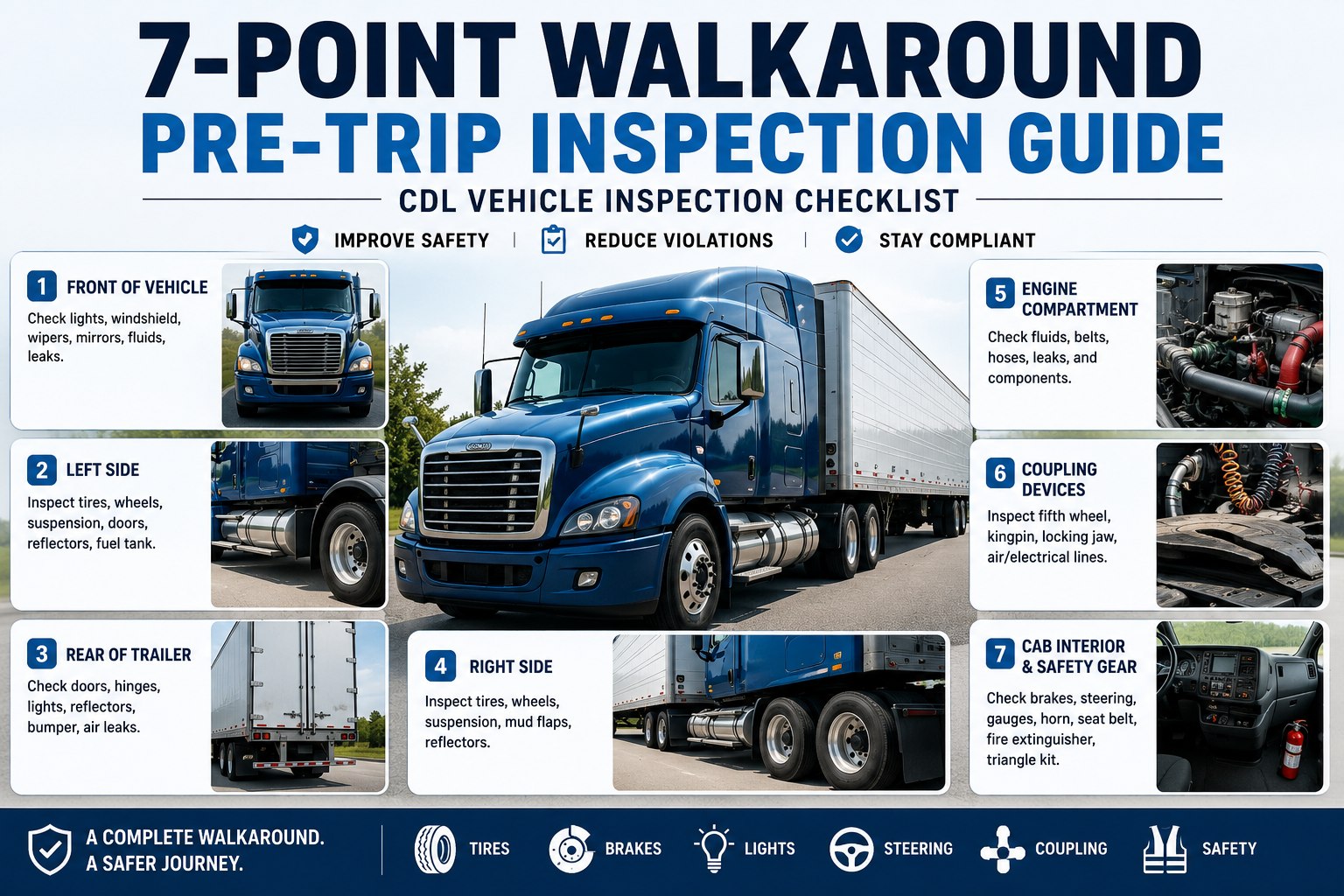
Digital DVIR with photo capture on brakes, tires, lights, coupling, and cargo securement. This is 80% of what makes trucks fail Levels I, II, IV, and V. Documented pre-trip completion satisfies FMCSA 49 CFR 396.11 and creates the Driver Observed category evidence trail.
CDL current, medical card current, HOS/ELD status clean for last 8 days, drug/alcohol program status verified. This satisfies Level III credential inspections and prevents the "expired medical" surprise that puts a driver out of service instantly.
A defect noted on DVIR must trigger a work order and either corrective action or "not required for safe operation" authorization before the truck rolls again. Paper systems break this chain; digital DVIRs enforce it automatically.
Clerical errors on prior inspections can be corrected via the FMCSA DataQ system if caught in time. Quarterly review of your carrier's inspection history identifies challenge-eligible items that would otherwise stay on your CSA record for 24 months.
The playbook above isn't theory — it's what separates fleets with 40th-percentile CSA scores from those sitting at 85th and getting inspection-selected on every pass. Try HVI free to see all four playbook items enforced automatically across your fleet.
From a safety manager running 145 tractors and 240 trailers across 6 lanes
Two years ago we were sitting at 87th percentile Vehicle Maintenance in CSA and getting inspection-selected on almost every weigh station pass. Our paper DVIR completion looked fine on the clipboard. Roadside told a different story: 30% Level I OOS rate. Brakes and tires every time.
Deployed digital DVIR with photo evidence on brake stroke, tire condition, and lighting. First quarter: OOS rate dropped from 30% to 11%. Twelve months later CSA Vehicle Maintenance percentile down to 42. Inspection-selection rate dropped noticeably because our USDOT number stopped tripping the risk-based selection algorithm. Clean inspection accumulation compounds — every clean stop dilutes the old violations still on record.
Frequently asked questions
What is the difference between DOT and CVSA inspection levels?
There's no functional difference — "DOT inspection levels" and "CVSA inspection levels" refer to the same standardized system. The Commercial Vehicle Safety Alliance (CVSA) is the nonprofit organization that develops the North American Standard Inspection Program. FMCSA (part of the US Department of Transportation) enforces those standards along with state-level partners. All 50 US states, plus Canadian provinces and Mexican federal enforcement, follow the same six primary CVSA inspection levels. The terms "DOT roadside inspection levels" and "CVSA levels" are used interchangeably by drivers, fleet managers, and enforcement officers. When a state trooper or DOT officer inspects a commercial motor vehicle, they follow the CVSA-published inspection procedures for whatever level the situation warrants. Every inspection outcome uploads to the FMCSA Safety Measurement System (SMS), where it feeds into your carrier's CSA percentile scores across seven BASICs (Behavior Analysis Safety Improvement Categories). CVSA also publishes Level VII (jurisdictional-specific inspections for school buses, hotel shuttles, and similar) and Level VIII (electronic inspection conducted wirelessly while the vehicle is in motion), but these are less commonly discussed because Level VII is jurisdiction-limited and Level VIII is still in limited-deployment testing across select states.
How does the 2026 CSA overhaul change how inspections affect my score?
The 2026 CSA overhaul introduces several changes to how roadside inspection results affect carrier scoring. The most impactful change: Vehicle Maintenance is now split into two separately scored categories. Standard Vehicle Maintenance covers shop-detected defects requiring technician intervention — internal brake wear, suspension failures, drivetrain issues surfacing during PM. Driver Observed Vehicle Maintenance covers walk-around items a driver should catch at pre-trip — lights, tires, coupling, visible leaks, cargo securement. Under the split, DVIR discipline directly affects your public CSA profile in a new, visible way. Fleets with strong eDVIR programs (digital DVIR with photo evidence) have a documented, measurable advantage in the Driver Observed category. Beyond the split, OOS violations continue to receive severity weight 2 (double the weight of non-OOS violations of the same category). Clean inspections continue to dilute past violations mathematically — more clean stops means lower percentile scores over the rolling 24-month violation window. The 2026 changes also include refinements to the Unsafe Driving BASIC and Hours of Service (HOS) BASIC calculations. Fleets should review their carrier profile against the updated methodology to identify which BASIC categories are most exposed and which improvements would produce the largest percentile drops.
What triggers a DOT roadside inspection?
Several triggers can put a commercial motor vehicle in front of a CVSA-certified inspector. Weigh station pull-in: any truck required to pull into a weigh station may be selected for inspection, either randomly, by the risk-based selection algorithm using the carrier's USDOT number, or by visible defect. Traffic stop: any moving violation (speeding, following distance, lane use) can result in an inspection following the traffic stop. Visible defect on patrol: burned-out lights, damaged tires, smoke from brakes, unsecured cargo, or leaking fluids give an inspector probable cause. Post-crash: any commercial motor vehicle involved in a crash resulting in a fatality, injury requiring medical transport, or vehicle towed from the scene must be inspected. Terminal/facility inspection (Level V): during a compliance review at the carrier's premises. Special enforcement campaigns: Brake Safety Day (Level IV), International Roadcheck (multi-day multi-level), and other CVSA-coordinated campaigns produce elevated inspection volume on specific dates. The risk-based selection algorithm merits specific attention: carriers with elevated CSA percentiles get selected more frequently, creating a feedback loop where high-violation carriers get inspected more, generating more violations. Breaking that cycle requires accumulating clean inspections through disciplined pre-trip DVIR and prompt defect correction — the exact operational shift that digital DVIR platforms enable at scale.
How long does a DOT roadside inspection take?
Duration varies significantly by inspection level and the truck's condition. Level I North American Standard: 45-60 minutes typical, up to 90 minutes for thorough inspections or when defects are found requiring follow-up. Level II Walk-Around: 30-45 minutes for the visual inspection plus driver credentials. Level III Driver/Credential: 15-20 minutes typically, sometimes as fast as 10 minutes if all documents are ready and clean. Level IV Special Study: varies widely by the specific item being inspected — a brake-focused Level IV can take 30-45 minutes; a documentation-focused Level IV may take under 20. Level V Vehicle Only: 30-45 minutes for the full vehicle inspection without a driver present. Level VI Radioactive Materials: 60-75 minutes typically due to enhanced Level I scope plus radiation detection and documentation review. Any level can extend if defects are found, if the inspector escalates from a lower level to Level I (Level II can escalate if visible defects suggest deeper issues), or if the driver's paperwork requires additional verification. Digital DVIR records with photo evidence typically reduce Level II and Level III completion time because credential and DVIR verification happens faster than paper document retrieval. Fleets running clean digital operations regularly complete Level III inspections in under 15 minutes and get back on the road with a clean inspection recorded to their CSA profile.
Can digital inspection records replace paper DVIRs during roadside inspections?
Yes. FMCSA has officially finalized electronic DVIR creation, maintenance, and signature under updated 49 CFR 396.11 language — removing previously ambiguous paper-based requirements. Digital inspection documentation is now unambiguously compliant at roadside inspections. The final rule also removed two long-obsolete requirements: the spare fuse requirement (irrelevant on modern vehicles with electronic fuse systems) and the liquid-burning flare requirement (superseded by LED and battery-powered warning devices). During a roadside inspection, a driver with a digital DVIR platform can present the current shift's DVIR, prior shift DVIRs, defect history, and corrective action records directly from a tablet or mobile device. Photo evidence attached to critical inspection items strengthens the compliance record beyond what paper systems can produce. Officers increasingly expect and accept digital DVIR presentation. Beyond roadside acceptance, digital platforms produce measurable operational benefits: reduced pre-trip completion time (typically 30-40% faster than paper), automatic defect-to-work-order routing preventing dispatch of trucks with known defects, and instant retrieval of full inspection history for FMCSA/OSHA audit requests. Fleets transitioning from paper to digital DVIR typically report OOS rate reductions of 40-60% within the first quarter and CSA Vehicle Maintenance percentile improvements within the first six months.
Roadside-ready records — from pre-trip photo to inspector's screen in seconds.
HVI ships with pre-built CVSA-aligned inspection templates covering every level's critical items. Photo evidence on brakes, tires, lights, coupling, cargo securement. Defects auto-generate work orders. Every inspection retained 12 months, retrievable in seconds during roadside stops or FMCSA audits. Driver Observed category evidence built by design. Live for your fleet in 5-7 days.
CVSA aligned · FMCSA 49 CFR 396.11 compliant · 2026 CSA scoring ready · SOC 2 Type II