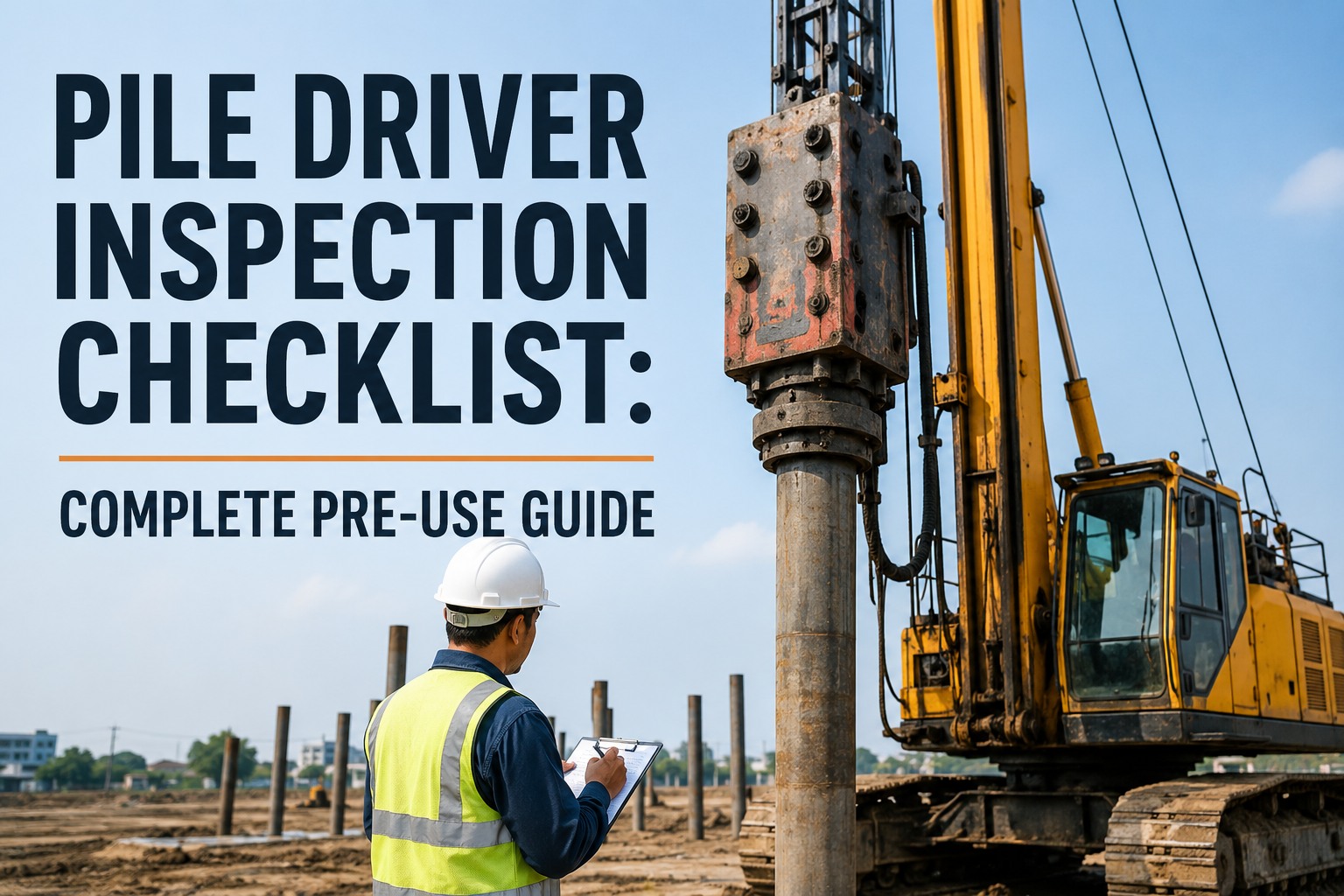
A pile driver is one of the most powerful — and least forgiving — machines on a construction site. A hammer weighing several tons rides up a set of leads and pounds a pile into the ground with thousands of pounds of force, fed by pressurized hoses that, if a coupling lets go, can thrash with enough violence to kill. Those hazards are exactly why OSHA wrote a standard specifically for this equipment, 29 CFR 1926.603, and why the rig's hammer, clamp, power unit, supply hoses, rigging, and retaining bolts must be inspected before each shift and periodically during use. The non-negotiable items aren't generic — they're pile-driver-specific safety devices: a safety chain on every hose connection, a blocking device under the hammer whenever workers are beneath it, and guards over the head block so the cable can't jump the sheaves. Miss one and the failure mode is catastrophic. This guide is your pile driver pre-use inspection checklist: the hazards that drive it, the OSHA framework, the daily walk-around, the mandated safety devices that must be verified every shift, and the leads and rigging checks. It applies whether you run an impact, diesel, hydraulic, or vibratory hammer. book a 30-minute walkthrough to see it set up for your crew.
A disconnected hose thrashes. An unblocked hammer falls. The pre-use check is what stands between them and your crew.
HVI runs the pile driver pre-use inspection from a phone — hammer, leads, hoses and safety chains, blocking device, head-block guards, rigging and retaining bolts — to OSHA 1926.603, flags any defect, tags an unsafe rig out of service, and keeps the documented before-each-shift record.
Why pile driving demands its own inspection
The hazards on a pile driver are unlike any other machine, and each maps to a specific OSHA-required safeguard the pre-use check must verify.
The thrashing hose
Steam, air, and hydraulic hoses carry pressure to the hammer. If a coupling disconnects, the line whips violently — which is why every connection needs a safety chain to tether it.
The falling hammer
A multi-ton hammer suspended in the leads can drop. Whenever workers are beneath it, a blocking device capable of supporting the hammer's full weight must be in place.
The jumped cable
The hoist cable runs over sheaves at the head block. Without guards, the cable can jump the sheave under load — so guards across the top of the head block are required.
One standard written just for this machine
OSHA 1926.603 exists because pile driving equipment carries hazards no general construction rule fully covers — and it's reinforced by 1926.20(b)(2), which requires frequent and regular inspections by a competent person for any rig (including hydraulic self-erecting rigs outside the crane subpart). When the rig uses a crane with running and standing wire rope, that rope also falls under the 1926.1412(d)(1) shift inspection. A generic equipment checklist captures none of the pile-driver-specific devices — the hose safety chains, the under-hammer blocking, the head-block guards, the two-valve steam controls — which is exactly why this machine needs a purpose-built pre-use inspection.
The pre-use inspection checklist
This is the before-each-shift walk-around, covering the rig from the hammer down to the rigging. Each item is a pass-or-pull decision before driving begins.
Most of these are pile-driver-specific devices a generic form never lists — the safety chains, blocking, head-block guards, and two-valve controls that OSHA mandates by name. sign up free and run the full 1926.603 pre-use check on a phone with photo capture, or book a demo to see pile-driver templates.
The OSHA-mandated safety devices
Four devices are written directly into 1926.603, and each must be verified before driving. These are the items an inspector checks first — and the ones that prevent a fatality.
Hose safety chains
A safety chain or equivalent on each hose connection to prevent the line thrashing if a coupling disconnects — at least ¼-inch chain rated around 3,250 lbs, and it applies to steam, air, and hydraulic hoses including at the power pack. Never shortened with knots or bolts.
Under-hammer blocking device
A blocking device capable of safely supporting the hammer's weight, placed in the leads under the hammer at all times while employees work beneath it. This is what stops a suspended hammer from becoming a falling one.
Head-block sheave guards
Guards across the top of the head block to prevent the hoist cable from jumping out of the sheaves under load — a derailed cable can drop the hammer or the pile.
Two shutoff valves
Steam and compressed-air line controls require two shutoff valves, at least one a quick-acting lever type within easy reach of the hammer operator — so the energy source can be killed instantly.
The hose safety chain deserves special emphasis because it's the most-cited and most-clarified provision: OSHA has confirmed (a)(10) applies broadly to "each hose connection," including hydraulic hammers and the power pack, not just steam lines. A securely tethered hose is the difference between a disconnected coupling being a nuisance and being fatal. HVI makes each mandated device a required, photo-verified line item.
Leads, rigging & the fall zone
Beyond the named devices, the structure that holds and guides the hammer — and the exclusion zone around it — must be verified every shift. These keep the rig stable and the crew clear.
Lead stability
Guys, outriggers, thrustouts, or counterbalances must be provided as needed to keep the rig stable, and when leads are inclined to drive batter piles, provisions must stabilize them. Check alignment and structure before each shift.
Rigging & retaining bolts
Couplings, support and lifting equipment, rigging, and retaining bolts are inspected before each shift and periodically during use. Hoist hooks need a means to prevent accidental disengagement, or use a shackle.
Fall zone & access
No worker under the hammer or pile, ever; essential crew stays to the sides or rear of the leads. Fixed leads need a ladder and anchor rings for lanyards, and loft platforms need guardrails.
the first blow. Every safeguard on a pile driver — the hose chains, the blocking device, the head-block guards, the lead stability, the fall zone — has to be confirmed before driving starts, because once the hammer is working there's no safe moment to fix a missed defect. The before-each-shift inspection isn't a formality; on this machine it's the entire margin of safety. HVI makes that pre-use check fast, complete, and documented every shift.
Paper checklists vs. HVI
Both technically record a pre-use check. Only one covers the OSHA-mandated pile-driver devices, tags an unsafe rig out of service, and keeps the documented before-each-shift record an inspector demands.
Paper / generic
- Generic form skips the hose safety chains
- Blocking device & head-block guards not verified
- Two-valve steam control never checked
- Defects noted on paper, rig runs anyway
- No documented before-each-shift record
- Lead stability & rigging missed under time pressure
With HVI software
- 1926.603 template covers every mandated device
- Hose chains, blocking & guards required, photo-verified
- Steam/air two-valve control a checked item
- A failed safety item tags the rig out of service
- Every defect auto-creates a tracked work order
- Audit-ready before-each-shift records export in minutes
tolerance for a missed safeguard. On a pile driver, the OSHA-required devices aren't optional extras — a missing hose chain, an absent blocking device, or an unguarded head block is a direct path to a fatality and a willful citation. A purpose-built pre-use inspection that makes every mandated device a required, documented check is the whole defense. HVI builds the 1926.603 devices into one template that can't be skipped.
Frequently asked questions
What should a pile driver pre-use inspection include?
A pile driver pre-use inspection covers the rig from the hammer down to the rigging, before each shift and periodically during use. The pile hammer, clamp, drive head, power unit, and cushion are checked per the manufacturer's recommendations. All pressurized hoses are inspected for leaks and damage, and critically, each hose connection must have its safety chain in place. The blocking device that supports the hammer must be present for any work under the hammer, and the head block must have guards so the cable can't jump the sheaves. The leads are checked for alignment and stability, with guys, outriggers, or counterbalances as needed. Rigging, couplings, retaining bolts, and the hoist wire rope are inspected, and on steam or air systems the two shutoff valves — one a quick-acting lever within the operator's reach — are verified. Finally, fall protection on the leads and the fall-zone exclusion around the hammer are confirmed. Most of these are pile-driver-specific items a generic form skips. HVI's inspection and maintenance software provides a 1926.603 template covering them all. sign up free and run the full pile-driver check.
What does OSHA 1926.603 require for pile driving equipment?
OSHA 29 CFR 1926.603 is the standard written specifically for pile driving equipment, and it names several required safeguards. Paragraph (a)(10) requires a safety chain or equivalent on each hose connection to prevent the line thrashing if a coupling disconnects — OSHA has clarified this applies broadly to steam, air, and hydraulic hoses, including at the power pack. A blocking device capable of safely supporting the hammer's weight must be placed in the leads under the hammer whenever employees work beneath it. Guards must be provided across the top of the head block to keep the cable from jumping the sheaves. Steam line controls must have two shutoff valves, at least one a quick-acting lever within easy reach of the operator. Guys, outriggers, thrustouts, or counterbalances must maintain rig stability, and fixed leads need ladders and anchor points for fall protection. Hydraulic self-erecting rigs that fall outside the crane subpart are still subject to 1926.20(b)(2), which requires frequent and regular inspection by a competent person. HVI's inspection and maintenance software builds these requirements into its templates. book a demo to see 1926.603 compliance.
Why do pile driver hoses need safety chains?
Because a pressurized hose that disconnects becomes a deadly whip. Pile driver hammers are fed by steam, compressed air, or hydraulic hoses under high pressure, and if a coupling fails or becomes disconnected, the energy in the line makes it thrash around violently — easily enough to injure or kill a nearby worker. OSHA 1926.603(a)(10) addresses this directly by requiring a safety chain, or equivalent means, on each hose connection to tether the line so it can't thrash if the coupling lets go. Best practice and some state standards specify at least a quarter-inch alloy steel chain rated around 3,250 pounds, and the chain must never be shortened with knots, bolts, or other makeshift devices, since that defeats its strength. OSHA has explicitly confirmed the requirement isn't limited to steam lines — it applies to hydraulic hammers and the hydraulic power pack as well, because the thrashing hazard is the same. Verifying every hose connection has its chain is one of the most important pre-use checks on the rig. HVI's inspection and maintenance software makes the hose-chain check a required, photo-verified item. sign up free and verify every hose connection.
How often must pile driving equipment be inspected?
The pile hammer, clamp, power unit, and supply hoses must be inspected in accordance with the manufacturer's recommendations, and the associated equipment — couplings, support and lifting equipment, rigging, and retaining bolts — must be inspected before each shift and periodically during use. So the baseline is a documented before-each-shift inspection, with ongoing checks as driving continues. When the rig uses a crane with running and standing wire rope, that rope is also subject to the 1926.1412(d)(1) requirement that a competent person perform a visual shift inspection before or during each shift. And for hydraulic self-erecting pile-driving rigs that fall outside the crane standard, OSHA's general 1926.20(b)(2) duty still requires frequent and regular inspections by a competent person. The practical approach is a thorough pre-use inspection every shift covering the hammer, hoses and safety chains, blocking, guards, leads, and rigging, layered with the manufacturer's periodic maintenance intervals. HVI's inspection and maintenance software tracks the before-each-shift checks and the periodic intervals together. book a demo to see inspection scheduling.
How does HVI help with pile driver inspections?
HVI is an inspection and maintenance software platform built for construction equipment, including pile driving rigs running impact, diesel, hydraulic, or vibratory hammers. Crews run the before-each-shift pre-use inspection from a phone or tablet using a template aligned to OSHA 1926.603, which makes the mandated safety devices required line items — a safety chain on every hose connection, the under-hammer blocking device, the head-block sheave guards, and the two-valve steam or air controls — with mandatory photo capture on each, so nothing critical can be checked off without proof. It also covers lead stability, rigging, retaining bolts, the hoist wire rope, and fall protection on the leads. A failed safety item tags the rig out of service until it's repaired, every defect auto-creates a tracked work order, and the platform keeps a timestamped before-each-shift record per rig that exports an audit-ready package in minutes. It works offline on the jobsite and syncs when back in range. book a demo and we'll map the software onto your equipment on the call.
Verify every mandated safeguard before the first blow — hose chains, blocking, guards, and all.
HVI runs the pile driver pre-use inspection from a phone to OSHA 1926.603 — hammer, leads, hoses and safety chains, the under-hammer blocking device, head-block guards, two-valve controls, rigging, and fall protection — makes each mandated device a required photo-verified item, tags an unsafe rig out of service, auto-creates a work order from every defect, and keeps the before-each-shift record. Protect the crew on the most unforgiving machine on the site.
No credit card required · Live in under two weeks · 1926.603 pre-use checklist + mandated-device verification + out-of-service tag-out + audit records in one platform
.png)