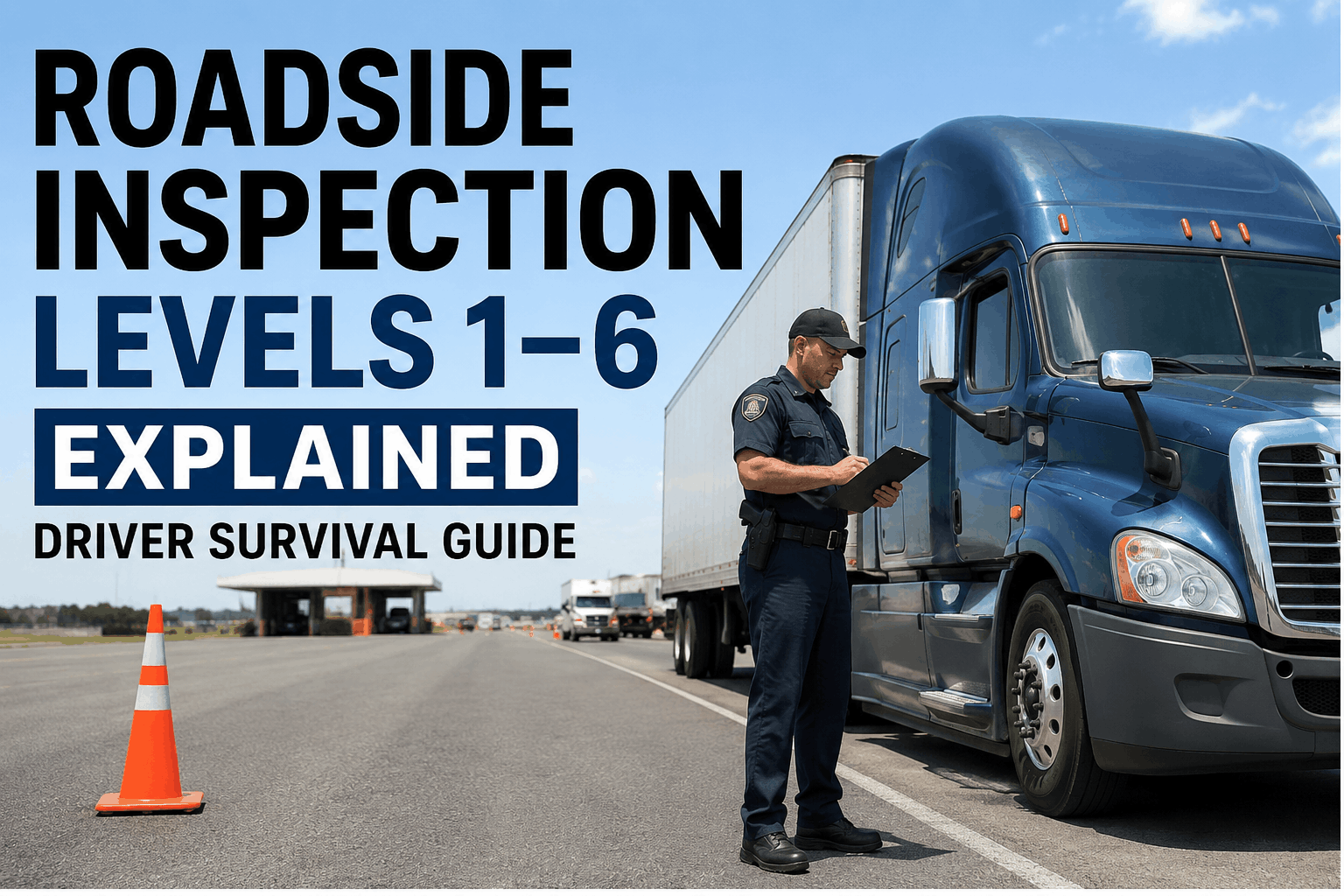
Roughly 4 million commercial motor vehicles get inspected at roadside every year across North America — and what determines whether you're parked for 15 minutes or out-of-service for the day is which CVSA level the inspector decides to run. There are six federal inspection levels, each with a specific scope, average duration, and a specific list of things the inspector is looking at. Knowing the difference between a Level I and a Level III before you pull into the weigh station is the difference between handing over your CDL and your logbook with confidence — or fumbling through a binder while the inspector is already deciding whether to upgrade you. This driver survival guide walks through all six CVSA inspection levels with 2025–2026 data: per-level scope, average duration, what specifically gets checked, the citation rates that drive OOS decisions, and the prep that keeps each level short. For fleet managers running multiple drivers across regions, Start your free HVI trial to put guided pre-trip workflows and audit-ready records on every driver — or book a demo to see how HVI prepares your fleet for any inspection level.
What actually triggers a roadside inspection
Inspectors don't pick trucks at random — there's a hierarchy of triggers behind every "pull around" wave at a weigh station. Knowing what put you in the queue helps you understand why the inspector is asking what they're asking.
License plate cameras and DOT number scans flag carriers with elevated CSA scores. High-score carriers get pulled even when others are bypassed.
Broken light, smoking exhaust, flat tire, loose cargo. Anything the inspector spots from the station triggers an automatic upgrade — usually to Level II or Level I.
The sticker is valid 3 months. After it expires, you become a higher-priority target. Visible, recent decal = often bypassed.
During Roadcheck (May 12–14, 2026) and Brake Safety Week, all trucks are subject to inspection regardless of CSA score or pre-screening.
Skipping a scale, refusing to stop, signs of impairment, or visible nervousness from the cab will get you waved in for at least a Level III.
Crash, near-miss, or formal complaint to FMCSA triggers a Level I-equivalent inspection regardless of decal status.
Level I — North American Standard Inspection
The big one. Inspector reviews driver credentials, HOS records, and crawls under the vehicle to inspect brakes, frame, and suspension. The 37-step process is the most thorough inspection you can get at roadside.
- CDL with correct class and endorsements
- DOT medical certificate (current, signed)
- HOS records via ELD or paper
- Seatbelt use, drug/alcohol impairment signs
- Daily DVIRs (prior + current)
- Carrier paperwork & shipping documents
- Brakes (under-vehicle inspection)
- Tires, wheels, rims, hubs
- Lights, reflectors, conspicuity tape
- Frame, suspension, coupling devices
- Steering & exhaust system
- Cargo securement & load locks
- Fuel & emissions system integrity
Level II — Walk-Around Inspection
The fast version. Same scope as Level I but inspectors don't crawl under the vehicle. Common at busy weigh stations where inspectors are working through a queue and need to move quickly.
- Full driver credential review
- HOS / ELD records check
- Cargo securement inspection
- Visible defect documentation
- External brake component inspection
- No under-vehicle examination
- No frame underside inspection
- No suspension component check (under)
- No CVSA decal issued on pass
- No internal brake adjustment check
Level III — Driver-Only Inspection
The paperwork inspection. Focuses entirely on the driver and carrier — license, medical card, HOS, ELD records, drug/alcohol clearinghouse status. No mechanical inspection of the vehicle itself.
- CDL: class, endorsements, restrictions, expiration
- Medical certificate (current and on file)
- Hours of Service via ELD
- Driver Vehicle Inspection Report (DVIR)
- Driver's Daily Log
- Shipping documentation
- Drug & Alcohol Clearinghouse status
- False/incomplete log entries (32.4% of driver OOS)
- No CDL or wrong class (24.4% of driver OOS)
- No medical card (14.9% of driver OOS)
- Form & manner HOS violations
- Failure to retain prior 7-day records
Level IV — Special Study Inspection
The research inspection. A one-time examination of a specific component, system, or compliance area — typically tied to a state or federal research study. Scope varies widely; could be brake-only, ELD-only, cargo-only.
- Brake-only inspection during Brake Safety Week
- ELD-only check during HOS compliance studies
- Tire-only inspection during a tire safety study
- Cargo securement study at agricultural ports
- Single-defect verification post-citation
- Focused scope — inspector checks one thing
- Short duration relative to Level I/II
- Findings still feed CSA scores
- OOS criteria still apply to the inspected item
- Can lead to Level upgrade if violation found
Level V — Vehicle-Only Inspection
The yard inspection. Same mechanical scope as Level I, but the driver doesn't need to be present. Common at carrier terminals, drop yards, and shipper facilities — where inspectors can examine vehicles between dispatches.
- Carrier terminals during scheduled audits
- Drop yards between dispatches
- Shipper facilities where trucks stage
- Post-citation re-inspection at a yard
- Pre-purchase inspections for fleet acquisitions
- Full brake system (under-vehicle)
- Tires, wheels, rims, hubs
- Steering & suspension components
- Frame & coupling devices
- Exhaust & fuel systems
- Lights, reflectors, conspicuity tape
Level VI — Enhanced Radioactive HRCQ Inspection
The specialty inspection. Required for vehicles transporting transuranic waste and Highway Route Controlled Quantities of radioactive material under 49 CFR 173.403. Combines Level I scope with enhanced radiological protection requirements.
- Radiological surveys of vehicle exterior
- Package marking, labeling, placards
- Shipping papers for Class 7 materials
- Driver training certificates (HM training)
- Carrier security plan documentation
- Route compliance verification
- Carriers under DOE transport contracts
- WIPP-routed transuranic waste haulers
- HRCQ Class 7 radioactive shipments
- Specialized nuclear waste carriers
- Any vehicle with HRCQ in transit
Inspection frequency & OOS distribution — what actually happens at roadside
Across the roughly 4 million CMV inspections conducted in North America each year, the level distribution is consistent and predictable. Most drivers will see Level I or Level II at some point during their career; Level VI exists for a very specific population.
Inside the 37-step Level I — what inspectors actually do
Level I is the most comprehensive — and the most feared — inspection. Knowing the actual sequence helps drivers anticipate what's next. Inspectors don't deviate much from this order, so you can read the room.
CDL, medical card, HOS records, ELD download (or paper logs), shipping papers, daily logs, prior 7-day records. Sets the tone — if paperwork is clean, the rest goes faster.
Seat belt, horn, mirrors, windshield, wipers, lights, reflectors, conspicuity tape. Tire condition (sidewall + tread depth), wheel rim integrity, mud flaps, license plates.
This is the deep dive. Inspector goes under the truck. Brake chambers, slack adjusters, brake lining, drums, air lines, frame condition, suspension components, fifth wheel/coupling.
Cargo type vs documentation, tiedown count and working load limit, blocking and bracing, load distribution, securement integrity. Loose tools, tarps, and dunnage on flatbeds are scrutinized closely.
Inspector documents findings, completes the inspection report, decides whether to issue a CVSA decal (pass) or place OOS (fail). Driver signs the inspection report.
What gets you placed out-of-service — the top citation categories
OOS placement is the worst outcome of any roadside inspection. CVSA's North American Standard Out-of-Service Criteria lists every condition that warrants OOS — but in practice, the same five categories drive over 90% of OOS orders across all inspection levels.
2026 CSA update — every inspection now scores differently
FMCSA's Safety Measurement System overhaul became fully operational in February 2026. The change matters for drivers because what used to score under one Vehicle Maintenance BASIC now scores in two separate categories — and one of them puts the driver directly on the hook.
All mechanical defects bundled together. A burned-out clearance light scored the same as a deep brake system issue. Drivers had no individual visibility in their CSA profile.
Defects a driver should have caught at pre-trip — lights, tires, leaks, missing tape, fluid levels — now score in their own category. Insurance carriers and shippers see this metric directly. Investigation threshold: 80th percentile.
Pre-roadside survival checklist — the 5-minute pre-stop scan
When the inspector waves you in, you have about 90 seconds before they reach your window. Here's what to verify in that window — and what to have ready before you climb down.
CDL, medical card, fuel receipts, shipping docs, prior 8-day logs — all in one binder or folder on the passenger seat. Don't have the inspector watch you fumble.
Open the ELD interface. Verify HOS clock is current. Make sure no malfunction codes are showing. Have the data-transfer process ready before the inspector asks.
Lights on, hazards on. Quick scan: tires (no obvious soft tires or cuts), lights (all working), reflective tape, fluid puddles under the truck, cargo straps tight.
If you have a current sticker, make sure it's on the windshield where the inspector can see it. A visible recent decal often turns a Level I selection into a Level II or III.
Calm, polite, direct. Answer questions specifically without volunteering extra information. The inspector's first impression of you carries through the entire inspection.
How HVI helps drivers and fleets prepare for any inspection level
Roadside inspection prep doesn't start at the weigh station — it starts at pre-trip. HVI's digital inspection platform builds Level I-ready records on every shift, so when an inspector arrives, the driver already has everything in place.
Required-field eDVIRs catch every category an inspector would check — tires, lights, brakes, fluids, coupling, cargo. Photo-verified, timestamped, archived against the VIN.
Any defect spotted at pre-trip auto-creates a maintenance work order. Items don't roll into the next shift unaddressed — eliminating the pattern that creates 80% of roadside citations.
Every inspection, work order, repair certification, and annual inspection record indexed by VIN and date. Roadside inspector or DOT auditor request — exports in under a minute.
HVI templates are pre-mapped to the 2026 "Driver Observed" BASIC categories — so daily inspections capture exactly the evidence that protects the driver's individual CSA profile.
The cleanest way to survive any of the six inspection levels is to have a paper trail that proves your driver caught every defect before the inspector did. Start your free HVI trial and put guided inspections, defect routing, and audit-ready records on your entire fleet in under an hour.
Frequently asked questions
Every roadside stop is decided in the first 90 seconds. HVI builds the inspection-ready record that keeps your fleet at Level III or below.
Guided eDVIRs, photo-verified defect catches, defect-to-work-order routing, and 12-month audit-ready records — the inspection-and-maintenance backbone that makes every CVSA level shorter.
No credit card required · Level I-ready inspections from day one · 12-month audit archive included