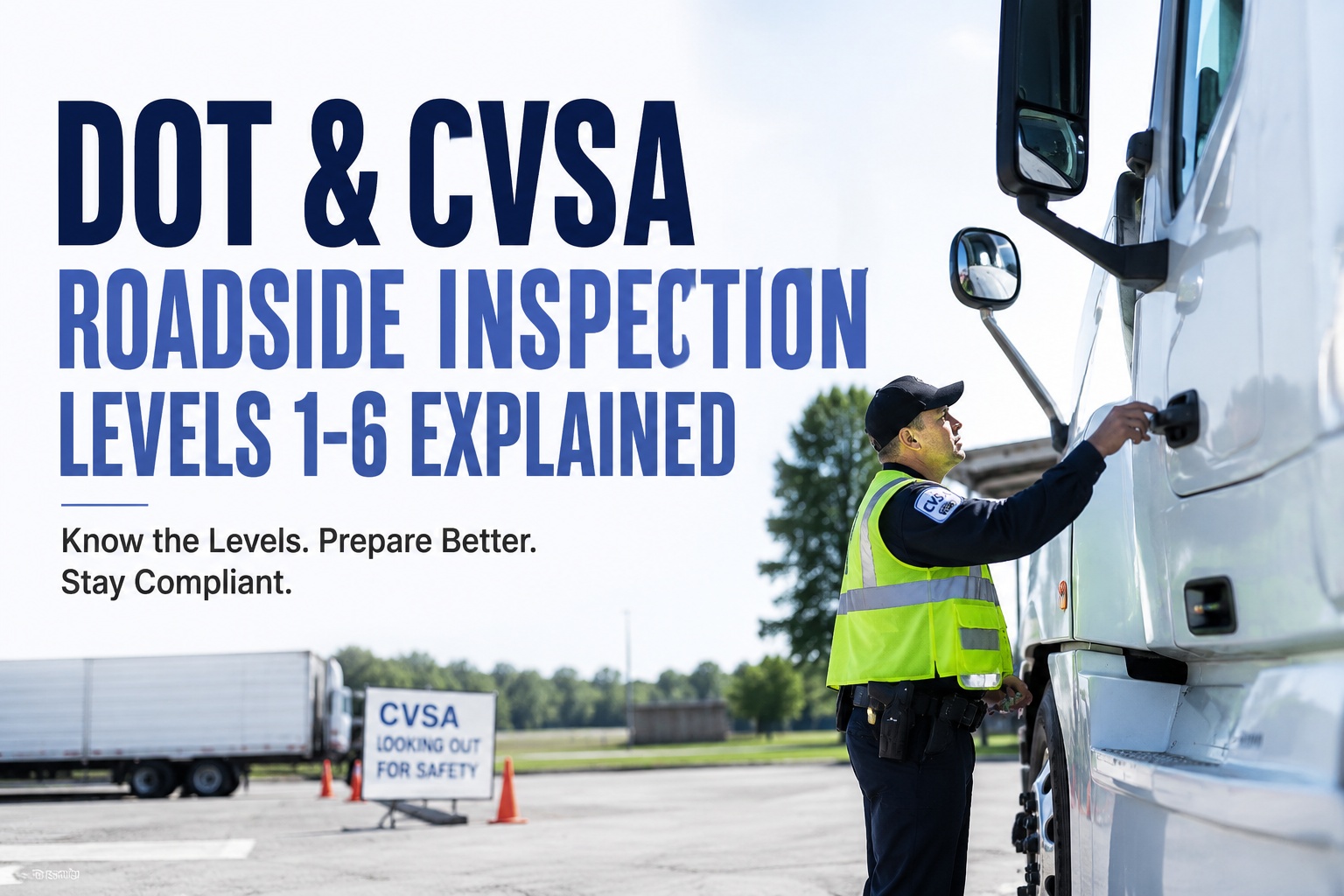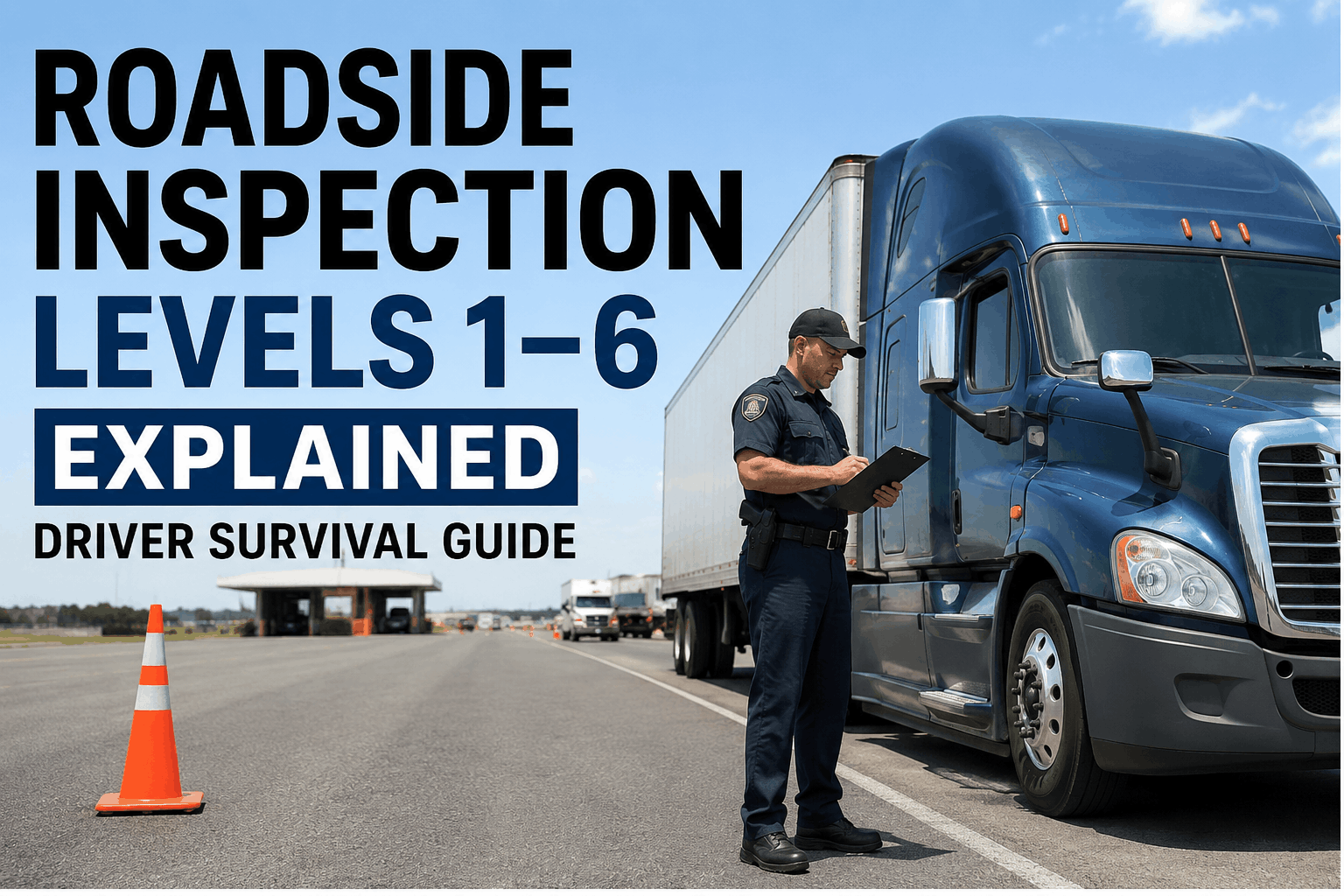
DOT inspection levels define the exact scope and depth of every roadside inspection a commercial motor vehicle faces — and understanding them is the difference between rolling through a weigh station and getting placed out of service on the shoulder. The CVSA publishes eight standardized levels, ranging from the comprehensive 37-step Level I inspection down to Level VIII electronic inspection conducted wirelessly. In 2025, roughly 4 million CMV inspections were conducted across North America, with 22.6% of vehicles and 5.9% of drivers placed out of service at the annual International Roadcheck. This page walks the six main DOT inspection levels, what each covers, how long it takes, when it triggers a CVSA decal, and the top violations inspectors find. Click any level in the interactive explorer below to see full details. Book a demo after you see how digital inspection prep changes the odds.
The 6 DOT Inspection Levels at a Glance
Every roadside stop, weigh-station check, and terminal inspection falls into one of six standardized levels. Click a card to see exactly what inspectors check, how long it takes, and whether it triggers a CVSA decal.
Beyond the six above, CVSA defines Level VII (jurisdictional-mandated programs, typically state-specific inspections for school buses and hotel shuttles) and Level VIII (electronic inspection conducted wirelessly while the vehicle is in motion). Below: what the 2025-2026 data actually shows, the top violations that put trucks out of service, how the 2026 CSA overhaul changes scoring, and the five common mistakes that guarantee failure.
The 2026 DOT inspection landscape by the numbers
Every DOT inspection level feeds the same enforcement machine — and the numbers make clear why treating any level casually is a mistake. Four data points frame the current landscape.
The pass-rate numbers tell the other side of the story: 81.6% of vehicles and 94.1% of drivers passed the 2025 Roadcheck with no OOS violations. The difference between fleets rolling through and fleets getting parked is a matter of preparation discipline. Book a demo to see per-truck inspection readiness tracked automatically
Top violations that put trucks out of service at every DOT inspection level
Whether the inspection is a Level I comprehensive or a Level II walk-around, the same handful of violation categories account for the majority of out-of-service orders. The 2025 CVSA data shows which categories to fix first.
Three categories — brakes, tires, and HOS — account for the majority of OOS orders across every DOT inspection level. Fixing them is the baseline for passing anything above Level III. Start free and target the exact violations that get trucks parked
How the 2026 CSA overhaul changes the DOT inspection stakes
Every DOT inspection outcome — clean or with violations — is reported to FMCSA and feeds directly into a carrier's Safety Measurement System (SMS) percentile. The February 2026 CSA overhaul restructures how those percentiles are calculated.
Actively improves your CSA score
Every no-violation inspection increases the fleet's "clean inspection count" without adding BASIC severity points. Fleets with high inspection volume and low violation rates see significant percentile improvements under the new formula.
Now counts 2x under the new formula
Under the 2026 overhaul, OOS violations carry a severity weight of 2 (vs. 1 for non-OOS). Violations only count for 12 months (down from 24), but the doubled severity means one OOS event drives a fleet's percentile up sharply.
The new formula rewards fleets with constant inspection readiness and penalizes fleets treating DOT inspections as occasional events. Fleets doing best have high clean-inspection volume — not the ones avoiding inspections entirely. Book a demo to see per-truck CSA impact modeling
5 common mistakes that guarantee a DOT inspection failure
Every failed DOT inspection at any level traces back to a small set of preventable mistakes. Fixing them is about matching the discipline the system expects.
Skipping or falsifying the daily DVIR
Driver marks the pre-trip DVIR "no defects" on a rushed paper form without walking around the truck. The brake air leak or worn tire that would have been caught is discovered instead by a CVSA inspector 4 hours later.
Ignoring brake adjustment intervals
Brake defects account for 41.1% of vehicle OOS violations for a reason: they drift out of spec silently between services and don't show as a warning light. A brake stroke check takes 5 minutes and prevents the top OOS trigger.
Letting tire tread drift below spec
Federal minimum tread is 4/32 on steer tires and 2/32 on other positions. Tires wear gradually, and the day the inspector's gauge reads 3/32 on a steer tire is the day the truck gets parked.
Expired credentials on the driver
Medical examiner's certificate lapsed 2 weeks ago. HAZMAT endorsement not renewed. CDL address hasn't been updated for a move. Any one of these is an instant Level III fail and can trigger escalation to Level I.
No digital record when an inspector asks
Under the 2026 CSA overhaul, a clean paper trail is worth less than a comprehensive digital record. When an FMCSA auditor requests 12 months of DVIRs and maintenance history, paper-based fleets produce partial records — and partial equals non-compliant.
Every mistake above is preventable with the right workflow. Fleets consistently passing every DOT inspection level aren't lucky — they run digital inspection discipline that catches defects before an inspector does. Book a demo to see the full workflow — or start free and get inspection-ready this week .
From a safety director on what actually changed after going digital
We were running 15-18% OOS rate at roadside — well above industry average, and it was costing us shipper contracts. Diagnosis took a while: paper DVIRs looked complete on the surface, but drivers were pencil-whipping the walk-around and defects were reaching CVSA inspectors before they reached us.
Digital inspection with mandatory photos on brakes, tires, and lighting changed the equation in one quarter. Our roadside OOS is now under 6%, our CSA percentile dropped 22 points, and we got two contracts back this year that we'd lost on safety scores.
Frequently asked questions
What are the 6 DOT inspection levels?
The six main DOT inspection levels are: Level I North American Standard (comprehensive 37-step check of driver + vehicle including under-vehicle, 45-60 minutes); Level II Walk-Around (Level I minus the under-vehicle portion, ~30 minutes); Level III Driver Credential (CDL, medical card, HOS, ELD, seat belt, ~15 minutes); Level IV Special Inspection (one-time examination of a specific component, like Brake Safety Week); Level V Vehicle-Only (full Level I vehicle checklist without driver present, at terminals); Level VI Enhanced Radioactive Shipment Inspection (Level I plus radiological survey for HRCQ shipments). CVSA also defines Level VII (state-mandated jurisdictional programs) and Level VIII (electronic inspection conducted wirelessly), for eight total. Level I is most common at International Roadcheck; Levels II and III dominate year-round enforcement; Level V is the standard annual DOT inspection.
Which DOT inspection level results in a CVSA decal?
Only three levels can issue a CVSA decal: Level I (Standard driver + vehicle), Level V (Vehicle-Only), and Level VI (Enhanced Radioactive). Levels I and V issue the standard decal, valid for three months and helping the vehicle avoid re-inspection during that window. Level VI issues a special Level VI decal. Level II inspections cover the same items as Level I but without the under-vehicle check, so they don't qualify for a decal even if the vehicle passes cleanly. Level III, IV, VII, and VIII inspections also do not result in a decal. The decal applies to the vehicle only, not the driver — a valid decal doesn't protect against a Level III driver-credential check.
What's the difference between Level 1 and Level 2 DOT inspections?
Level I is the comprehensive 37-step North American Standard Inspection covering all driver credentials plus every accessible mechanical component including under-vehicle inspection of brakes, suspension, coupling, and frame. Level II covers the same driver credentials and mechanical items, but only those visible without going under the vehicle. If a full under-vehicle inspection isn't possible, a Level I is formally downgraded to Level II. Level I takes 45-60 minutes and can result in a CVSA decal; Level II takes ~30 minutes and does not issue a decal. Both are common at weigh stations, but Level II is more frequent when throughput matters. A Level II inspector can escalate to full Level I if they spot visible problems.
How can I prepare my fleet for a DOT inspection?
Fleets that consistently pass every DOT inspection level share four preparation practices. First, treat every truck as if a Level I is coming: full pre-trip DVIR every day, digitally enforced with photo verification. Second, target the top three OOS categories directly — brakes, tires, and hours-of-service — because they account for the majority of out-of-service orders across every level. Third, maintain audit-ready digital records for 12+ months covering DVIRs, work orders, credentials, and inspection outcomes, all searchable in under 10 seconds. Fourth, automate credential expiration alerts on medical certificates, CDLs, and annual inspections at 60 days out. Fleets moving from paper to digital typically cut roadside OOS rates 40-60% within the first quarter.
Do DOT inspections affect a carrier's CSA score?
Yes, and the impact just became more pronounced. Under the February 2026 CSA overhaul, every DOT inspection outcome — clean or with violations — feeds directly into the carrier's Safety Measurement System (SMS) percentile, which shapes intervention decisions, insurance premiums, and shipper eligibility. OOS violations now carry a severity weight of 2 (up from 1), meaning one OOS event drives the percentile up sharply. The counting window has been reduced from 24 months to 12 months. Vehicle Maintenance has been split into standard and Driver Observed categories. Clean inspections actively improve the carrier's percentile by increasing inspection volume without adding severity points. Fleets that consistently pass Level I, II, and III build a percentile advantage that opens contract eligibility with safety-focused shippers.
Pass every DOT inspection level — because every truck was already ready
HVI enforces digital pre-trip and post-trip DVIR per vehicle, tracks every defect until closed with photo verification, preserves audit-ready records for FMCSA and CVSA inspections, and surfaces the violations most likely to trigger OOS. Live in under two weeks. Fleets typically cut roadside OOS rates 40–60% within the first quarter.
No credit card · No hardware · Inspection-ready day one