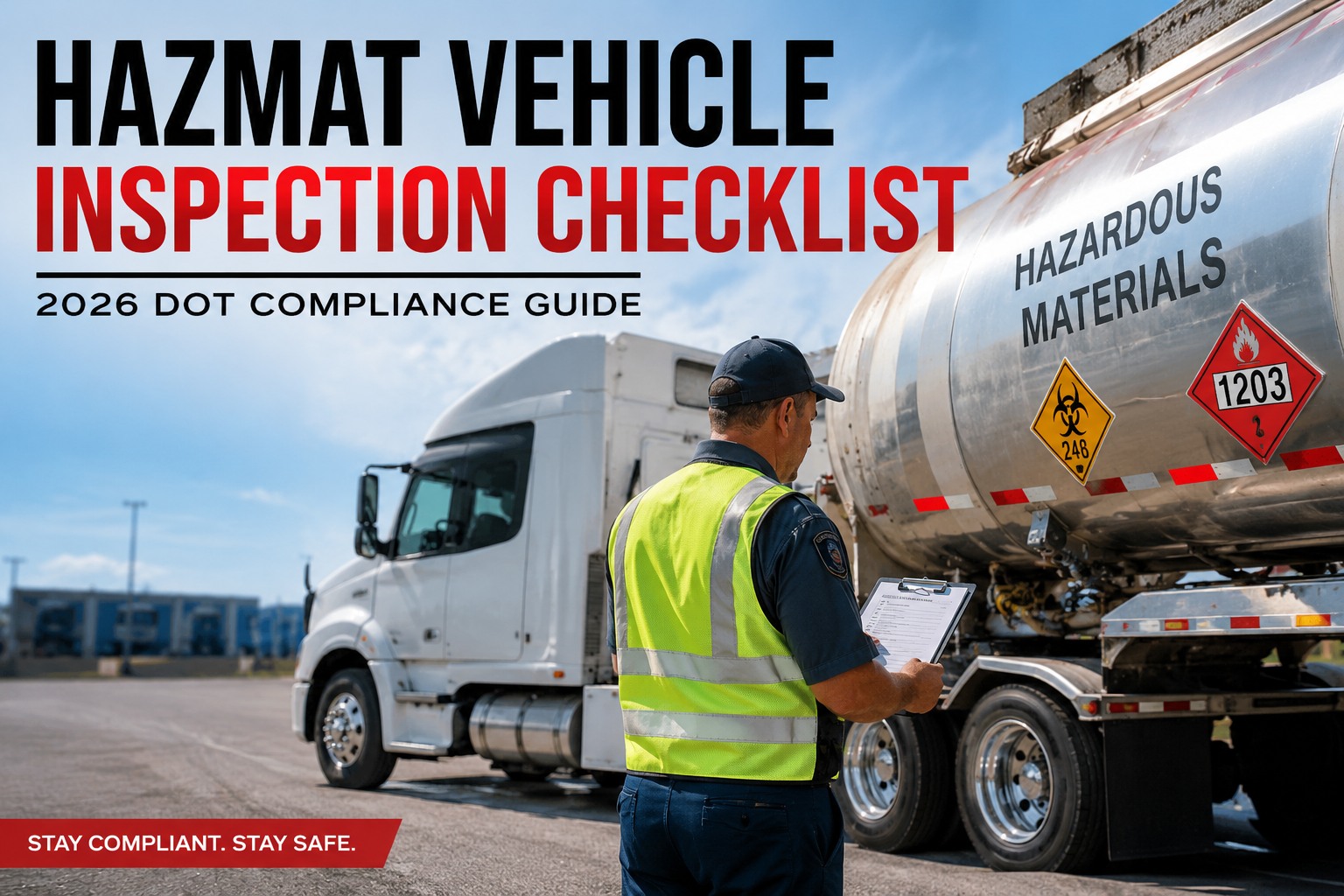
HazMat vehicle inspection checklists sit at the intersection of four separate regulatory frameworks — 49 CFR Parts 172, 173, 177, and 397 — and a single missed item can trigger fines, out-of-service orders, and PHMSA investigations. Unlike standard commercial vehicles, a HazMat inspection must simultaneously verify vehicle mechanical fitness, placard compliance, documentation completeness, emergency equipment readiness, and driver credentials including CDL Hazmat Endorsement with current TSA background check. Book an HVI demo to deploy the framework across your fleet.
Four inspection pillars. Nine hazard classes. One compliance framework.
HazMat inspections carry zero-margin regulatory exposure. Every pillar must be verified before dispatch — and every hazard class carries its own rules on top of the general framework.
Standard DVIR per 49 CFR 396.13 plus HazMat-specific mechanical items. Brakes, tires, lighting checked with heightened scrutiny.
All 4 sides placarded per 49 CFR 172. UN/NA numbers visible. Color, symbol, class match cargo. Placards secure & undamaged.
Shipping papers within driver reach. Emergency Response Guidebook (ERG) onboard. CDL HME current. TSA background verified.
Fire extinguisher rated for load. Spill kit & sorbent. PPE. Incompatible classes segregated per 49 CFR 177.848.
The regulatory stack — 49 CFR Parts 171-180 explained
Standard commercial vehicle inspection runs under FMCSA jurisdiction via 49 CFR Parts 390-396. HazMat inspection adds a second layer under PHMSA (Pipeline and Hazardous Materials Safety Administration) via 49 CFR Parts 171-180 — the Hazardous Materials Regulations (HMR). Both jurisdictions enforce simultaneously. Understanding which CFR part governs which inspection item is the difference between a compliant inspection and a citation the driver didn't see coming.
Defines placard requirements, marking, labeling, shipping paper preparation, and emergency response information. This is where the 9 hazard class placard specifications originate.
Packaging authorization, quantity limits per package, and shipper obligations. The shipper must certify compliance before the carrier accepts the load — but the driver verifies.
Loading, unloading, and segregation requirements. Section 177.848 is the segregation table — the master compatibility chart that determines which classes can be loaded together.
Attendance requirements (§397.5), parking restrictions (§397.7), route selection (§397.11), smoking prohibitions (§397.13). Fines under 397 stack on top of any Part 172-177 violations found.
Training obligations under 49 CFR 172.704 require refresher every 3 years for all hazmat employees — not just drivers. Missing training records is one of the most-cited HazMat carrier violations at compliance reviews. Book an HVI demo to see training-record tracking automated across your workforce
Pillar 01 — Vehicle pre-trip (with HazMat overlay)
The standard DVIR under 49 CFR 396.13 covers all commercial vehicles. HazMat overlays additional scrutiny: the same brake failure or lighting defect that would earn a citation on a dry van becomes an immediate out-of-service order on a HazMat load. Fleets that pass general DVIR checks routinely fail HazMat pre-trip because they don't recalibrate to the elevated standard.
- Service brakes: no leaks, full function verified
- Parking brake tested with full engine power
- Tires: no cuts to sidewall, tread above legal min
- Lights: all functional, no cracked lenses
- Exhaust system: no leaks that could contact cargo
- Fuel system: no leaks, tank cap sealed
- Tank integrity (bulk loads): no dents, damage, corrosion
- Cargo tank vents functional if applicable
- Manway covers secured, gaskets intact
- Load compartment clean, no residue from prior load
- Cargo securement rated for hazmat load type
- Placards holders undamaged, spring-loaded if applicable
Pre-trip inspection under 49 CFR 397.11 must also verify the driver is thoroughly familiar with the regulations, the specific hazards of the cargo being transported, and the emergency response procedures. This isn't a checkbox — roadside inspectors will ask HazMat drivers specific questions about their load and expect knowledgeable answers. Book an HVI demo to see HazMat pre-trip templates that build the required driver knowledge check into daily workflow.
Pillar 02 — Placards & marking verification
Placards are the highest-visibility HazMat compliance item and the most-cited violation category at roadside inspection. 49 CFR Part 172 mandates placards on all four sides of the vehicle, minimum 10.8 inches per side, with UN/NA identification numbers displayed when required by the specific class and quantity of material transported. Wrong placard, missing placard, damaged placard, or placard color/symbol mismatch to actual cargo all trigger immediate out-of-service.
Placards required on front, rear, and both sides of the vehicle or transport unit. Missing placard on any side = OOS. Walk around the vehicle before dispatch and photo-document each side.
The placard color, hazard symbol, and class number must match the material being transported per the shipping paper classification. Class 3 flammable liquid placard on a Class 8 corrosive load is a serious violation.
Specific materials and quantities require the UN/NA identification number displayed on or below the placard. Bulk packaging above certain thresholds always requires UN/NA display. Verify per 49 CFR 172.332.
Placards must be legible, undamaged, and securely attached. Faded, torn, sun-damaged, or loose placards fail inspection. Placard holders must hold placards in the required orientation without flapping in wind.
Placard changes during multi-drop delivery routes create the classic HazMat compliance failure: the driver removes the placard after unloading a class but forgets to update the display for the next remaining class. Multi-drop hazmat routes require placard verification at every stop, not just at initial dispatch. Try HVI free to deploy per-stop placard verification workflows.
Pillar 03 — Documentation stack
HazMat documentation is where paper-based operations fail most often. The required paperwork must be immediately accessible to the driver during transport and immediately producible during any inspection or emergency. Location matters: shipping papers must be within the driver's reach or stored in a driver's door pouch, not buried in the sleeper or under a seat.
Per 49 CFR 177.817, shipping papers must be within driver's reach while restrained by seat belt, or in driver's door pouch, or on driver's seat if driver is out of vehicle. Buried in sleeper or in glove box behind items = violation.
Current edition ERG must be onboard. The most recent edition is the reference; older editions fail. Emergency contact info in shipping papers must connect to a real 24-hour-monitored line, not voicemail.
Driver CDL must show current H or X endorsement. Endorsement requires renewed TSA Security Threat Assessment every 5 years. Expired HME during transport = immediate OOS plus driver-level violations.
Every HazMat employee must be trained on general awareness, function-specific, safety, and security awareness within 90 days of employment and refresher every 3 years. Training records retained for the duration of employment plus 90 days.
Training records are the most-cited documentation gap at PHMSA compliance reviews. The requirement covers not just drivers but also loaders, dispatchers, shipping paper preparers, and anyone whose function affects HazMat transportation safety. Fleets often overlook non-driver staff. Try HVI free to centralize training records across all HazMat employees in one automated system.
Pillar 04 — Emergency equipment & segregation
Emergency preparedness under 49 CFR Part 397 requires specific equipment matched to the cargo class transported. Segregation under 49 CFR 177.848 defines which hazard classes cannot be loaded together on the same vehicle. Both are frequent inspection focus items and both drive OOS orders when found deficient.
- Fire extinguisher rated for load class (10 lb+ typical hazmat)
- Spill cleanup kit sized for potential release
- Sorbent materials matched to cargo type
- PPE: gloves, eye protection, respirator if required
- Emergency contact numbers & ERG onboard
- Reflective triangles (fusees prohibited for flammable loads)
- Segregation table consulted before loading
- Incompatible classes not loaded together
- Separation distances maintained per table
- Blocking & bracing prevents contact during transit
- Cargo compartment cleared of residue from prior load
- Load plan documented for multi-class shipments
Attendance requirements under 49 CFR 397.5 require the driver to remain within 100 feet of the vehicle at rest stops for most hazmat loads. Parking restrictions under 49 CFR 397.7 limit where hazmat vehicles can park — not within 300 feet of buildings for placarded loads with certain classes. Smoking within 25 feet of a hazmat vehicle carrying flammables violates 49 CFR 397.13. These aren't obscure rules; roadside inspectors verify attendance and parking positioning as part of any hazmat stop.
From a compliance officer running 62 hazmat units across chemical & fuel distribution
Our compliance review two years ago hit us hard. PHMSA looked at three months of paper hazmat pre-trips. Missing training records for 8 warehouse loaders. Placard photo evidence: none. Segregation documentation on mixed loads: none. We paid a five-figure fine plus a corrective action plan we had 90 days to complete.
Deployed HVI with the four-pillar hazmat template. Photo evidence on placards at dispatch and after every drop. Training records auto-tracked for every hazmat employee, not just drivers. Segregation table built into the load-planning workflow. Next compliance review: zero findings. Zero fines. The compliance officer said our records were among the cleanest they'd seen. Four pillars, one platform, one week to deploy — and no more sleepless nights before every PHMSA visit.
Frequently asked questions
What is required in a HazMat vehicle inspection?
A HazMat vehicle inspection combines four inspection pillars that must all pass before dispatch. Pillar 1 — Vehicle Pre-Trip: standard DVIR per 49 CFR 396.13 covering brakes, tires, lighting, coupling, and cab safety, plus hazmat-specific mechanical items including tank integrity (for bulk loads), cargo tank vents, manway covers and gaskets, load compartment cleanliness, and placard holder condition. Pillar 2 — Placards and Marking: placards required on all four sides of the vehicle per 49 CFR 172, minimum 10.8 inches per side, with correct class/color/symbol matching cargo, UN/NA numbers where required, and legible, undamaged, securely-attached condition. Pillar 3 — Documentation: shipping papers within driver's reach per 49 CFR 177.817, current Emergency Response Guidebook (ERG) onboard, CDL with current Hazmat Endorsement (HME), and training records per 49 CFR 172.704. Pillar 4 — Emergency Equipment and Segregation: fire extinguisher rated for load class, spill cleanup kit and sorbent materials matched to cargo type, appropriate PPE, and cargo segregation per the 49 CFR 177.848 segregation table verifying incompatible hazard classes are not loaded together. Beyond the four pillars, drivers must be prepared to demonstrate familiarity with the specific hazards of the cargo, emergency response procedures, and the routing restrictions under 49 CFR 397.11. Inspectors regularly test driver knowledge with specific questions about the load being carried.
What documents must a HazMat driver carry?
HazMat drivers must carry a specific documentation stack accessible during transport and immediately producible at any roadside inspection. Shipping papers are the primary hazmat document: they must be prepared by the shipper per 49 CFR 172.202-202, contain proper shipping name, hazard class, UN/NA identification number, packing group, and total quantity, plus emergency contact information routing to a real 24-hour-monitored phone line. Under 49 CFR 177.817, shipping papers must be within the driver's reach while restrained by seat belt, in the driver's door pouch, or on the driver's seat when the driver is out of the vehicle. Emergency Response Guidebook (ERG): the most current edition must be onboard, typically stored with the shipping papers. The ERG provides immediate action guidance for first responders during an incident. CDL with Hazmat Endorsement (HME): the driver's CDL must display the H endorsement (for tank vehicle plus hazmat, X endorsement is used). HME requires a TSA Security Threat Assessment renewed every 5 years. Medical examiner's certificate and Clearinghouse status must be current. Training certification records demonstrating compliance with 49 CFR 172.704 training requirements (general awareness, function-specific, safety, and security awareness training within 90 days of employment, refresher every 3 years). Route documentation for specific hazmat classes with routing restrictions, particularly explosives (Class 1) and radioactives (Class 7) which have designated route requirements. Missing any of these documents at inspection produces immediate driver OOS orders.
What are the placarding requirements for HazMat vehicles?
HazMat placarding requirements are defined in 49 CFR Part 172, Subpart F. Placards must be displayed on all four sides of the vehicle or transport unit: front, rear, and both sides. Each placard must be a minimum of 10.8 inches on each side (diamond-shaped), with the specified color, hazard class number, and symbol matching the material transported. Placards must be visible from the direction they face, legible from a reasonable distance, and securely attached to the vehicle so they don't flap or dislodge during transit. UN/NA identification numbers are required on or immediately below the placard in specific circumstances: for bulk packaging above 3,500 pounds, for certain material types regardless of quantity, and for tank vehicles transporting listed materials. The 9 hazard classes each have their own placard specifications: Class 1 Explosives (orange), Class 2 Gases (varies by subclass), Class 3 Flammable Liquids (red), Class 4 Flammable Solids (varies), Class 5 Oxidizers and Organic Peroxides (yellow), Class 6 Toxic and Infectious Substances (white), Class 7 Radioactive (yellow-white), Class 8 Corrosives (black-white), Class 9 Miscellaneous (black-white striped). Multi-class loads may require multiple placards or a Dangerous placard depending on quantities and specific class combinations. Placards must be updated whenever the load composition changes at intermediate stops. Wrong placard, missing placard on any side, damaged or faded placards, or color/symbol/class mismatch to actual cargo all produce immediate out-of-service orders and stackable violations under both PHMSA and FMCSA authority.
How often does HazMat training need to be renewed?
HazMat training requirements under 49 CFR 172.704 apply to all hazmat employees, not just drivers. Every hazmat employee must receive initial training within 90 days of their first hazmat-related work activity, with a refresher required every 3 years thereafter. The training must cover four specific areas: general awareness/familiarization (the HMR requirements and hazmat identification), function-specific training (specific to the employee's role, such as loading, driving, or documentation preparation), safety training (including emergency response and personal protection), and security awareness training (recognizing and responding to security threats). Employees performing loading and unloading, packaging, marking, labeling, placarding, shipping paper preparation, driving, or any function affecting hazmat safety are all covered by this requirement. This is where many carriers get caught at PHMSA compliance reviews: they track driver training carefully but overlook warehouse loaders, dispatch personnel who prepare shipping papers, and other non-driver staff whose training is equally required. Training records must document the employee's name, training completion date, description of training content, and name and address of the person providing training. Records must be retained for the duration of the employee's hazmat employment plus 90 days afterward. Modern fleet compliance platforms track training records automatically with expiration alerts and audit-ready record retention — a significant operational advantage over paper training files that get lost between HR and safety departments.
Can digital inspection software replace paper HazMat records?
Yes — digital HazMat inspection records are compliant under current FMCSA and PHMSA regulations and are now the operational standard for any carrier serious about compliance. FMCSA finalized electronic DVIR creation, maintenance, and signature under updated 49 CFR 396.11 language. PHMSA does not prescribe a specific record format but requires records be retrievable and legible; digital records satisfy both requirements more effectively than paper. Digital HazMat inspection platforms produce four structural advantages over paper systems. First, photo evidence on placards, shipping papers, emergency equipment, and cargo securement creates a timestamped audit trail that paper signatures cannot match. Second, training records for all hazmat employees can be centralized in one system with automated expiration alerts — solving the most-cited PHMSA compliance gap. Third, segregation table validation can be automated at load planning: the system flags incompatible class combinations before loading rather than after the load is on the road. Fourth, PHMSA compliance reviews and roadside inspection responses can be produced in seconds rather than the multi-day paper searches that typically follow a review request. Fleets transitioning from paper to digital HazMat platforms typically report significant reductions in placard violations (30-50% in the first quarter), documentation citations (60-80% reduction), and training-record gaps (near elimination). PHMSA compliance review outcomes shift from "corrective action required" to "zero findings" within the first year of digital adoption. Deployment for a hazmat-focused fleet typically completes in 5-7 days.
HazMat inspection compliance — deployed in 5-7 days, sleep well every night.
HVI ships with pre-built HazMat templates covering all four inspection pillars. Photo evidence on placards, shipping papers, emergency equipment, and segregation. CDL HME expiration alerts. Training records automated per 49 CFR 172.704 for all hazmat employees. PHMSA compliance history retrievable in seconds. Live for your fleet in 5-7 days.
49 CFR Parts 172-177-397 aligned · PHMSA HMR compliant · TSA HME tracking · SOC 2 Type II