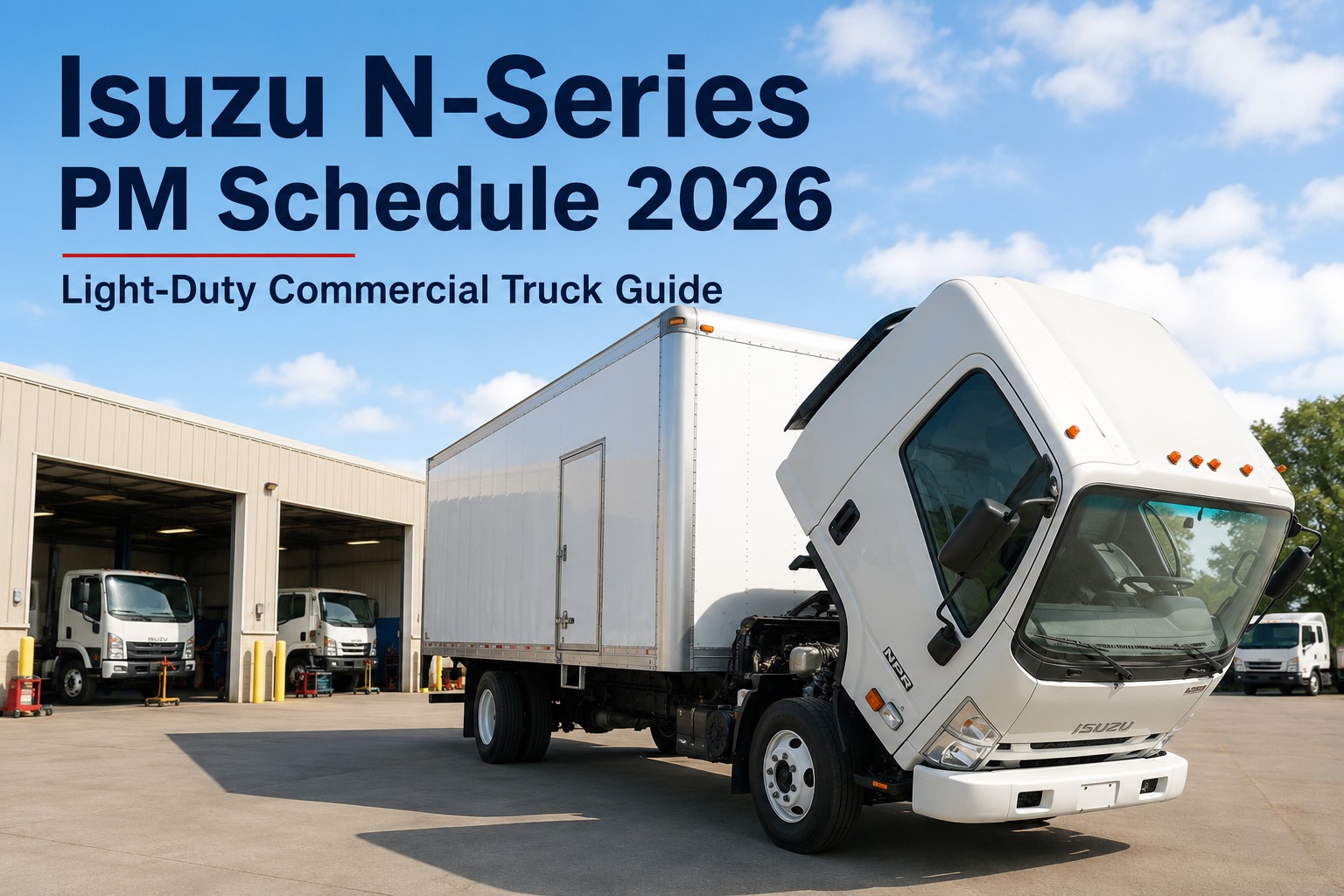
Your Isuzu N-Series PM schedule looks simple on paper — oil at 10,000 miles, filters at 15,000, drivetrain at 50,000. But stop-and-go delivery duty compresses those intervals hard. An NPR idling 4 hours a day hits engine-wear thresholds long before the odometer says so, and a $180 oil change you delayed becomes a $6,000 DPF rebuild. This guide maps every interval by miles and hours, and shows how to automate the whole thing. Book a demo to see it live.
Isuzu N-Series PM Schedule: The Complete Interval Map
Five service tiers. One staircase. Every mile and hour interval your fleet needs to track.
That staircase is the skeleton of every N-Series PM program. But the intervals above assume normal driving conditions — steady highway miles, moderate climate, minimal idling. Delivery fleets almost never operate under those conditions. Below is how to read the schedule for the way your trucks actually run, model by model, system by system.
NPR, NQR, NRRwhich model needs what — and why it matters
The Isuzu N-Series lineup spans Class 3 through Class 5 — three weight classes, two powertrains, and significantly different duty cycles. Understanding which model you're scheduling for determines whether a 10,000-mile oil interval is conservative, appropriate, or dangerously optimistic.
The critical detail most PM spreadsheets miss: on diesel N-Series models, Isuzu specifies oil change intervals in both miles and engine hours. The owner's manual recommends 10,000 miles for diesel models under normal conditions — but also flags that trucks operating under "unusual conditions" like frequent short trips, extended idling, or dusty environments need shorter intervals. An NQR doing refrigerated urban delivery with 8 hours of daily idle can accumulate 11,000 engine hours on just 75,000 odometer miles — the engine wear equivalent of nearly 300,000 highway miles. If you're scheduling PM by mileage alone on that truck, you're servicing at roughly one-third the frequency the engine actually needs. Book a demo to see dual-trigger PM (miles + hours) set up for your fleet
The Full Isuzu N-Series PM Scheduleevery interval, every system, one table
Below is the consolidated preventive maintenance schedule for Isuzu N-Series diesel models (NPR-HD, NPR-XD, NQR, NRR) based on Isuzu's published owner's manual recommendations and the Priority Service Maintenance Program (PSMP) framework. Gas-powered NPR and NPR-HD models follow similar intervals with 7,500-mile oil changes instead of 10,000.
| System / Component | 10K mi | 15K mi | 30K mi | 50K mi | 100K mi |
|---|---|---|---|---|---|
| Engine oil + filter | ✓ | ✓ | ✓ | ✓ | ✓ |
| Brake pads + rotors inspect | ✓ | ✓ | ✓ | ✓ | ✓ |
| Tire inspect + torque studs | ✓ | ✓ | ✓ | ✓ | ✓ |
| Grease king pins + propshaft | ✓ | ✓ | ✓ | ✓ | ✓ |
| Leak inspection (all systems) | ✓ | ✓ | ✓ | ✓ | ✓ |
| Fuel filter replace | — | ✓ | ✓ | ✓ | ✓ |
| Tire rotation + stud torque | — | ✓ | ✓ | ✓ | ✓ |
| Suspension + exhaust inspect | — | ✓ | ✓ | ✓ | ✓ |
| Air filter replace | — | — | ✓ | ✓ | ✓ |
| Wiper blades replace | — | — | ✓ | — | ✓ |
| Electrical + pressure sensors | — | — | ✓ | ✓ | ✓ |
| Transmission fluid replace | — | — | — | ✓ | ✓ |
| Differential fluid replace | — | — | — | ✓ | ✓ |
| Coolant drain + replace | — | — | — | ✓ | ✓ |
| Valve lash adjust + EGR gaskets | — | — | — | ✓ | ✓ |
| Wheel bearings repack + seals | — | — | — | ✓ | ✓ |
| A/C filter clean (inside + out) | — | — | — | ✓ | ✓ |
| DPF cleaning + sensor adjust | — | — | — | — | ✓ |
| DEF supply pump filter | — | — | — | — | ✓ |
| Exhaust injector inspect/replace | — | — | — | — | ✓ |
Scroll right to see all intervals · Source: Isuzu owner’s manual + PSMP framework
The table above covers normal operating conditions. Isuzu explicitly calls out several conditions that shorten these intervals: dusty environments (common for landscape and construction upfits), extended idling (reefer trucks and food service), and frequent short trips under 10 miles (virtually every urban delivery route). Under those conditions, oil changes should happen at roughly 7,500 miles or 200 engine hours — whichever comes first. Fuel filters may need replacement at every oil service rather than every 15,000 miles. Start free — HVI lets you set dual-trigger PMs by miles and hours on every unit
Why Hours Beat Milesthe hidden interval problem on delivery trucks
Here's the number that catches most delivery fleet managers off guard: a typical urban delivery truck idles 3 to 5 hours per day. Over a 250-day work year, that's 750 to 1,250 hours of engine-on time that the odometer doesn't register at all. Maintenance cost on last-mile delivery fleets accounts for roughly 20% of total operating expense — and a significant chunk of that cost comes from services performed too late because the schedule was tracking miles only.
The 4HK1 turbodiesel in the NQR and NRR is a robust engine — Isuzu has been refining it for decades — but it's not immune to the thermal cycling and incomplete combustion that sustained idle produces. Low exhaust temperatures during idle prevent the DPF from reaching regeneration temperature (roughly 1,100°F). Soot accumulates. The truck starts throwing P2463 (high soot) and P244B (high differential pressure) codes. At that point you're looking at a forced regeneration that may not complete, or a DPF pull-and-clean that runs $2,000 to $4,000 depending on your market. A DPF replacement on an N-Series can hit $6,000 to $8,000. Book a demo — see how HVI tracks engine hours against DPF health indicators
The Aftertreatment TaxDPF, DEF, and SCR maintenance on the 4HK1
Every diesel N-Series truck built after 2010 uses Selective Catalytic Reduction (SCR) with Diesel Exhaust Fluid (DEF) to meet EPA emissions standards. The aftertreatment system is the single most expensive maintenance line item on the truck after the engine itself — and it's the one most directly punished by missed or delayed PM.
Service at 100,000 miles — or sooner if soot load codes appear. Pull, clean, and reinstall runs $2,000–$4,000. Full replacement: $6,000–$8,000. Idle-heavy trucks may need cleaning as early as 60,000–70,000 miles.
DEF consumption runs roughly 2–3% of diesel fuel consumed. The DEF supply pump filter is serviced at 100,000 miles. If the truck runs out of DEF and the driver ignores dash warnings, the engine enters a performance-restricted mode and will eventually refuse to restart.
Inspected and replaced at 100,000 miles. Carbon buildup around the injector tip is the primary failure mode — when the injector can't atomize properly, forced regeneration fails and DPF replacement follows. Book a demo to see aftertreatment health tracked in HVI
The aftertreatment system is where skipped oil changes and ignored engine-hour triggers compound into five-figure repair bills. Clean oil produces cleaner combustion, which produces less particulate matter, which keeps the DPF healthier longer. Every missed oil service accelerates soot loading. It's a chain reaction — and the only way to break it is a PM schedule that actually triggers on engine condition, not just calendar or odometer.
Severe Duty Intervalswhen standard schedules aren't enough
Isuzu's owner's manual defines "unusual operating conditions" that require accelerated PM. If your N-Series trucks check any of these boxes, you should be running shortened intervals — and most delivery and service fleets check at least two or three.
Reefer units, food trucks, mobile service vehicles. Oil degrades faster; DPF soot builds. Cut oil interval to 7,500 mi / 200 hrs.
Urban parcel delivery, catering routes. Engine never fully warms up; moisture contaminates oil. Replace fuel filter every oil service.
Landscaping, agricultural supply, construction upfits. Air filter clogs faster; intake restriction stresses turbo. Inspect air filter at every oil service.
Near-GVWR operations (beverage, building materials). Brake wear accelerates; wheel bearings load up. Inspect brakes at every 7,500 miles, not 10,000.
The gap between "normal" and "severe" isn't academic. Isuzu dealers report that trucks operating in severe-duty conditions without adjusted intervals are two to three times more likely to need a premature DPF service or turbocharger repair. Setting up dual-trigger PM schedules — miles and hours — with condition-specific adjustments for each unit is the difference between proactive maintenance and reactive repair bills. Start free — configure severe-duty PM rules per truck in HVI
From a delivery fleet manager who switched to hours-based scheduling
We had 14 NQRs doing furniture delivery — averaging maybe 80 miles a day but 9 hours of engine-on time between idle at docks and slow residential streets. We were changing oil every 10,000 miles like the book says, which worked out to roughly every 5 months. When we pulled an oil sample at 8,000 miles, the lab flagged it as critically degraded — viscosity breakdown, high soot loading, the works.
We moved to a 250-hour trigger using our CMMS and the interval dropped to about every 7 weeks. Parts cost went up maybe $400 a year per truck. But our first DPF regen failure cost us $3,200 in shop time and downtime. After the switch, we haven't had a single aftertreatment code in 14 months. The math isn't even close.
Automating Isuzu N-Series PMhow HVI replaces spreadsheets and sticky notes
Knowing the intervals is the easy part. Executing them consistently across 10, 20, or 50 trucks — each running different daily miles, different idle hours, and different body configurations — is where the PM program either holds together or falls apart. Here's what the workflow looks like when it's automated in HVI versus managed manually.
Configure each N-Series truck with its own PM schedule — 10,000 miles for highway-duty NPRs, 7,500 miles or 250 hours for idle-heavy NQRs. HVI watches both counters and triggers on whichever comes first.
When a threshold hits, HVI creates the work order with the correct task list for that interval tier (oil only at 10K, oil + fuel filter at 15K, full drivetrain at 50K). No manual lookup, no forgetting what's due.
The work order arrives with the Isuzu-specific inspection checklist attached. Assign it to your in-house tech or the dealer shop — they complete the checklist digitally on a phone or tablet. Book a demo to see the mobile inspection flow
Log parts consumed (oil filter, fuel filter, DEF filter), update inventory counts, and close the work order. HVI resets the PM counter and starts the clock for the next service window automatically.
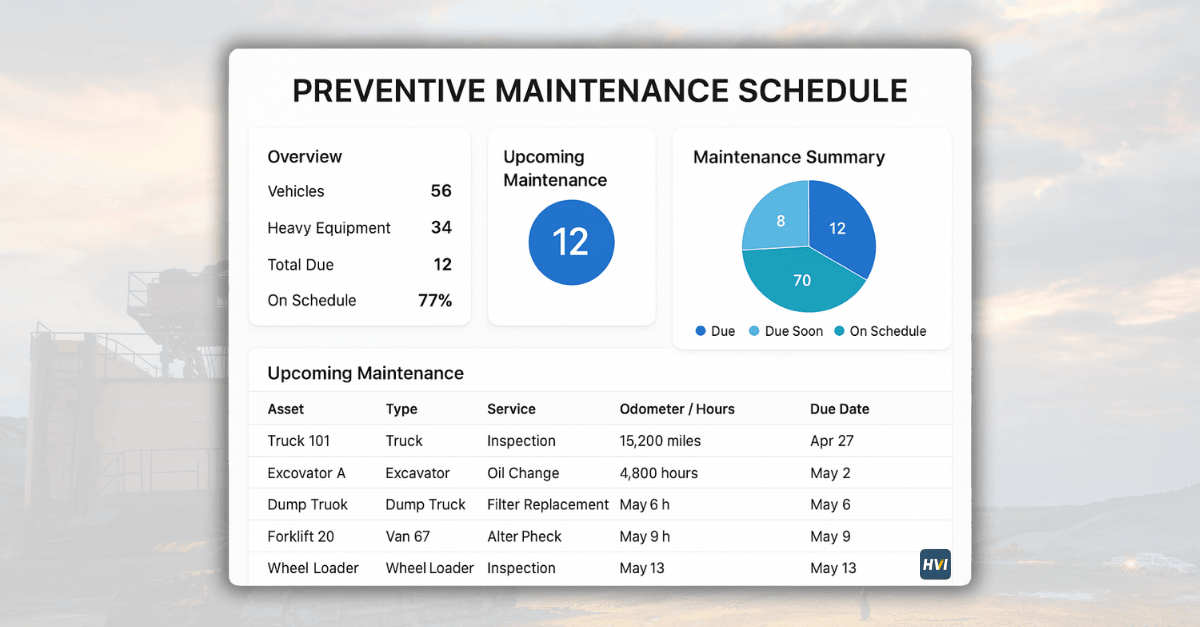
The result: every N-Series truck in your fleet has a live PM status — green (current), yellow (approaching), red (overdue) — visible on a single dashboard. No truck slips through the cracks because a spreadsheet row got accidentally deleted or an engine-hour reading wasn't logged.
Frequently asked questions
How often should I change oil on an Isuzu NPR diesel?
Isuzu recommends oil and filter changes every 10,000 miles for diesel N-Series models (NPR-HD, NPR-XD, NQR, NRR) under normal operating conditions. Gas-powered NPR and NPR-HD models use a 7,500-mile interval. However, trucks operating under severe-duty conditions — extended idling, frequent short trips under 10 miles, dusty environments, or near-GVWR loading — should shorten that interval to approximately 7,500 miles or 200–250 engine hours, whichever comes first. Most urban delivery fleets fall into the severe-duty category whether they realize it or not, because stop-and-go routes with significant idle time at loading docks accumulate engine hours far faster than the odometer suggests. Using a CMMS like HVI to track both miles and engine hours ensures the oil gets changed when the engine actually needs it, not when a calendar reminder fires.
What is included in the Isuzu N-Series 50,000-mile service?
The 50,000-mile service on an Isuzu N-Series diesel is the most comprehensive scheduled maintenance event before the 100,000-mile DPF service. It includes everything from the 10K, 15K, and 30K intervals (oil and filter change, brake inspection, fuel filter replacement, air filter replacement, tire rotation, suspension and exhaust inspection, electrical system check) plus several major additional items: transmission fluid replacement, differential fluid replacement, engine coolant drain and replacement, valve lash adjustment with EGR gasket replacement, front wheel bearing repack and seal replacement, A/C filter cleaning (inside and outside), fan blade and fan clutch inspection, and steering gear box torque check. This service typically takes a full shop day and represents the highest single-visit parts and labor cost in the regular PM cycle. Skipping or delaying the 50K service is one of the most common causes of premature transmission wear and coolant system failures on high-mile N-Series trucks.
How often does the DPF need cleaning on an Isuzu NQR or NRR?
Isuzu schedules DPF cleaning at 100,000 miles under normal conditions. However, trucks that operate in heavy-idle or short-trip duty cycles — which describes most urban delivery and refrigerated operations — may need DPF service as early as 60,000 to 70,000 miles. The DPF relies on exhaust temperatures exceeding roughly 1,100°F to complete passive regeneration cycles. Sustained idle keeps exhaust temperatures well below that threshold, causing soot to accumulate faster than the system can burn it off. Common warning signs include P2463 (high soot accumulation), P244B (high differential pressure), and P2459 (regeneration frequency) diagnostic codes. A pull-and-clean service typically costs $2,000 to $4,000, while a full DPF replacement can reach $6,000 to $8,000. Tracking engine hours and monitoring regeneration completion rates through a CMMS helps predict when the DPF will need attention before emergency codes appear.
What happens if I skip the Isuzu N-Series PM schedule?
Skipping PM intervals on an Isuzu N-Series creates a compounding failure chain. A missed oil change leads to increased soot and particulate in combustion, which accelerates DPF loading. A clogged DPF triggers more frequent forced regenerations, which stresses the exhaust injector and aftertreatment system. A failed exhaust injector means regeneration can't complete at all, forcing a DPF pull-and-clean or replacement — a repair that can easily exceed $4,000 to $8,000 in parts and labor. Beyond the aftertreatment system, skipped transmission and differential fluid changes lead to premature gear wear, delayed coolant replacement causes corrosion and water pump failure, and neglected valve lash adjustment degrades engine performance and fuel economy. On delivery fleets where a single truck out of service costs $500 to $1,000 per day in lost revenue and rescheduled stops, the downstream cost of a skipped $180 oil change can multiply by 20 to 40 times within 6 to 12 months.
Can I use a CMMS to automate Isuzu N-Series PM scheduling?
Yes — and for delivery fleets running multiple N-Series trucks, a CMMS is the most reliable way to prevent missed intervals. A platform like HVI (Heavy Vehicle Inspection) lets you configure PM schedules by both mileage and engine hours on each individual truck, automatically generate work orders when either threshold is reached, attach OEM-specific inspection checklists to each service event, track parts consumed and inventory levels, and maintain a complete digital service history per unit. The dual-trigger capability (miles plus hours) is particularly important for N-Series delivery fleets where idle time can add 50% or more to effective engine wear beyond what the odometer shows. HVI also supports preventive maintenance for mixed fleets, so if you're running Isuzu N-Series alongside Freightliner, Hino, or other brands, every unit's PM schedule lives in one system with one dashboard.
Your Isuzu N-Series PM schedule, running on autopilot
Set the intervals once. HVI watches both odometer and engine hours on every truck, generates work orders at the right time, attaches the correct checklist, and tracks every part consumed. No spreadsheets. No missed services. No surprise aftertreatment bills. Live in under two weeks.
No credit card · No hardware required · Works with any telematics provider