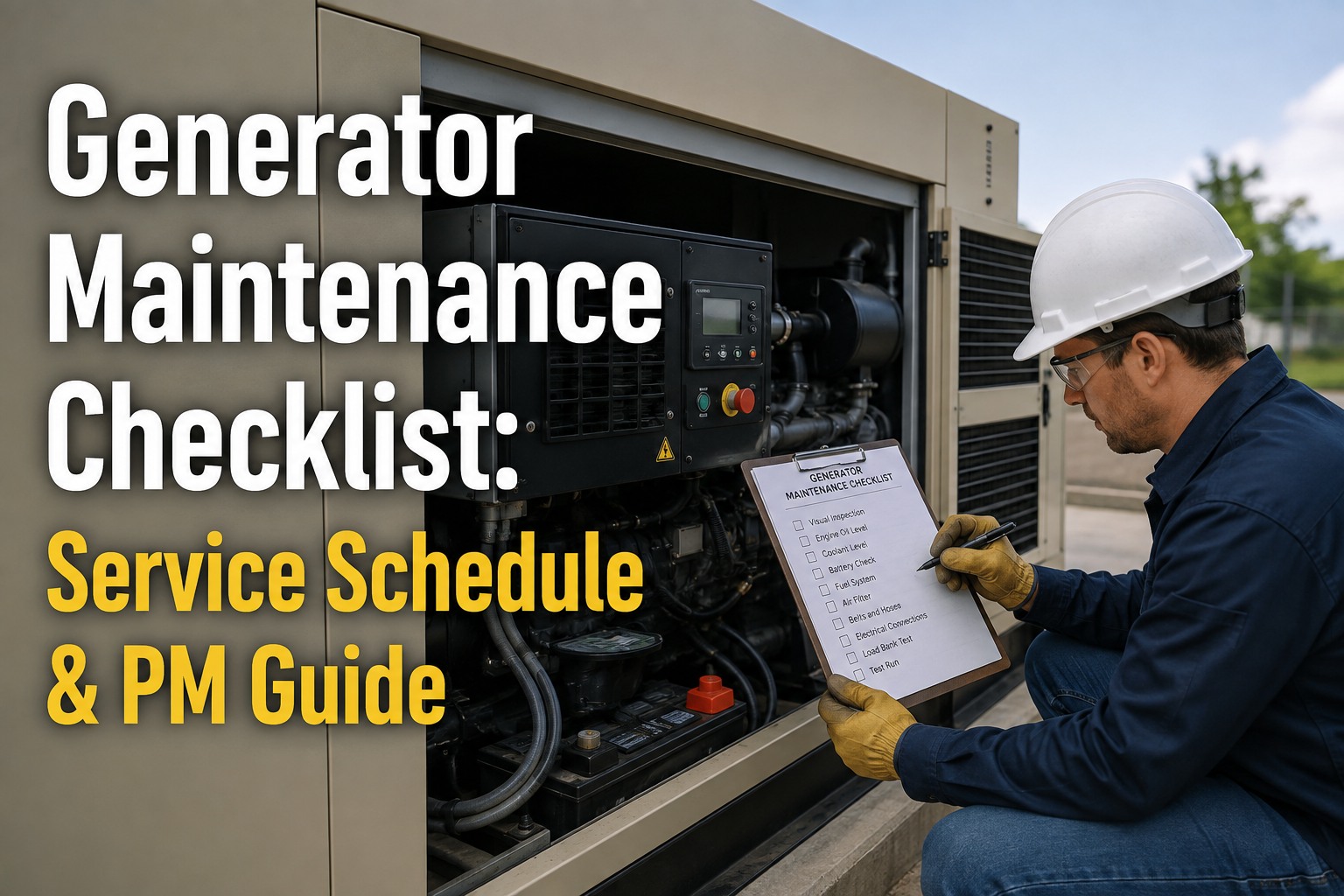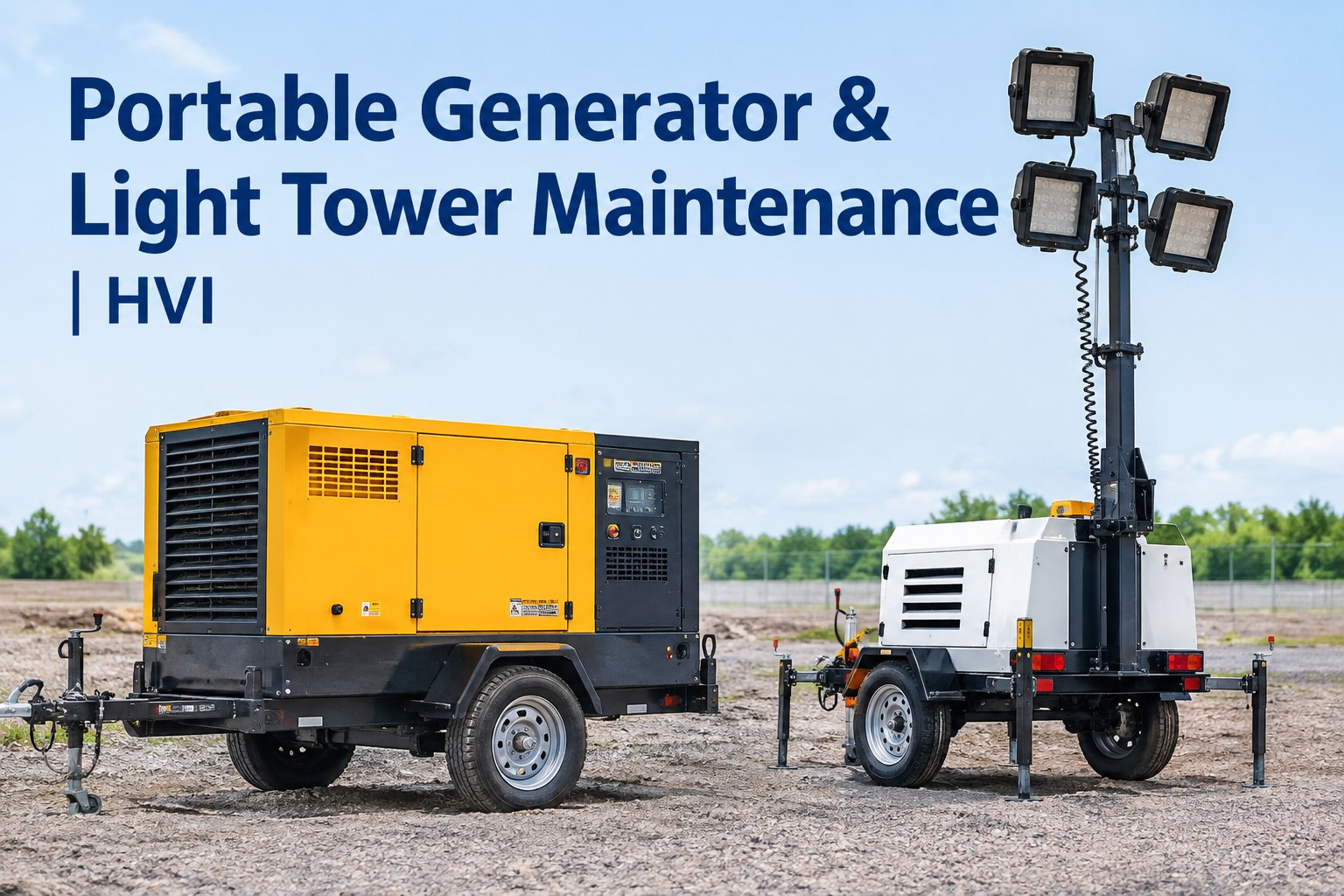
Portable generator and light tower maintenance is the job nobody schedules until a paving crew is standing in the dark with a unit that won't crank. The fix is simple: service these towable machines by engine hours, not guesswork and track all of it in one place. HVI schedules every PM off each unit's actual hours and auto-creates a work order the moment a check fails. See how it tracks every tower
Keep Every Light Tower Running Before the Night Shift Needs It
A light tower is really four assets in one trailer — a diesel generator, a mast and lamps and a road-going chassis with tyres and brakes. Each has its own service clock. Here's what a portable generator and light tower maintenance program looks like when the hours are tracked for you, not guessed. See it live →
- Fuel filterOK · 500h cycle
- LampsLED · healthy
- Tyres & brakesInspect · due
- Mast & outriggersPassed
Most fleets treat the whole light tower as one machine with one service date. It isn't. The diesel generator, the mast and lighting, and the tow-behind chassis each wear on a different clock — and a unit that passes an engine check can still be one bald tyre away from being undriveable. Here's how to service each system on its own schedule, and stop tracking it all on a clipboard.
Four machines, one trailerthe systems a light tower maintenance plan has to cover
Break the unit into its four systems and the whole job gets simpler. Miss one, and that's usually the one that strands the crew. This is the split every portable generator and light tower maintenance checklist should follow.
The diesel generator
The heart of the unit. Engine oil and filter on an hour-based interval, fuel and air filters, coolant, belts, and the battery. This is where neglect shows up fastest — a small engine has less oil capacity and less margin than a big machine.
The mast & lamps
The reason the unit exists. Check mast raising and locking, cable and winch condition, lamp function and aiming, and the light head. LED heads last far longer than metal halide, but a seized mast or frayed winch cable grounds the tower regardless.
The chassis & running gear
The part everyone forgets until a roadside stop. Tyre condition and pressure, wheel bearings, brakes, lights and reflectors, the tow hitch and safety chains, and the outriggers that keep the raised mast stable in wind.
The fuel system
Long run times and light loads are hard on fuel systems. Watch fuel quality and water separation, keep the tank vent clear, and don't let a unit sit idle at very light load for long stretches — it fouls the engine over time.
Track all four on paper and one always slips. Track them by engine hours with automatic reminders and none does. See all four service clocks in one place
Service by the hour, not the huncha practical light tower maintenance schedule
The single biggest upgrade to portable generator maintenance is switching from calendar guesswork to engine hours — a tower that ran 300 hours last month needs service sooner than one that ran 40, and only the hour meter knows. Here's a realistic interval framework; always confirm exact figures against your unit's manual.
Dusty and remote sites shorten every one of these intervals. That's exactly why hour-based scheduling beats a fixed calendar — the machine tells you when it's due. You can build these intervals directly from HVI's digital generator maintenance checklist and let the platform trigger each PM automatically. Watch a PM trigger itself by engine hours
The generator exercise schedulethe calendar routine that keeps a standby unit ready
Hours cover the wear items, but a light tower generator also needs a calendar-based exercise schedule — because the failures that strand a crew often show up on units that barely ran at all. An idle generator grows a weak battery, stale fuel, and, if only ever run at light load, wet stacking. Regular exercise under real load catches those before deployment day.
Exercise the generator under 50–90% load for at least 30 minutes, even if the unit hasn't been deployed. This is what actually catches a dying battery or a stuck fuel solenoid before you need it.
Battery load test, coolant and belt inspection, fuel quality check, and a full visual on the mast, cables, and lamp wiring — the parts a quick pre-start walk misses.
Load-bank test at full rated capacity to confirm the set holds voltage and frequency, plus air and fuel filter replacement and a trailer brake and wheel-bearing check on towed units.
Full service per the OEM hour-based schedule, coolant flush, injector or fuel-system inspection, and a complete trailer safety certification where required.
Why the load matters: running a diesel at very light load for long stretches causes wet stacking — unburned fuel and soot fouling the exhaust and injectors. A weekly load exercise burns that off. HVI can hold this exercise cadence as recurring scheduled tasks per unit, so nobody has to remember which tower is due.
The pre-deployment checklistrun this before any tower leaves the yard
Whatever the schedule says, no light tower should roll out without one final walk. This is the reactivation checklist that catches the dusk-on-site surprises — keep it on the phone so it's done in the yard, not under a deadline. In HVI each line becomes a required inspection item that has to be cleared before the unit is signed off.
- Engine oil and coolant at correct level, no leaks
- Fuel topped off and clean; water separator drained
- Battery charged, terminals clean and tight
- Generator runs and holds stable voltage under load
- Air filter and belts in good condition
- Mast raises, locks, and lowers smoothly; winch cable sound
- All lamps light, aim correctly, and lenses are clean
- Tyres at correct pressure, no cuts; wheel nuts tight
- Brakes, lights, hitch, and safety chains functional
- Outriggers deploy and lock for a stable raised mast
Ten lines, five minutes, and almost every night-shift breakdown is caught before it happens. Run it on paper if you must — but run it digitally and every check is timestamped, photo-backed, and impossible to skip. Use this light tower checklist online free
When a tower won't cooperatefast light tower troubleshooting by symptom
Even a well-maintained unit acts up on site. Most light tower faults trace back to a handful of causes — and knowing the likely culprit saves you from swapping expensive parts that were never the problem. Here's the quick symptom-to-fix map for the failures crews hit most.
The theme across every row: these are logging problems as much as mechanical ones. A unit that flickered last week or cranked slow last month was telling you something — if the reading was captured. That history turns a mystery breakdown into a scheduled fix. See how inspection history flags a fault early
Raising it safelymast and outrigger setup that prevents a tip-over
A surprising share of mast damage starts with bad setup, not bad parts — and a raised mast on unstable footing is a genuine safety hazard. Two rules matter most, and both belong on every operator's pre-raise routine.
Building these into the pre-deployment inspection — so the outrigger and mast checks can't be signed off until confirmed — is one of the simplest safety wins a digital checklist gives you. See mast and outrigger checks built into sign-off
The math on a neglected towerwhy hour-based PM pays for itself
Preventive maintenance on a light tower isn't expensive. Skipping it is. The annual PM cost of a single diesel light tower is modest — the damage from a failure at the wrong moment is not, because these units fail exactly when a whole crew is depending on them.
Typical annual preventive maintenance cost for one diesel light tower using OEM parts — a fraction of a single lost night shift.
Common oil-and-filter interval for the small diesel engines in these units — shorter on dusty or heavily loaded sites.
Typical LED light-head life, versus roughly 10,000 for metal halide — but only if the mast, winch, and wiring around it are kept serviced.
The failures that strand a crew — a dead battery, a clogged fuel filter, a bald trailer tyre, a seized mast — are all catchable weeks ahead in the data, if someone is logging readings instead of ticking boxes. That's the difference between a checklist and a maintenance system. Use the light tower checklist online free and log real readings
From clipboard to connected fleetwhat HVI changes for portable generator maintenance
A paper checklist is a fine place to start. But light towers are the classic orphan asset — they get treated like small gear until they cause a big problem, and paper is exactly why. Here's what moving to a digital, meter-driven system changes.
Log hours, trigger PM automatically
Enter or import each unit's engine hours and HVI schedules oil, fuel-filter, and inspection PMs by meter reading — no calendar guesswork, no unit slipping past its interval.
Run checks as digital inspections
Your pre-start and service checks become mobile inspections with photo evidence — engine, mast, lamps, tyres, and brakes captured on the phone the operator already has, timestamped and stored.
Turn defects into work orders
A failed item — a worn tyre, a low battery, a fuel leak — becomes a work order assigned to the shop automatically, so nothing found in the yard gets forgotten by dispatch.
See the whole tower fleet at once
Every unit's hours, PM status, parts used, and service history in one place — so you know which towers are ready for tonight and which need shop time before they're dispatched.
None of this needs new hardware or a heavy rollout. The same platform that runs your preventive maintenance scheduling handles light towers alongside the rest of the fleet, so a machine that used to slip through the cracks gets the same discipline as everything else you own.
From a rental fleet maintenance lead
Light towers were our worst assets for one dumb reason — nobody owned their service. They'd come back from a job, get parked, and go straight back out without anyone checking the hours. Then one would die on a night paving job and it was a crisis.
Once we started scheduling them by engine hours like the rest of the fleet, the panic calls basically stopped. The tyres and mast were the surprise — those were failing more than the engines ever did, and paper checks never caught them because everyone only looked at the generator.
Frequently asked questions
How often should you service a portable generator or light tower?
Service by engine hours, not the calendar — these units run wildly different hours by job. A practical framework: a quick pre-start walkaround every shift; an engine PM around 250 hours (oil and filter, air filter, battery, belts, load test); and a deeper service around 500 hours (fuel filter, cooling, electrical, mast winch, wheel bearings, brakes). Add a reactivation check when a unit leaves storage, and shorten intervals on dusty sites. Always confirm figures against your manual.
What are the most common light tower failures?
Rarely the dramatic engine ones. Top offenders: a dead battery (especially after storage), a clogged fuel filter or contaminated fuel from light-load running, water intrusion into fixtures, and the one paper checks miss most — the trailer running gear: bald tyres, worn bearings, neglected brakes. A seized mast or frayed winch cable grounds the tower too. Lamps themselves fail rarely (LED heads last around 50,000 hours). Nearly all of these build gradually and are catchable weeks ahead if someone logs real readings.
Why track light tower maintenance by engine hours instead of dates?
Because wear is driven by how much a unit runs, not by time passing. Two identical towers bought the same day can be hundreds of engine hours apart in a season. A calendar treats them the same — so one gets over-serviced while the other blows past its oil interval. Hour-based (meter-based) scheduling ties each PM to the actual hours on that specific unit, so service triggers when the machine needs it. The catch: tracking hours across a scattered fleet by hand is nearly impossible — which is why a system that captures each unit's hours and triggers PM automatically matters.
Do towable light towers need trailer and brake inspections too?
Yes — and it's the part most plans underweight. A towable tower is a road-going trailer for much of its life, so its running gear needs the same attention as any towed asset: tyre condition and pressure, wheel bearings, brakes, lights, tow hitch, and safety chains. The outriggers that steady the raised mast in wind are safety-critical too. These get missed because crews think of a tower as a generator and inspect only the engine — yet tyres, bearings, and brakes fail more often than the engine. Building the trailer checks into the same routine, so they can't be skipped, is exactly what a digital system enforces.
Can HVI manage light towers alongside the rest of my fleet?
Yes. Although HVI is built around heavy vehicle inspection and maintenance, it manages preventive maintenance for all kinds of industrial equipment, and light towers fit naturally. Schedule PMs by engine hours, run pre-start and service checks as digital inspections with photos (engine, mast, lamps, tyres, brakes), and have any failed item generate a work order automatically. Each unit gets its own service history, parts, and fuel record, and the whole tower fleet sits in one dashboard alongside your trucks — so they stop being orphan assets and get the same discipline as everything else you run.
Give your light towers the same discipline as the rest of your fleet
HVI schedules every generator and light tower PM off actual engine hours, runs your pre-start and service checks as digital inspections with photos, auto-generates work orders for defects, and keeps every unit's history in one dashboard. The orphan asset finally gets managed like the rest of the fleet — and the night shift stops inheriting surprises.
No credit card · No hardware · Manage your first light tower in minutes