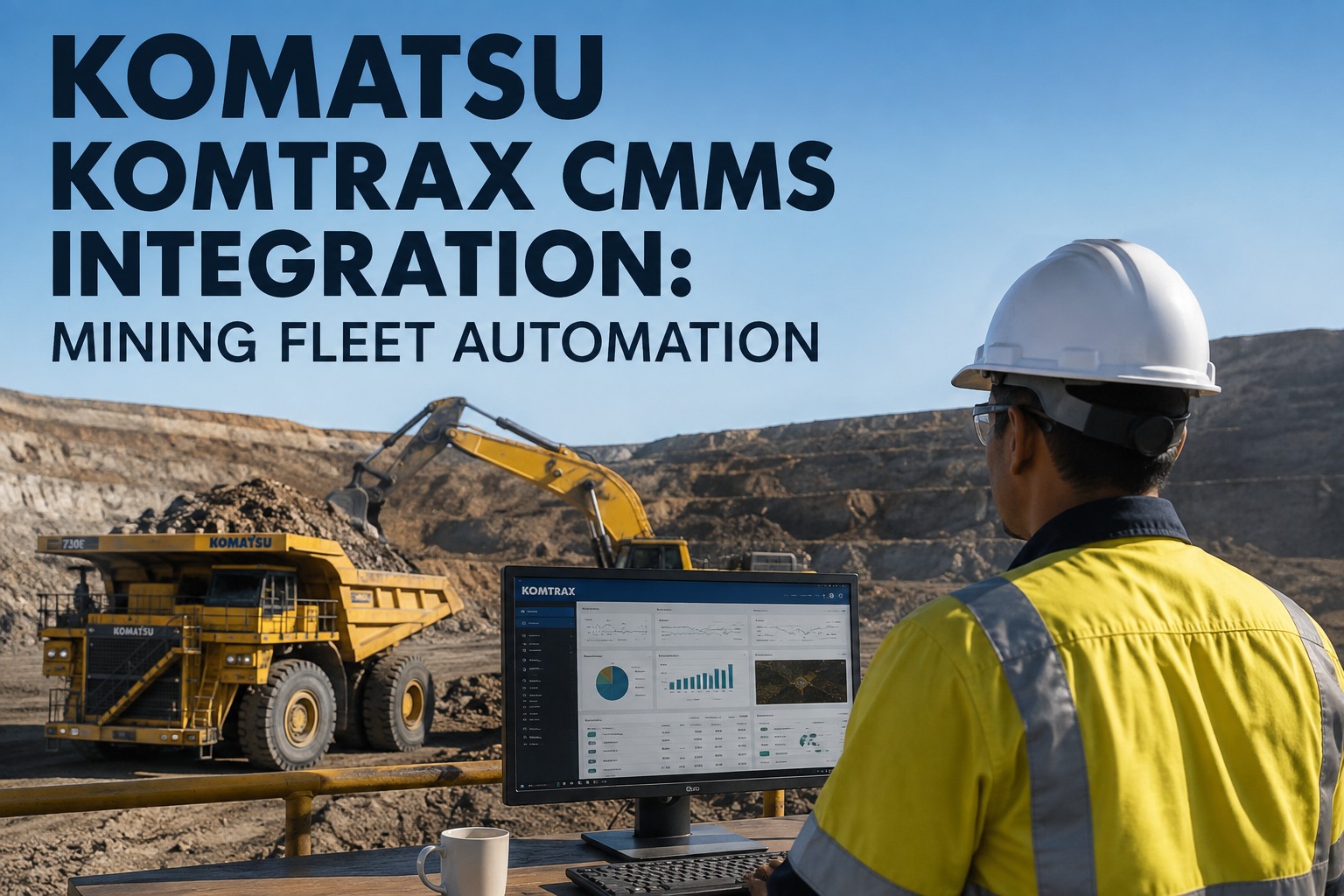
Every Komatsu machine leaving the factory since 2001 has KOMTRAX built in — engine hours, fuel burn, load cycles, fault codes streaming from HD haul trucks and PC excavators. On a mine site with 60 pieces of Komatsu iron, that's a lot of data usually stranded in a portal nobody opens between shift changes. This Komatsu KOMTRAX integration guide shows how the data flows into HVI — PMs firing on real working hours, faults routing to on-site techs, inspections syncing when a truck rolls into wifi. Book a demo
Your Komatsu haul trucks already report. HVI is where the reports become work orders — even in the pit with no signal.
KOMTRAX + KOMTRAX Plus data flows into HVI over the ISO 15143-3 (AEMP 2.0) API. Engine hours trigger PMs at Komatsu OEM intervals. Fault codes route to on-site techs. Inspections queue offline in the mobile app and sync the moment the machine reaches wifi. Purpose-built for the operational reality of mining fleets.
Mine-site reality — where KOMTRAX data lives, and where it dies
The Komatsu KOMTRAX integration story on a construction site and a mine site are two different stories. On a jobsite, connectivity is fine. On an active mine, the picture is fragmented: the pit bottom has zero cellular, the haul road has intermittent, the maintenance shop has wifi, and underground operations have nothing until the machine reaches the portal. Any real mining-fleet integration has to handle all four zones.
Fleets that ignore the zones end up with two data systems: KOMTRAX for the trucks that report, spreadsheets for the underground fleet that doesn't. HVI handles both from one system. Book a demo to see the offline sync workflow on an underground loader
The data flow — Komatsu iron to HVI work order in five stops
The integration path is the same across HD785 haul trucks, PC2000 shovels, WA900 loaders, D375 dozers, and the underground fleet. Every Komatsu machine reports through KOMTRAX to Komatsu's cloud, then into HVI through the AEMP 2.0 API. From there, HVI's rule engine fires PMs, routes faults, and lands work orders in the on-site tech's queue.
Komatsu machine
HD haul truck, PC shovel, WA loader, D dozer, GD grader. ECM continuously outputs engine hours, working hours, fuel burn, load cycles, fault codes, DEF, coolant temp, operating mode.
KOMTRAX / KOMTRAX Plus
Factory-installed hardware since 2001. Standard KOMTRAX: hourly cellular / daily satellite. KOMTRAX Plus adds load counts, cycle times, engine analytics for mining-class machines.
Komatsu cloud (My Komatsu)
Komatsu's data hub. Exposes fleet data through the ISO 15143-3 (AEMP 2.0) API — a REST/JSON endpoint. Komatsu doesn't charge to connect other systems.
HVI rules engine
Polls the AEMP 2.0 endpoint. Maps machine serial to asset. Checks working hours vs Komatsu OEM PM intervals. Reads fault codes against severity rules. Fires actions.
Work order
Tech-assigned ticket in the mobile queue. Machine ID, fault, working hours, location, parts — pre-populated. Works offline in the pit; syncs on next handshake.
Every Komatsu mining fleet already runs steps 1-3. What HVI adds is steps 4-5 — and specifically the offline resilience in step 5 that keeps the workflow running when the machine is 1,200 feet down or 40 minutes off the last cellular tower. Start free and connect a KOMTRAX feed this week
KOMTRAX vs KOMTRAX Plus — what data feeds what workflow
Not every Komatsu machine reports the same data. Standard KOMTRAX ships on construction-class equipment. KOMTRAX Plus is on the mining classes — HD haul trucks, PC1250+ shovels, WA800+ loaders. Understanding which feed lands in HVI matters because the rules that make sense on a WA320 don't make sense on an HD785.
The mining feed unlocks the analytics that matter on mine economics: cost per ton hauled, cycle time trends per operator, load factor per shovel-truck pairing. Construction feed is enough for PM and utilization. Both flow through the same integration; HVI presents the fuller picture where the machine supports it. Book a demo to see KOMTRAX Plus data driving cost-per-ton dashboards
PM triggers — Komatsu OEM intervals mapped to KOMTRAX hours
KOMTRAX separates total engine hours from working hours. This distinction matters for PM: a haul truck idling in the queue accumulates engine hours but not working hours, and Komatsu's OEM service intervals are typically based on working hours. HVI reads both and triggers PMs on whichever field the manufacturer specifies for that machine class.
| Machine class | Standard PM intervals | Trigger field | HVI action |
|---|---|---|---|
| HD785 / HD1500Rigid haul truck | 250 / 500 / 1000 / 2000 hr | Working hours | Auto-open PM work order, parts pre-listed |
| PC1250 / PC2000Mining excavator / shovel | 250 / 500 / 1000 / 4000 hr | Working hours + cycle count | Whichever hits first — hours or cycles |
| WA800 / WA900Wheel loader (mining) | 250 / 500 / 1000 / 2000 hr | Working hours | Auto-open with brake / hydraulic sub-checks |
| D375 / D475Bulldozer | 250 / 500 / 1000 hr | Working hours | Auto-open with undercarriage inspection |
| GD655 / GD675Motor grader | 250 / 500 / 1000 hr | Engine hours | Standard PM with blade wear check add-on |
The PM trigger table is configured once per machine class at setup. After that, every PM in the fleet fires at the exact OEM interval on the exact right field — and no service manager has to manually track when a haul truck is due. Book a mining demo to see PM auto-triggering on a live HD785 fleet
From a Maintenance Manager running 34 Komatsu machines at a copper mine
KOMTRAX had been running for years before we integrated with a real CMMS. In the office we'd pull up My Komatsu, see the fleet numbers, and feel like we had a handle on things. Out at the pit, our shift techs were doing everything on paper because the office system didn't work with no signal — and by the time inspections got walked back and typed into the system, they were four hours old and half of them had been re-done because the same truck came back for something else.
The HVI Komatsu integration was two things. First, KOMTRAX working-hour data started firing our PMs directly — no more service manager tracking a spreadsheet, no more haul trucks going 60 hours past a 500-hour service because someone missed an email. Second, and this is the piece nobody sold us on but ended up mattering more, the mobile app worked offline. Techs did their inspections at the shovel, at the truck, wherever — and it synced when they rolled through the shop wifi at end of shift. Twelve months in: unplanned downtime on our HD785 fleet dropped 41%, and we haven't had a missed PM on a mining-class machine in eight months.
Frequently asked questions
How does Komatsu KOMTRAX integrate with HVI CMMS?
HVI connects to Komatsu's telematics infrastructure through the ISO 15143-3 (AEMP 2.0) API — the same standard endpoint Komatsu's own My Komatsu platform uses to consolidate Komatsu and non-Komatsu fleet data. Setup takes about two hours: request AEMP 2.0 API credentials from your Komatsu dealer (Komatsu does not charge for API access, unlike some other OEMs), authorize HVI's connection, select which Komatsu machines to sync, and map machine serial numbers to HVI asset records. Data begins flowing on the next KOMTRAX sync — hourly on cellular-connected units, daily on satellite-only units. No hardware installation is required on the machine side: every Komatsu machine leaving the factory since 2001 has KOMTRAX built in, and mining-class units have KOMTRAX Plus with richer telemetry. HVI receives engine hours, working hours (a critical distinction for PM), fuel burn rate, GPS location, fault codes, DEF level, load counts (on KOMTRAX Plus machines), operating mode, and utilization data. Once connected, HVI's rule engine converts the raw feed into automated PM work orders, fault-code-driven maintenance tickets, and operator scorecards — no manual reconciliation between Komatsu's portal and the CMMS.
Does the KOMTRAX-HVI integration work at remote or underground mine sites?
Yes — this is one of the specific reasons mining fleets choose HVI over cloud-only CMMS platforms. Mine-site connectivity is fragmented across four zones: shop and office (full wifi and cellular), haul road and surface operations (intermittent cellular), open pit and bench (no cellular, satellite only, longer intervals), and underground (no signal at all until the machine or operator reaches the portal). HVI is built for this reality. On the KOMTRAX side, Komatsu machines already buffer data on-board and transmit when signal returns, and satellite-equipped units report at longer intervals (typically once per 24 hours). On the HVI side, the mobile inspection app runs fully offline — inspections, fault-code lookups, work order status, and PM checklists all cache locally on the tech's phone or tablet. When the operator does an inspection at the shovel face or an underground loader, the data queues in the app; the moment the machine or operator returns to wifi range (typically at end of shift when the truck rolls into the shop), the entire queue uploads in bulk. This is what makes HVI work for underground copper mines, remote iron-ore pits, and coal operations where the pit bottom sits well outside any cellular network coverage.
What's the difference between KOMTRAX and KOMTRAX Plus?
Standard KOMTRAX ships on Komatsu's construction and utility classes (WA320 loaders, PC300 excavators, D65 dozers, GD655 graders). It reports the core telematics data set: engine hours, working hours, fuel burn, GPS location, fault codes, DEF level, and basic utilization. KOMTRAX Plus is Komatsu's richer telemetry system for mining-class equipment — the HD haul truck series (HD785, HD1500), the large mining excavators and shovels (PC1250 and above), the large mining loaders (WA800 and above), and heavy dozers. On top of the standard KOMTRAX data, KOMTRAX Plus adds full load count detail, cycle time analytics per shovel-truck pairing, richer engine performance telemetry (peak power, torque curves, exhaust temperatures), and more granular operating-mode breakdowns. For a mining fleet, KOMTRAX Plus is what unlocks the analytics that matter on mine economics: cost per ton hauled, cost per cycle, load factor per shovel-truck pair, operator productivity comparisons. HVI reads both feeds through the same AEMP 2.0 API and presents the richer picture wherever KOMTRAX Plus is available — and applies the appropriate PM interval logic per machine class (haul trucks and mining excavators fire on working hours plus cycle counts; smaller construction units fire on working hours only).
How does HVI handle Komatsu fault codes in the maintenance workflow?
Komatsu machines output fault codes with severity classifications through the ECM, and KOMTRAX transmits them along with the timestamp and current working hours when the code fired. HVI ingests each code as an event tied to a specific machine, then routes based on severity. Critical faults (low oil pressure, hydraulic failure, engine over-temp, brake system fault) fire immediate SMS or email alerts to the maintenance manager and on-call technician, open a priority work order pre-populated with machine location and fault detail, and flag the machine Out of Service until inspection is complete. Degraded-condition faults (DEF quality warnings, DPF regen incomplete, sensor drift, coolant low) queue a work order for the next scheduled service window and log to machine history — with a repeat-fault alert if the same code fires three or more times in seven days. Informational codes log silently for trend analysis and monthly reliability reporting. This severity-based routing prevents the alert-fatigue trap that ruins most fault-code workflows: technicians only get notifications for events that actually require action, while the routine diagnostics still get captured for pattern analysis and warranty documentation.
Can HVI handle mixed fleets running Komatsu plus Cat, John Deere, and Volvo?
Yes — and this is a common scenario in mining and construction operations. Very few mine sites run 100% Komatsu; most mix Komatsu haul trucks and shovels with Cat dozers and support equipment, John Deere articulated dumps, Volvo loaders, and occasionally Hitachi excavators. HVI supports the ISO 15143-3 (AEMP 2.0) standard across all major heavy-equipment OEMs. When a mine runs multiple manufacturers, HVI pulls data from each OEM's respective API using AEMP 2.0 for common fields (engine hours, working hours, location, fuel level, fault codes, utilization) and, where richer OEM-specific data is required, connects to the manufacturer's proprietary endpoint (Cat's NextGen VisionLink API for detailed fault-code descriptions, KOMTRAX Plus for load cycle detail, JDLink for Deere-specific analytics). The result: one unified asset record per machine regardless of manufacturer, one work order queue for all technicians, one PM engine applying the correct OEM interval per class, one dashboard for the whole mixed fleet. Mixed-brand mining operations routinely report saving 12-15 hours per week previously lost to portal switching between My Komatsu, VisionLink, JDLink, and CareTrack before centralizing the streams into HVI. Book a mining demo to see a mixed Komatsu + Cat + Deere fleet unified in HVI.
Your Komatsu fleet already generates the data. The offline mobile app is what makes it usable in the pit.
Connect KOMTRAX to HVI in about two hours. PMs fire at Komatsu OEM intervals on working-hour data. Fault codes route to the right on-site tech. Load cycles feed cost-per-ton analytics. And the whole workflow runs offline in the pit, underground, or wherever the network doesn't reach — syncing the second the machine rolls back into wifi.