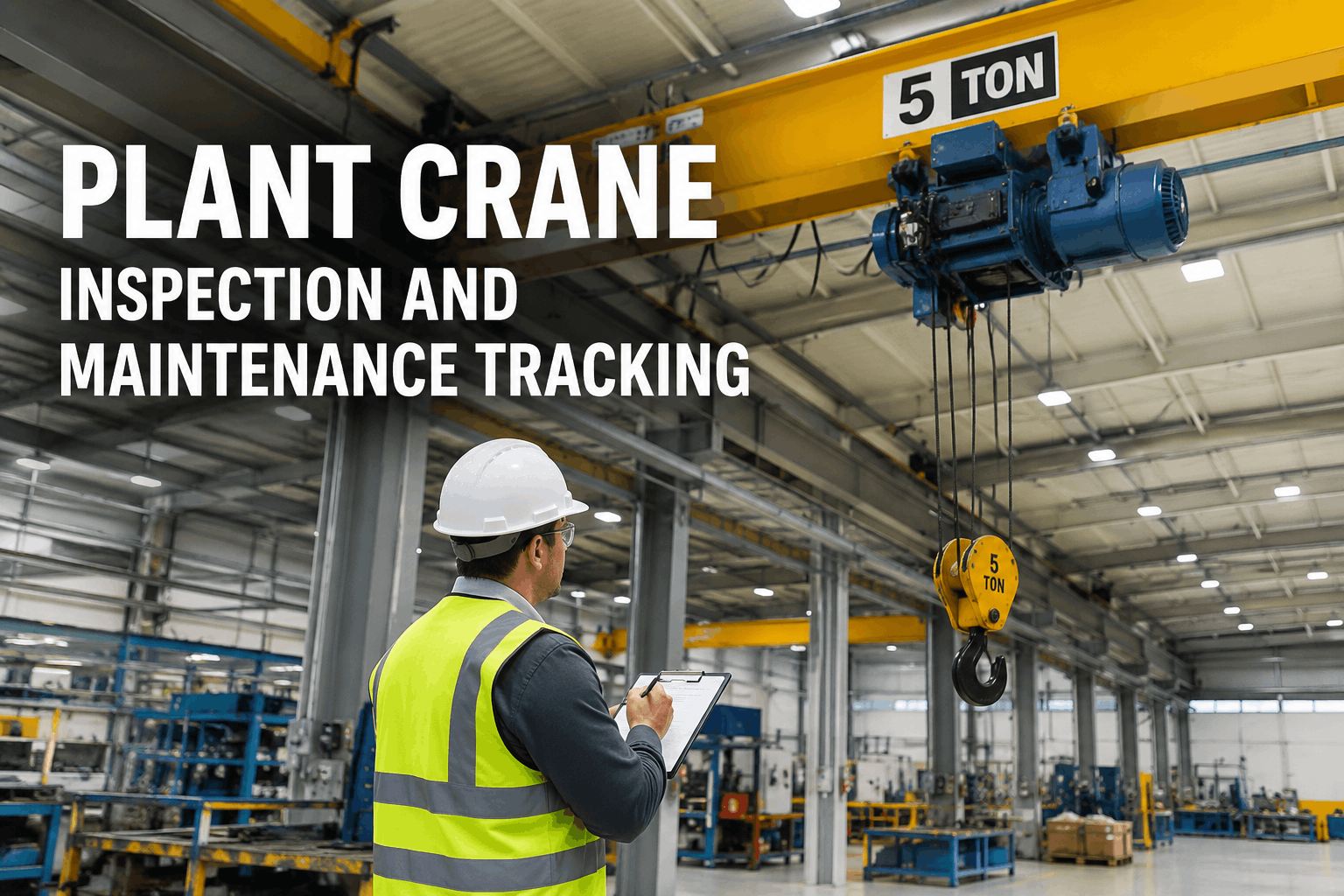
Most plant managers know their overhead crane needs inspecting. What trips up even careful manufacturing operations is which standard applies to which crane — because OSHA 1910.179 covers top-running bridge and gantry cranes, but the jib crane in the weld bay falls under ASME B30.11, and the monorail hoist over the assembly line under B30.16. Apply the wrong standard, or assume a crane is exempt because it isn't a "bridge crane," and you've got a compliance gap that OSHA's General Duty Clause will still hold you to. The cadence is just as specific: OSHA mandates two distinct inspection tiers — frequent inspections (daily to monthly) and periodic inspections (one to twelve months) — plus a daily visual on hooks and chains and a monthly certification record with the inspector's signature and the equipment identifier. And the rule that decides every audit is blunt: if it's not documented, it didn't happen. A daily check done from memory, or a monthly cert sitting in a binder no one can find, is the same as no inspection at all. HVI's plant crane inspection software turns the frequent and periodic tiers, the per-crane-type checklists, and the certification records into one tracked, audit-ready workflow across every overhead, jib, and gantry crane on the floor. schedule a 30-minute walkthrough with our team to see it mapped to your plant's cranes.
Right standard, right cadence, documented — or it didn't happen.
HVI tracks frequent and periodic inspections, the daily hook-and-chain visual, and the monthly certification record for every overhead, jib, and gantry crane in your plant — each crane type on its correct standard, every record audit-ready in seconds.
Match the crane to its standard
The first compliance step is knowing which rule governs each crane on your floor. Getting this wrong is the most common — and most citable — mistake in plant crane programs.
Overhead bridge crane
Top-running bridge and trolley cranes — the workhorse over most plant floors. Governed by OSHA 1910.179 with ASME B30.2 incorporated by reference.
OSHA 1910.179 · ASME B30.2Jib crane
Wall- or floor-mounted swinging arm serving a work cell. Not covered by 1910.179 — governed by ASME B30.11, enforced under OSHA's General Duty Clause.
ASME B30.11 · General DutyGantry crane
Bridge supported on legs that travel on floor rails. Covered alongside overhead cranes by OSHA 1910.179 and ASME B30.2 — same two-tier inspection regime.
OSHA 1910.179 · ASME B30.2Many facilities wrongly assume they're exempt because their equipment isn't a top-running bridge crane. Under the General Duty Clause, they're not — monorails (B30.16/B30.17) and jib cranes (B30.11) carry inspection obligations too. In HVI, each crane type loads its correct checklist automatically.
The two inspection tiers OSHA requires
1910.179 splits crane inspection into two cadences by depth and frequency. Knowing which tier covers what — and who is qualified — is the backbone of a compliant plant program.
Daily to monthly
Visual and functional checks: operating mechanisms, hooks, hoist chains, rope reeving, air and hydraulic systems, and brakes. Hooks and chains get a daily visual; chains add a monthly certification record.
Who: operator / designated personOne to twelve months
A complete inspection scaled to service severity: deformed or cracked members, loose bolts, worn sheaves and drums, bearings, brake-system parts, gears, and electrical apparatus — with written documentation.
Who: qualified personThe periodic interval isn't always "annual" — it's one to twelve months depending on the crane's activity, severity of service, and environment. A heavily used crane in a harsh plant environment needs the short end of that range, and HVI lets you set the interval per crane.
The daily frequent-inspection checklist
Before each shift or day of use, the operator runs the frequent visual and functional checks. In HVI, each group is a checklist section completed on a phone, with a photo required on any flagged item.
Lifting & load path
- Hook for cracks, deformation, throat opening, twist (daily visual)
- Hook latch present and operating
- Hoist chain or wire rope for wear, kinks, broken wires, stretch
- Rope reeving correct per manufacturer specs
- Lower-block and load-bearing components
Motion & controls
- Hoist up/down, bridge, and trolley travel — smooth, no drift
- Brakes hold the load with no excessive drift
- Upper and lower limit switches stop travel
- Pendant or radio controls respond correctly, labels legible
- Air or hydraulic systems for leaks or pressure loss
Safety & structure
- Warning horn, lights, and motion alarms functional
- Anti-collision and overload-limit devices (if equipped)
- Runway, rails, and end stops clear and undamaged
- Capacity markings present and legible on crane and hook block
- No loose bolts, cracked welds, or deformed members visible
A defective crane is removed from service until repaired — and the frequent check is what catches the worn brake or hooked latch first. sign up for a free HVI account and build the frequent checklist for every crane type on your floor, or schedule a live demo to see a flagged hook defect lock the crane out automatically.
Documentation: if it's not recorded, it didn't happen
OSHA's position is unambiguous — the inspection isn't complete until it's documented. These are the records a plant crane program must capture and keep, and the retention periods that go with them.
| Record | Must include | Retain |
|---|---|---|
| Daily frequent check | Date, crane ID, items checked, any defects | Per program / best practice |
| Monthly chain certification | Date, inspector signature, chain/equipment identifier | 3 months minimum |
| Periodic inspection | Items checked, results, qualified person's name & signature, date | 12 months minimum |
| Load test & major repair | Test results, repair detail, sign-off | Life of crane (best practice) |
Monthly certifications and periodic records must be readily available — an auditor expects to see them on request, not next week. In HVI every record is timestamped, signed, tied to the specific crane, and exportable in seconds. sign up free and make every crane's inspection history audit-ready on demand.
Paper binders vs. HVI crane tracking
Both run the same inspections. Only one keeps each crane on its correct standard and cadence — and produces the documentation OSHA demands the moment it's asked for.
Paper & binders
- Jib and monorail cranes assumed exempt — and missed
- Periodic inspections lapse with no interval tracking
- Monthly chain certs scattered, hard to produce on request
- Daily checks done from memory, not recorded
- A flagged defect noted, then the crane keeps running
- Audit means hunting through binders for signed records
With HVI software
- Each crane type loads its correct standard and checklist
- Frequent and periodic intervals scheduled and flagged before they lapse
- Signed certification records stored per crane, exportable instantly
- Every daily check timestamped with photos and operator
- A critical defect auto-locks the crane out and opens a work order
- Full multi-crane history exports for an OSHA auditor in seconds
frequent and periodic — on every plant crane, each on its correct OSHA or ASME standard, each documented to survive an audit. Daily inspection prevents the vast majority of crane failures, and OSHA's rule is blunt: if it's not documented, it didn't happen. HVI tracks both tiers, every crane type, and every signed record in one platform.
Frequently asked questions
Which OSHA standard applies to plant cranes?
It depends on the crane type. OSHA 1910.179 governs top-running overhead bridge cranes and gantry cranes in general industry, and incorporates ASME B30.2 by reference, making that standard legally enforceable. However, 1910.179 does not cover every crane: jib cranes fall under ASME B30.11, and underhung cranes and monorails under B30.16 and B30.17. Facilities sometimes assume these are exempt because they aren't bridge cranes — but under OSHA's General Duty Clause, the inspection obligations still apply. The practical rule is to map every crane on your floor to its correct standard. HVI loads the right checklist for each crane type automatically, so overhead, jib, and gantry cranes are each inspected to the applicable requirements.
What's the difference between frequent and periodic crane inspections?
OSHA 1910.179 defines two tiers. Frequent inspections happen at daily to monthly intervals and are visual and functional checks of operating mechanisms, hooks, hoist chains, rope reeving, air and hydraulic systems, and brakes — typically performed by the operator or a designated person. Periodic inspections happen at one to twelve month intervals depending on the crane's activity, severity of service, and environment, and are complete inspections covering deformed or cracked members, loose bolts, worn sheaves and drums, bearings, brake parts, gears, and electrical apparatus — performed by a qualified person with written documentation. The periodic interval is not automatically annual; a heavily used crane in a harsh environment needs more frequent periodic inspection. HVI schedules both tiers per crane.
What needs to be inspected daily on a plant overhead crane?
The frequent (daily) inspection focuses on the load path and controls. Hooks must be visually inspected daily for cracks, deformation, throat opening, and twist, with the latch present and working. Hoist chains and wire rope are checked for wear, kinks, broken wires, and stretch, and rope reeving verified against manufacturer specs. Functionally, the operator confirms hoist, bridge, and trolley motion is smooth, brakes hold the load, limit switches stop travel, controls respond correctly, and warning devices work. Capacity markings should be legible and no loose bolts, cracked welds, or deformed members visible. Hoist chains also require a monthly certification record with the date, inspector's signature, and chain identifier. HVI captures the daily check with photos and the monthly cert with a signature.
How long must plant crane inspection records be kept?
Retention varies by record type. Monthly chain certification records must be retained for at least three months and include the date, the inspector's signature, and an identifier for the chain inspected. Periodic (often annual) inspection records must be kept for at least twelve months and include the items checked, the results, and the qualified person's name, signature, and date. Best practice — and what many auditors expect — is to retain periodic records for the service life of the crane, and to keep load-test, major-repair, and incident records permanently. The governing principle is OSHA's: if it's not documented, it didn't happen, and the records must be readily available on request. HVI timestamps, signs, and stores every record per crane and exports them in seconds.
How does HVI help with plant crane inspection and maintenance?
HVI runs the whole program as one tracked system. Each crane type — overhead bridge, jib, gantry, monorail — loads its correct checklist mapped to the applicable OSHA or ASME standard. Operators complete frequent (daily) inspections from a phone with photos required on flagged items, and the monthly chain certification captures a signature and the equipment identifier. Periodic inspections are scheduled per crane at the right one-to-twelve-month interval and flagged before they lapse. Critical defects automatically lock the crane out of service and create a work order until a documented repair is signed off. Every record is timestamped, signed, tied to the specific crane, and exportable in seconds for an OSHA audit — meeting the "if it's not documented, it didn't happen" standard. schedule a demo and we will set it up around your specific cranes and intervals on the call.
Track every plant crane on its right standard, cadence, and record.
HVI runs frequent and periodic inspections, monthly certifications, and defect work orders for every overhead, jib, and gantry crane in your plant — each on its correct OSHA or ASME standard, with audit-ready documentation you can produce in seconds. Meet 1910.179 and B30, keep unsafe cranes locked out, and never fail the "it didn't happen" test again. Sign up free today.
No credit card required · Live in under two weeks · Frequent + periodic inspections + certifications + work orders in one platform