Nearly one in five trucks that rolled across a scale in 2025 got pulled out of service — and almost none of it was for anything exotic. It was brakes out of adjustment, a bald steer tire, a dead clearance lamp, a log that didn't match the ELD. The same handful of problems tops the list every single year. This rundown of the top 10 FMCSA violations in 2026 walks each one in order of how often it grounds a truck or a driver, why it keeps happening, and the specific habit that prevents it. Most of them are caught in a two-minute walk-around — if someone actually does the walk-around. Book a 30-minute walkthrough to see these caught before the truck leaves the yard.
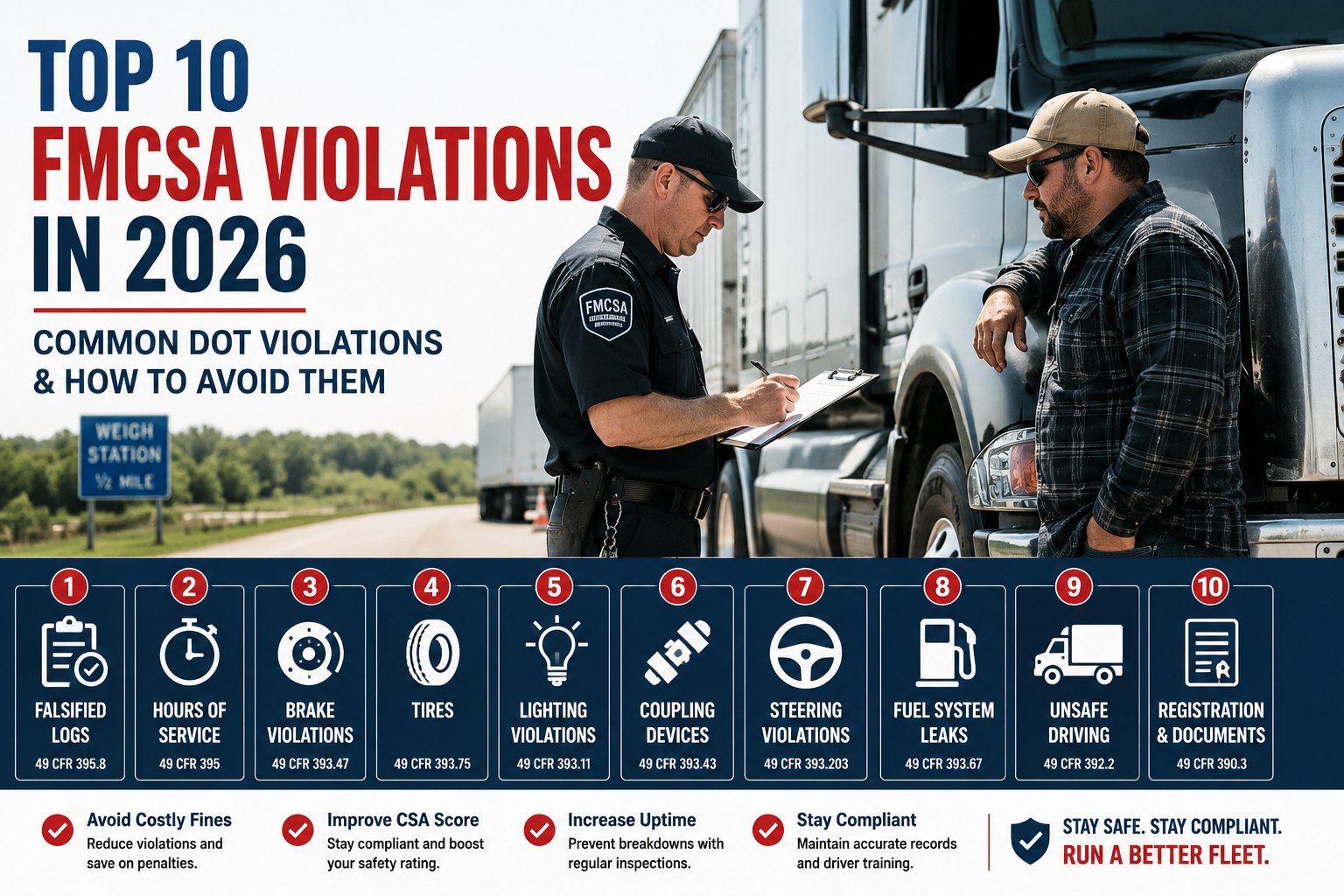
Top 10 FMCSA Violations in 2026 & How to Avoid Them
The FMCSA and DOT violations that ground the most trucks and drivers — ranked by frequency, with the reg cite, why each one happens, and the inspection habit that prevents it.
FMCSA MCMIS · CVSA Roadcheck
- Vehicle OOS rate
- ~18%
- Top vehicle violation
- Brakes
- Top driver violation
- Hours of service
- Audit violations
- 62,000+
Most are preventable in a pre-trip
-
~1 in 5
vehicles inspected were placed out of service in 2025 — an 18% OOS rate
CVSA Roadcheck 2025 -
41%+
of all vehicle out-of-service orders are brake-related — the #1 cause
CVSA Roadcheck 2025 -
62,000+
FMCSA audit violations cited in 2025 across 865 violation codes
FMCSA audit data 2025 -
$7,155
average penalty per audit violation — some reaching $125,000
FMCSA penalty data 2025
Why these violations matter more than the fine
A roadside violation isn't just a ticket. Every one gets logged in FMCSA's Safety Measurement System, weighted by severity, and rolled into your CSA scores — and the Vehicle Maintenance BASIC is one of the highest-weight categories there is. A pattern of violations does more than cost you fines: it raises your insurance, flags you for data-driven audit targeting, and can put drivers or trucks out of service on the spot, which means a parked truck and a missed load. The through-line across almost the entire top 10 is that these are visible, preventable defects — the kind a proper pre-trip or post-trip catches every time. See how HVI surfaces these before dispatch
The top 10 FMCSA violations in 2026, ranked
Ranked by how often they ground a truck or driver in FMCSA roadside and audit data. Use the filter to sort by category — vehicle defects, driver credentials, or records — and note the amber cards: those are the ones that put a unit out of service on the spot.
-
1
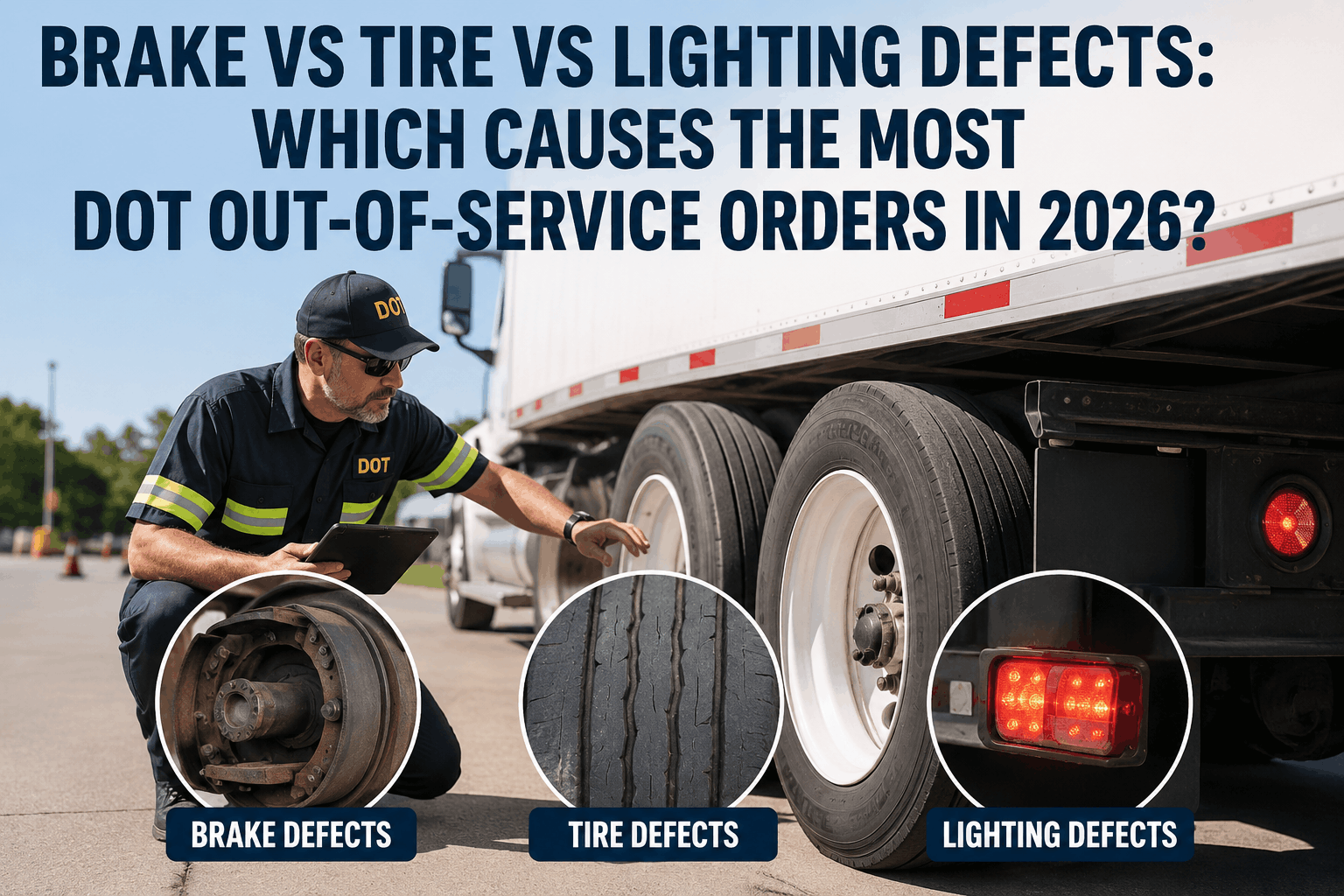
Brake system violations
Why it happens: out-of-adjustment slack adjusters, worn linings, air leaks, and the 20%-defective-brakes rule adding up one wheel-end at a time.
Prevent it: measure pushrod stroke and lining at every position on a documented pre-trip — not by eye.
-
2
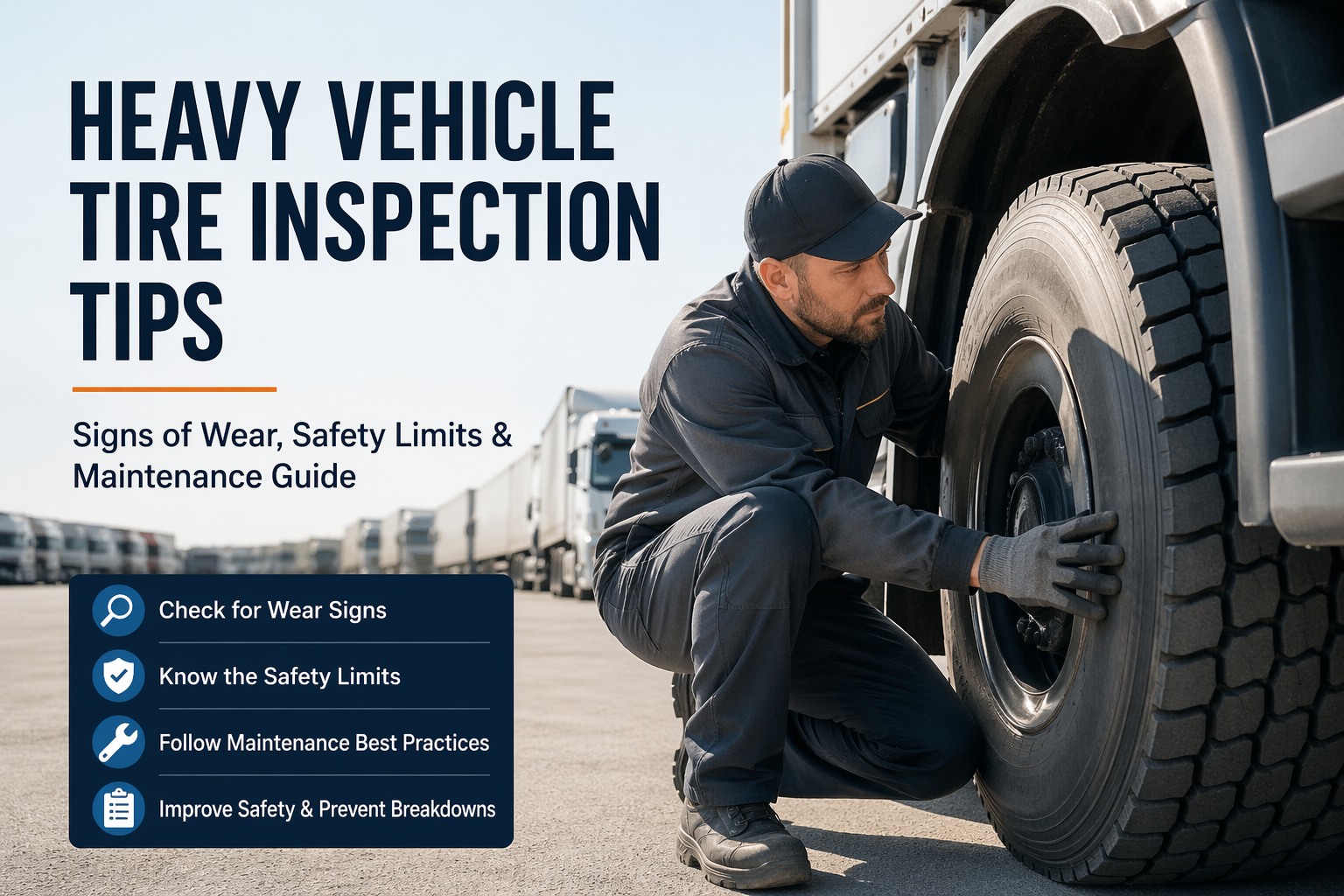
Tire violations
Why it happens: tread below 4/32" on steers or 2/32" elsewhere, underinflation, exposed belts, cuts, and sidewall bulges.
Prevent it: gauge tread and pressure on the walk-around; a single flagged tire can ground the whole truck.
-
3
Lighting & lamp violations
Why it happens: burned-out clearance, marker, brake, or tail lamps — the single most preventable violation on the list.
Prevent it: a lamp check every pre-trip; a dead bulb is a two-minute fix in the yard, not a roadside stop.
-
4
Hours-of-service violations
Why it happens: driving over the 11- or 14-hour limits, blown 30-minute breaks, and misunderstood short-haul exemptions.
Prevent it: ongoing HOS training and regular ELD-data audits so limits aren't crossed in the first place.
-
5
No / invalid CDL
Why it happens: expired, suspended, or wrong-class licenses — often because a suspension was never self-reported.
Prevent it: track license status and expiries in the driver qualification file, not on a spreadsheet nobody opens.
-
6
Parts & accessories in disrepair
Why it happens: defects an inspector can spot in seconds — loose components, leaks, worn parts left unrepaired between services.
Prevent it: route every reported defect to a work order and fix it before the truck dispatches again.
-
7
Missing periodic inspection paperwork
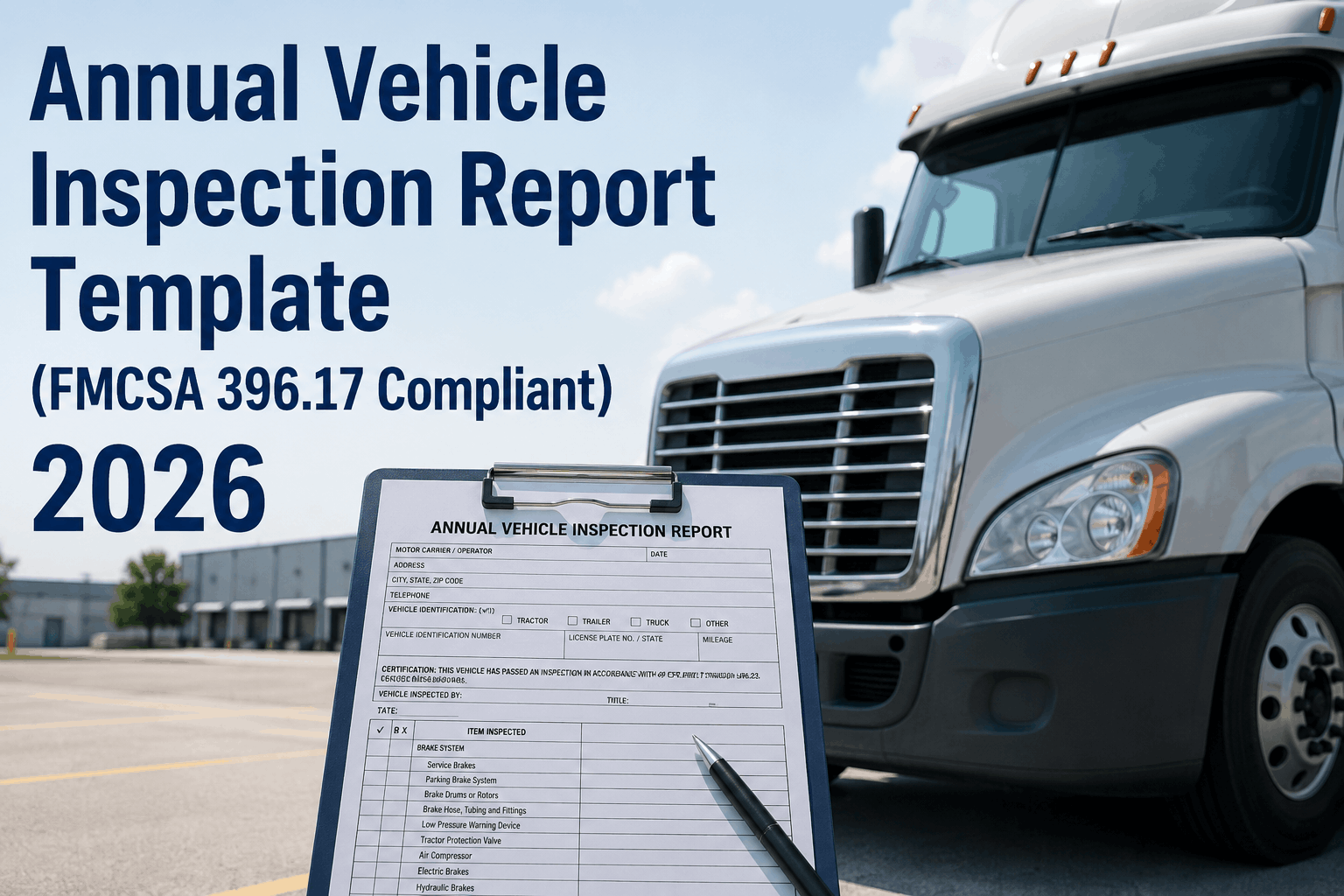
Why it happens: the annual inspection was done but the report or decal isn't on the vehicle — a paperwork gap, not a mechanical one.
Prevent it: keep the signed annual report digitally and carry proof on the unit; set an expiry alert before it lapses.
-
8
False or wrong record of duty status
Why it happens: logs that don't match the ELD, GPS, or fuel receipts — or using paper when an ELD is required.
Prevent it: audit ELD edits and unassigned driving time regularly; false logs carry the highest severity weight.
-
9
No valid medical certificate
Why it happens: a lapsed DOT medical card — the exam expired and nobody flagged the renewal date in time.
Prevent it: track med-card expiries alongside license and inspection dates with an automated reminder.
-
10
Drug & Alcohol Clearinghouse failures
Why it happens: hiring a driver without running the required pre-employment Clearinghouse query — 2,696 such violations in 2025.
Prevent it: build the full query into onboarding and run annual queries on every CDL driver, owner-operators included.
Seven of these ten — brakes, tires, lights, parts in disrepair, inspection paperwork, DVIR records, and defect handling — are prevented outright by a documented daily inspection that actually gets done. Put a guided pre-trip on every driver's phone
The pattern hiding in the top 10
Line the ten up and they sort into three buckets — and each bucket has a single root cause. Fix the root cause and you knock out most of the list at once.
-
Vehicle defects
Brakes, tires, lights, parts in disrepair
Root cause: rushed or skipped pre-trips. Fixed by a documented daily inspection.
-
Driver credentials
HOS, CDL, medical card
Root cause: untracked expiries and training gaps. Fixed by alerts and monitoring.
-
Records & documentation
Inspection paperwork, RODS, Clearinghouse
Root cause: scattered, backfilled records. Fixed by one digital system of record.
Notice that two of the three root causes point at the same thing: a documented, hard-to-skip inspection and record process. That's not a coincidence — it's why fleets that go digital see fewer roadside surprises. Book a demo to see the three buckets covered in one place
How to avoid the top FMCSA violations
The fleets that stay clean aren't lucky — they've built the catch into the daily routine instead of hoping the scale doesn't happen. Here's what that looks like versus the reactive approach.
Reactive fleet
- Finds out about the defect from a roadside citation
- Pre-trips are a signature on a clipboard, not a real look
- Expiries tracked on a spreadsheet nobody opens
- Defects noted on paper, lost before the shop sees them
- Records scattered and backfilled when auditors ask
Inspection-ready fleet
- Catches brakes, tires, and lights on a guided daily pre-trip
- Pass/fail gates block a rushed or backfilled inspection
- Automated alerts for inspection, med-card, and license expiries
- Defects auto-route to a work order before dispatch
- Every record timestamped and produced in seconds for an audit
None of this is exotic — it's the same pre-trip and recordkeeping the regulations already require, just done so it can't quietly slip. Sign up free and build the catch into every shift
Expert view
Rob C.
Director of Safety
Regional carrier
180 power units
People assume the violations that hurt you are some hidden mechanical thing. They're not. It's a marker lamp, a steer tire a groove low, a slack adjuster barely out. Stuff a driver walks past in thirty seconds because the pre-trip is just a box they tick.
When the inspection went digital and the app made them actually record brake and tire numbers, our roadside violations dropped off a cliff. Same regulations, same trucks — the only thing that changed is the check couldn't be faked anymore. That's the whole story of this top-10 list.
— Rob C., Director of Safety, regional carrier
Frequently asked questions
What is the most common FMCSA violation?
Brake-system violations are the single most common vehicle out-of-service violation year after year. In the 2025 CVSA International Roadcheck, brake systems accounted for about 24% of all vehicle out-of-service violations, and when combined with the "20% defective brakes" criterion, brake-related issues made up more than 41% of all vehicle OOS orders. On the driver side, hours-of-service violations are the most common, at roughly 32% of driver out-of-service violations. The reason brakes top the list is that they're evaluated on every axle, so one weak wheel-end can fail the whole vehicle — and out-of-adjustment or worn brakes are easy to miss on a rushed pre-trip.
What are the top 10 DOT violations in 2026?
Based on FMCSA roadside and audit data, the most-cited violations are brake systems, tires, lighting and lamps, hours of service, no or invalid CDL, parts and accessories in disrepair (Part 396), missing periodic inspection paperwork, false or wrong records of duty status, no valid medical certificate, and Drug and Alcohol Clearinghouse query failures. The mix spans three areas: vehicle defects, driver credentials, and records or documentation. What stands out is how ordinary they are — none involve exotic mechanical failures. Most are visible, preventable issues that a proper pre-trip or post-trip inspection and a basic expiry-tracking system would catch before a truck ever reaches a scale.
How do FMCSA violations affect my CSA score?
Every roadside violation is recorded in FMCSA's Safety Measurement System, assigned a severity weight, and sorted into one of the CSA BASIC categories — such as Vehicle Maintenance, Hours-of-Service Compliance, or Unsafe Driving. More severe and more recent violations carry more weight. A pattern of violations raises your percentile in the relevant BASIC, which increases the likelihood of a DOT intervention, roadside inspection targeting, and higher insurance premiums. The Vehicle Maintenance BASIC is one of the highest-weight categories, which is why recurring brake, tire, and lighting violations are so damaging. Out-of-service violations weigh especially heavily and can follow a carrier for months.
Which FMCSA violations put a truck out of service?
A vehicle is placed out of service when an inspector finds a violation that meets the CVSA North American Standard Out-of-Service Criteria. Common vehicle OOS conditions include defective brakes (or the 20%-defective-brakes rule), flat or severely worn tires with exposed cord, inoperative required lamps in some cases, and unsecured cargo. On the driver side, out-of-service conditions include exceeding hours-of-service limits, operating without a valid CDL or medical certificate, and, after a grace period, operating with a revoked ELD. An out-of-service order means the truck or driver cannot move until the violation is corrected — which is why these carry the most operational and financial pain.
How can digital inspections reduce FMCSA violations?
Seven of the top ten violations — brakes, tires, lights, parts in disrepair, inspection paperwork, records of duty status, and defect handling — trace back to inspections that were rushed, skipped, or poorly documented. A digital inspection platform reduces them in a few direct ways: it gives brake stroke, lining, and tire tread their own measurement fields so a defect shows up as a trend before it becomes a violation; it uses pass/fail gates so an inspection can't be backfilled or skipped; it routes flagged defects straight to a work order so they're fixed before dispatch; and it tracks inspection, med-card, and license expiries with automated alerts. The result is a documented, provable compliance record you can produce in seconds during an audit.
Turn the most common FMCSA violations into a non-issue
HVI runs the daily pre-trip and post-trip as guided pass/fail inspections — brakes, tires, and lights measured and photographed, defects routed to work orders, and expiry alerts for inspections, medical cards, and licenses. The violations that ground trucks and drivers get caught in the yard, and your compliance record is audit-ready the moment an inspector asks.
No credit card · No hardware · Live on your fleet in under two weeks