See how a regional trucking company transformed their maintenance approach by connecting daily inspections directly to repair workflows—reducing unplanned downtime by 52%, catching 3.4x moredefects before failure, and saving $312,000 annually in emergency repairs and lost productivity.
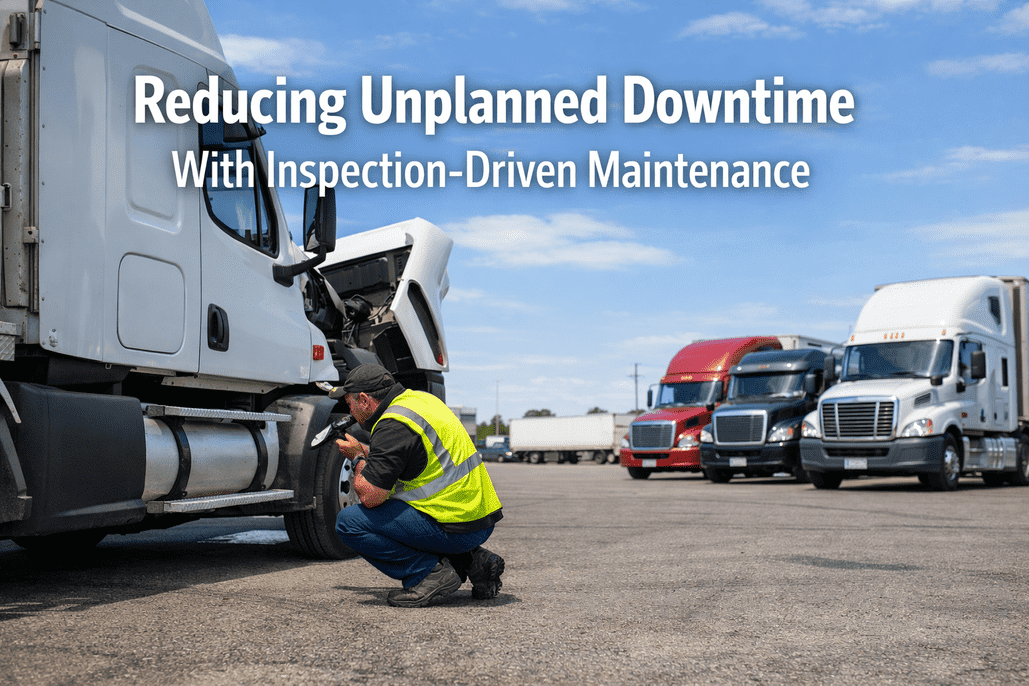
Reducing Unplanned Downtime With Inspection-Driven Maintenance
Fleet Operations Overview
For transportation and logistics fleets, unplanned downtime isn't just an inconvenience—it's a direct hit to revenue, customer relationships, and driver morale. When trucks break down unexpectedly, loads get delayed, customers lose trust, and the scramble for emergency repairs drains budgets faster than any planned maintenance ever could. Schedule a free fleet assessment to identify your biggest downtime risks.
Fleet Composition
Class 8 tractors, dry vans, reefers, and flatbed trailers serving regional distribution
Operating Profile
Regional runs averaging 400-600 miles daily with overnight turnarounds
Maintenance Team
In-house maintenance across main terminal and two satellite yards
This regional carrier had built a reputation for on-time delivery over two decades. But as their fleet aged and driver turnover increased, unplanned breakdowns were becoming more frequent—threatening the reliability that customers depended on. The maintenance team was skilled, but they were constantly fighting fires instead of preventing them.
Downtime Challenges
A detailed analysis of the previous 12 months revealed a troubling pattern: the fleet was experiencing far more unplanned downtime than industry benchmarks, and the root cause wasn't mechanical failure—it was missed early warning signs during daily inspections.
12-Month Downtime Analysis
Before inspection-driven maintenance implementation
Top Breakdown Categories (Preventable)
Are preventable breakdowns costing your fleet? Start your free trial and begin catching defects before they become roadside emergencies.
Missed Defects Before Change
The investigation revealed that drivers were actually performing inspections and noting defects—but the information wasn't flowing to the people who could act on it. The disconnect between inspection and maintenance created a dangerous blind spot.
The Inspection-to-Repair Disconnect
Completes paper DVIR
24-72 hour delay typical
Weekly form collection
23% of forms never actioned
Paper forms damaged, illegible, or never turned in
From defect noted to work order created
"Nothing ever gets fixed anyway"
Emergency expedited shipping for breakdown repairs
The maintenance manager described it bluntly: "Our drivers were doing their jobs. They were writing down problems. But by the time those forms reached my desk—if they reached my desk—the truck had already been running for three more days. We were always behind."
Experiencing Similar Inspection-to-Repair Gaps?
Our fleet specialists can help you identify where defect reports are getting lost and design a workflow that ensures every issue reaches your maintenance team immediately.
Inspection-to-Maintenance Workflow
The solution required more than just digitizing paper forms. The company redesigned their entire workflow to create a direct pipeline from driver-reported defects to maintenance action—with automatic prioritization and accountability at every step. Schedule a consultation to see how this workflow applies to your fleet.
New Inspection-Driven Maintenance Workflow
Digital Pre-Trip Inspection
Driver completes mobile inspection with guided checklist. Defects captured with photos, severity rating, and GPS location.
Automatic Defect Routing
System analyzes defect severity and routes to appropriate response: critical issues trigger immediate alerts, others queue for scheduled maintenance.
Work Order Generation
Maintenance management system automatically creates work order with defect details, photos, vehicle history, and parts recommendations.
Technician Assignment
Work orders assigned based on technician skills, current workload, and vehicle location. Tech receives mobile notification with full context.
Repair & Verification
Technician documents repair with photos. System notifies driver of completion and updates vehicle status for next dispatch.
Key Integration Features
Real-Time Alerts
Critical defects trigger immediate push notifications to maintenance supervisor and fleet manager
Parts Prediction
System suggests likely parts needed based on defect type and vehicle history, enabling pre-staging
Trend Analysis
Identifies recurring issues by vehicle, component, or driver to target preventive action
Driver Feedback Loop
Drivers receive notification when their reported defects are repaired, building trust and engagement
The digital platform integrated with the existing maintenance management system, eliminating double-entry and ensuring every inspection feeds directly into the maintenance workflow. Start your free trial to experience seamless inspection-to-maintenance integration.
Implementation Approach
Rolling out a new inspection workflow across 127 drivers required careful change management. The company focused on demonstrating value quickly to build driver buy-in—and making sure the maintenance team could handle the increased visibility.
Foundation Setup
- Configured inspection templates for each vehicle type
- Integrated with existing maintenance management system
- Established defect severity criteria and routing rules
- Trained maintenance supervisors on new workflow
Pilot Group Launch
- 25 drivers selected for initial rollout
- Daily check-ins to address questions and friction
- Refined inspection checklist based on driver feedback
- Demonstrated repair completion notifications to build trust
Full Fleet Deployment
- Phased rollout by terminal location
- Peer training from pilot group champions
- Paper forms officially retired
- Real-time compliance dashboard activated
Optimization & Expansion
- Added trailer-specific inspection workflows
- Implemented predictive maintenance alerts
- Integrated fuel data for efficiency monitoring
- Expanded to reefer unit inspections
"The turning point was when drivers started getting texts that their reported issues were fixed. Suddenly they realized someone was actually listening. Defect reporting went from something they avoided to something they took seriously."
— Fleet ManagerDowntime Reduction Results
Within 12 months of full deployment, the fleet achieved dramatic improvements in uptime, maintenance efficiency, and cost control—while actually reducing the administrative burden on both drivers and maintenance staff.
Additional Operational Impact
Want Results Like These for Your Fleet?
Every fleet is different, but the principles are the same: connect inspections directly to maintenance, prioritize defects automatically, and close the feedback loop with drivers. Let us show you exactly how it would work for your operation.
Key Lessons
The transformation revealed several insights that apply to any fleet looking to reduce unplanned downtime through better inspection practices.
Visibility Changes Behavior
When drivers can see that their reported defects are being tracked and repaired, they report more issues. When managers can see real-time compliance, they enforce standards. The digital dashboard created accountability that paper never could.
Speed Matters More Than Perfection
A minor defect addressed in 24 hours prevents a major failure next week. The old process prioritized thoroughness over speed; the new process prioritizes rapid response while maintaining quality documentation.
Trust Drives Engagement
The feedback loop—telling drivers when their issues are fixed—was more important than any training. Drivers became active participants in maintenance rather than reluctant compliance box-checkers.
Data Enables Prevention
Tracking defect patterns revealed that 40% of brake issues occurred on trailers assigned to specific routes with steep grades. Adjusting PM intervals for those trailers eliminated the pattern entirely.
Ready to apply these lessons to your fleet? Our implementation team has helped hundreds of fleets transition from reactive to inspection-driven maintenance. Schedule a call to discuss your specific challenges, or start your free trial and see the platform in action today.
"Before this system, we were a reactive maintenance shop disguised as a proactive one. We talked about preventive maintenance, but we spent 60% of our time on emergency repairs. Now that ratio is flipped. We're actually preventing problems instead of just responding to them. The difference shows in our numbers, our driver satisfaction, and frankly in how much I enjoy coming to work."
Transform Your Fleet Maintenance Approach
Stop losing revenue to preventable breakdowns. Inspection-driven maintenance creates a direct pipeline from driver-reported defects to completed repairs—catching issues early, reducing downtime, and building the data foundation for true predictive maintenance.
Ready to Reduce Unplanned Downtime?
See how inspection-driven maintenance can transform your fleet's uptime and cut emergency repair costs without adding burden to drivers or technicians.