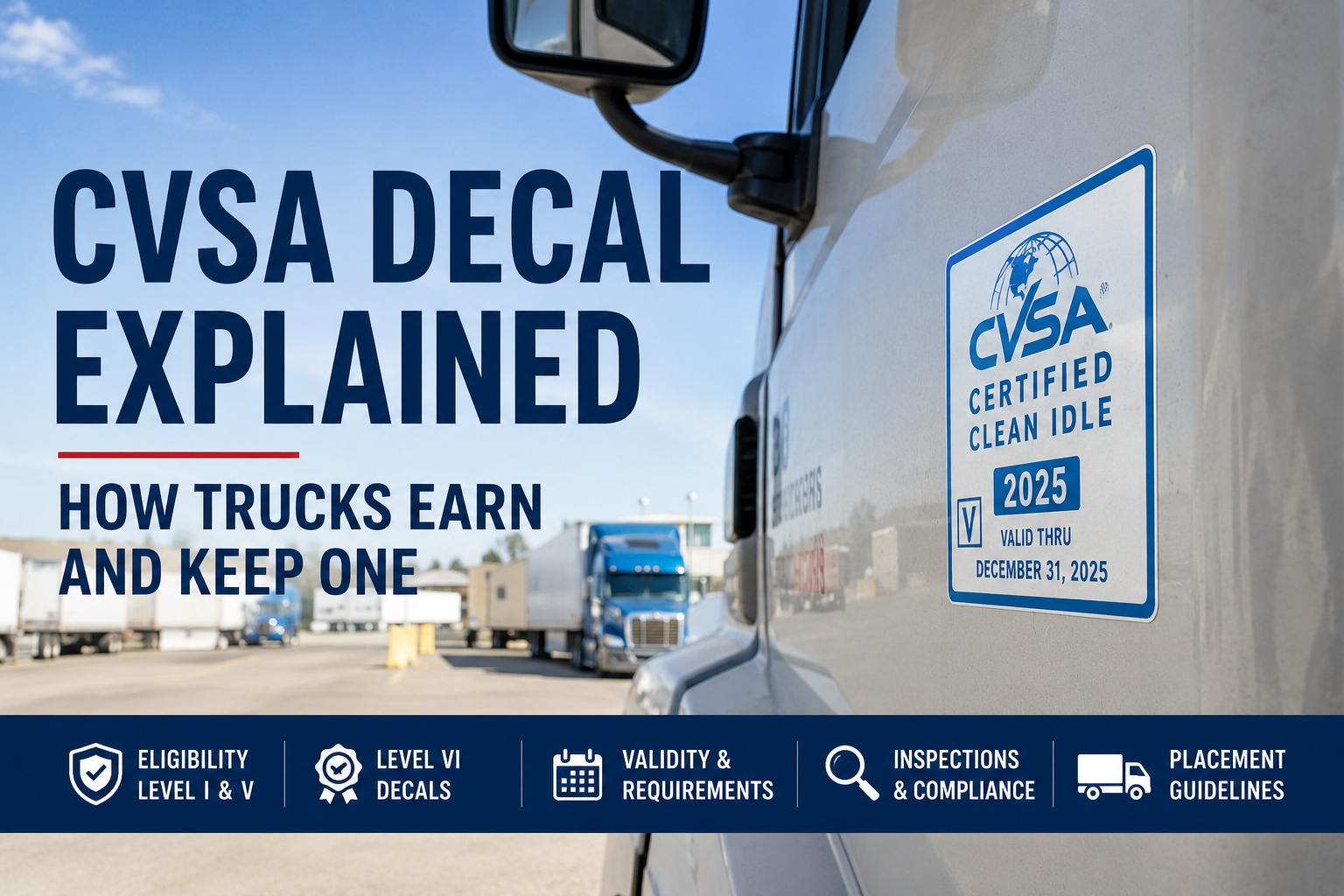
A CVSA decal signals to any roadside officer that a commercial motor vehicle recently passed a Level I, V, or VI inspection with no critical vehicle inspection item violations. Vehicles with a valid decal generally bypass re-inspection for the month of issuance plus two calendar months. The decal encodes information — year digit, corner cuts for quarter month, colour by type — and applies to the vehicle only, not the driver. This guide walks decal anatomy, pathways and placement — book a demo for HVI decal-earning prep.
The CVSA Decal — What It Says Before You Say Anything
Officers read the decal in under 2 seconds. Year, quarter month, inspection type — all encoded in the shape and colour before the plate is even called in.
3 pathways to earn a CVSA decal
- Most comprehensive standard inspection
- Driver credentials + full vehicle exam
- Standard decal if no critical vehicle item violations
- Vehicle inspection without driver present
- Usually at motor carrier premises
- Standard decal if no critical vehicle item violations
- Special inspection for radioactive material shipments
- Defect-free requirement at point of origin
- Blue decal, single-trip validity
Level III (driver-only) inspections do not produce a decal. The CVSA decal system applies to vehicle condition only — a driver can be placed OOS while the vehicle keeps its valid decal.
The rest of this page walks the standard decal validity rule (month of issuance plus 2 calendar months), why the CVSA decal is not a shield from re-inspection, the Level VI single-trip decal, exact windshield placement per 49 CFR 393.60(e), decal removal triggers, and how fleets structurally prepare units to earn and keep decals. Book a 30-minute demo to see decal-earning inspection prep run per unit in HVI.
The standard decal validity rule — and why the exact date matters less than the month
Standard CVSA decals are valid for the month of issuance plus two additional calendar months. A decal affixed on July 28 expires September 30 — not October 28. The rule is month-based, not date-based, so a decal received on the last day of a month effectively grants only two remaining full months of coverage. Fleets that time their inspections early in a month capture roughly a full 3-calendar-month bypass window.
| Decal issued | Quarter | Corner cuts | Expires |
|---|---|---|---|
| January 5, 2026 | Q1 (1st month) | Both upper corners removed | March 31, 2026 |
| February 12, 2026 | Q1 (2nd month) | Upper right corner removed | April 30, 2026 |
| March 25, 2026 | Q1 (3rd month) | No corners removed (intact) | May 31, 2026 |
| April 3, 2026 | Q2 (1st month) | Both upper corners removed | June 30, 2026 |
| July 28, 2026 | Q3 (1st month) | Both upper corners removed | September 30, 2026 |
| December 15, 2026 | Q4 (3rd month) | No corners removed (intact) | February 28, 2027 |
There is no penalty for driving with an expired decal — the vehicle can still operate legally — but it loses the inspection-bypass advantage. Any expired decal must be removed before a new one is applied. And the year digit changes each January (2026 = "6", 2027 = "7"), so a decal with the previous year's digit is visually obvious to an inspector regardless of the month rule. Book a demo to see per-unit decal-status tracking in HVI.
Why the decal is not a shield — inspector discretion remains
A valid CVSA decal generally exempts the vehicle from re-inspection for the coverage window, but "generally" is doing real work in that sentence. CVSA operational policy retains inspector discretion. If an officer observes an obvious defect on a vehicle displaying a valid decal — a lamp out at close range, visible tire damage, an audible air leak — nothing prohibits re-inspection. And if that re-inspection uncovers a critical vehicle inspection item violation, the existing decal is removed on the spot.
General bypass
Vehicle with valid decal driving normally past a scale house or roving patrol will typically be waved through without secondary inspection. This is the operational payoff of holding a decal.
Obvious defect observed
Officer spots a visible or audible issue (missing lamp, damaged tire, air leak, hanging component). Discretion allows pull-in even with valid decal displayed. Decal is not a legal shield against observed defects.
Level III driver inspection
Driver-only inspection can proceed regardless of vehicle decal status. Decal applies to vehicle condition only. Driver documentation, HOS, licence, and medical are all inspectable independent of decal validity.
Decal removal
If re-inspection uncovers a critical vehicle inspection item violation, the existing CVSA decal is removed. If the vehicle is later re-inspected and passes (or defects are corrected on scene), a new decal may be issued.
The distinction matters for compliance messaging. A CVSA decal is a probability-shifter, not a guarantee. It substantially reduces the likelihood of duplicate re-inspection during the coverage window, and it signals to carriers, brokers, and insurers that the vehicle passed a rigorous exam. But it does not eliminate roadside inspection risk, and it does not protect the driver. Start a free HVI trial to run pre-trip inspections aligned to CVSA critical vehicle inspection items.
Level VI decal — the single-trip exception for radioactive shipments
The Level VI decal is a special-purpose inspection artefact that operates on completely different rules than the standard decal. It applies only to vehicles and combinations transporting transuranic waste or Highway Route Controlled Quantities of radioactive material, and it requires the vehicle to pass the North American Standard Level VI Inspection defect-free at the point of origin — a stricter threshold than the standard decal's "no critical items" requirement.
Blue & distinct
- Blue colour, distinct design from standard decal
- Hole-punched with year, month, day of inspection
- CVSA Level VI logo prominent
Single-trip validity only
- Valid only for the shipment for which it was issued
- Not valid after the shipment is completed
- Equipment change en route requires new inspection
Entire vehicle combination
- Applies to entire vehicle and/or combination
- Unlike standard decal (power unit only)
- Standard decal also affixed if missing/invalid
Top of passenger windshield
- Passenger side edge, near top of windshield
- Bottom edge no more than 6 inches from top
- Out of wiper sweep, no view obstruction
All CVSA-certified Level VI inspectors will honour a valid Level VI decal. En-route Level VI re-inspection occurs only if an obvious defect is observed or suspected. If a critical item is detected en route, the vehicle must return to compliance and be re-inspected before continuing. Any expired standard decal or previous Level VI decal must be removed before a new Level VI decal is affixed. Refer to 49 CFR 393.60(e)(1) and (2) for windshield decal placement restrictions on all commercial vehicles. Book a demo to see Level VI inspection templates and single-trip decal tracking in HVI.
A safety manager on the operational payoff of a valid decal fleet-wide
We run 34 tractors regional, mixed dry van and reefer. Four years ago we averaged one Level I roadside pull per truck every 5-6 months. Some passed, some didn't. Every pull was 45-90 minutes off the road even when we passed clean. We calculated the cost at roughly $180 per pull in lost drive time plus dispatcher rework.
Started scheduling every truck for a voluntary Level V vehicle inspection at our terminal every quarter with the state DOT inspector. Prep the truck the day before: full DVIR walkthrough, brake stroke check, lighting walk with photo evidence, coupling condition. Success rate first year: 78% earned the decal on first attempt. Second year: 91%. Third year running: 96%.
The operational payoff was bigger than we expected. Not just fewer pulls — also cleaner CSA scores from fewer inspection events on file, faster gate transitions at customer sites that scan decals, and our insurance broker specifically referenced our decal-earning rate at last renewal. The decal isn't a shield, but it's the closest thing we have to a public trust signal, and structural prep is what earns it.
Frequently asked questions
What is a CVSA decal?
A CVSA decal is a coloured sticker affixed to a commercial motor vehicle by a CVSA-certified Level I, V, or VI inspector after the vehicle passes an eligible inspection with no critical vehicle inspection item violations per the North American Standard Out-of-Service Criteria. The decal displays the last digit of the calendar year (2026 = "6") at the top and the CVSA trademarked logo. Standard decals are single-colour and apply to the power unit; Level VI decals are blue, hole-punched with year/month/day, and apply to the entire vehicle and/or combination. Vehicles displaying a valid CVSA decal are generally not subject to re-inspection during the coverage window, which is the month of issuance plus two additional calendar months. The decal is a probability-shifter that reduces duplicate roadside inspections rather than a legal shield — inspector discretion allows re-inspection if an obvious defect is observed. Critically, the CVSA decal applies to the vehicle condition only, not the driver — a driver can be placed out-of-service on a Level III (driver-only) inspection while the vehicle continues to display a valid decal.
How does a vehicle earn a CVSA decal?
Three pathways lead to a CVSA decal. Level I North American Standard Inspection: the most comprehensive standard inspection, covering both driver credentials (licence, medical card, hours of service, seat belt) and full vehicle exam (brakes including trailer connections, coupling devices, exhaust, frame, fuel system, lighting, safe loading, steering, suspension, tires, wheels/rims, windshield wipers, emergency equipment). If no critical vehicle inspection item violations are detected, the inspector affixes a standard CVSA decal. Level V Vehicle-Only Inspection: same vehicle-side scope as Level I but without the driver present, typically conducted at a motor carrier's premises. Standard decal issued on clean vehicle findings. Level VI North American Standard Inspection for Transuranic Waste and Highway Route Controlled Quantities of Radioactive Material: special-purpose inspection required at point of origin for radioactive shipments. Requires the vehicle and/or combination to be defect-free (a stricter threshold than "no critical items"). Results in the blue Level VI decal, valid for single trip only. Level III (driver-only) and Level IV (special study) inspections do not result in CVSA decals. Inspectors must be CVSA-certified for the specific level they are conducting to affix a valid decal.
How long is a CVSA decal valid?
Standard CVSA decals are valid for the month of issuance plus two additional calendar months — a maximum coverage window of approximately three calendar months. The rule is month-based, not date-based, so a decal issued late in a month grants a shorter effective bypass window. Example: a decal issued on July 28, 2026 expires September 30, 2026 (not October 28, 2026). A decal issued on July 3 covers essentially the same expiry date but a longer usable period. The quarter-corner-cut system on the decal itself makes the exact issue month readable at a glance: both upper corners removed = 1st month of the calendar quarter; upper right corner only removed = 2nd month; no corners removed (intact) = 3rd month. Combined with the year digit at the top of the decal, an officer can determine the exact month and year of issuance in under 2 seconds. No penalty applies for operating a vehicle with an expired CVSA decal — the vehicle can still operate legally, it just loses the inspection-bypass advantage. Level VI decals operate on different rules: single-trip validity only, hole-punched with exact year/month/day, not valid after the specific shipment for which they were issued.
Does a CVSA decal apply to the driver too?
No — and this is one of the most important operational distinctions in the CVSA decal program. CVSA decal criteria apply only to the condition of the vehicle, not the driver. An inspector may issue a CVSA decal for a vehicle that passes Level I or V inspection cleanly even if the driver receives an out-of-service violation on the driver-side portion of that same Level I inspection. This means: a driver who fails their HOS check, presents an invalid medical card, or is otherwise placed OOS can trigger driver-side citations while the vehicle they were driving still earns and displays a valid CVSA decal. Conversely, drivers operating a vehicle with a valid CVSA decal remain subject to Level III driver-only inspections at any point during the decal's coverage window — the decal does not protect against driver-side re-inspection. Practical consequence for fleets: earning decals fleet-wide reduces vehicle re-inspection frequency but does not reduce driver-inspection frequency. Structural compliance programs need to run driver-credential management and vehicle-inspection preparation as parallel workstreams, not as one combined effort.
Where does the CVSA decal go on a truck?
Standard CVSA decal placement: lower right corner of the exterior surface of the passenger-side windshield on the power unit. This placement complies with 49 CFR 393.60(e)(1) and (2), which restricts windshield decals to areas that do not interfere with the driver's view and are outside the sweep of the wiper. The placement is standardised across North America so inspectors can locate and read the decal quickly at scale-house pull-ins, roadside stops, or during roving patrol observation. Level VI decal placement differs: passenger side edge of the windshield near the top, with the bottom edge of the decal no more than 6 inches from the top of the windshield. It must be out of the sweep of the wiper and not affixed where it would interfere with the driver's view. When a Level VI decal is affixed, a standard CVSA decal is also applied per operational policy if the vehicle does not already have a valid standard decal. Any expired regular decal or any previous Level VI decal must be removed before a new decal is affixed. Verify current CVSA operational policy and 49 CFR 393.60 windshield decal placement restrictions before affixing or removing decals — CVSA policy is updated periodically and this article reflects the position at time of writing.
Structural prep for the inspection. Fleet-wide decal earning as an operational KPI.
HVI runs pre-trip and PM inspections aligned to the CVSA critical vehicle inspection item list, tracks decal-status per unit with expiry alerts, captures photo evidence on every defect, and routes confirmed defects into corrective work orders that must be closed before dispatch. Fleets that structurally prepare units for Level I/V inspections earn CVSA decals at higher rates and hold them longer. Live in under two weeks. No hardware. No credit card.
Trusted by fleets preparing for CVSA-decal-earning inspections across USA & Canada · Ready on day one