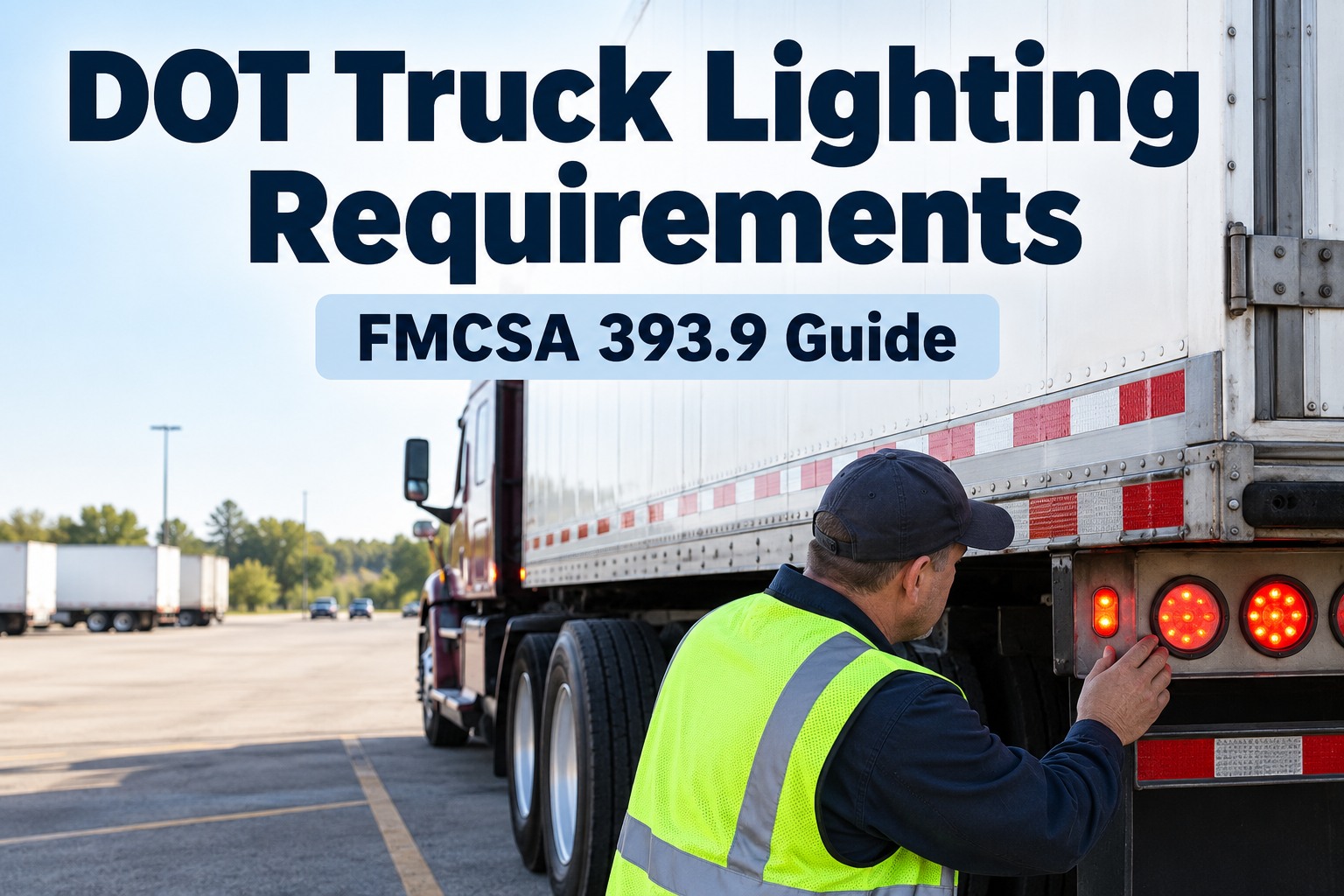
DOT truck lighting requirements are the #3 cause of vehicle out-of-service orders in North America — roughly 14% of all OOS findings. Every citation traces to a specific section of 49 CFR 393.9 or 393.11, and every section carries a different severity weight, CSA hit, and escalation path. A cracked lens is not a headlamp out; a missing conspicuity strip is not the same as an inoperable stop lamp. This guide walks the violation ladder from note-only to gateway-Level-I — book a demo to catch lighting defects before dispatch in HVI.
Lighting Violation Severity Ladder — What Actually Triggers OOS
Not every lighting defect ends the trip. Some are notes. Some are tickets. Some are out-of-service. And some open the door to a full Level I inspection. Know which rung you're on before dispatch.
Every rung has a different cost profile. Level 4 is the one most fleets underestimate — a working truck with a marker lamp out becomes a truck with 4 additional violations after the inspector walks the whole vehicle.
The rest of this page walks the specific lamp requirements under 49 CFR 393.11 Table 1 (colour, position, mounting height), the FMVSS 108 conspicuity system that DOT-C2/C3/C4 tape must meet, the top 8 lighting violations roadside inspectors actually cite, the amber-stop-lamp prohibition most fleets forget, and the pre-dispatch checks that catch every rung of the ladder. Book a 30-minute demo to see lighting inspection templates per asset in HVI.
49 CFR 393.11 Table 1 — what lamps are actually required
49 CFR 393.11 references FMVSS No. 108 for every lamp on a commercial motor vehicle. Table 1 in the regulation specifies quantity, colour, mounting position, and mounting height per lamp category by vehicle type. All commercial motor vehicles manufactured on or after December 25, 1968 must meet the applicable FMVSS 108 requirements in effect at the time of manufacture. The rule was amended again on February 19, 2026 (91 FR 7873) with clarifications carrying forward, and the current requirements form the baseline every roadside inspection tests against.
| Lamp category | Required quantity & colour | Position / height |
|---|---|---|
| Headlamps | 2 white (or 4 for units with 4-lamp systems) | Front, symmetrical; height per FMVSS 108 |
| Tail lamps | 2 red | Rear, symmetrical; visible from 500 ft |
| Stop lamps | 2 red (amber prohibited under 393.11(c)) | Rear, symmetrical; may be combined with tail lamps |
| Turn signals (front) | 2 amber or white | Front, symmetrical; visible from side and front |
| Turn signals (rear) | 2 red or amber | Rear, symmetrical; amber recommended for visibility |
| Clearance lamps | 2 amber (front) + 2 red (rear) for units >80" wide | Near top of unit; indicates overall width |
| Side marker lamps (front) | 2 amber | Near front, one per side; height per FMVSS 108 |
| Side marker lamps (rear) | 2 red | Near rear, one per side; height 381-2,108 mm (15-83") |
| Identification lamps | 3 amber (front) + 3 red (rear) for units >80" wide | Centre, top, evenly spaced; groups of 3 |
| Licence plate lamp | 1 white | Illuminates rear plate; 2026 exemption applies to certain truck tractors |
| Backup lamp | 1+ white (where equipped) | Rear; illuminates only when in reverse |
| Reflex reflectors | Red at rear, amber at sides | Per Table 1 — may be replaced by conspicuity tape at same locations |
Two rules trip fleets more than any other. Amber stop lamps and tail lamps are explicitly prohibited under 49 CFR 393.11(c) — a truck with an aftermarket amber tail lamp assembly is a violation waiting for an inspection. And missing hardware (rather than a burned-out bulb) is the fastest inspector-side citation because it's identifiable without touching the vehicle. Both categories catch fleets that treat lighting as "check bulbs at PM" rather than "verify hardware present at pre-trip." Book a demo to see per-asset lighting inspection templates aligned to 393.11 Table 1 in HVI.
Conspicuity system — DOT-C2, C3, C4 and the 50% rule
49 CFR 393.11(b) requires trailers manufactured on or after December 1, 1993 with overall width of 80 inches or more and GVWR over 10,000 pounds to have a retroreflective conspicuity system meeting FMVSS No. 108 S5.7. Pre-1993 trailers fell under 49 CFR 393.13, which required retrofit by March 31, 1999. The rules are specific — and enforcement is well-defined — because inspectors can measure conformity without any diagnostic tool.
Certified tape only
Materials must be certified DOT-C2 (50 mm wide), DOT-C3 (75 mm wide), or DOT-C4 (100 mm wide) per FMVSS 108 S5.7.1.5. Every strip must carry the certification marking. Non-certified reflective tape (bulk rolls from a truck stop) will not pass inspection regardless of how new or bright it looks.
Sides: 50% length
Side conspicuity treatment must cover at least 50% of the trailer's length with alternating red and white strips. Placement runs as continuous as possible along the lower side of the trailer body. Gaps or peel-off segments that drop coverage below 50% are cited.
Upper rear corners
Pairs of strips at least 300 mm (12 inches) long positioned horizontally and vertically, as close to the top of the trailer as practicable and as far apart as practicable. Missing upper corner strips is the single most commonly cited conspicuity violation on box trailers.
Lower rear across width
Rear treatment runs across the full width of the body along the lower rear. Peeled, faded, or paint-covered strips fail even if physically present. Pressure-washing loosens adhesive over time — a common cause of tape dropping off between inspections.
Faded, torn, missing, or paint-covered conspicuity material can trigger OOS on trailers built after the applicable dates. And because conspicuity condition is visible at 30 feet, it's often the reason an inspector pulls a truck in for the full Level I check — the gateway violation pattern. Quarterly conspicuity inspections with photo evidence and replacement-on-defect protects the CSA record. Book a demo to schedule quarterly conspicuity checks per trailer in HVI.
The 8 lighting violations roadside inspectors cite most
Every roadside inspection has a hit list. On lighting, the top 8 violations cover more than 80% of citations issued by CVSA-certified inspectors. Every one is preventable at pre-trip inspection with a driver who knows what to look for.
Inoperable required lamp
- Cite: 49 CFR 393.9
- Weight: 2 (headlamps: 6)
- Any required lamp not functioning at inspection time
- Multiple lamp failures escalate to OOS
Missing conspicuity (rear)
- Cite: 393.11A1-CSLRR
- Weight: 3
- Lower rear retroreflective sheeting missing
- Trailer manufactured on/after July 1, 1997
Upper corner reflectors
- Cite: 393.11TU
- Weight: 3
- Truck-tractor upper body corner requirements
- Post-July 1997 tractors need corner sheeting/reflectors
Headlamps inoperable
- Cite: 49 CFR 393.9H
- Weight: 6 (highest lighting weight)
- OOS trigger — truck cannot move
- Both low beam & high beam per FMVSS 108
ABS lamp defective (trailer)
- Cite: 49 CFR 393.55(e)
- Weight: 4
- ABS malfunction indicator lamp
- Trailers manufactured on/after March 1, 1998
Amber tail/stop lamp
- Cite: 49 CFR 393.11(c)
- Weight: 3
- Amber tail or stop lamp explicitly prohibited
- Aftermarket combined lamp assemblies at risk
Licence plate lamp out
- Cite: 49 CFR 393.11 Table 1
- Weight: 2
- 1 white lamp required to illuminate rear plate
- 2026 exemption applies to certain truck tractors
Damaged / hanging lens
- Cite: 49 CFR 393.9
- Weight: 2
- Cracked lens allowing water intrusion
- Lamp hanging by wire = citable defect
Each violation is cited independently, and the CVSA operational framework treats violations from the same regulatory subsection as one violation per unit — but multiple defects across different subsections stack. A truck with one marker lamp out (393.9), one missing upper corner strip (393.11TU), and one damaged lens (393.9) can end up with 2-3 separate citations on the same inspection report. Start a free HVI trial to log lighting inspections per unit with photo evidence.
A safety manager on the two-year CSA record impact of a $5 bulb
We run 68 tractors and about 140 trailers, regional dry van. Two years ago we had a driver leave the yard with a rear turn signal out. Roadside pulled him at 2 hours in for the marker lamp, ended up with a full Level I inspection. Inspector wrote up the turn signal (393.9), a missing upper corner conspicuity strip on the trailer (393.11TU), and a licence plate lamp out that the driver hadn't caught either. Three separate citations. Truck OOS on the turn signal for about 90 minutes while we ran parts out.
The $5 bulb cost us: 90 minutes of OOS downtime, one $147 ticket to the driver, three CSA violations that hit the carrier profile for 24 months, and a follow-up compliance review 8 months later where the auditor specifically asked to see our pre-trip inspection records for lighting. That one turn signal put us on a review that took two weeks to prepare for.
Since then every pre-trip DVIR includes photo evidence of every required lamp category and every conspicuity strip. Zero lighting violations in the 18 months following. The one bulb we caught at pre-trip is still cheaper than any of the ways we didn't catch it.
Frequently asked questions
What are the DOT lighting requirements for a commercial truck?
49 CFR 393.11 references FMVSS No. 108 for every required lamp on a commercial motor vehicle, and Table 1 in the regulation specifies quantity, colour, mounting position, and mounting height per lamp category by vehicle type. Every CMV manufactured on or after December 25, 1968 must meet the FMVSS 108 requirements in effect at the time of manufacture. Required lamp categories include: 2 white headlamps (or 4 on 4-lamp systems), 2 red tail lamps, 2 red stop lamps (amber prohibited under 393.11(c)), 2 amber or white front turn signals, 2 red or amber rear turn signals, clearance lamps (2 amber front + 2 red rear on units over 80" wide), side marker lamps (2 amber front + 2 red rear, height 381-2,108 mm), identification lamps (3 amber front + 3 red rear on units over 80" wide, in centred groups), 1 white licence plate lamp, backup lamps (where equipped), and reflex reflectors (red rear, amber sides) which may be replaced by DOT-certified conspicuity tape at the same locations. Trailers 80" wide or greater with GVWR over 10,000 pounds manufactured on/after December 1, 1993 also require a retroreflective conspicuity system per FMVSS 108 S5.7. Pre-1993 trailers fell under 49 CFR 393.13 with retrofit deadline March 31, 1999.
Which lighting defects put a truck out of service?
Not every lighting defect triggers OOS — enforcement follows a severity ladder. Note/warning tier: cracked lens (still functioning), minor mount damage, dirty lens obscuring output; documented to carrier profile but no ticket. Ticket/citation tier: single inoperable required lamp (marker, clearance, ID), missing conspicuity strip section, missing reflex reflector; roadside citation with CSA severity weight 2-4, 24-month record impact. OOS tier: headlamps inoperable (49 CFR 393.9H, severity weight 6 — highest lighting weight), all stop lamps inoperable, all tail lamps inoperable, both turn signals on one side inoperable, ABS malfunction indicator lamp defective on post-1998 trailers (49 CFR 393.55(e)). Truck grounded on the roadside until repaired and re-inspected. Gateway-to-Level-I tier: any visible lighting defect can prompt a full North American Standard Level I inspection covering brakes, tires, coupling, load securement, and driver documentation — the "gateway violation" pattern where one $5 bulb becomes 1-2 hours of inspection with cascading violations. Lighting defects account for roughly 14% of all vehicle OOS findings and rank as the #3 cause of vehicle OOS orders in North America. The severity ladder is what makes pre-trip lighting inspection one of the highest-ROI compliance activities on any fleet.
What are the conspicuity tape requirements for trailers?
Under 49 CFR 393.11(b), trailers with overall width of 80 inches or more and GVWR over 10,000 pounds manufactured on or after December 1, 1993 must have a retroreflective conspicuity system meeting FMVSS No. 108 S5.7. Materials must be certified as DOT-C2 (50 mm wide), DOT-C3 (75 mm wide), or DOT-C4 (100 mm wide) per FMVSS 108 S5.7.1.5, or reflex reflectors, or a combination of both. Every strip must carry the DOT certification marking — non-certified reflective tape (bulk rolls from a truck stop) will not pass inspection regardless of appearance. Placement specifications: side conspicuity treatment must cover at least 50% of the trailer's length with alternating red and white strips, placed as continuous as possible along the lower side of the trailer body. Upper rear corners require pairs of strips at least 300 mm (12 inches) long, positioned horizontally and vertically, as close to the top of the trailer as practicable and as far apart as practicable. Lower rear treatment runs across the full width of the trailer body along the lower rear. Faded, torn, missing, or paint-covered material can trigger OOS on trailers built after the applicable dates. Pre-1993 trailers fell under 49 CFR 393.13 with retrofit required by March 31, 1999.
Are amber stop lamps or tail lamps legal on commercial trucks?
No. 49 CFR 393.11(c) explicitly prohibits amber stop lamps and tail lamps on commercial motor vehicles: "No commercial motor vehicle may be equipped with an amber stop lamp, a tail lamp, or other lamp which is optically combined with an amber stop lamp or tail lamp." This includes any aftermarket combined lamp assembly where amber stop or tail lamp functions have been added or where the stop or tail lamp lens is amber. The prohibition covers optically combined lamps as well as separate amber stop or tail lamps — even if the amber function is technically supplementary. Stop lamps and tail lamps must be red per Table 1 of 393.11. Rear turn signals may be red or amber (amber is often recommended for visibility, and many OEM configurations use amber rear turn signals), but the stop and tail lamp functions themselves must be red regardless. Fleets that install aftermarket LED lamp assemblies should verify the assembly is DOT/FMVSS 108 compliant before installation — some cheap aftermarket LED replacement assemblies use amber for both turn and stop signals in a combined function, which fails 393.11(c) at inspection. A citation under 393.11(c) carries CSA severity weight 3 and produces a 24-month record impact per violation.
How can drivers catch lighting defects before dispatch?
Every pre-trip DVIR should include a full lighting walk covering each 393.11 Table 1 required lamp category on the specific vehicle configuration. Practical sequence for a tractor-trailer: with engine off and key on, walk the front verifying headlamps (low + high beam), front turn signals, front clearance lamps, front side markers, front identification lamps if equipped. Move to driver side verifying side marker lamps, side conspicuity strip continuity, reflex reflectors. Walk the rear verifying tail lamps, stop lamps (require second person or reflective wall — press brake, observe), rear turn signals, licence plate lamp, backup lamps (in reverse gear), rear clearance lamps, rear identification lamps, rear side markers, rear conspicuity treatment (upper corners, lower across width). Passenger side same sequence as driver side. Trailer: repeat the entire process for trailer-side lamps and conspicuity. Photo evidence: capture every required lamp illuminated and every conspicuity strip section with the phone camera on the DVIR — the photo record proves the inspection happened and provides evidence at any subsequent compliance review. Any defect flagged during the walk becomes a work order before dispatch — not an "I'll get it at the next stop" note. A $5 bulb replaced in the yard is a $0 problem; the same bulb missed becomes the gateway violation that opens a full Level I inspection.
Catch the $5 bulb at pre-trip. Not the gateway violation at roadside.
HVI runs pre-trip lighting DVIRs on driver mobiles with templates aligned to 49 CFR 393.11 Table 1 by vehicle configuration, captures photo evidence of every required lamp and conspicuity strip, flags recurring lighting defects per unit as pattern signals, routes confirmed defects into corrective work orders, and produces per-asset lighting history for compliance review readiness. The bulb that would have been the gateway violation gets replaced in the yard — not on the roadside. Live in under two weeks. No hardware. No credit card.
Trusted by fleets running lighting compliance across USA, Canada, UK & Australia · Ready on day one