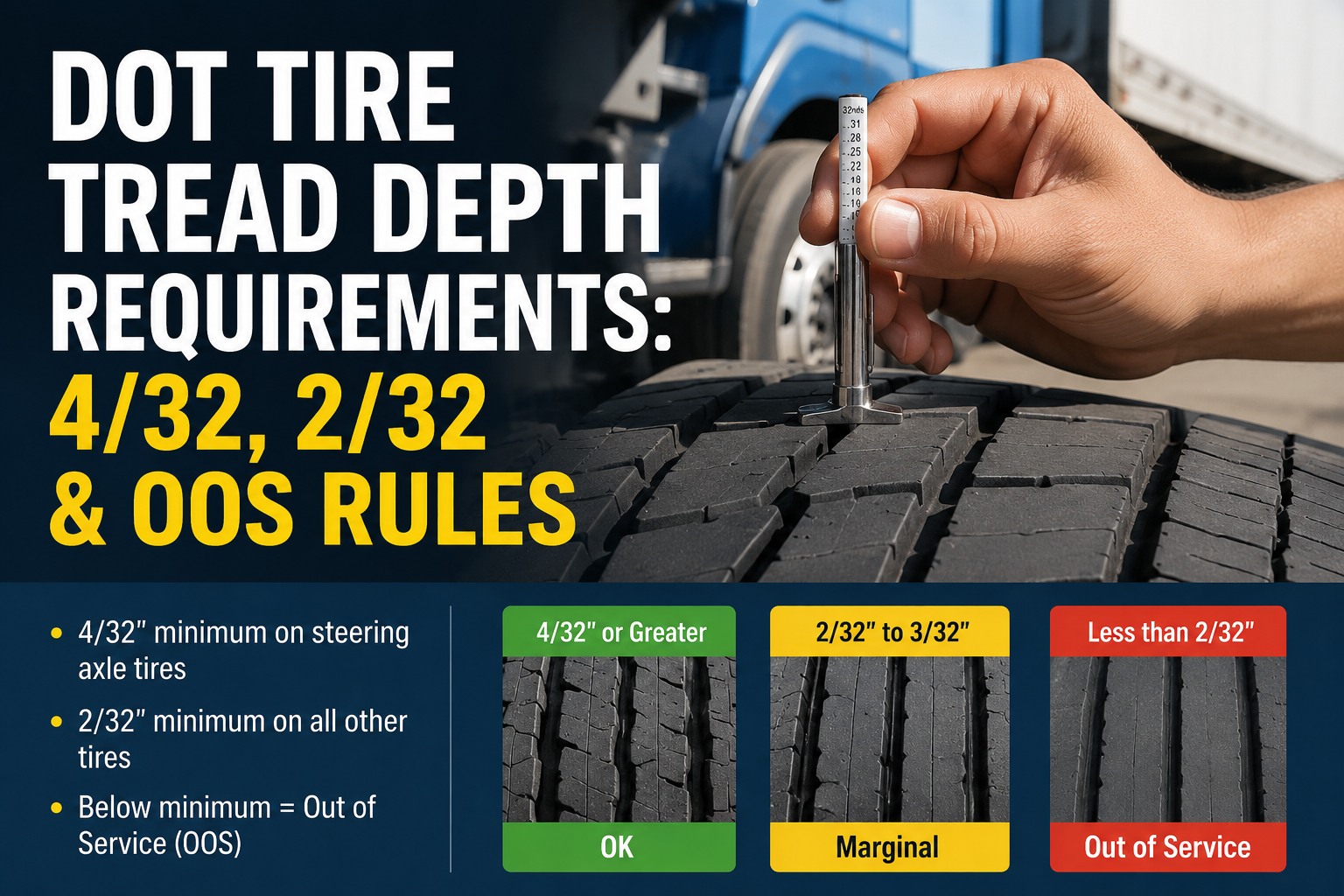
A new commercial truck tire starts around 12/32" of tread and wears down a thirty-second at a time — invisibly — staying legal right up until the day an inspector's gauge says it isn't. DOT tire tread depth requirements come down to two numbers most people get slightly wrong: not one universal minimum, but different thresholds for different tire positions. Steer tires and everything else are held to different standards, and knowing which number applies where is the difference between a tire that passes and one that grounds the truck. Book a demo to track tread depth per tire before it crosses the line.
DOT Tire Tread Depth Requirements: 4/32, 2/32 & OOS Rules
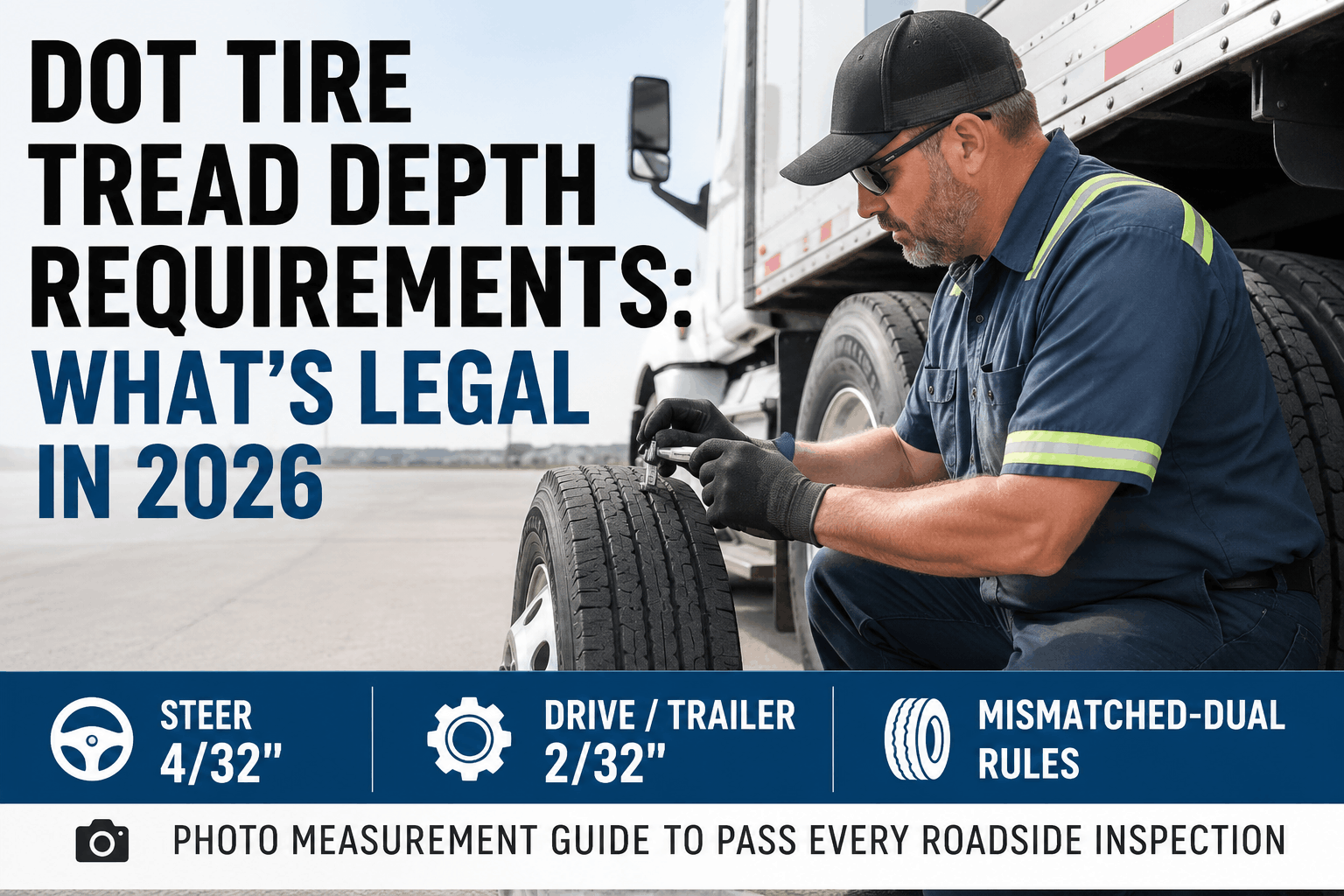
Front wheels of a bus, truck, or truck tractor must have at least 4/32" tread groove pattern depth, measured at any point on a major tread groove.
Drive and trailer positions must have at least 2/32" in a major tread groove — the higher steer requirement reflects their role in steering and wet-weather control.
Educational overview based on 49 CFR 393.75 — not legal advice. These are federal operating minimums; CVSA out-of-service criteria are separate and worded differently (covered below). State rules and manufacturer guidance may add requirements. Always verify current FMCSA regulations and inspection criteria before relying on any figure.
That position-based split is the single most misunderstood thing about truck tire compliance. There is no one "DOT minimum tread depth" that applies to every tire — the federal rule sets a higher bar for the front (steer) tires that do the steering and carry the most safety-critical role, and a lower bar for the drive and trailer tires behind them. Present a single universal number and you'll either replace good tires too early or, worse, run a steer tire that's legal by the trailer standard but a violation up front. Everything else about tire compliance — how you measure, what counts as a groove, when a tire is out of service — builds on getting this first distinction right.
How to measure tread depth correctly
A tread reading is only as good as where and how you take it. The regulation is specific about this, and getting it wrong in either direction causes problems — a bad measurement can flag a good tire or pass a bad one.
Take the reading in one of the main circumferential grooves. The rule specifically excludes measurements where tie bars, humps, or fillets are located, and the thin decoupling groove at the shoulder is not a major groove.
Tires rarely wear evenly. What matters is the minimum remaining tread at the relevant location — not an average across the tire. One spot in one major groove below the minimum is enough to create a violation.
A calibrated tread-depth gauge is far more reliable than visual estimation or the penny trick. Those quick checks can catch an obviously bald tire, but they won't tell you a steer tire sitting just above or below 4/32".
Write down the actual number, the tire position, and the date. A recorded measurement lets you track wear over time and spot a tire approaching its threshold before it crosses it.
This is where informal "looks fine" checks fall apart: the difference between a compliant steer tire and a violation is a single thirty-second of an inch, invisible to the eye. A gauge and a recorded number turn a guess into evidence.
Tire conditions that go beyond tread depth
Tread depth is only part of the picture. The federal rule and inspection criteria flag several tire conditions that can create a violation or an out-of-service condition regardless of how much tread remains — a tire can have plenty of tread and still be unsafe to operate.
Body ply or belt material showing through the tread or sidewall.
The tread or sidewall separating from the tire body.
A flat tire, or one with a detectable or audible leak.
Cuts or damage deep enough to expose the internal ply or belt material.
Bulges or knots indicating internal damage or separation.
Tires labeled for off-road or non-highway use, run on the highway.
These conditions matter because they can place a tire — and the vehicle — out of service on the spot, independent of the tread numbers. A driver walking the truck should treat any of them as a stop-and-escalate finding. Confirm the current, full set of conditions and their exact treatment in 49 CFR 393.75 and applicable inspection criteria, since wording and interpretation carry nuance. Start free on HVI to log these conditions with photos as they're found.
FMCSA operating minimum vs. CVSA out-of-service line
Here's a distinction that trips up even experienced fleets: the federal operating minimum and the roadside out-of-service criteria are two different standards, set by two different bodies, and they don't use the same numbers.
The federal standard a tire must meet to be legally operated: 4/32" on steer/front tires, 2/32" on other positions, measured in a major groove. Fall below and you're subject to a citation.
A separate, differently-worded standard inspectors apply to decide whether to place a tire out of service. It's commonly cited as stricter and measured differently — for example, using adjacent grooves at multiple points, and treating a tire at or below a set fraction of maximum inflation as out of service.
This is also why "my tire is above 2/32" isn't automatically a safe answer for a steer position — the position, the standard being applied, and the measurement method all matter. Managing to a buffer keeps you clear of both standards at once. Book a demo to set replacement-threshold alerts before the line
Retread and steer-position restrictions
The federal rule adds specific restrictions on regrooved, recapped, and retreaded tires in certain positions. These are narrower than the internet sometimes suggests, so here's the careful version.
No bus may be operated with regrooved, recapped, or retreaded tires on the front wheels.
A regrooved tire with a load-carrying capacity at or above 2,232 kg (4,920 lb) is restricted from the front wheels of a truck or truck tractor.
Beyond these federal provisions, tire manufacturers and some states set their own guidance on retread use and placement. The safe practice is to follow the federal rule, manufacturer specifications, and any applicable state requirements together — and to confirm the exact current provisions in 49 CFR 393.75 rather than relying on a summary.
Inflation and irregular wear: the root-cause layer
Tread depth tells you when a tire is worn out. Inflation and wear patterns tell you why — and ignoring that means replacing tires without fixing what's eating them.
Correct cold inflation depends on the tire and the load being carried — there is no single "right" pressure for every truck tire. Under-inflation builds heat and causes shoulder wear and blowouts; over-inflation causes center wear and a harsh ride. Follow the tire and vehicle manufacturer's recommended inflation for the load, and check pressure cold for an accurate reading.
Uneven tread wear is often a warning sign of an underlying mechanical issue — alignment, suspension, worn components, or chronic inflation problems. Replacing a tire that wore unevenly without addressing the cause just sets up the replacement to fail the same way. The wear pattern is a diagnostic clue worth reading.
This is where recorded data pays off: when you can see that the same axle or the same vehicle keeps chewing through tires in the same pattern, you can chase the alignment or suspension problem instead of just buying more tires. Book a demo to surface recurring wear across vehicles and axles
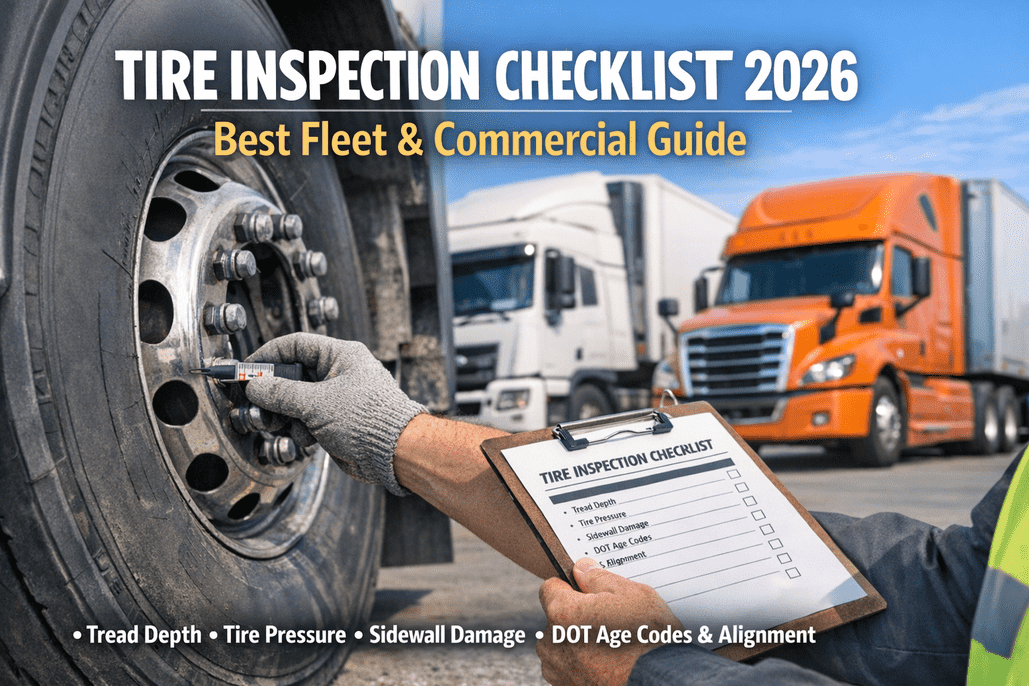
The practical tire inspection checklist
Here's what a thorough tire check covers — the items a driver runs during a pre-trip, and the ones that get escalated to qualified maintenance. Adapt it to your equipment and follow applicable regulatory and manufacturer guidance.
Visibly low tread, obvious damage, flats or leaks, embedded objects, low or soft tires — anything that looks or sounds wrong.
Precise tread measurement near limits, suspected separation, sidewall damage, recurring wear patterns, and any condition needing a repair-or-replace decision.
The driver's job is to catch and flag; the technician's job is to measure, decide, and document. A clear escalation line between the two is what keeps a borderline tire from either being ignored or being condemned without a proper check. Book a demo to route tire findings from driver to technician automatically
Pre-trip finding vs. maintenance issue vs. out-of-service
Not every tire finding is the same severity, and knowing the difference shapes how you respond. Three distinct outcomes, three different responses.
A driver spots a tire issue during inspection — the ideal moment, in the yard, before the truck moves. It's documented and routed for a decision.
A tire below a replacement threshold or showing wear that needs attention. It becomes a tracked corrective action — repair or replace, then verify.
A defect serious enough under inspection criteria that the tire or vehicle can't operate until corrected — the outcome prevention is designed to avoid.
The entire goal of a structured tire program is to move findings to the left — catching them as pre-trip findings and maintenance issues in the yard, so they never become out-of-service conditions at the roadside. That shift is where documentation and consistent measurement earn their keep. Start free to catch tire issues before they reach an inspector.
From a maintenance manager who started measuring, not guessing
For years our tire "inspection" was a driver kicking a tire and a tech eyeballing the steers. We got a steer-tire tread violation that we absolutely should have caught, and it stung — because it was preventable. So we started actually gauging every steer tire and writing the number down by position, every PM.
Two things happened. One, we stopped getting surprised — we could see a steer tire trending toward 4/32 and swap it on our schedule instead of an inspector's. Two, we noticed one tractor was burning through steers way faster than the rest, same shoulder wear every time. Turned out to be an alignment issue we'd never have found by guessing. The recorded numbers didn't just keep us legal — they told us where the real problem was.
The bottom line on tire tread depth
DOT tire tread depth requirements aren't complicated once you get the core distinctions right. Here's the whole picture in one frame.
4/32" on steer/front tires, 2/32" on other positions under 49 CFR 393.75 — never one universal minimum for every tire.
Gauge the major grooves at the shallowest point, avoid tie bars and fillets, and record the number by position.
Cuts, exposed cord, separation, leaks, inflation, and wear patterns all matter — and root causes need fixing, not just the tire.
Add the FMCSA-minimum-versus-CVSA-out-of-service distinction, manage to a replacement buffer, and keep a documented measurement history, and tire compliance becomes a routine you control rather than a roadside gamble. Always confirm the current federal thresholds, out-of-service criteria, and retread provisions against 49 CFR 393.75 and applicable inspection criteria before acting. For the day-to-day, the reliable path is simple: measure correctly, record consistently, and fix the cause — which is exactly where a structured tire-management process earns its place. Book a demo to manage tire inspections and tread depth with HVI.
Frequently asked questions
What is the DOT minimum tire tread depth for commercial trucks?
Under the federal regulation 49 CFR 393.75, the minimum tread depth depends on the tire's position, and there is no single universal number for every tire. Steer or front tires — the tires on the front wheels of a bus, truck, or truck tractor — must have a tread groove pattern depth of at least 4/32 of an inch, measured at any point on a major tread groove. All other tires, meaning the drive and trailer positions, must have at least 2/32 of an inch measured in a major tread groove. The higher requirement for steer tires reflects their safety-critical role in steering response and wet-weather control. It's important to understand that these are federal operating minimums — the point at which a tire falls below the legal standard and a driver can be cited. They are measured in a major tread groove, and the measurement specifically excludes locations where tie bars, humps, or fillets are found; the thin decoupling groove at the shoulder is not considered a major groove. Separately, the Commercial Vehicle Safety Alliance (CVSA) applies its own out-of-service criteria at roadside inspections, which are worded and measured differently. Because both the federal thresholds and the out-of-service criteria can carry nuance and are updated over time, fleets should verify the current requirements directly against 49 CFR 393.75 and applicable CVSA inspection criteria.
How should tire tread depth be measured?
Tread depth should be measured in a major tread groove using a proper tread-depth gauge, and read at the shallowest relevant point rather than averaged across the tire. Several details matter. The measurement must be taken in one of the main circumferential grooves — the regulation excludes measurements where tie bars, humps, or fillets are located, and the thin decoupling groove at the shoulder does not count as a major groove. Because tires rarely wear evenly, what matters is the minimum remaining tread at the relevant location: a single spot in a major groove below the minimum can constitute a violation, so averaging can hide a problem. A calibrated tread-depth gauge is far more reliable than visual estimation or the penny test; those quick checks can catch an obviously worn tire but won't reliably distinguish a steer tire sitting just above or below 4/32", where the margin is a single thirty-second of an inch. Finally, record the actual measurement with the tire position and date, because a documented reading lets you track wear over time and identify a tire approaching its threshold before it crosses it. Following regulatory requirements, tire manufacturer guidance, and qualified inspection procedures together gives the most reliable result.
What tire conditions can put a truck out of service?
Beyond insufficient tread depth, several tire conditions can create a violation or an out-of-service condition regardless of remaining tread, because they indicate the tire is unsafe to operate. Under the federal rule and applicable inspection criteria, these include body ply or belt material exposed through the tread or sidewall; tread or sidewall separation; a flat tire or one with an audible or otherwise detectable air leak; cuts or damage deep enough to expose the ply or belt material; bulges or knots indicating internal damage; and tires labeled "Not for Highway Use" being operated on the highway. Inflation is also a factor — roadside out-of-service criteria commonly treat a tire at or below a set fraction of its maximum inflation pressure as an out-of-service condition. The key point is that a tire can have plenty of tread and still be placed out of service because of one of these conditions, so tire inspection has to look at the whole tire, not just the tread numbers. Because the exact conditions, thresholds, and their treatment carry regulatory nuance and are periodically updated, verify the current specifics in 49 CFR 393.75 and the applicable CVSA out-of-service criteria.
Are retreaded tires allowed on commercial trucks?
Retreaded, recapped, and regrooved tires are permitted in many positions on commercial trucks, but the federal rule places specific restrictions on certain positions, and these are narrower than they are sometimes described. Under 49 CFR 393.75, no bus may be operated with regrooved, recapped, or retreaded tires on its front wheels. Separately, a regrooved tire with a load-carrying capacity at or above 2,232 kilograms (4,920 pounds) is restricted from use on the front wheels of any truck or truck tractor. These are the specific federal provisions; they do not amount to a blanket prohibition on retreads across all positions. Beyond the federal rule, individual tire manufacturers publish their own guidance on where and how their retreaded products should be used, and some states impose additional requirements. The safe approach for a fleet is to follow the federal regulation, the tire manufacturer's specifications, and any applicable state requirements together, and to confirm the exact current provisions directly in 49 CFR 393.75 rather than relying on a general summary, since the position-specific details are where compliance is won or lost. Recording the tire type and position for each wheel makes it far easier to demonstrate that retread placement follows the applicable rules.
How does tire management software help with tread-depth compliance?
Tire and inspection management software helps with tread-depth compliance by turning tire inspection from an informal visual check into a documented, trackable process — it captures and organizes the measurements and evidence, rather than calculating compliance for you or replacing an inspector's judgment. A platform like Heavy Vehicle Inspection (HVI) lets a fleet record the actual tread-depth reading for each tire by position, so a steer tire's 4/32-inch requirement and a drive or trailer tire's 2/32-inch requirement are tracked against the right standard. It captures photographs of tire conditions such as cuts, bulges, or exposed cord, records findings tied to the specific vehicle and tire position, creates corrective actions that can be assigned and verified, and retains the full inspection history so it's searchable later. That recorded history delivers two practical benefits: a fleet manager can see which tires are approaching replacement thresholds and schedule the swap proactively, and can investigate recurring wear patterns across specific vehicles or axles to find underlying causes like alignment or suspension problems. What the software does not do is guarantee a particular inspection outcome or replace the fleet's regulatory obligations — it functions as a tire and inspection management layer that makes measurements, evidence, and history reliable and retrievable, which fleets should pair with following current FMCSA regulations and applicable inspection criteria.
Manage tire inspections & tread depth with HVI
HVI turns tire compliance into a documented process: capture tread-depth readings by position, attach photos of every condition, record findings against the specific vehicle and wheel, assign and verify corrective actions, and keep a searchable history that flags tires approaching their thresholds and reveals recurring wear across axles. Measure correctly, record consistently, fix the root cause — with the evidence to prove it. HVI keeps the records; it doesn't replace your regulatory obligations or an inspector's judgment.
Tread-depth capture · Photo evidence · Wear-pattern history · Corrective-action tracking