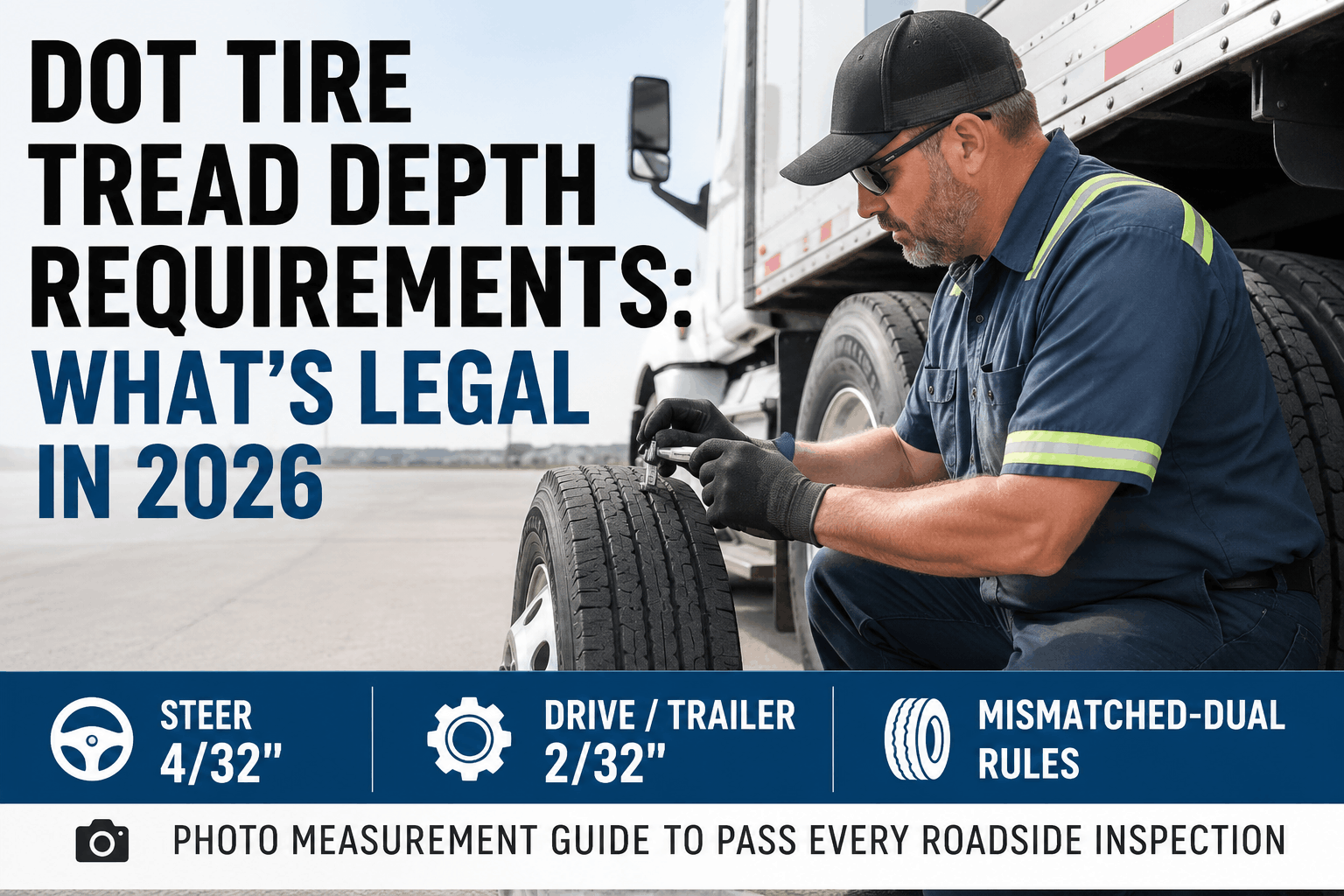
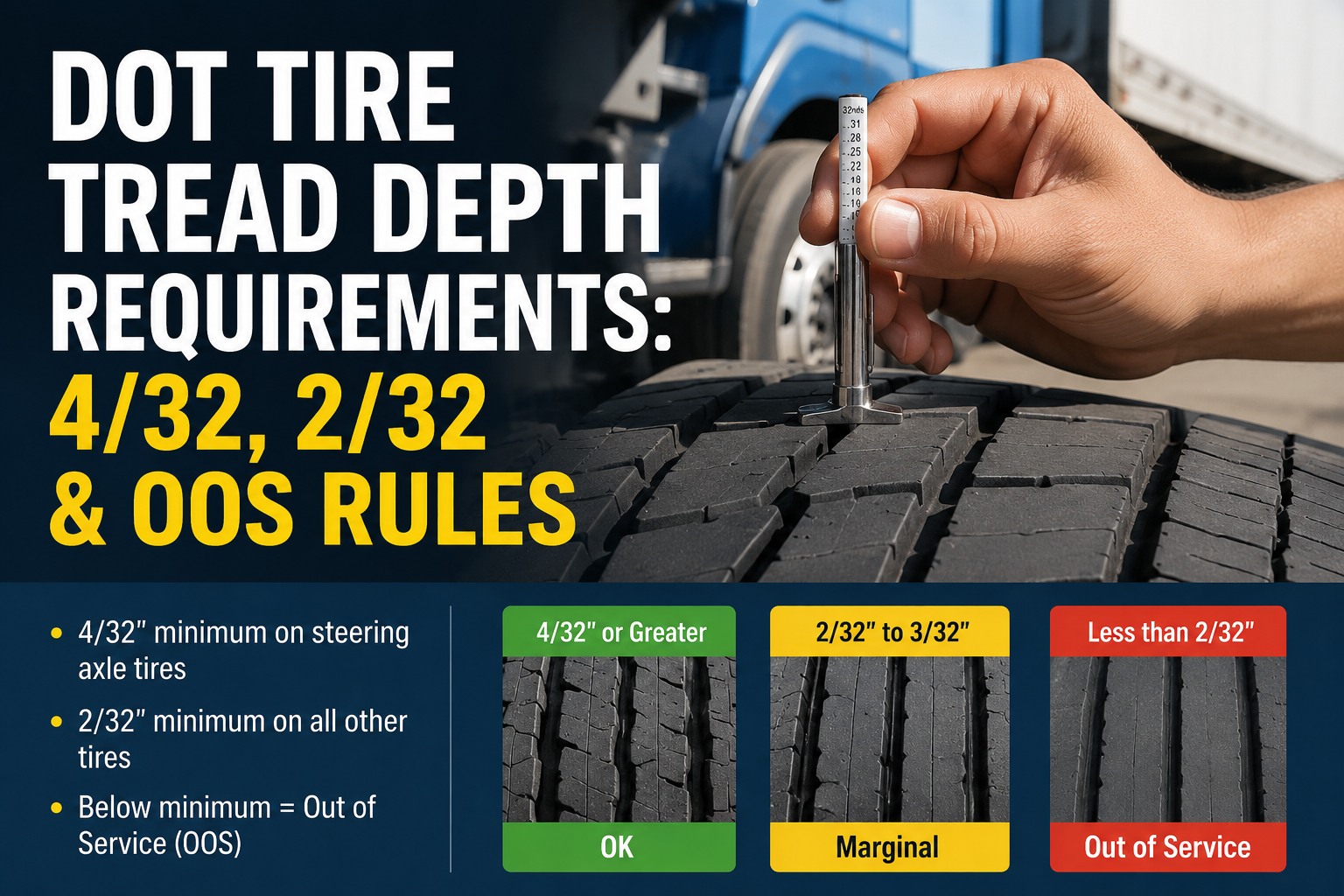
Tyre violations account for 21.4% of all vehicle out-of-service findings — the second most common OOS category after brakes. During the 2025 International Roadcheck, tyre defects caused 53.5% of all roadside breakdowns — the single largest breakdown category. The numbers that determine pass or fail are not complicated: 4/32" on steer axles, 2/32" on everything else. But there is a critical distinction most drivers and fleet techs miss: DOT minimum (FMCSA citation threshold) and CVSA OOS threshold (immediate shutdown) are different numbers — and both apply simultaneously at every roadside inspection. A steer tyre at 3/32" gets a citation but keeps rolling. A steer tyre at 1/32" in two adjacent grooves gets parked on the spot. Knowing these numbers — and how to measure them correctly — is the difference between passing and being placed out of service. HVI's digital inspection platform includes AI tyre analysis that estimates tread depth from photos and flags tyres approaching both DOT and CVSA thresholds — so your drivers catch wear at the yard before an inspector catches it at the scale.
Catch Tyre Wear Before the Weigh Station
HVI's AI analyses tyre photos for tread depth estimation, uneven wear patterns, and approaching minimums — at every daily inspection, across 163+ components.
The Two Tread Depth Standards: DOT vs. CVSA
This is the most important distinction in tyre compliance — and the one most drivers get wrong. Two different standards apply simultaneously, with different consequences.
Steer Axle
4/32" in any major groove
2/32" in two adjacent grooves
Drive Axle
2/32" in any major groove
1/32" in two adjacent grooves at 3 spots
Trailer Axle
2/32" in any major groove
1/32" in two adjacent grooves at 3 spots
What this means in practice: A steer tyre at 3/32" earns a citation (below DOT 4/32" minimum) but is not placed OOS. At 1.5/32" in two adjacent grooves — OOS and the truck is parked. Smart fleets replace at 5/32" steer and 3/32" drive/trailer to maintain a safety margin above both thresholds.
How to Measure Tyre Tread Depth Correctly
Inspectors measure at the shallowest point in any major tread groove — not on wear indicators, stone ejectors, or tie bars. Here is the exact technique.
1
Use a Calibrated Tread Depth Gauge
A $5 tread depth gauge is the most accurate tool. The "penny test" gives a rough estimate (all of Lincoln's head visible = less than 2/32") but is not precise enough for compliance measurements. Inspectors use calibrated gauges — your measurements should match their method.
2
Measure Every Major Tread Groove
Insert the gauge into each major groove on the tyre. The thin decoupling groove at the shoulder is not a major groove — it can be worn away without violation. Major grooves are the primary channels that span most of the tread width. If one spot on one major groove is below minimum — that is a violation.
3
Measure at Multiple Points Around the Circumference
Tread wears unevenly. Measure at a minimum of 3 points spaced at least 8 inches apart around the circumference. CVSA OOS criteria require depth to be below threshold at 3 separate locations for drive/trailer tyres — inspectors check multiple spots.
4
Check Both Sides and the Centre
Under-inflation causes centre wear. Over-inflation causes edge wear. Misalignment causes one-sided wear. Measure inside edge, centre, and outside edge separately. The lowest reading at any point is your compliance measurement — not the average.
5
Inspect Inner Duals — The Hidden Fail Point
The inner tyre on dual assemblies is the most commonly missed inspection item. Drivers cannot see it without getting low and looking between the tyres. Inspectors always check inner duals — and find violations there at disproportionate rates. HVI's guided walk-around requires inner dual photo capture.
HVI's AI analyses tyre photos at every daily inspection — estimating tread depth, detecting uneven wear patterns, and flagging tyres approaching DOT minimums. No gauge required for the daily check; gauge measurement at PM intervals confirms the AI reading.
Schedule a demo to see AI tyre analysis. Or
start free.
Immediate OOS Tyre Conditions (Any Position)
These conditions cause instant out-of-service regardless of tread depth — and every one is a daily inspection visual check.
Exposed body ply or belt material through tread or sidewall
Tread or sidewall separation from the casing
Flat tyre or audible air leak (456,000+ violations over 5 years)
Cuts or damage exposing ply or belt material
Bulge or blister on sidewall — immediate replacement required
Inflation below 50% of maximum sidewall pressure
Weight exceeding load rating marked on sidewall
Tyres marked "Not for Highway Use" on a highway vehicle
Wear Patterns That Signal Bigger Problems
Tread depth alone does not tell the full story. How the tyre wears reveals maintenance problems that affect both safety and fuel efficiency.
Centre Wear
Cause: Over-inflation. Tread wears faster in the centre because only the middle contacts the road.
Fix: Reduce to manufacturer spec. Check with dual-headed gauge weekly.
Edge Wear (Both Sides)
Cause: Under-inflation. Tread wears on both shoulders while the centre lifts off the road. Costs 1–2% fuel economy per 10 PSI low.
Fix: Inflate to spec. Consider TPMS for continuous monitoring.
One-Sided Wear
Cause: Misalignment. Steer axle misalignment of 0.5 degrees costs $2,000–$4,000 in fuel over 100,000 miles plus accelerated tyre replacement.
Fix: Alignment check. HVI AI detects one-sided wear patterns from tyre photos.
Feathering / Scalloping
Cause: Toe misalignment or worn suspension components (bushings, ball joints). Creates a sawtooth pattern across the tread face.
Fix: Suspension inspection + alignment. Do not just replace the tyre — the pattern returns.
Flat Spots
Cause: Locked brakes during hard stops, or a parked vehicle sitting for extended periods. Creates a vibration felt in the steering at speed.
Fix: Check brake system for drag or imbalance. Replace tyre if flat spot causes vibration.
HVI's AI detects abnormal wear patterns from daily inspection photos — catching alignment issues, inflation problems, and suspension wear before they accelerate tyre degradation or fail a roadside inspection.
Start free or
schedule a demo to see AI tyre analysis in action.
Know the Numbers. Measure Correctly. Replace Early.
Tyre compliance is not a single number — it is two sets of standards (DOT citation + CVSA OOS) across three axle positions (steer, drive, trailer) measured at multiple points (grooves, circumference, edges) with additional instant-OOS conditions that apply regardless of tread depth. The fleets that never get parked for tyre violations are not running better tyres — they are running better inspection processes: gauge measurement during daily walk-arounds, AI photo analysis that tracks wear progression between PM intervals, and replacement thresholds set above DOT minimums (5/32" steer, 3/32" drive/trailer) to maintain a safety buffer. HVI delivers this process: guided tyre inspection at every walk-around, AI tread depth estimation from photos, wear pattern detection, approaching-minimum alerts, and historical tracking that shows wear rate per vehicle. Start free today — or schedule a demo and see AI tyre analysis on your fleet.
Never Fail a Tyre Inspection Again
AI tread depth analysis. Wear pattern detection. DOT + CVSA dual-threshold alerts. Inner dual photo verification. Trusted by 25,000+ users.
Frequently Asked Questions
Q: What is the DOT minimum tyre tread depth for commercial vehicles?
Under 49 CFR 393.75: steer tyres must have at least 4/32" tread depth in any major groove. All other tyres (drive and trailer) must have at least 2/32" in any major groove. Measurements cannot be taken on wear indicators, tie bars, or stone ejectors. If one spot on one major groove is below the minimum — it is a citation.
Q: What is the difference between DOT and CVSA tyre requirements?
DOT (FMCSA) sets the citation threshold: 4/32" steer, 2/32" other. Below these = violation ticket but vehicle can continue. CVSA sets the OOS shutdown threshold: 2/32" steer (in two adjacent grooves), 1/32" other (in two adjacent grooves at 3 spots 8" apart). Below these = immediate out-of-service order. Both apply at every roadside inspection.
Start free with HVI — the platform tracks both thresholds.
Q: Can retreaded tyres be used on steer axles?
For trucks and truck tractors: retreaded and recapped tyres are permitted on steer axles under 49 CFR 393.75. However, regrooved tyres with a load capacity of 4,920 lbs or more are prohibited on front wheels. For buses: retreaded, recapped, or regrooved tyres are prohibited on front wheels under any circumstance. Retreads are permitted on all drive and trailer positions for all vehicle types.
Q: When should I replace tyres to avoid violations?
Major fleets recommend replacing at 5/32" steer and 3/32" drive/trailer — maintaining a safety margin above both DOT and CVSA thresholds. This buffer accounts for measurement variation, wear between inspections, and the accelerating wear rate that occurs as tread gets thinner. HVI tracks tread depth trends over time and alerts when tyres approach your configured replacement threshold.
Schedule a demo.
Q: What are the mismatched dual tyre rules?
Under 49 CFR 393.75(h), dual tyres must not contact each other or any other part of the vehicle. Mismatched sizes on the same axle position create uneven load distribution, accelerated wear, and potential tyre-to-tyre rubbing. While FMCSA does not specify a maximum circumference difference, industry best practice is no more than 3/4" difference in circumference between dual partners. HVI's guided dual inspection includes gap verification and matched-set checking.