A worn tire is easy to read wrong. Shoulder wear on a trailer tire and shoulder wear on a steer tire look identical — but one is underinflation and the other might be a bent axle two positions away. That's the trap in tire wear pattern diagnosis: a single pattern on a single tire isn't a diagnosis, it's one data point. The mechanics who actually stop tires wearing out read the whole truck's tire set together, because the pattern that repeats across positions, or shows up where it shouldn't, points to the real cause. This guide covers the pattern-to-cause relationships and how to read them across positions to find the fault behind the wear. Book a demo to see wear patterns tracked by position across the fleet.
One Tire Is a Clue — the Truck Is the Diagnosis
The same wear pattern means different things at different positions, and a fault on one axle often shows up on another. Read a single tire and you replace a symptom; read the whole set together and you find the alignment, axle, or suspension cause behind it.
Tire wear patterns are genuine diagnostic signals — inflation, alignment, suspension, axle geometry, load, and braking all leave their signature in the tread. But a pattern is a clue, not a verdict. The same signature can come from different causes depending on where the tire sits, and one mechanical fault often prints wear on several tires at once. The skill isn't memorizing patterns; it's reading them in context.
A Pattern Is a Signal, Not a Verdict
The single biggest mistake in wear diagnosis is treating a pattern as proof of one specific fault, replacing the tire, and moving on — only for the same wear to reappear on the replacement in another 30,000 miles. A pattern narrows the search; it doesn't end it.
Replace the symptom
See shoulder wear, blame inflation, fit a new tire. If the real cause was alignment or a load issue, the new tire starts wearing exactly the same way the day it goes on — and you pay twice for the same undiagnosed fault.
Fix the cause
Compare the pattern across positions and axles, confirm inflation and matching first, then investigate the mechanical condition — and correct it before replacing. The new tire goes onto a truck that won't destroy it.
USTMA points to pressure, alignment, rotation, and tread as the core areas of tire maintenance — and notice that three of those four are truck conditions, not tire conditions. That's the whole point: most irregular wear is the truck writing its mechanical problems onto the rubber, which is why you diagnose the truck, not just the tire. Book a demo to see wear tied to a probable mechanical cause.
The Patterns and Their Usual Causes
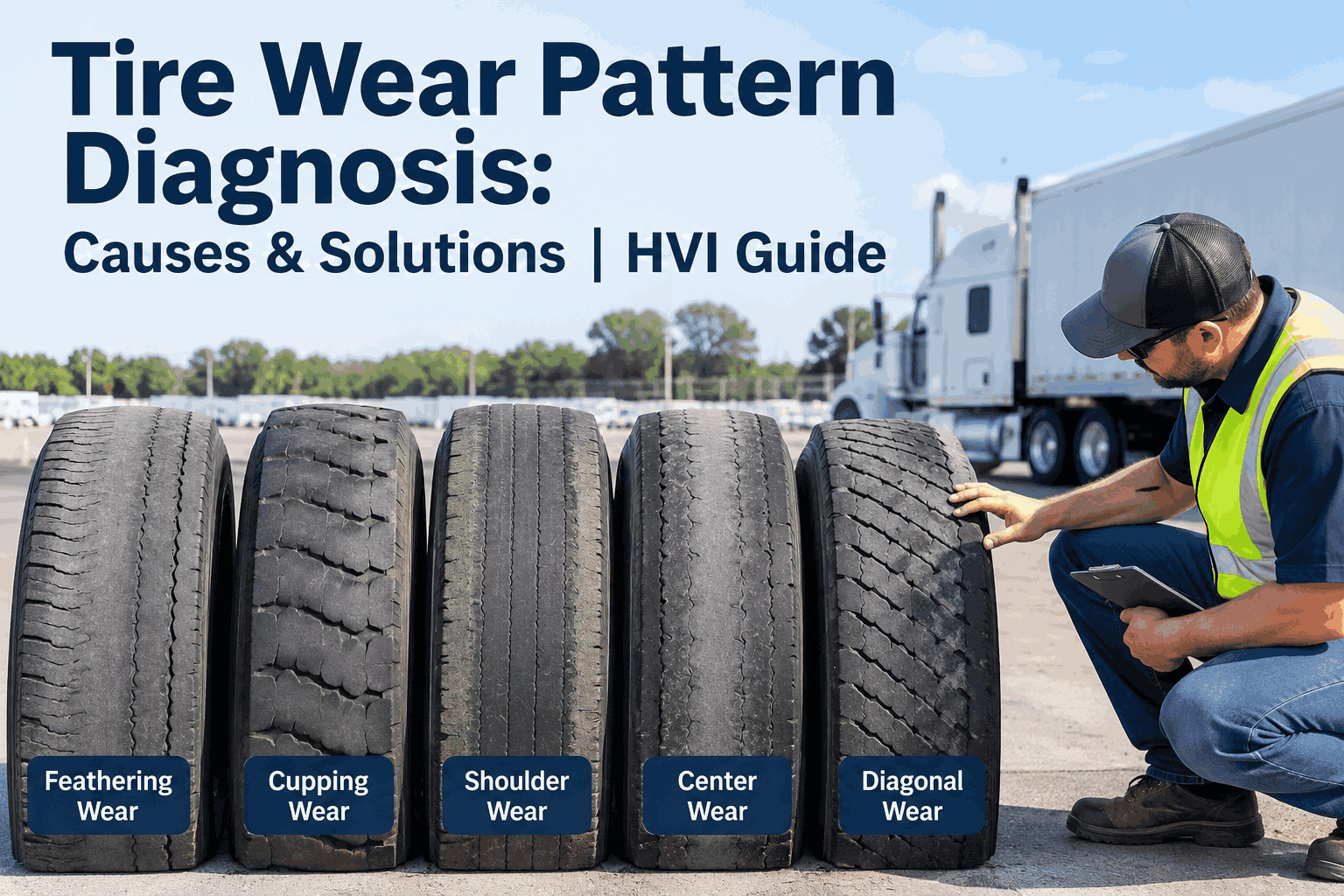
Start with the vocabulary. Each pattern has a most-likely cause, and knowing the shortlist is the first filter. Treat these as the probable cause to confirm, not the final answer.
The center rib worn faster than the shoulders.
Both outer edges worn ahead of the center.
One shoulder worn, tapering across the face.
Ribs sharp one edge, smooth the other — a hand-rub tell.
Wavy, dipped scallops around the tread.
Flat spots or wear crossing the tread diagonally.
Tread blocks worn high-to-low front to back.
A localized bald patch on the tread.
This catalogue is the reference every diagnosis starts from — and HVI covers each pattern's look-and-fix in depth in its wear-pattern diagnosis guide shown in a demo. But the catalogue is where most guides stop, and it's only step one. The pattern tells you what to suspect; where it sits tells you what it actually is. Start free and log the pattern on every position.
Why the Same Pattern Means Different Things by Position
Here's what the pattern catalogue can't tell you on its own: position changes the diagnosis. A pattern that means one thing on a steer tire can mean something completely different on a trailer, because the positions do different jobs and answer to different mechanical systems.
Steering, camber, and upstream faults
Steer tires answer to front-end alignment and suspension geometry — but they also reveal faults from behind them. Irregular steer wear can trace to drive-axle misalignment pushing the truck slightly sideways, which the steering corrects for, printing wear up front.
Torque, rotation, and dual matching
Drive tires take engine torque and live in duals, so heel-and-toe, alternate-lug, and diagonal wear point at drive-axle condition, overdue rotation, or mismatched duals as much as alignment. Same shoulder wear, different suspect list than a steer.
Axle alignment, bearings, and load
Trailer tires are free-rolling, so their wear points hard at trailer-axle alignment, bearing condition, and load distribution. Diagonal or one-sided trailer wear is often a trailer axle out of square, not a tire or inflation problem at all.
So the diagnostic question is never just "what's this pattern?" — it's "what's this pattern, at this position?" The drive-axle-to-steer link is the classic example: a fault at the back writes its signature at the front, and only someone reading both positions together makes the connection. That's the difference between chasing tires and finding the cause. Book a demo to compare wear across a truck's positions.
Read the Set: How Cross-Position Diagnosis Works
Reading the whole truck's tires together is a short, repeatable routine. It turns eight separate tire checks into one diagnosis of the vehicle underneath them.
Confirm every tire's pressure cold. Shoulder and center wear are inflation until proven otherwise — fix pressure before you go chasing alignment.
Check duals are matched and rotation is current. A mismatch or overdue rotation mimics mechanical wear — clear those before diagnosing the truck.
Note which pattern shows on which tire. One tire is a clue; the same pattern on both sides of an axle, or across axles, is a mechanical fault.
Let the position and spread point at the system — front alignment, drive axle, trailer axle, suspension — and correct that before the tire is replaced.
The logic that ties it together: symmetrical wear on both tires of an axle usually means inflation or load; wear on one side across a whole axle points at that axle's alignment; and a pattern caused elsewhere — like steer wear from a drive-axle problem — only reveals itself when you compare positions. Read the set and the truck tells you what's wrong; read one tire and you're guessing. Start free and map wear across every position.
How HVI Turns Wear Patterns Into Corrective Action
Cross-position diagnosis needs the patterns recorded where they can be compared — not scattered across shift notes. Three capabilities make the whole-truck read possible and the fix trackable.
Wear pattern by wheel position
Log the pattern and a photo at each position — steer, drive, trailer, inner and outer — so the whole truck's wear sits in one view and cross-position faults become visible instead of hidden.
Route the mechanical cause
Route a suspected alignment, axle, or suspension fault to a work order — so an irregular pattern triggers the correction behind it, not just a tire swap that wears the same way.
Recurring-wear analytics
Track wear across assets over time — so a truck or position that keeps generating the same pattern surfaces as a maintenance problem to solve, not a tire budget to keep refilling.
The result is wear diagnosis that closes the loop: the pattern is captured by position, compared across the truck, traced to the mechanical cause, routed for correction, and tracked so the fix holds. That's how tire spend stops being a recurring expense and becomes a readout of the fleet's mechanical health. Book a demo to see it across your fleet. Start free and diagnose wear by position.
From a fleet manager who found the fault two axles away
We kept killing steer tires on one tractor and kept replacing them, blaming the front alignment. It wasn't until we logged the wear at every position and looked at the whole truck that it clicked — the drive axle was out of square, steering was fighting it, and the steer tires paid for it. Aligned the drive axle and the steer wear stopped. The pattern across the truck found what the one tire couldn't.
Frequently asked questions
What do tire wear patterns tell you?
Tire wear patterns are diagnostic signals about the vehicle's condition. Center wear usually points to overinflation; both-shoulder wear to underinflation or overload; one-sided wear to camber or toe misalignment; feathering to toe; cupping or scalloping to worn shocks, suspension, or imbalance; diagonal or erratic wear to axle alignment or mismatched duals; heel-and-toe to drive-axle issues or overdue rotation; and flat spotting to hard braking or long stationary loading. But a pattern is a probable cause to confirm, not proof of a single fault — where the tire sits changes what the same pattern means.
Why does the same wear pattern have different causes at different positions?
Because each position does a different job and answers to different mechanical systems. Steer tires respond to front-end alignment and steering geometry; drive tires take torque, run in duals, and respond to drive-axle condition, rotation, and dual matching; trailer tires are free-rolling and respond to trailer-axle alignment, bearings, and load. So one-sided wear on a steer suggests front camber or toe, while the same wear on a trailer more likely means a trailer axle out of square. Reading the pattern together with its position is what turns a guess into a diagnosis.
Can a problem on one axle cause tire wear on another?
Yes, and it's a common miss. A classic example is drive-axle misalignment: if the drive axle pushes the truck slightly sideways, the steering compensates to keep it tracking straight, and that continuous correction prints irregular wear on the steer tires — even though the fault is two positions back. Thrust-angle and axle-geometry problems routinely show up on tires other than the ones nearest the fault. That's why reading the whole truck's tire set together, rather than diagnosing one tire in isolation, catches causes a single-tire read would miss.
Should you replace a tire showing irregular wear?
Replace it only after you've found and corrected the cause — otherwise the new tire wears out the same way. First rule out inflation (check pressure cold) and confirm matching and rotation, since those mimic mechanical wear. Then use the pattern and its position to point at the mechanical fault — alignment, axle, suspension, bearings — and fix that. A tire with irregular wear may still need replacing if it's below tread minimum or damaged, but replacing it without addressing the underlying condition just resets the same clock on a fresh tire.
How do you diagnose tire wear across a fleet?
Capture the wear pattern and a photo at each wheel position, so the whole truck's wear can be compared in one view rather than tire by tire. Rule out inflation and matching first, map which pattern shows at which position, and follow the spread to the mechanical system behind it. Then route the suspected cause for correction and track recurring wear across assets over time — so a truck or position that keeps generating the same pattern is flagged as a maintenance problem. A platform like HVI records wear by position, routes defects, and trends recurring patterns for exactly this.
Diagnose the Truck, Not Just the Tire
Capture wear patterns by wheel position with photo evidence, compare across the whole truck to find the fault that prints on more than one tire, route the mechanical cause for correction, and track recurring wear across the fleet — so you fix the alignment, axle, or suspension behind the wear instead of buying the same tire twice. Live in under two weeks, trusted by 25,000+ users worldwide.
No credit card · No hardware · Wear-pattern inspection fields ready on day one