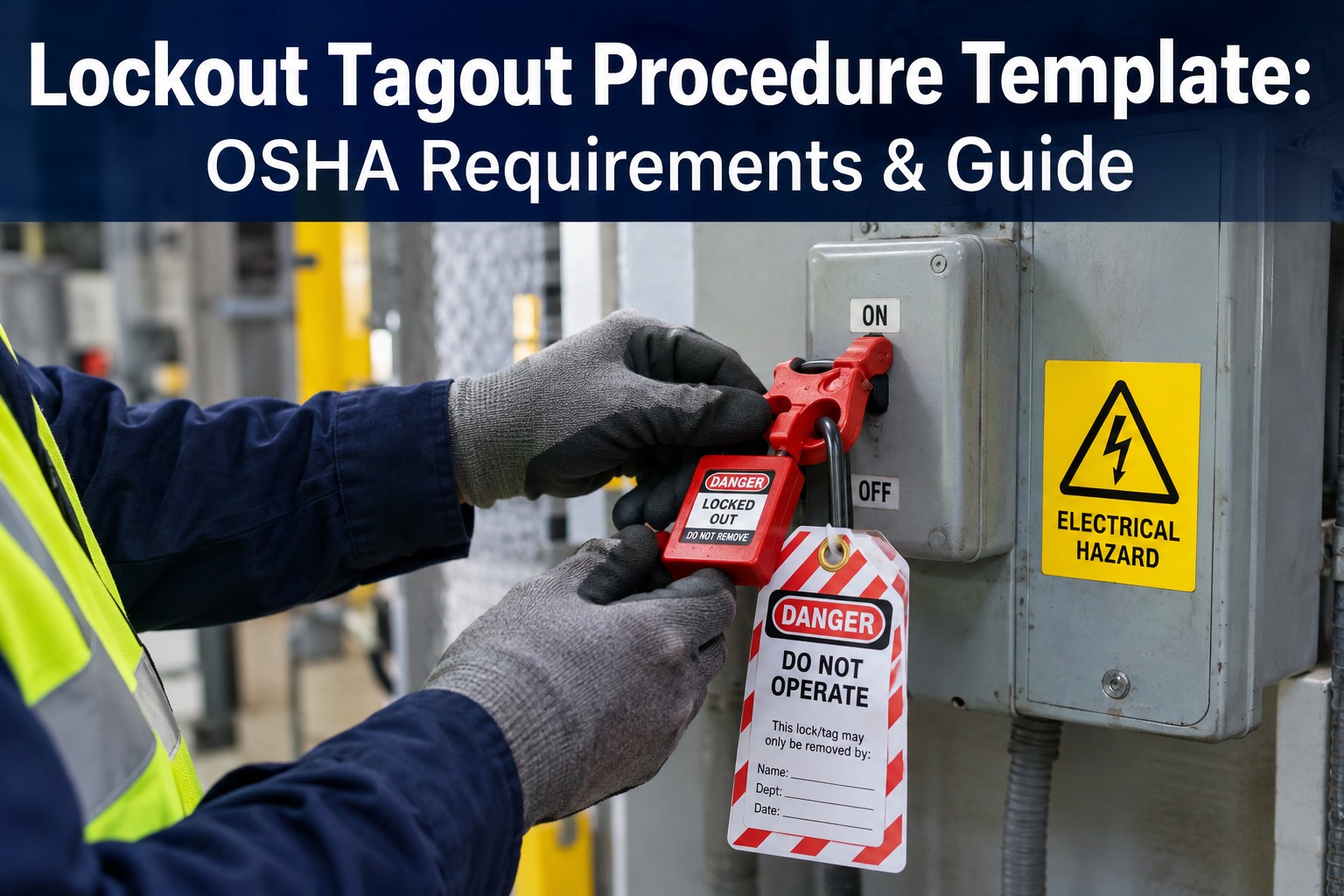
A company-wide "we use lockout/tagout" policy won't protect the technician reaching into a machine. What protects them is a lockout tagout procedure that tells that specific person which energy sources this machine has, where to isolate them, how to release stored energy, and how to verify it's dead before a hand goes in. OSHA's 1910.147 requires that specificity — not a binder of good intentions. This guide covers what a compliant energy-control procedure must include and how to build machine-specific ones. Book a demo to see asset-specific procedures managed in HVI.
Lockout Tagout Procedure Template: OSHA Requirements & Guide
The most useful procedure tells an authorized employee exactly how hazardous energy is controlled on the machine in front of them. Here's how to build one that does.
Educational resource, not legal advice. Procedures must be adapted to your specific equipment, energy sources, manufacturer requirements, and applicable OSHA or state-plan rules.
Under OSHA 29 CFR 1910.147, controlling hazardous energy isn't a single document — it's a program with three legs: written energy-control procedures, employee training, and periodic inspections. The procedures are where most programs are strong or weak, because a generic template that says "isolate all energy sources" tells an authorized employee nothing about the hydraulic accumulator that stays pressurized after shutdown or the exact disconnect that de-energizes this press. This guide walks the procedure requirements, how to build machine-specific ones that are actually usable, and the training and inspection obligations that surround them.
Policy vs. procedure: why the difference matters
People use "LOTO policy" and "LOTO procedure" interchangeably, and that confusion is exactly where programs fail an inspection. They're two different things, and OSHA requires both.
The high-level program document: your organization's overall approach, rules, responsibilities, who's authorized, and how the program is governed. It's the framework — necessary, but it doesn't tell anyone how to lock out a specific machine.
The working document an authorized employee uses at the equipment: this machine's energy sources, isolation points, devices, stored-energy hazards, and verification steps. This is what actually controls the hazard on the floor.
A common citation pattern is an employer with a polished written policy but no equipment-specific procedures — or procedures so generic they'd apply to any machine, which means they truly apply to none. The policy sets the rules; the procedure does the work. Book a demo to attach specific procedures to each asset in HVI
What a lockout tagout procedure must include
A usable energy-control procedure walks the authorized employee through a defined sequence. OSHA requires procedures that clearly outline the scope, purpose, authorization, rules, and techniques for controlling energy — and in practice that means these components, in order.
Which specific equipment this procedure covers, and the servicing/maintenance situations it applies to. A common procedure covering similar machines must identify the specific equipment by type and location.
The specific, ordered steps to shut the machine down normally before isolation — not "turn it off," but the correct sequence for this equipment.
Every hazardous energy source on this machine, by type and magnitude — electrical, hydraulic, pneumatic, mechanical, thermal, gravity, spring, chemical, and others where present.
Exactly where and how to isolate each source — the specific disconnect, valve, or block — and where the lockout or tagout device goes on each.
How to dissipate or restrain residual and stored energy — bleed hydraulic pressure, block elevated components, discharge capacitors, relieve springs — until the machine is genuinely safe.
The step that confirms all energy is controlled before work begins, using the right method for the equipment — try-to-start, test for voltage, check gauges at zero.
Then, at the end of the job, the return-to-service steps: inspect the work area, confirm all employees are clear, remove devices per the procedure, and notify affected employees before re-energizing. A procedure that names the actual disconnects, the actual accumulator, and the actual verification method for this machine is worth more than a hundred generic templates. Start free on HVI to build procedures on each asset record.
Does every machine need its own procedure?
This is one of the most common — and most misunderstood — LOTO questions. The answer is nuanced, and getting it wrong in either direction causes problems: either endless redundant paperwork, or dangerous gaps.
If multiple machines have the same energy sources, isolation points, and shutdown sequence, one documented procedure can cover them — as long as it identifies the specific equipment it applies to by type and location. Identical presses on a line don't each need a unique document.
When machines differ in energy sources, isolation points, or shutdown sequence, they need distinct procedures. A hydraulic press and a pneumatic conveyor can't share a procedure — the isolation and stored-energy steps aren't the same.
OSHA's 1910.147 includes a narrow exception: a machine's procedure need not be documented if all eight conditions in the standard's note are met — including that the machine has a single, readily identified energy source with no potential for stored energy, isolation fully de-energizes it, one authorized employee has exclusive control, and there's no history of LOTO-related injury on that machine. Miss even one condition and the documented procedure is required. In practice, most industrial equipment doesn't meet all eight, so don't assume the exception applies — verify each condition.
So the honest answer isn't "every machine needs a unique document" and it isn't "one procedure covers everything." It's: group genuinely similar equipment under a common procedure, write distinct procedures where energy control materially differs, and only skip documentation when all eight exception conditions are truly met — a judgment for qualified safety personnel. Book a demo to organize common and machine-specific procedures across your assets
Stored energy: the part that kills people
Flipping the disconnect isn't the finish line. A machine that's electrically isolated can still hold enough stored energy to cause a fatal injury, and stored-energy hazards are behind many serious LOTO incidents. Isolation isn't complete until residual energy is released or restrained.
Pressure held in accumulators, cylinders, and lines after shutdown.
Compressed air trapped in tanks, lines, and actuators.
Raised components, rams, or loads that can drop when released.
Compressed or extended springs storing mechanical force.
Charge retained in capacitors even after power is cut.
Hot surfaces, fluids, or components that haven't cooled.
Rotating flywheels or moving parts still in motion.
Trapped process fluids, steam, or pressurized systems.
Not every machine has every type — the procedure's job is to identify which of these are actually present on this equipment and specify how each is made safe: bleed the accumulator, block the ram, discharge the capacitors, let it cool. A procedure that isolates the main power but ignores a pressurized accumulator can kill someone who trusted it.
Training: authorized, affected, and other employees
OSHA defines three categories of employee for LOTO, each with a different training objective. A frequently cited deficiency is training the authorized employees well and forgetting that affected employees must be trained too.
Performs the lockout/tagout — the person who services or maintains the equipment. Trained in recognizing hazardous energy sources, the type and magnitude present, and the methods and means to isolate and control it.
Operates the machine being serviced, or works in the area where it's happening. Must be instructed in the purpose and use of the procedure — and never to touch a locked-out machine or attempt to restart it.
Works in an area where LOTO procedures may be used. Needs awareness-level instruction about the prohibition on attempting to restart or re-energize locked-out equipment.
Retraining is required when job assignments change, when machines or processes change, when procedures are updated, or when a periodic inspection reveals deviations or gaps in an employee's knowledge — it isn't a fixed annual event. Training must be certified, with each employee's name and training dates on record. Start free to keep LOTO training records by employee and category.
The annual periodic inspection
This is one of the most commonly cited parts of the whole standard, usually because employers either skip it or don't document it. OSHA requires a periodic inspection of each energy-control procedure, and it has specific rules about who and what.
Each energy-control procedure must be inspected at least once a year to ensure it's being followed and the standard's requirements are met.
Performed by an authorized employee other than the one(s) using the procedure being inspected — you can't audit your own procedure.
Where lockout is used, the inspector reviews each authorized employee's responsibilities under the procedure. Tagout adds a review with affected employees and tag limitations.
Certify that each inspection happened, identifying the machine or equipment, the date, the employees included, and the person who performed it.
The inspection isn't just a compliance box — it's the built-in quality check on your program. If an authorized employee can't articulate the correct isolation sequence during the review, that's a training gap surfacing exactly where you want to catch it. Deviations and inadequacies found must be corrected. Book a demo to schedule, record, and certify annual LOTO inspections per procedure
Group lockout, shift changes, and contractors
Real maintenance is rarely one person, one lock, one shift. The standard has specific provisions for the situations where multiple people or handoffs are involved — and these are where protection quietly breaks down if the procedure doesn't address them.
When several authorized employees service the same equipment, each must be protected as if they held sole control — typically through a group lockout device or lockbox where every employee applies a personal lock. Protection can't depend on one person's single lock.
When work carries across shifts, there must be an orderly transfer of lockout/tagout protection between outgoing and incoming employees, so hazardous energy stays controlled continuously — never a gap where the machine is unprotected during a handoff.
When outside personnel service your equipment, your employer and theirs must coordinate so each understands and follows the applicable energy-control procedures. Both sides need to know the other's LOTO expectations before work starts.
Each of these adds coordination that a single-person procedure doesn't capture, which is why the program has to account for how work actually happens on your floor — multiple trades on one machine, a job that runs past shift end, a contractor who's never seen your equipment. Getting these documented and communicated is part of a complete program.
From a maintenance manager who centralized it all
Our LOTO procedures lived in a binder in the maintenance office and a shared drive nobody could navigate. When a tech got assigned to a machine, they'd either work from memory or go hunt for the procedure — and "from memory" is exactly how people get hurt. Our annual inspections were just as messy; I honestly couldn't have told you which procedures had been inspected that year.
We moved every procedure onto the asset it belongs to, so it shows up on the work order when someone's assigned. Training records and inspection certifications sit against the same equipment. Last audit, the inspector asked to see the procedure and inspection history for a specific press, and I had all of it on screen in under a minute. That's the difference between having a program and being able to prove you have one.
A good procedure is specific, findable, and inspected
A strong lockout tagout procedure isn't a generic template with your logo on it — it's a machine-specific document that tells an authorized employee exactly how hazardous energy is controlled on the equipment in front of them. Under OSHA 1910.147, that means procedures identifying the specific machine, its shutdown sequence, every energy source by type and magnitude, the isolation points and devices, the stored-energy release or restraint steps, and the verification that confirms the machine is genuinely safe before work begins — plus the return-to-service steps at the end. Around those procedures sits the rest of the program: training tailored to authorized, affected, and other employees; the group lockout, shift-change, and contractor provisions; and the periodic inspection, performed at least annually by an independent authorized employee and certified in writing. Whether every machine needs its own document depends on how similar the equipment is and whether the narrow eight-condition exception applies — a judgment for qualified safety personnel.
The operational challenge behind all of it is the same one the standard keeps pointing at: the procedure only protects someone if they can find the right one, and the program only survives an audit if the training and inspection records are current and retrievable. That's the role HVI plays — associating energy-control procedures, work orders with isolation instructions, training records, periodic-inspection records, and corrective actions with specific assets, so the correct procedure travels with the equipment and the whole compliance picture for any machine is one search away. To be clear about the boundary: HVI helps you manage, organize, and document the program, but it doesn't make a lockout/tagout program OSHA-compliant on its own and doesn't replace qualified safety professionals. This article is an educational resource, not legal advice; adapt everything here to your actual equipment, manufacturer requirements, and applicable OSHA or state-plan standards. Book a demo to build asset-specific LOTO procedures in HVI.
Frequently asked questions
What should a lockout tagout procedure include?
A compliant energy-control procedure under OSHA 1910.147 should walk an authorized employee through controlling hazardous energy on a specific machine, and it generally includes several components in sequence. First, it identifies the machine or equipment, along with the scope and purpose — the servicing and maintenance situations it applies to; a common procedure covering similar equipment must identify that equipment by type and location. Second, it specifies the shutdown sequence, the ordered steps to shut the machine down normally before isolation. Third, it identifies every hazardous energy source on the machine by type and magnitude — electrical, hydraulic, pneumatic, mechanical, thermal, gravity, spring, and others where present. Fourth, it specifies the isolation points and how to apply the lockout or tagout device at each — the actual disconnects, valves, or blocks. Fifth, it describes how to release or restrain stored and residual energy, such as bleeding hydraulic pressure, blocking elevated components, discharging capacitors, or relieving springs. Sixth, it requires verification of isolation before work begins, using the appropriate method for the equipment. Finally, it covers the return-to-service steps: inspecting the work area, confirming employees are clear, removing devices per the procedure, and notifying affected employees before re-energizing. The value of a real procedure is that it names the actual energy sources, isolation points, and verification method for that specific machine rather than offering generic instructions.
Does every machine need its own LOTO procedure?
Not necessarily a unique document for each machine, but the answer is nuanced. If multiple machines share the same energy sources, isolation points, and shutdown sequence, a single common energy-control procedure can cover them, provided it identifies the specific equipment it applies to by type and location — identical presses on a line don't each need a separate document. However, when machines differ materially in their energy sources, isolation points, or shutdown sequences, they require distinct procedures, because a hydraulic press and a pneumatic conveyor genuinely can't share isolation and stored-energy steps. There is also a narrow exception under which a machine's procedure need not be documented, but only if all eight specific conditions in the standard's note are met — including that the machine has a single energy source that is readily identified and isolated, has no potential for stored or residual energy, is fully de-energized by the isolation, is under the exclusive control of one authorized employee during service, and has no history of LOTO-related injury. Most industrial equipment does not meet all eight conditions, so the exception should never be assumed. The practical approach is to group genuinely similar equipment under common procedures, write distinct procedures where energy control materially differs, and treat the documentation exception as the rare case it is.
How often must a LOTO procedure be inspected, and who can do it?
OSHA 1910.147 requires a periodic inspection of each energy-control procedure at least annually — at least one inspection per year for each procedure — to ensure the procedure and the standard's requirements are being followed. This is one of the most commonly cited parts of the standard, usually because employers either skip the inspection or fail to document it. The inspection must be performed by an authorized employee other than the one or ones using the procedure being inspected; someone can't audit their own procedure. The inspection must identify and correct any deviations or inadequacies found. Where lockout is used, it must include a review between the inspector and each authorized employee of that employee's responsibilities under the procedure; where tagout is used, the review must also include affected employees and cover the limitations of tags. These reviews can be conducted in group meetings rather than one-on-one. Finally, the employer must certify that the periodic inspection was performed, and the certification must identify the machine or equipment involved, the date of the inspection, the employees included, and the person who performed it. Beyond compliance, the annual inspection is a valuable quality check, because it's often where training gaps surface.
What is the difference between authorized, affected, and other employees?
OSHA 1910.147 defines three categories of employee, each with a distinct role and training objective, and confusing them is a common source of compliance gaps. An authorized employee is the person who actually performs the lockout or tagout — the individual who services or maintains the equipment. Authorized employees must be trained in recognizing hazardous energy sources, understanding the type and magnitude of energy present in the workplace, and knowing the methods and means to isolate and control that energy. An affected employee is one whose job requires operating or using a machine on which servicing is being performed under lockout or tagout, or whose job requires working in an area where such servicing is being performed. Affected employees must be instructed in the purpose and use of the energy-control procedure, and critically, that they must never attempt to start up or use equipment that is locked or tagged out. An other employee is anyone whose work operations are or may be in an area where energy-control procedures might be used; they need awareness-level instruction about the procedures and the prohibition against attempting to restart or re-energize locked-out or tagged-out equipment. A very frequently cited deficiency is that employers train their authorized employees thoroughly but overlook the requirement to instruct affected employees, so it's worth confirming all three categories are covered. Training must be certified with each employee's name and training dates.
What is the difference between a LOTO policy and a LOTO procedure?
A lockout/tagout policy and a lockout/tagout procedure are related but distinct, and OSHA effectively requires both. The energy-control policy, sometimes called the written energy-control program, is the high-level document describing your organization's overall approach to controlling hazardous energy — the rules, the responsibilities, who is authorized, how the program is governed and reviewed, and the general requirements everyone must follow. It's the framework for the program. A machine-specific energy-control procedure, by contrast, is the working document an authorized employee actually uses at a particular piece of equipment; it details that machine's specific energy sources, isolation points, lockout or tagout device application, stored-energy release steps, and verification method. The distinction matters because a common compliance failure is having a polished, comprehensive written policy but lacking equipment-specific procedures — or having procedures so generic they could apply to any machine, which means they effectively guide no one on any real machine. The policy establishes the rules and expectations; the procedure delivers the actual protection on the floor by telling a specific person how to control energy on a specific machine. A complete program needs the policy to set the framework and the machine-specific procedures to make it real, and the procedures are where the day-to-day protection of employees genuinely happens.
Build asset-specific LOTO procedures in HVI
HVI attaches energy-control procedures to the equipment they protect, surfaces them on work orders, and keeps training records, periodic-inspection certifications, and corrective actions against the same asset — so the right procedure is always findable and the whole compliance history is one search away. HVI helps you manage and document the program; it doesn't replace qualified safety professionals or make a program compliant on its own. Mobile-first for the floor, live in under two weeks.
No credit card · Asset-specific procedures · Training & annual-inspection records on day one