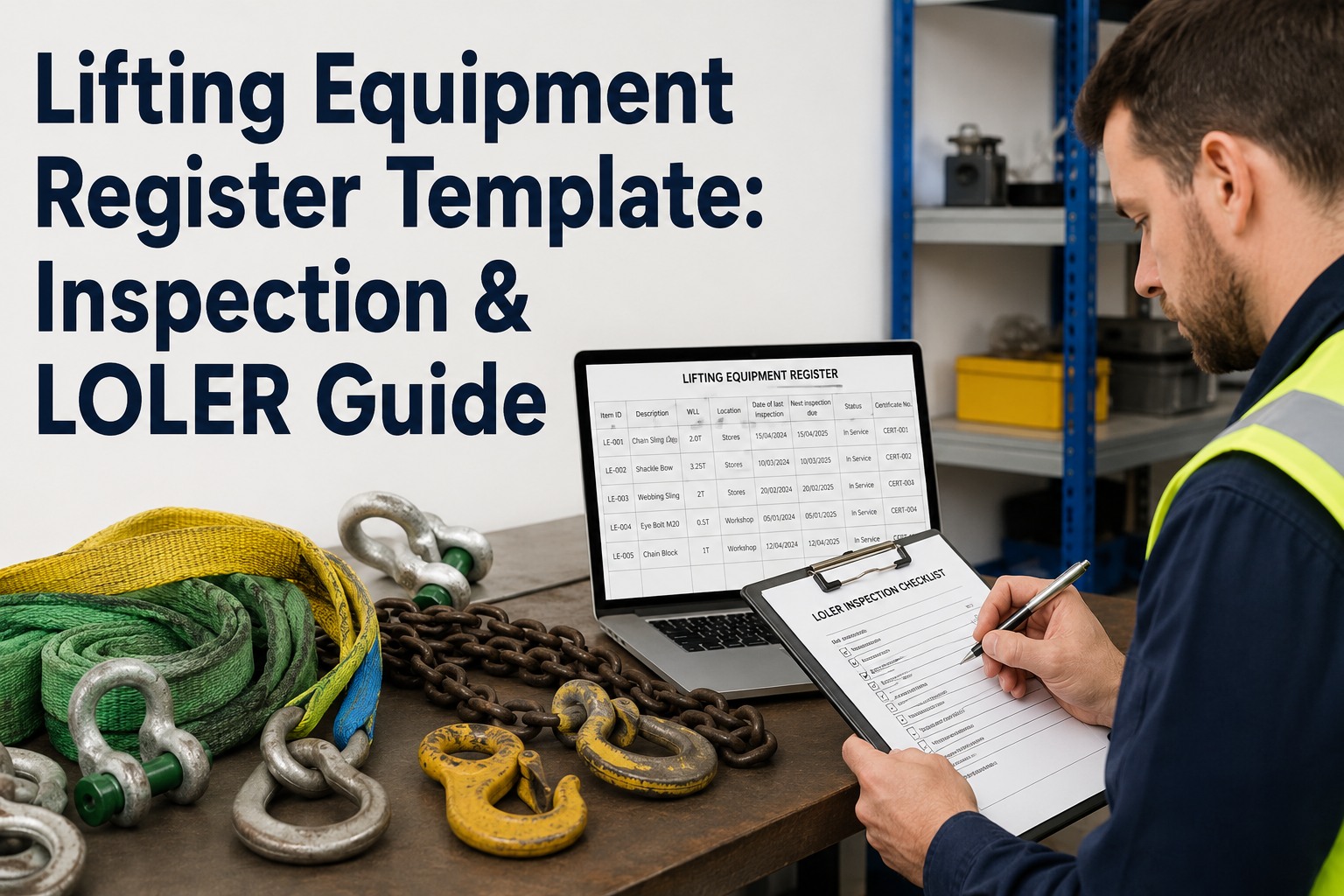
A lifting equipment register template that lists slings and shackles in a single batch row is not a LOLER register — it's a gap waiting for HSE. Every lifting accessory (chains, wire rope slings, webbing, shackles, eyebolts, beams) is lifting equipment in its own right, needs unique identification, its own 6-monthly thorough examination, its own Schedule 1 report, and its own row. A single overhead crane can hang 40+ accessories each needing individual entries — book a demo to digitize your lifting equipment register in HVI.
What a Complete Lifting Equipment Register Actually Holds
Not a spreadsheet of "slings x24" — a row per accessory, individually identifiable, individually examined, individually traceable to a Schedule 1 report.
6 accessories · 6 unique IDs · 4 in service · 1 due within 14 days · 1 overdue · 1 quarantined pending destruction. That's a register that stands up to HSE inspection.
The rest of this page walks the columns every register needs, the accessory-specific discard criteria under BS EN standards, the tagging and quarantine controls that HSE looks for, and the workflow that keeps hundreds of accessories audit-ready without a spreadsheet meltdown. Book a 30-minute demo to see per-accessory register templates in HVI.
The columns every lifting equipment register template needs
A register that captures only "type + count" is not a register — it's an inventory. A LOLER-compliant register captures the same data per row that the Schedule 1 report captures per examination, so the two documents can be cross-referenced against each other. Nine columns cover chains, slings, shackles, eyebolts, lifting beams, spreader bars, and every other accessory type.
Unique asset ID
- Site-specific unique identifier (never shared)
- Typically type-prefix + serial (CHN-0184, WEB-0421)
- Matches the physical tag on the accessory
- Never reissued after item is destroyed
Type & specification
- Accessory type (chain sling / webbing / shackle)
- Configuration (2-leg, 4-leg, single, endless)
- Size / diameter / span
- Material / grade
WLL / SWL
- Working Load Limit as marked on accessory
- Configuration-derated where applicable
- Must match legible tag on accessory (LOLER Reg 7)
- Illegible marking = accessory withdrawn
Manufacturer & date
- Manufacturer where known
- Manufacture date / batch number
- Purchase date / entry-to-service date
- Original EC / UKCA declaration on file
Location
- Site / depot / rigging loft
- Storage location within site
- Person responsible
- Track movements between sites
Last examination
- Date of most recent thorough examination
- Competent person name & qualification
- Report reference number
- Schedule 1 report attached / linked
Next due
- Calculated as last exam + 6 months (accessories)
- Alert cadence at 90 / 60 / 30 / 14 days
- Cannot be extended by duty holder
- Written Scheme can shorten (never lengthen)
Status
- In service / Due / Overdue / Quarantined / Destroyed
- Photo of current condition
- Any active defect notes
- Colour tag indicating status physically
Certificate & history
- Original test certificate on entry to service
- Historical examination reports (all)
- Defect history & corrective action
- Destruction record when removed
The 9 columns look verbose until an HSE inspector arrives and asks for the current status, examination report, and defect history for a specific shackle on a specific rigging job. A register that answers that question in seconds is compliant. A register that produces "which sling do you mean?" is the setup for enforcement action. Book a demo to see the 9-column register applied per accessory in HVI.
Discard criteria by accessory type — what a competent person is looking for
Every accessory type has its own inspection criteria under BS EN standards (BS EN 818 chains, BS EN 13414 wire rope slings, BS EN 1492 webbing, BS EN 13889 shackles), and every one has its own numeric or observable thresholds for withdrawal from service. A competent person examines against these criteria; a user performs pre-use visual against a simplified subset. Below is the essential removal criteria per major accessory family.
| Accessory | Standard | Immediate removal criteria |
|---|---|---|
| Chain slings | BS EN 818 | Elongation >5% of link pitch; wear >10% of chain diameter; cracks, nicks, cuts; twisted or bent links; heat damage; missing or illegible tag |
| Wire rope slings | BS EN 13414 | 10 broken wires randomly distributed in one lay OR 5 in one strand in one lay; kinking, birdcaging, crushing; corrosion or heat damage; damaged ferrules or fittings |
| Webbing slings | BS EN 1492-1 | Cuts >10% of edge width; abrasion damage; heat/chemical damage (glazing, hardening); broken or damaged stitching; damaged end fittings; missing or illegible label |
| Round slings | BS EN 1492-2 | Cover damage exposing internal fibres; heat/chemical damage; UV degradation; damaged eyes; illegible label; any indication of overload |
| Shackles | BS EN 13889 | Deformation of bow or pin; elongation >5%; cracks at pin holes; wear on pin bearing surfaces; thread damage on pin; illegible SWL marking |
| Eyebolts | BS EN 1677 series | Bent shank; cracks around eye; damaged or worn threads; reduced neck diameter; heat damage; missing or illegible SWL |
| Hooks | BS EN 1677 / ASME B30.10 | Cracks (any); throat opening >15% from original; twist >10°; wear at load-bearing surface; damaged or non-functional safety latch; illegible SWL |
| Lifting beams & spreaders | Manufacturer criteria | Structural cracks in weld; deformation of main member; damage to load-attachment points; illegible SWL or centre-of-gravity marking |
Two absolute rules that follow from the criteria. First: any accessory that fails an examination criterion is withdrawn from service immediately, quarantined, and either repaired by a competent authority (if the standard permits) or destroyed. There is no "monitor and continue" option for a failed accessory. Second: repair of a failed lifting accessory is prohibited under most BS EN standards — slings, shackles, and eyebolts are typically destroyed rather than repaired, because reworked components cannot reliably restore their original load rating. Chain slings are one of the limited exceptions where competent repair by the manufacturer or an accredited repairer may be possible under strict conditions. When in doubt, destroy. Book a demo to see accessory-specific inspection templates with the correct BS EN criteria per type.
Tagging, quarantine, and destruction — the physical controls the register depends on
A digital register is only as good as the physical controls that keep the correct accessory in the correct status. Four physical controls sit alongside the digital record and make the register enforceable in a real rigging loft: unique identification tagging, colour-coded status tagging, quarantine storage separation, and documented destruction. Skip any one and the register drifts from reality within weeks.
Unique ID tag
Every accessory carries a physical tag with its unique register ID, stamped or laser-etched, matching the register row exactly. Ink markings degrade — permanent marking is essential. If tag becomes illegible, accessory is withdrawn until re-identified.
Colour status tag
Quarterly colour code (green Q1 / yellow Q2 / red Q3 / blue Q4) tied to next-examination-due quarter. Visual identification of status without opening the register. Rigger can spot an out-of-cycle accessory in the loft at a glance.
Quarantine storage
Physically separate storage location for defective, out-of-date, or awaiting-destruction accessories — not the same bin as in-service kit. Locked or clearly signposted so an accessory cannot accidentally re-enter service.
Documented destruction
Condemned accessories physically destroyed (cut, shredded) — not just discarded whole. Destruction date and method recorded against the register entry. Original ID never reissued to a new accessory to preserve historical traceability.
The physical + digital combination is what stops the failure mode HSE inspectors describe most often: a defective sling with an out-of-date colour tag being pulled from the "in-service" bin and used on a lift because no-one physically separated it. Digital records without physical controls fail this test; physical controls without digital records fail the audit. Both must exist and be maintained. Start a free HVI trial to run the digital register alongside your rigging loft's colour-tag system.
Pre-use, inspection, thorough examination — three distinct checks that don't substitute
Three separate checks, three separate people, three separate records
The most common misunderstanding about lifting accessory compliance is that a rigger's pre-use check somehow satisfies LOLER, or that a regular in-house inspection can substitute for the 6-monthly statutory examination. It cannot, and treating them as interchangeable is one of the fastest routes to an HSE improvement notice. The pre-use check is the user's responsibility before every lift. Under PUWER 1998 and the Work at Height Regulations 2005 for people-lifting, the operator or rigger visually inspects the accessory before use: check the ID tag is legible, check the WLL matches the planned lift, check for obvious defects (cuts, kinks, deformation), and check the accessory is fit for the intended configuration. It is not documented against every lift; it is embedded in the lift plan and the rigger's competence. A rigger who spots a defect during pre-use quarantines the accessory and raises a defect against its register entry. The routine inspection is the duty holder's responsibility at intervals determined by risk (PUWER Regulation 6). Between the statutory thorough examinations, a competent in-house inspector may run periodic checks on high-cycle or high-risk accessories to catch developing wear before the 6-month examination date. This is documented and retained. The thorough examination is the statutory LOLER Regulation 9 duty: 6-monthly for accessories, by a competent person who is sufficiently independent of the daily maintenance arrangement (typically an engineer surveyor from a SAFed-member inspection company). The output is a Schedule 1 report containing the 11 mandatory items. This cannot be signed by the accessory user, cannot be signed by the rigger, cannot be signed by an in-house maintenance technician who has a commercial interest in declaring the accessory safe. The three checks operate in parallel across the same accessory: user pre-use before every lift, in-house routine inspection between statutory dates, and independent thorough examination every 6 months. All three are required and each has a specific role in the compliance chain. A clean thorough examination does not permit skipping pre-use checks, and a diligent pre-use check does not extend the interval between thorough examinations.
A lifting supervisor on the shift from paper register to per-accessory digital records
We're a mechanical contractor with 6 workshops across the north-west. Rigging loft at each site with anywhere between 80 and 220 accessories — chains, wire rope, webbing, shackles, eyebolts, spreaders. Paper register for years, then a shared spreadsheet. When our insurer asked for a full accessory audit ahead of policy renewal, we spent about three weeks assembling the file — and still had gaps on 14 items across the sites. Insurance premium went up in response.
Digital register per accessory with type-specific templates was the fix. Every accessory has its own ID, its own examination history, its own certificate, its own defect notes. The 6-monthly LOLER dates trigger 90 / 60 / 30-day alerts automatically. When our external competent person turns up for examination, they scan the ID tag and the template opens with prior history against that specific accessory. Insurer's next audit took two days instead of three weeks. Premium came back down. Bigger win: we haven't had an out-of-date accessory in service at any site in 14 months.
Frequently asked questions
What should a lifting equipment register template include?
A LOLER-compliant lifting equipment register captures the same data per accessory that a Schedule 1 thorough examination report captures per examination, so the two documents cross-reference. Nine columns cover every accessory type. Unique asset ID — site-specific unique identifier (typically type-prefix plus serial like CHN-0184 or WEB-0421) matching the physical tag on the accessory, never reissued after destruction. Type and specification — accessory type, configuration, size or diameter, material or grade. WLL/SWL — working load limit as marked, configuration-derated where applicable, must match the legible tag per LOLER Regulation 7. Manufacturer and dates — manufacturer where known, batch number, purchase date, entry-to-service date, EC or UKCA declaration on file. Location — site, depot, rigging loft, storage location, person responsible, movement history. Last examination — date of most recent thorough examination, competent person name and qualification, report reference number, Schedule 1 report attached. Next due — calculated as last exam plus 6 months for accessories, alert cadence at 90/60/30/14 days. Status — in service, due, overdue, quarantined, destroyed. Certificate and history — original test certificate, all historical examination reports, defect history and corrective action, destruction record when removed.
How often must lifting accessories be examined under LOLER?
Every 6 months. Under LOLER Regulation 9(3), all lifting accessories (chains, wire rope slings, webbing slings, round slings, shackles, hooks, eyebolts, plate clamps, lifting beams, spreader bars) must be thoroughly examined by a competent person at least every 6 months. This is the same statutory interval that applies to equipment used to lift persons, and it is stricter than the 12-month interval for equipment used to lift loads only. There is no usage-frequency exemption — a webbing sling used twice a year in a storage facility still requires 6-monthly examination. The 6-month rule applies to every accessory regardless of how often it is used. A Written Scheme of Examination drawn up by a competent person can specify bespoke intervals, but in practice this is used to shorten the 6-month interval for high-risk or high-cycle use, not to lengthen it. The duty holder has no discretion to extend the statutory interval unilaterally. Every examination must be documented in a Schedule 1 report containing the 11 mandatory items, retained until the next report is made or 2 years, whichever is later. A crane's current certificate does not cover the accessories used with it — they are separate lifting equipment in their own right.
When must a sling or shackle be removed from service?
Every accessory type has its own numeric or observable withdrawal criteria under BS EN standards. Chain slings (BS EN 818): elongation over 5% of link pitch; wear over 10% of chain diameter; cracks, nicks, cuts; twisted or bent links; heat damage; missing or illegible tag. Wire rope slings (BS EN 13414): 10 broken wires randomly distributed in one lay OR 5 in one strand in one lay; kinking, birdcaging, crushing; corrosion or heat damage; damaged ferrules. Webbing slings (BS EN 1492-1): cuts over 10% of edge width; abrasion damage; heat or chemical damage (glazing, hardening); broken or damaged stitching; damaged end fittings; missing or illegible label. Round slings (BS EN 1492-2): cover damage exposing internal fibres; heat/chemical damage; UV degradation; any indication of overload. Shackles (BS EN 13889): deformation of bow or pin; elongation over 5%; cracks at pin holes; wear on pin bearing surfaces; thread damage on pin; illegible SWL marking. Eyebolts (BS EN 1677 series): bent shank; cracks around eye; damaged or worn threads; reduced neck diameter; heat damage. Any accessory failing an examination criterion is withdrawn from service immediately, quarantined, and either repaired by a competent authority (where the standard permits) or destroyed. Slings, shackles, and eyebolts are typically destroyed rather than repaired.
What is the difference between a pre-use check and a thorough examination?
Three distinct checks apply to every lifting accessory and none substitutes for the others. Pre-use check: the user's or rigger's responsibility before every lift, under PUWER 1998 and Work at Height Regulations 2005 for people-lifting. Rigger visually inspects the accessory: ID tag legible, WLL matches the planned lift, no obvious defects (cuts, kinks, deformation), fit for intended configuration. Not documented against every lift; embedded in the lift plan and the rigger's competence. A defect spotted at pre-use triggers quarantine and a register defect entry. Routine inspection: the duty holder's responsibility at intervals set by risk (PUWER Regulation 6). Between statutory thorough examinations, a competent in-house inspector may run periodic checks on high-cycle or high-risk accessories. Documented and retained. Thorough examination: the statutory LOLER Regulation 9 duty, 6-monthly for accessories, by a competent person sufficiently independent of daily maintenance (typically an engineer surveyor from a SAFed-member inspection company). Output is a Schedule 1 report with 11 mandatory items. Cannot be signed by the user, rigger, or in-house maintenance technician with a commercial interest in declaring the accessory safe. All three checks are required and each has a specific role.
Do I need to identify every sling and shackle individually?
Yes. Every lifting accessory is lifting equipment in its own right under LOLER and requires unique identification, its own Schedule 1 thorough examination report, and its own entry in the lifting equipment register. Batching multiple accessories under a single register row or a single examination report is one of the most common HSE findings on lifting-related audits and improvement notices. Practically this means every sling, shackle, eyebolt, and beam carries a physical tag with its unique register ID (typically type-prefix plus serial, stamped or laser-etched for permanence), and every register row corresponds to exactly one physical accessory. A single overhead crane might be used with 40 to 50 separate slings, chains, and shackles — each requiring its own tag, own register row, and own 6-monthly examination. Managing this at scale on spreadsheets is where most compliance gaps originate: accessories get missed, combined into batches with single report dates, or examined but not recorded individually. The register should track each unique ID through its life from purchase to destruction, and the ID should never be reissued to a new accessory because doing so breaks the historical traceability that LOLER Regulation 11 depends on.
Every sling, every shackle, every certificate — on one digital register
HVI holds each lifting accessory as an individual asset with unique ID, WLL, current status, historical Schedule 1 examination reports, photo evidence, and defect history. 90-, 60-, 30-, and 14-day alerts before every 6-monthly LOLER examination. Type-specific inspection templates apply the correct BS EN criteria per accessory. Quarantine flow physically separates defective items from active service. When HSE audits, when your insurer asks, when a lift plan needs the current status of a specific shackle — the answer is one screen. Live in under two weeks. No hardware. No credit card.
Trusted by construction, mechanical, engineering & industrial fleets across UK, Ireland & Australia · Ready on day one