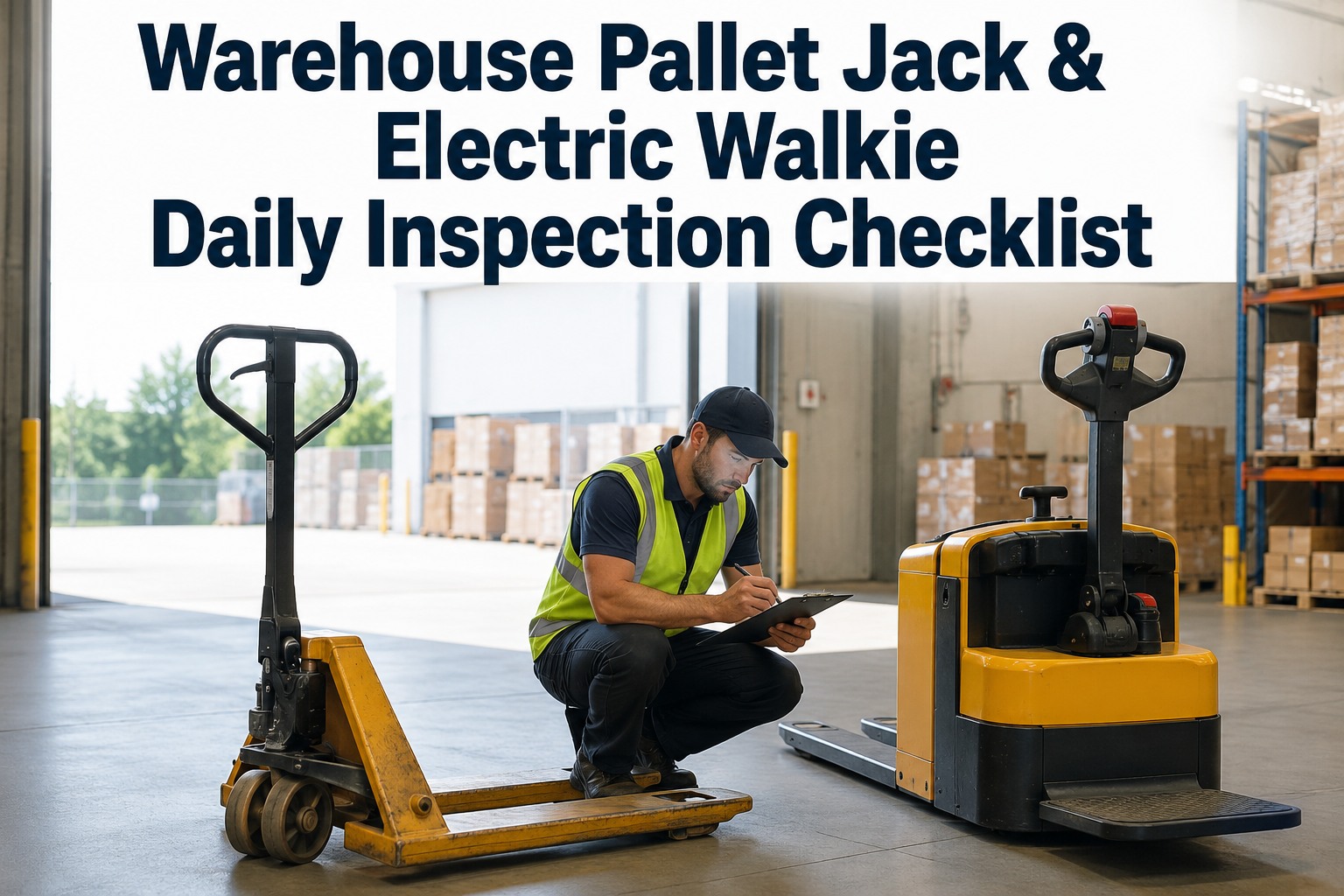
An electric pallet jack feels like the most ordinary machine in the warehouse — which is exactly why its daily inspection gets skipped. But under OSHA, an electric walkie or rider pallet jack is a Class III powered industrial truck, governed by 29 CFR 1910.178 just like a forklift: operators must be trained and certified, and the machine must be inspected before every shift, with any defect taking it out of service until repaired. The line that matters is power. A purely manual pallet jack — human push, hand-pump lift — is not a PIT and isn't covered, but the moment a battery drives travel or lift, the full rule applies. This page gives you the complete daily checklist in OSHA's own two-phase structure — KEY OFF for the visual walkaround, KEY ON for the operational test — plus the defects that mean stop now. Run it in two minutes before each shift to protect operators, loads, and your compliance record. Pair it with HVI inspection and maintenance software to complete it on a phone, flag defects with photos, and keep an audit-ready record per unit. Always check your operator's manual for model-specific items.
WAREHOUSE · ELECTRIC PALLET JACK & WALKIE DAILY INSPECTION
Two Minutes, Two Phases, Zero Surprises
An electric pallet jack is a Class III powered industrial truck — OSHA requires a check before every shift. HVI runs the full KEY-OFF and KEY-ON inspection on a phone, flags any defect with a photo, and keeps the audit-ready record OSHA expects.
Class III
OSHA powered-industrial-truck category
1910.178
the OSHA standard that applies
Every shift
inspection frequency required by law
~2 min
to run the full daily check
First: Does Your Pallet Jack Even Need This?
The whole rule turns on one question — is it powered? Get this right before anything else, because it decides whether OSHA's PIT requirements apply at all.
MANUAL PALLET JACK
NOT a PIT
Human push/pull for travel, hand-pump for lift, simple hydraulics. OSHA does not classify it as a powered industrial truck, so PIT certification isn't required — though basic load-handling and strain-injury training is still smart, and a quick fork-and-wheel check still prevents drops.
ELECTRIC WALKIE / RIDER
IS a PIT
An onboard battery drives travel and/or lift through a tiller control. This makes it a Class III powered industrial truck under 1910.178 — full stop. Operators must be trained and certified, and the daily pre-shift inspection on this page is legally required.
Rider models raise the stakes further: a standing platform means higher speed and more mass, which increases kinetic energy and braking distance — so the brake and throttle checks below matter even more.
Phase 1 · KEY OFF: The Visual Walkaround
With the unit parked, forks lowered, and key off, work these checks by hand and eye. This is where you catch damage before any power is involved.
Forks
Straight, not bent or cracked, tips not excessively worn. Bent or worn forks drop loads and damage pallets.
Load & Steer Wheels
No flat spots, chunks, cracks, or embedded debris. Worn wheels hurt traction and control on smooth concrete.
Battery & Cables
Battery secured, no leaks or corrosion, cables and connectors intact and not frayed. Inspect charging cables before plugging in.
Hand Guards & Tiller
Hand guards present, tiller handle undamaged, controls and grips intact. The tiller is the operator's only point of control.
Leaks & Hydraulics
Check the floor and the lift cylinder for hydraulic leaks. A leaking lift system can drop a raised load without warning.
Data Plate & Decals
Capacity data plate present and legible, all safety decals in place. Confirm the load rating matches the work and the unit's serial number.
Phase 2 · KEY ON: The Operational Test
Now power up and confirm the unit actually performs. These are the function checks that prove it's safe to move a load.
Brakes — Hold on a Grade
The most safety-critical operational check. Confirm the service brake engages smoothly and the unit holds on an incline, and that the handle brake works in both the up and down positions. On heavier rider units, braking distance is longer — verify it stops predictably before you trust it with a load.
Throttle & Return-to-Neutral
The throttle should run smoothly forward and reverse and return to neutral the instant it's released. A throttle that sticks is an immediate out-of-service condition.
Lift / Lower & Plugging
Raise and lower the forks smoothly through full range, and test the plugging (reversing) function for prompt, controlled direction changes.
Horn & Warning Devices
Test the horn and any lights or alarms — essential for blind intersections and pedestrian-heavy aisles. A dead horn fails the inspection.
Steering & Battery Indicator
Confirm steering responds smoothly with no excessive play, and check the battery discharge indicator shows enough charge for the shift's workload.
Stop Now: Out-of-Service Defects
OSHA is clear — any powered industrial truck not in safe operating condition must be removed from service until repaired by authorized personnel. If you find any of these, tag it out and report it.
Brakes that don't hold or engage
Throttle that sticks or won't return to neutral
Any hydraulic leak or a lift that drifts down
Bent, cracked, or badly worn forks
Damaged battery, frayed cables, or corrosion
Non-working horn or warning device
Excessive steering play or erratic response
Missing or illegible capacity data plate
Repairs must be made only by authorized, trained personnel — operators should never attempt their own fixes unless trained and authorized. Document the defect and the correction before the unit returns to service.
Paper Clipboard vs. HVI
A per-shift check across a fleet of walkies, an out-of-service rule, and an OSHA audit trail to keep — exactly what a digital checklist was built for.
CLIPBOARD ON THE DOCK
Per-shift checks skipped when it's busy
Defects noted on paper, lost by next shift
No proof the OSHA check was done
A flagged jack quietly back in the aisle
No history to spot a recurring fault
HVI INSPECTION SOFTWARE
Per-shift checklist on a phone, every unit
Defects become tracked work orders with photos
Timestamped, OSHA-ready audit trail
Out-of-service status until repair is certified
Full history per unit reveals patterns
Run Every Pallet Jack Check in Under Two Minutes
HVI gives warehouses a guided daily KEY-OFF and KEY-ON inspection for electric walkies and rider pallet jacks, aligned with OSHA 1910.178 — forks, wheels, battery, hydraulics, brakes, throttle, and horn — with photo-flagged defects, defect-to-work-order routing, out-of-service control, and timestamped audit-ready records per unit. Protect operators, loads, and compliance, one quick check at a time. Trusted by 25,000+ users worldwide.
Frequently Asked Questions
Is an electric pallet jack a powered industrial truck?
Yes. OSHA classifies an electric pallet jack — walkie or rider — as a Class III Electric Motor Hand Truck, a type of powered industrial truck governed by 29 CFR 1910.178, the same standard that covers forklifts. That means operators must be trained and certified before use, and the unit must receive a daily or per-shift inspection. The deciding factor is power: a purely manual pallet jack that relies on human push and a hand-pump lift is not a powered industrial truck and isn't subject to PIT certification, but the moment an onboard battery drives travel or lift, the full rule applies.
Sign up for a free HVI trial to stay compliant.
How often must an electric pallet jack be inspected?
Before every shift. OSHA requires powered industrial trucks to be examined at least daily, or before each shift in operations that run continuously across multiple shifts. The check has two parts: a KEY-OFF visual inspection of forks, wheels, battery and cables, hand guards, leaks, and the data plate, followed by a KEY-ON operational test of brakes, throttle, lift/lower, plugging, horn, steering, and the battery discharge indicator. Any defect that affects safe operation must be corrected before the truck is returned to service. The whole check takes about two minutes once it's routine — and logging it each time is what proves the legal requirement was met.
Schedule a demo to see per-shift tracking.
Do operators need certification to use an electric pallet jack?
Yes. Because an electric pallet jack is a Class III powered industrial truck, operators must complete OSHA-required training and evaluation under 1910.178(l) before operating one, just as they would for a forklift. Training combines formal instruction, practical hands-on exercises, and an evaluation of the operator's performance in the actual workplace, and operators must be re-evaluated at least every three years. Many operations also require operators to be at least 18 and to wear PPE such as steel-toe boots and a high-visibility vest. A manual pallet jack does not carry this certification requirement, though basic safe-handling training is still recommended.
Sign up for a free HVI trial to track operators and inspections.
What defects take a pallet jack out of service?
Any condition that makes the unit unsafe. The most critical are brakes that don't hold or engage, a throttle that sticks or won't return to neutral, any hydraulic leak or a lift that drifts down on its own, and bent, cracked, or badly worn forks. Others include a damaged battery or frayed cables, a non-working horn, excessive steering play, and a missing or illegible capacity data plate. When any of these is found, OSHA requires the truck to be removed from service until it's repaired by authorized, trained personnel — operators shouldn't attempt their own repairs. The defect and its correction should both be documented before the unit goes back to work.
Schedule a demo to see out-of-service workflows.
Why bother inspecting something as simple as a pallet jack?
Because the consequences aren't simple. An electric walkie can move thousands of pounds in tight, pedestrian-heavy aisles, and a failed brake, sticky throttle, or leaking lift can cause a struck-by injury, a dropped load, or a tip on a ramp. OSHA treats these machines as seriously as forklifts for exactly that reason, and inadequate inspection documentation is a common citation. A two-minute pre-shift check catches the worn wheel, frayed cable, or drifting lift before it becomes an incident — and a digital record proves the check happened. Inspecting consistently also extends equipment life and reduces unplanned downtime by catching wear early.
Sign up for a free HVI trial to make every check count.