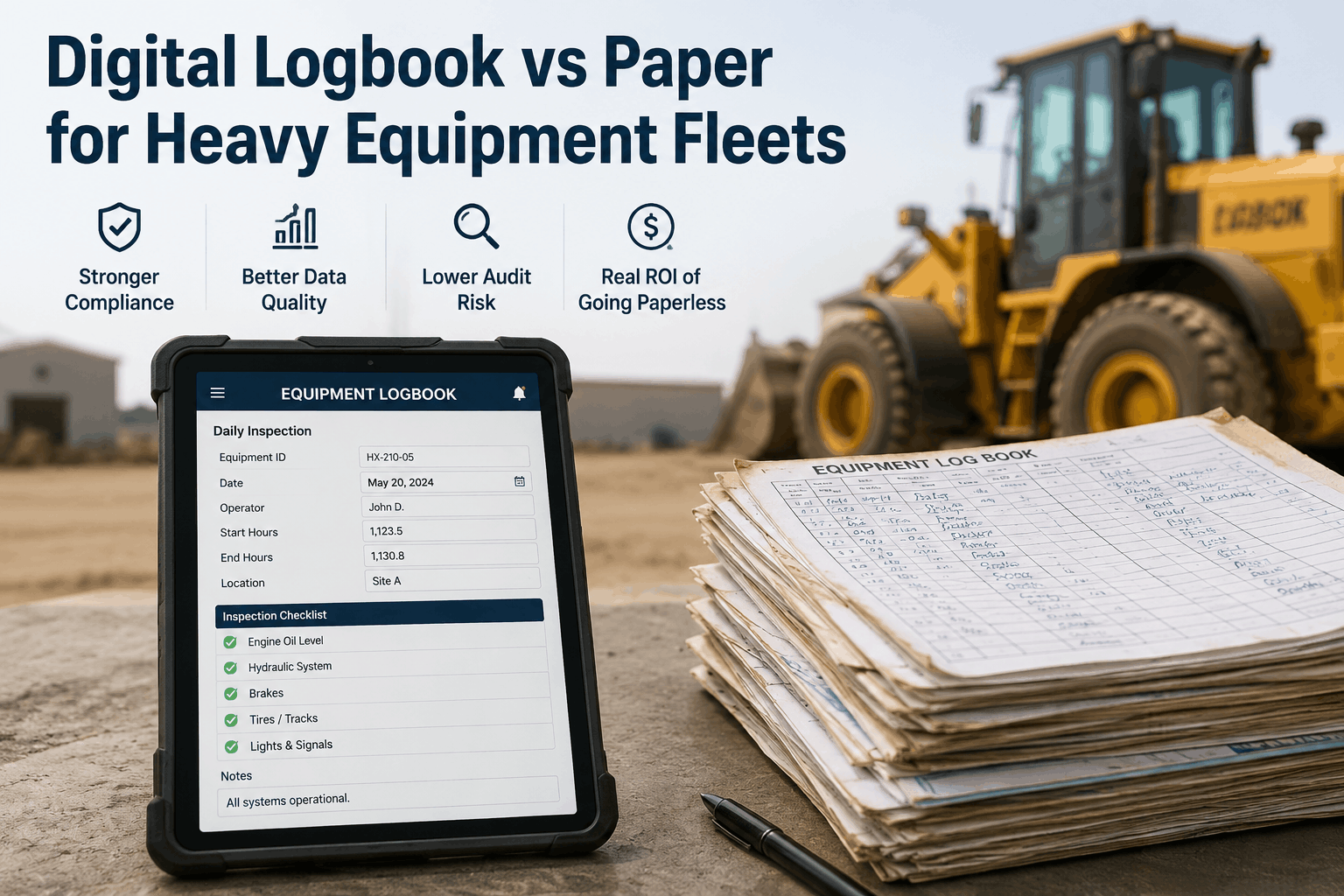
For decades the heavy equipment logbook was a clipboard in the cab and a binder in the office, and it worked well enough that nobody questioned it. That era is ending — not because paper got worse, but because the cost of its blind spots finally became impossible to ignore. The average operation running paper logs captures only about 40% of the events that actually happen; the other 60% — the early signals of wear, the skipped entry, he defect nobody wrote down — is exactly where downtime and compliance risk hide. Worse, 7.5% of paper documents are lost entirely, 43% of vehicles have critical issues missed on paper checklists, and when an auditor arrives, 93% of carriers audited in 2025 walked away with at least one violation, most traced to missing or disorganized paperwork. Meanwhile a digital inspection takes 5–10 minutes against 20-plus for paper, and the switch typically pays for itself inside the first month. With eDVIRs officially authorized by FMCSA effective March 23, 2026, the question is no longer whether to go digital but how much the delay is costing. This is the honest comparison of digital logbook vs paper — on compliance, audit risk, data quality, and real ROI — for heavy equipment fleets.
Paper Captures 40% of What Happens. You're Flying on the Rest.
HVI replaces every clipboard, form, and filing cabinet with searchable, timestamped, photo-backed records — guided inspections in minutes, instant defect-to-work-order routing, and an audit package that exports in seconds instead of a three-day binder hunt.
The Honest Comparison, Side by Side
No spin — here's how the two methods stack up on the things that actually matter to a heavy equipment fleet. The pattern is consistent across every category.
What Matters
Paper Logbook
Digital Logbook
Time per inspection
20+ minutes
5–10 minutes
Events captured
~40%
Near 100%
Records lost
7.5% lost entirely
Cloud-stored, nothing lost
Audit retrieval
Days of binder hunting
Seconds, searchable
Defect to repair
Manual hand-off, lost slips
Auto-routed work order
Trend data
None — checkmarks only
Full history per asset
Time to ROI
—
Often within 1 month
The Four Hidden Costs of Paper
Paper looks free — a pad of forms is cheap. The real cost is invisible until it isn't: it shows up as a missed defect, a failed audit, a lost record, an hour of admin a day. These are the four that hurt most.
Missed Defects
43% of vehicles have critical issues missed on paper checklists. A checkmark scrawled at shift start hides what a guided digital walk-around catches — before it becomes a roadside failure.
Audit Exposure
93% of carriers audited in 2025 got at least one violation, most from disorganized paperwork. Penalties run $1,270–$16,000+ per occurrence — a single missing record can trigger an out-of-service order.
Lost Records
7.5% of paper documents vanish entirely — coffee-stained, misfiled, lost in transit. The record you can't produce looks like a compliance failure even when the work was actually done.
Admin Drain
Manual filing, transcription, and searching eat 40–60% more admin time than digital. That's hours every day spent re-keying and hunting for paper instead of managing the fleet.
The Data-Quality Gap: Checkmarks vs. Evidence
This is the difference that compounds. A paper logbook produces checkmarks; a digital one produces evidence — and in the 2026 compliance environment, evidence is what protects the fleet.
PAPER PRODUCES
A checkmark with no proof behind it
Illegible handwriting, skipped fields
No timestamp, no photo, no GPS
Zero trend data across the asset's life
DIGITAL PRODUCES
Photo-verified defect with severity
Mandatory fields — no skipping ahead
Automatic timestamp and GPS stamp
Searchable history that reveals patterns
The 2026 CSA overhaul splits Vehicle Maintenance into shop-detected and driver-observed categories — meaning your logbook must now prove who should have caught a defect and when. Paper checkmarks can't. Timestamped, photo-backed digital records can.
The ROI Math for a 50-Unit Fleet
The comparison stops being abstract when you put real numbers on it. Here's where the money comes from when a typical fleet switches off paper.
$43–46K
saved per year
Typical annual saving for a 50-vehicle fleet — eliminated paper, reduced admin labor, avoided violations.
40–60%
less admin time
Cut from eliminating manual filing, transcription, and record searches across the team.
300–500%
ROI
Typical return when counting time savings, repair reduction, avoided violations, and downtime.
<1 month
to break even
Most fleets reach positive ROI within the first month of going paperless.
Going Paperless Without the Disruption
The most common objection isn't the value — it's the fear of a messy transition. In practice it's straightforward: run both in parallel briefly, and adoption follows fast.
1
Run Parallel
Digital and paper side by side for about a week — operators get comfortable while nothing is at risk. Adoption typically hits 95% in that first parallel week.
2
Go Live
Guided checklists make digital faster than paper, so operators stop reaching for the clipboard on their own. Minimal training — modern apps are intuitive.
3
Compound the Gains
Every shift adds searchable history; trend data, audit readiness, and savings build from there — automatically.
The Debate Is Settled — Make the Switch
Digital inspections in minutes, photo-verified defect capture, auto-routed work orders, searchable asset history, and audit packages on demand — FMCSA-compliant eDVIRs and full heavy equipment logbooks in one platform. Positive ROI in the first month. Trusted by 25,000+ users worldwide.
Frequently Asked Questions
Is a digital logbook actually compliant — or do I still need paper?
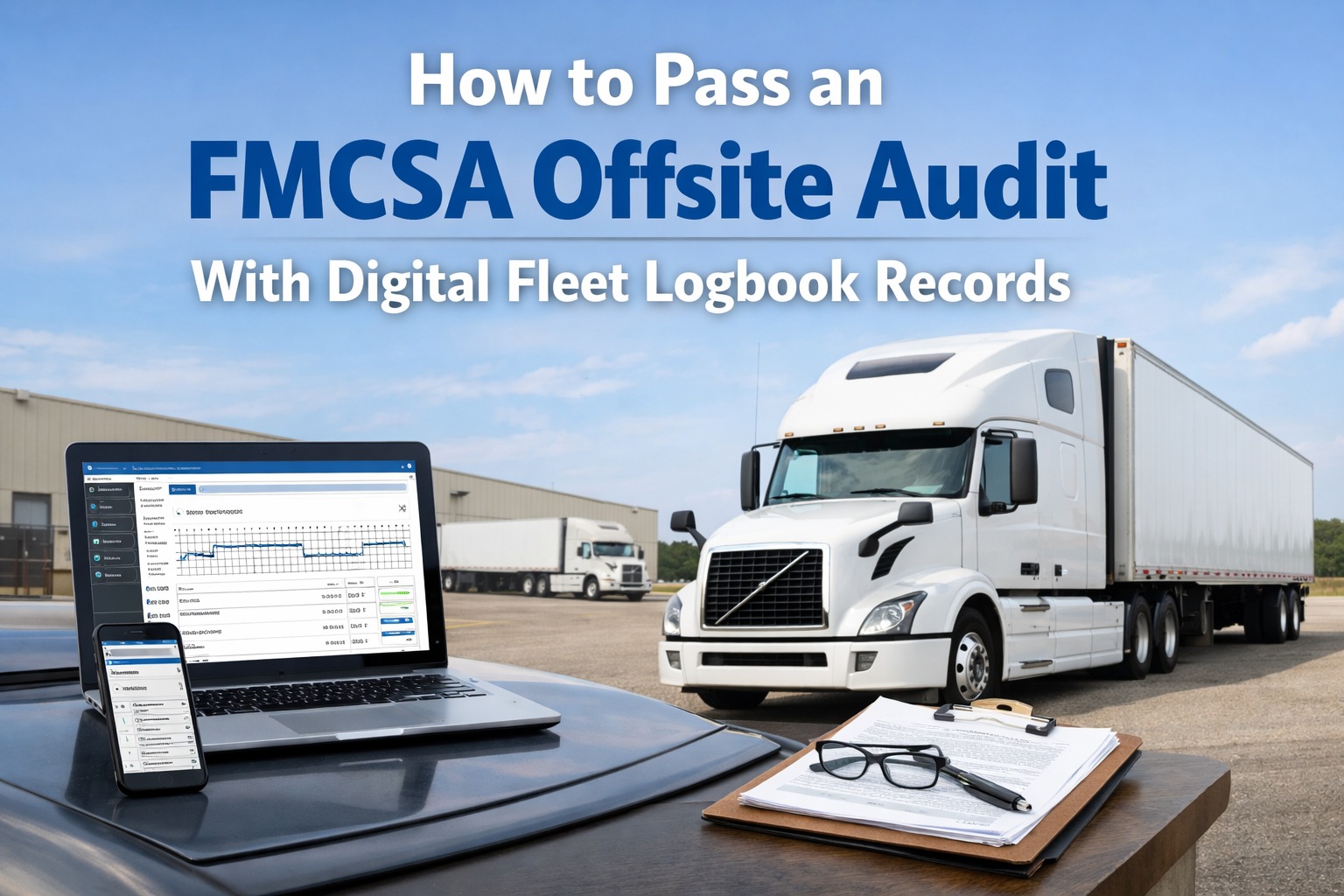
Digital is fully compliant and increasingly the expected standard. FMCSA permits electronic records under 49 CFR 390.31, and eDVIRs were officially authorized effective March 23, 2026. Electronic records must contain all required information including digital signatures, route to the right recipients, be retained for the required period, and be producible for audits — all of which a proper digital logbook does automatically. You don't need to keep paper backups once you're on a compliant system.
Sign up for a free HVI trial to go compliant and paperless.
How much does a fleet really save by going paperless?
A typical 50-vehicle fleet saves around $43,000–$46,000 a year from eliminated paper costs, 40–60% less administrative time, and avoided compliance violations ($1,270–$16,000+ per occurrence). Counting all value streams — time, repair reduction, avoided fines, and downtime — fleets see 300–500% ROI, and heavy equipment fleets report even higher returns over 24 months. Most operations reach positive ROI within the first month.
Schedule a demo to run the numbers on your fleet.
Why is paper such a compliance risk if the work is getting done?
Because compliance depends on proof, not just performance. Paper records get lost (7.5% vanish entirely), illegible, or misfiled, and 93% of carriers audited in 2025 received at least one violation — most triggered by missing or disorganized documentation rather than actual unsafe equipment. When you can't produce a record on demand, it looks like a failure even when the work was done. Digital records are timestamped, photo-backed, and searchable, so the proof is always there.
Will my operators actually use it?
Adoption is usually easier than managers expect. Digital inspections take 5–10 minutes versus 20-plus on paper thanks to guided, tap-to-complete checklists, so once operators try it they prefer it. The proven approach is running digital and paper in parallel for about a week — adoption typically reaches 95% in that first week, after which people stop reaching for the clipboard on their own. Most digital-transformation failures come from poor change management, not the technology, so a short parallel period solves it.
Sign up for a free HVI trial to test it with your crew.
What does digital capture that paper can't?
Evidence and trends. Paper produces a checkmark with no proof; digital produces a photo-verified defect with severity, an automatic timestamp and GPS stamp, mandatory fields that can't be skipped, and a searchable history that reveals patterns across an asset's life. Paper captures only about 40% of operational events, missing the early degradation signals where downtime hides. This matters daily now, not just at audit time — the 2026 CSA overhaul specifically demands documented, attributable inspection records.
Sign up for a free HVI trial to capture it all.