Forklift Battery and Fuel Tracking for Warehouses

By William Jerry on June 4, 2026

forklift-battery-fuel-tracking

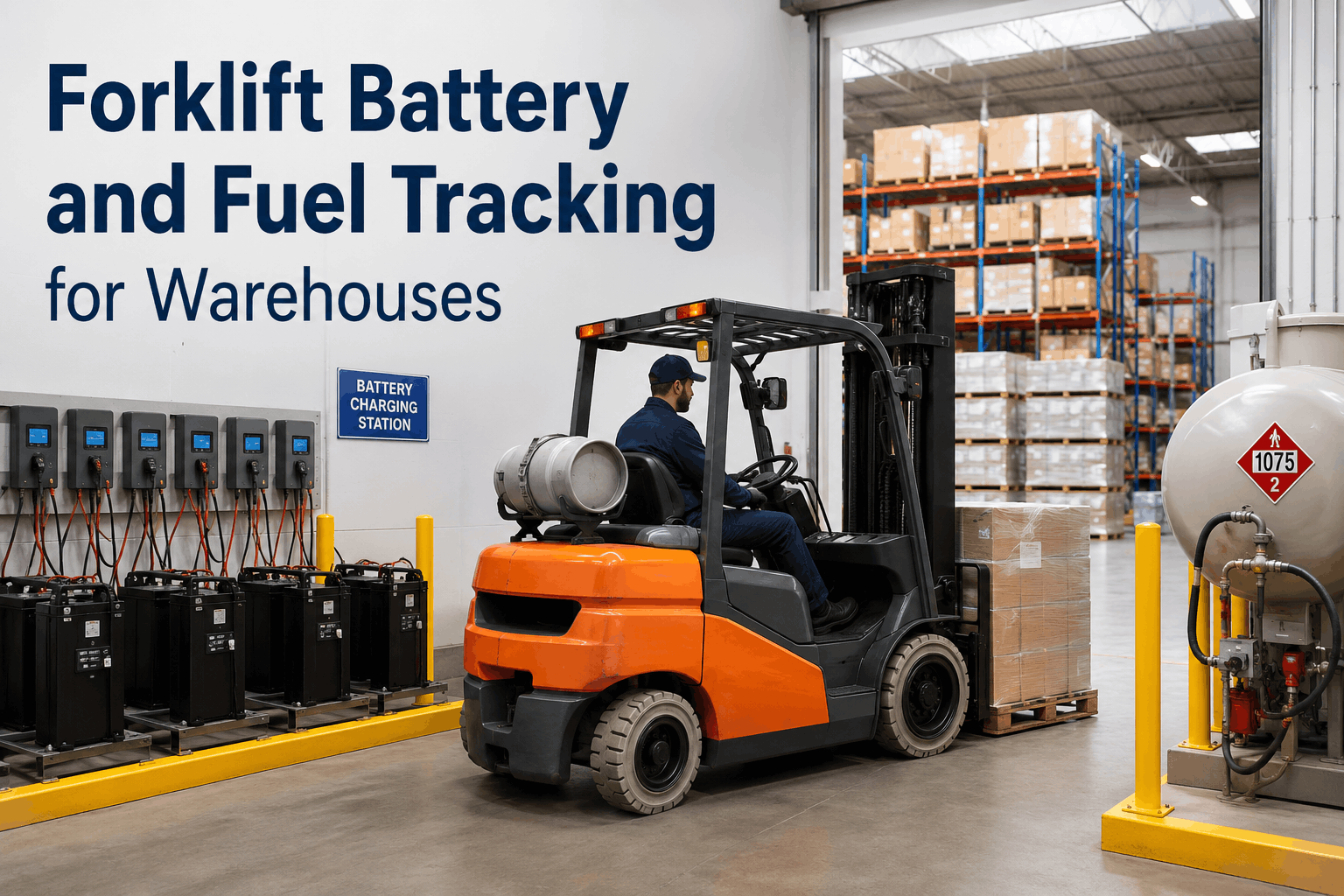
Walk through almost any busy warehouse and you'll find three different energy systems running at once: electric lifts cycling in and out of a battery room, propane units swapping cylinders at the dock, and a few diesel machines working the yard. Each one burns money in a completely different way — and almost nobody tracks them in the same place. The battery room runs on a clipboard and the charging tech's memory. Propane swaps get tallied on a tank-cage sheet, if at all. Diesel goes in a fuel log that lives in a different binder. The result is a blind spot the size of your entire material-handling energy budget: a $5,000 lead-acid battery quietly replaced two years early because nobody watched its charge cycles, operators losing 30 minutes a shift to tank swaps no one measures, an opportunity-charging window missed so often the fleet never gets full uptime. Forklift battery and fuel tracking software pulls all three energy streams into one platform — battery health and charge cycles, propane cylinder swaps, and diesel consumption — so the warehouse can see, for the first time, what each lift truck actually costs to run. This page breaks down where forklift energy money leaks across all three power types and how one tracking system turns guesswork into uptime.

Three Energy Systems. One Blind Spot. One Platform.
HVI tracks electric battery health and charge cycles, propane cylinder swaps, and diesel consumption from a single app — so you stop replacing batteries early, stop losing shifts to bad charging windows, and finally know the real cost-per-hour of every lift truck.

Three Power Types, Three Ways to Lose Money

Electric, propane, and diesel forklifts each have a signature failure mode that drains budget when it goes untracked. Knowing the leak for each is the first step to plugging it.

ELECTRIC

Early Battery Death

Lead-acid batteries run $2,000–$6,000; lithium-ion $8,000–$20,000. Bad charging windows, missed watering, and unmonitored cycles kill them years early — a cost that compounds silently across the fleet.

PROPANE

Lost Swap Time

Tank changes interrupt workflow 4–6 times per shift, and operators can spend 30 minutes a day on fuel logistics. Untracked, that lost time and cylinder usage never shows up in any cost report.

DIESEL

Untracked Consumption

Yard diesel lifts burn fuel with no per-unit visibility — so a machine consuming more than its twin, or a slow leak, hides inside a single fuel-delivery total until the budget blows.

The Battery Room: Where the Biggest Asset Hides

A forklift battery is one of the most expensive consumables in the building — and the most mismanaged. Run it on instinct and paper logs and you're choosing to replace batteries years ahead of schedule. Tracking turns the battery room from guesswork into a managed asset.

Battery room on paper

Charge cycles counted by memory, not measured
Watering and equalization missed or guessed
Thermal events go unnoticed until a battery fails
No way to know which battery is degrading early
Opportunity-charging windows missed, uptime lost

Battery room with HVI

Charge cycles logged per battery, life tracked
Watering and PM scheduled with alerts
Health flagged before a battery strands a lift
Degrading units identified early, replaced on plan
Charge windows tracked so the fleet stays running
A single lead-acid battery replaced two years early can cost $5,000 you didn't need to spend — and across a fleet that compounds fast. HVI tracks every battery's cycles and health so replacement happens on schedule, not by surprise. sign up for a free HVI trial and put your battery room on data.

Opportunity Charging: Uptime Won or Lost in the Breaks

For multi-shift warehouses with no 8-hour downtime window, opportunity charging — topping up during breaks and shift changes — is what keeps electric lifts running continuously. But it only works if the windows are actually used. Tracking makes the difference between a fleet that runs all day and one that runs out of charge.

BREAK

Lithium-ion can recover 30–50% charge in under an hour — a lunch break becomes usable runtime.

SHIFT CHANGE

A short top-up at handover keeps the same battery working across multiple shifts — no swap needed.

CONTINUOUS UPTIME

Used consistently, opportunity charging eliminates the battery-swap bay and maximizes equipment availability.

The catch: miss the windows and the benefit evaporates. Tracking charge events per battery shows whether the strategy is actually being followed — or quietly failing.

One Number That Settles the Debate: Cost per Hour

Electric, propane, diesel — the endless warehouse argument over which is cheaper only resolves when you track real cost per hour. The data favors electric, but only a fleet that measures it can prove it and act on it.

ELECTRIC
$1.25/hr

Lower maintenance, fewer moving parts, 15,000–20,000 hr lifespan.
PROPANE
$2.00/hr

Fast refuel and rugged, but ~40% higher maintenance cost per hour.
Maintenance for propane forklifts runs about 40% higher per hour than electric — but you can only capture that saving if you track cost per unit across all three power types in one place. Without tracking, the cheaper fleet stays a guess.
Whether electric wins for your operation depends on your shifts, your space, and your duty cycle — and the only way to know is to measure all three energy types together. HVI does exactly that. schedule a live demo to see unified forklift energy tracking.

From Three Binders to One Screen

The whole point is consolidation: every energy stream, every lift truck, one platform that builds cost and health data from daily work instead of scattered paper. Here's the loop.

1

Log Every Energy Event

Battery charges and waterings, propane swaps, diesel fills — captured per unit on a phone, no separate binders.

2

Track Health & Cost

Battery cycle life, swap frequency, and consumption roll up into cost-per-hour and PM schedules per truck.

3

Act Before It Costs

Replace the dying battery on plan, fix the charging window, flag the thirsty diesel — before any of it blows the budget.

See What Every Lift Truck Really Costs to Run

Battery room tracking, charge-cycle and health monitoring, propane swap logs, diesel consumption, opportunity-charging visibility, and cost-per-hour across all three power types — in one warehouse energy platform. Trusted by 25,000+ users worldwide.
Frequently Asked Questions

Can one system track electric, propane, and diesel forklifts together?
Yes — that's the core value. Most warehouses run a mixed fleet but track each energy type on a separate paper system: a clipboard in the battery room, a tally sheet at the propane cage, a fuel log for diesel. HVI pulls battery health and charge cycles, propane cylinder swaps, and diesel consumption into one platform, so you can finally compare cost-per-hour across all three and see your full material-handling energy budget in one place. Sign up for a free HVI trial to unify your fleet.
How does tracking extend forklift battery life?
Forklift batteries are expensive — $2,000–$6,000 for lead-acid and $8,000–$20,000 for lithium-ion — and most get replaced years early because they're managed on instinct. Bad charging windows, missed watering, and unmonitored thermal events degrade a battery silently. Tracking charge cycles, scheduling watering and PM, and flagging health issues per battery lets you replace on schedule instead of by surprise, capturing the full lifespan you already paid for. Schedule a demo to see battery room tracking.
What is opportunity charging and why does tracking it matter?
Opportunity charging means topping up an electric forklift's battery during breaks and shift changes rather than running a full charge cycle. Lithium-ion can recover 30–50% in under an hour, so multi-shift warehouses can run continuously without a battery-swap bay. The catch is that it only works if the windows are consistently used — miss them and the fleet runs out of charge. Tracking charge events per battery shows whether the strategy is actually being followed or quietly failing.
Is electric really cheaper than propane to operate?
On a cost-per-hour basis the data favors electric — maintenance runs about $1.25/hour for electric versus $2.00/hour for propane, roughly a 40% reduction, and electric units often last 15,000–20,000 hours versus 10,000–15,000 for propane. But the right answer depends on your shifts, space, and duty cycle, and you can only prove it by tracking real cost per unit across all power types. Propane still wins on refuel speed and rugged outdoor use. Sign up for a free HVI trial to compare your real costs.
How much time do propane tank swaps actually cost?
More than most operations realize. Tank changes interrupt workflow 4–6 times per shift, and operators can spend around 30 minutes a day on fuel logistics — time that never appears in any cost report because it isn't tracked. Logging swaps per unit surfaces both the cylinder usage and the productivity drain, so you can decide whether a particular machine or shift pattern would be cheaper on electric. Sign up for a free HVI trial to track propane swaps.

Share This Story, Choose Your Platform!

Start Free Trial Book a Demo