Here's the encouraging truth buried in the enforcement data: the most common DOT violations aren't random. Year after year, roadside findings concentrate in a handful of predictable areas — brakes, tires, lights, a few documentation gaps — so most are catchable before a truck reaches an inspection site. A defect found in your yard during a structured pre-trip is a maintenance note; the same defect at roadside is an out-of-service order and a stalled load. This guide breaks down what actually gets cited and maps each to a prevention step. Book a demo to catch defects before an inspector does.
Most Common DOT Violations: What They Are & How to Prevent Them
Where roadside findings concentrate, why they happen, and the prevention step for each — grounded in current inspection data, not fear.
Figures are from the 2025 CVSA International Roadcheck — a 72-hour enforcement campaign, not a full-year or all-inspection dataset. Rankings and percentages vary by campaign, year, and jurisdiction. Always verify current figures with CVSA and FMCSA. Not legal advice.
Before the specifics, one framing point that matters enormously: the numbers below come from a specific, named enforcement event, and they describe out-of-service violations — the serious findings that pull a truck off the road — not every citation an inspector can write. That distinction runs through this whole article. A roadside inspection can end in no findings, a minor citation, a maintenance violation, or an out-of-service order, and those are very different outcomes. The good news in the data is consistent: the large majority of vehicles and drivers pass without an out-of-service violation, and the ones that don't tend to fail in the same predictable places. Prevention is possible precisely because the targets are known.
First split: vehicle violations vs. driver violations
Roadside inspection findings fall into two broad buckets, and confusing them muddies any prevention plan. They're detected differently, prevented differently, and owned by different people in your operation.
Mechanical and equipment defects — brakes, tires, lighting, cargo securement, required inspection items. These are prevented by maintenance, structured pre-trips, and inspection discipline. In the 2025 Roadcheck, the leading vehicle out-of-service categories were brakes and tires.
Credential and duty-status issues — hours of service, CDL problems, medical card, false logs. These are prevented by process and training, not a wrench. In the 2025 Roadcheck, hours of service led driver out-of-service violations at 32.4%.
This article focuses mostly on the vehicle side, because that's where structured inspection and maintenance can prevent findings directly — but a complete roadside picture includes both, and the driver-side items are just as capable of parking a truck. Book a demo to see where structured inspections close the vehicle-side gaps
Where vehicle out-of-service violations concentrate
Here are the leading vehicle out-of-service categories from the 2025 CVSA International Roadcheck, as a share of vehicle out-of-service violations. Read these as "where the serious findings cluster in this campaign," not as a permanent ranking — the order shifts year to year and by focus area.
These four categories dominate vehicle out-of-service findings, but the exact order and shares move each year — for example, brakes were about 43% the prior cycle and 41.1% in 2025. Treat the categories as durable and the precise percentages as a snapshot. Start free on HVI to build inspections that target these exact areas.
Not every finding is out-of-service — the three outcomes
One of the most misunderstood parts of roadside enforcement is that findings aren't all equal. Lumping them together leads to bad prevention decisions, so separate them clearly.
A defect or infraction noted during inspection that doesn't meet the out-of-service threshold. It's recorded and may need correction, but the vehicle can typically continue operating.
An issue like a missing or incomplete required record. Depending on the specifics, this is often a violation to correct rather than an automatic out-of-service condition — the two are not the same.
A defect serious enough, under the North American Standard Out-of-Service Criteria, that the vehicle cannot be operated until it's corrected. This is the finding that actually parks the truck.
The practical takeaway: a missing document is not automatically an out-of-service order, and treating every finding as catastrophic wastes effort. What matters is knowing which defects cross the out-of-service line — the serious brake, tire, and safety-system conditions — and preventing those first, while still keeping documentation clean. Confirm current out-of-service criteria and classifications with CVSA and FMCSA, since they're updated over time. Book a demo to keep the record side clean and the serious defects caught early
The prevention framework: every violation maps to a step
This is the heart of a real prevention program. Each common violation category isn't just a thing to worry about — it maps to a specific pre-trip check, a scheduled maintenance task, a record to create, and a verification step. Here's how the top categories break down. Book a demo to see this framework as configurable inspection templates
Notice the pattern in every row: find it, measure it, document it, fix it, verify it. That five-step loop, applied consistently to the categories that actually get cited, is what turns roadside findings from a recurring surprise into a rare exception. Start free to build these checks into structured inspection templates.
Use your own data to kill repeat offenders
The single biggest prevention upgrade most fleets are missing isn't a better checklist — it's using their own recurring inspection data to find and fix root causes. A defect that keeps reappearing is telling you something.
A specific truck that fails the same check repeatedly, a component defect showing up fleet-wide, or a location generating clustered findings — patterns invisible on paper become obvious in aggregated inspection data.
Recurring lighting failures on one unit may be a wiring or grounding issue, not bad bulbs. Repeated brake findings may point to a spec, a route, or a maintenance-interval problem — not just wear.
Address the underlying cause and the repeat violation stops — one root-cause fix prevents many future roadside findings, which is far cheaper than citing them one by one.
This is the difference between a fleet that treats each violation as a one-off and one that treats its inspection history as a diagnostic tool. The data to do this is generated every time you inspect a vehicle — the only question is whether it's captured in a form you can actually analyze. Book a demo to turn recurring defects into root-cause fixes
From a safety manager who broke the cycle
We kept getting lighting and brake findings at roadside, and every time we'd fix that one truck and move on. It felt like whack-a-mole. What changed everything was actually looking at the inspection data in aggregate — turned out three specific trailers accounted for most of our lighting violations, and it was a grounding problem, not bulbs. We'd been replacing bulbs for a year.
Once we fixed the actual cause, those findings basically stopped. Same story on brakes — one route was eating linings faster than our PM interval assumed, so we tightened the interval for those units. I'm not going to pretend inspections became fun, but we went from dreading roadside checks to being pretty confident. The violations were always preventable. We just hadn't been reading our own data.
The takeaway: known targets, repeatable prevention
The most common DOT violations are common precisely because they're predictable — and predictable is preventable. Here's the whole prevention picture in one frame.
Brakes, tires, lighting, and cargo securement dominate vehicle out-of-service findings — with the exact ranking shifting by campaign and year.
For each category: pre-trip check, technician measurement, documented repair, and verification before return to service.
Use recurring inspection findings to fix root causes — the repeat offenders among trucks, components, and locations.
Do those three things and roadside inspections stop being a source of anxiety. The vehicles that pass cleanly aren't lucky — they're the ones whose defects were caught, measured, fixed, and verified before they ever left the yard. Keep the documentation clean, prevent dispatch when a vehicle isn't ready, and the out-of-service order becomes a rare event instead of a recurring cost. Always confirm current FMCSA and CVSA requirements and out-of-service criteria, and treat enforcement-campaign statistics as the labeled snapshots they are.
Frequently asked questions
What are the most common DOT violations?
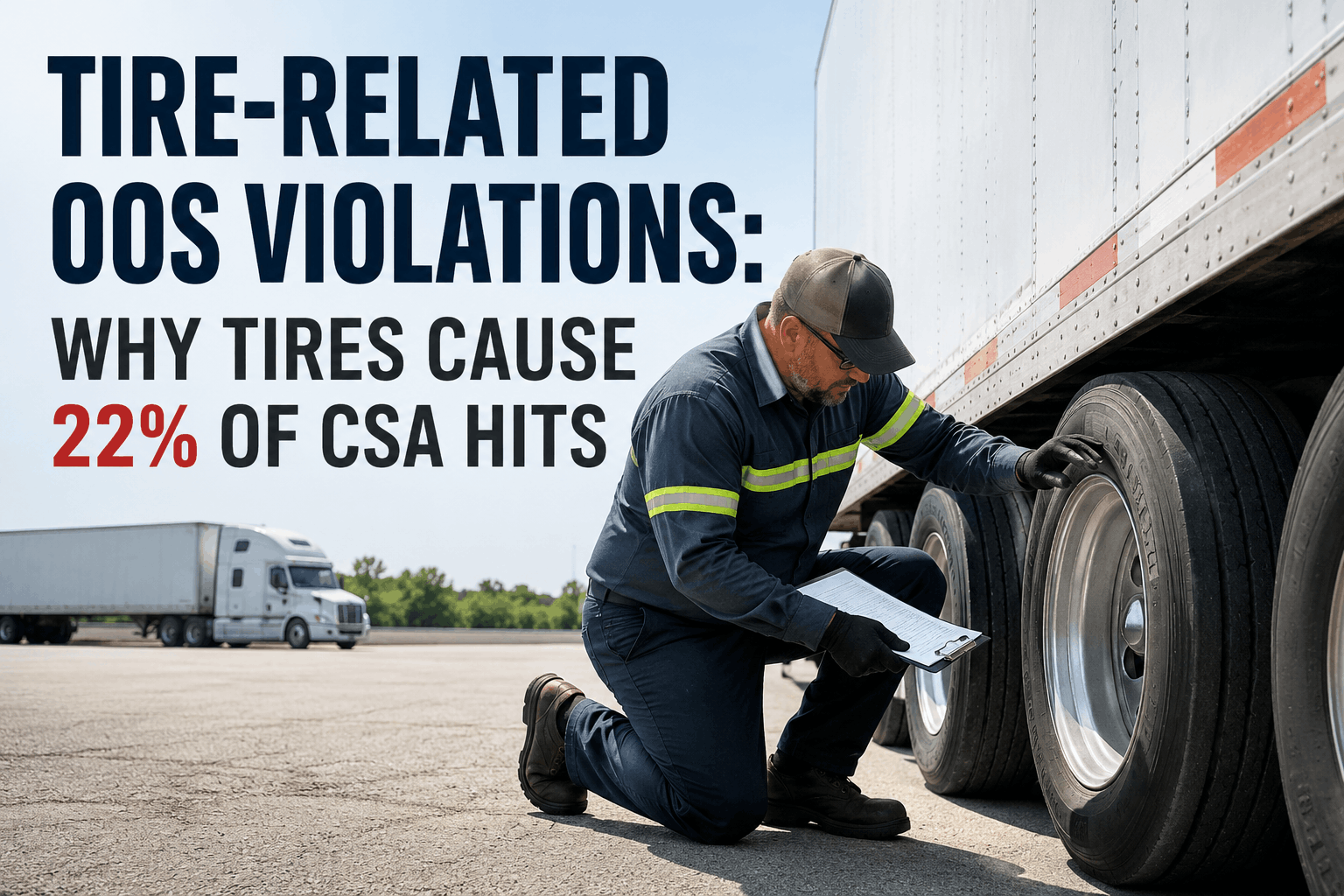
Based on the 2025 CVSA International Roadcheck — a 72-hour North American enforcement campaign that conducted 56,178 inspections in May 2025 — the leading vehicle out-of-service violations concentrated in a few categories. Brake-related conditions led the way: brake systems accounted for 24.4% of vehicle out-of-service violations, and when combined with the "20% defective brakes" condition, brake-related issues made up 41.1% of vehicle out-of-service violations. Tires were second at 21.4%, followed by lighting at roughly 14% and cargo securement at roughly 11%. On the driver side, hours of service led driver out-of-service violations at 32.4%, followed by no CDL, no medical card, and false records of duty status. It's important to read these figures in context: they come from a specific enforcement campaign and describe out-of-service violations, not every citation or every routine roadside inspection across the year, and the exact rankings and percentages shift by campaign, year, and jurisdiction — for example, combined brake violations were about 43% the prior cycle versus 41.1% in 2025. What stays consistent is that brakes, tires, and lighting are perennial high-frequency categories, which is exactly why they're the most productive targets for prevention. Always verify current figures against CVSA and FMCSA sources.
Why are brake violations so common?
Brakes consistently lead vehicle out-of-service violations for a combination of practical reasons. First, the braking system is a high-wear system — linings, adjustment, air components, and related parts degrade continuously with use, so problems develop steadily between services. Second, brakes are highly detectable at roadside: inspectors can check brake condition, adjustment, and air-system function relatively quickly, so defects that exist are likely to be found. That combination of high failure rate and high detectability is why brake-related conditions have led vehicle out-of-service findings across recent CVSA International Roadcheck cycles, staying above 40% of vehicle out-of-service violations when the brake-system and "20% defective brakes" categories are combined. The "20% defective brakes" condition specifically applies when at least one-fifth of a vehicle's brakes have an out-of-service condition. The key prevention insight is that many brake violations involve measurable conditions — pushrod stroke and lining thickness against adjustment limits — that a quick visual check can miss but a proper measurement by a qualified technician will catch. This is why brake condition should be measured and adjusted on a maintenance schedule rather than assessed only by a glance during a rushed pre-trip, and why documenting those measurements matters for demonstrating a systematic maintenance program.
Is a missing document an automatic out-of-service violation?
Not necessarily, and this is a common misunderstanding worth clearing up. Roadside inspection outcomes are not all equal: an inspection can result in no findings, an ordinary citation or finding that doesn't meet the out-of-service threshold, a maintenance or documentation violation that needs correction, or an actual out-of-service condition that prevents the vehicle from operating until fixed. A missing or incomplete required document is often a violation that must be corrected rather than an automatic out-of-service order — the specific treatment depends on the document, the circumstances, and the applicable regulations and out-of-service criteria. An out-of-service condition, by contrast, is a defect serious enough under the North American Standard Out-of-Service Criteria that the vehicle cannot legally be operated until the problem is corrected; the serious brake, tire, steering, and safety-system defects are the ones that typically cross that line. The practical implication for fleets is twofold: keep required documentation complete and retrievable so paperwork issues don't generate avoidable violations, but prioritize preventing the serious mechanical defects that actually place vehicles out of service. Because out-of-service criteria and classifications are updated over time, confirm the current standards and how specific findings are classified with CVSA and FMCSA rather than assuming.
How can a pre-trip inspection prevent violations?
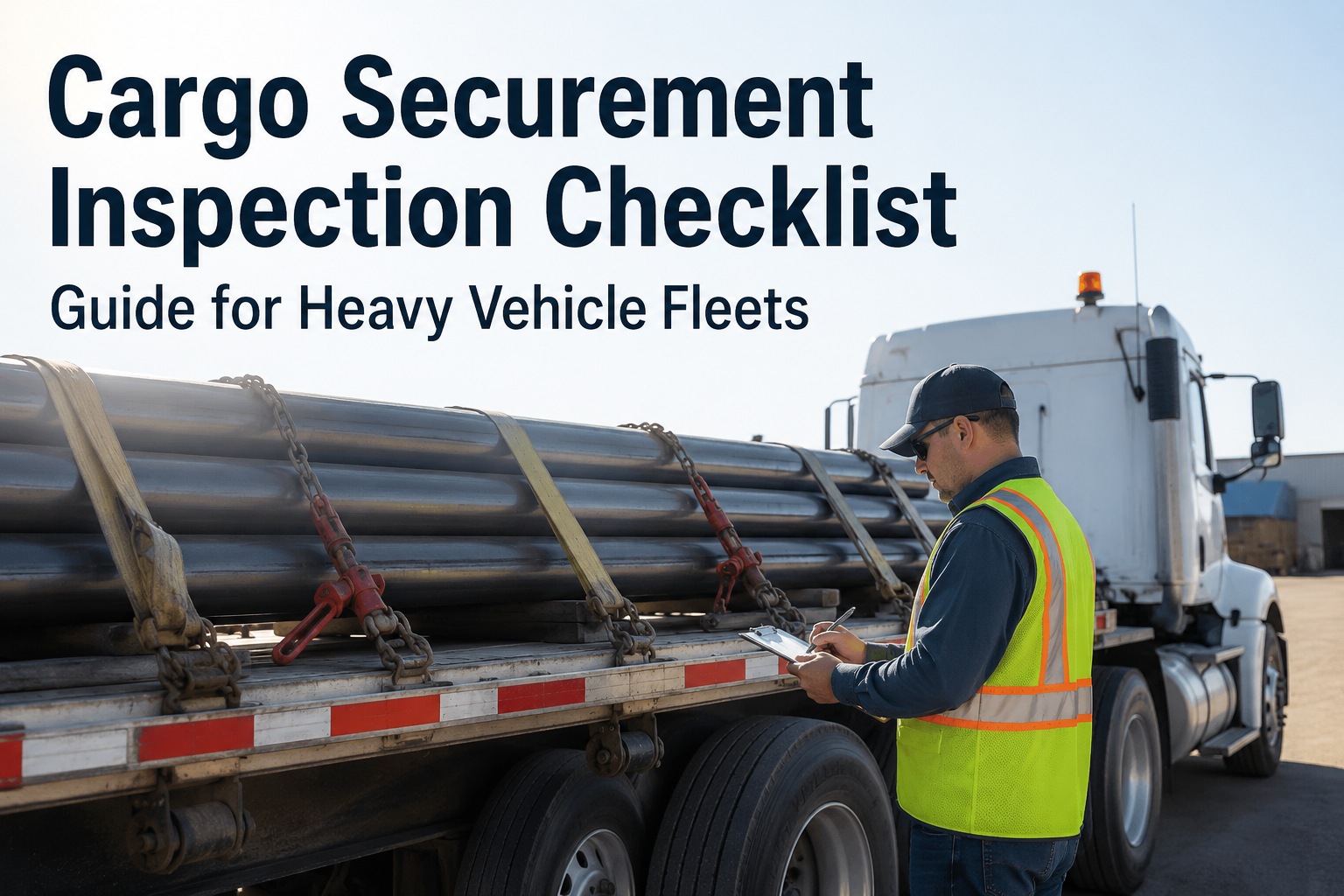
A structured pre-trip inspection is one of the most effective violation-prevention tools a fleet has, because it catches the same defects an inspector would find — while the truck is still in the yard, where a defect is a maintenance task rather than an out-of-service order. The key is that the pre-trip is structured and consistent rather than a rushed glance. For lighting, that means walking the vehicle and confirming every required lamp — headlights, brake lights, turn signals, and marker lights — actually works, since inoperative lamps are among the most common and most preventable findings. For tires, it means checking inflation, tread depth, and looking for cuts, bulges, and damage at every position. For brakes, it means listening for air leaks, checking the low-air warning, and looking for obvious damage, while recognizing that certain brake conditions require proper measurement by a technician rather than a visual check alone. For cargo securement, it means verifying tiedowns, anchor points, and load distribution before moving. The most powerful version of this pairs the pre-trip with documentation: when a defect is found, it's recorded with evidence, routed to repair, and verified as corrected before the vehicle is dispatched. That closes the loop so the same defect doesn't reach a roadside inspection, and it builds a record demonstrating a systematic inspection process.
How does inspection software help reduce violations?
Inspection and maintenance software helps reduce preventable violations by turning inspection from a paper formality into a continuous, closed-loop process, and by making a fleet's own data usable for root-cause prevention. Practically, a platform like Heavy Vehicle Inspection (HVI) provides configurable inspection templates that can target the high-frequency violation categories — brakes, tires, lighting, cargo securement, and required records — so drivers and technicians check exactly what inspectors check. It lets each defect be captured with photo evidence and tracked through to a documented repair, so nothing found during inspection is lost or forgotten. It supports preventive-maintenance scheduling so wear items like brakes and tires are serviced before they fail, keeps a searchable vehicle history so recurring defects on specific trucks, components, or locations become visible and can be traced to a root cause, and can provide dispatch controls that flag a vehicle that isn't ready to return to service. Together, these create a continuous compliance loop — inspect, capture evidence, repair, verify, and control dispatch — rather than relying on an annual audit or a roadside inspection to discover problems. The result is that defects are caught and corrected in the yard rather than at the roadside. Fleets should still verify current regulatory requirements independently, since software supports a compliance process but does not replace the underlying obligations.
Reduce preventable inspection findings with HVI
The most common DOT violations are the most preventable — if you catch them first. HVI gives you configurable inspection templates targeting the high-frequency categories, photo evidence on every defect, defect-to-repair tracking, preventive-maintenance scheduling, searchable vehicle history for root-cause analysis, and dispatch controls that keep an unready vehicle from rolling. Turn inspection into a continuous compliance loop instead of discovering problems at the roadside. HVI supports your compliance process; it doesn't replace your regulatory obligations.
Configurable inspections · Photo evidence & defect tracking · PM scheduling · Dispatch controls