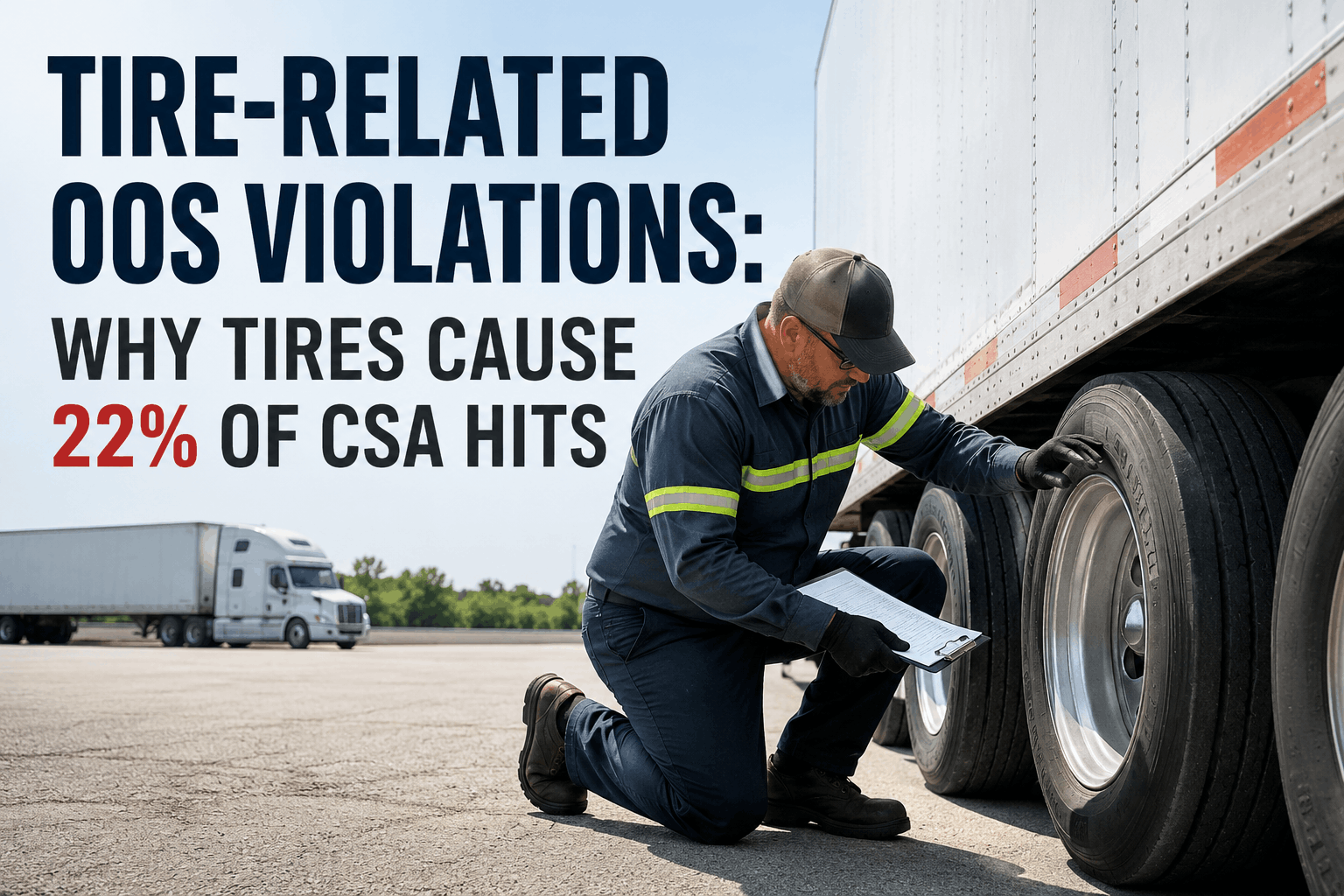
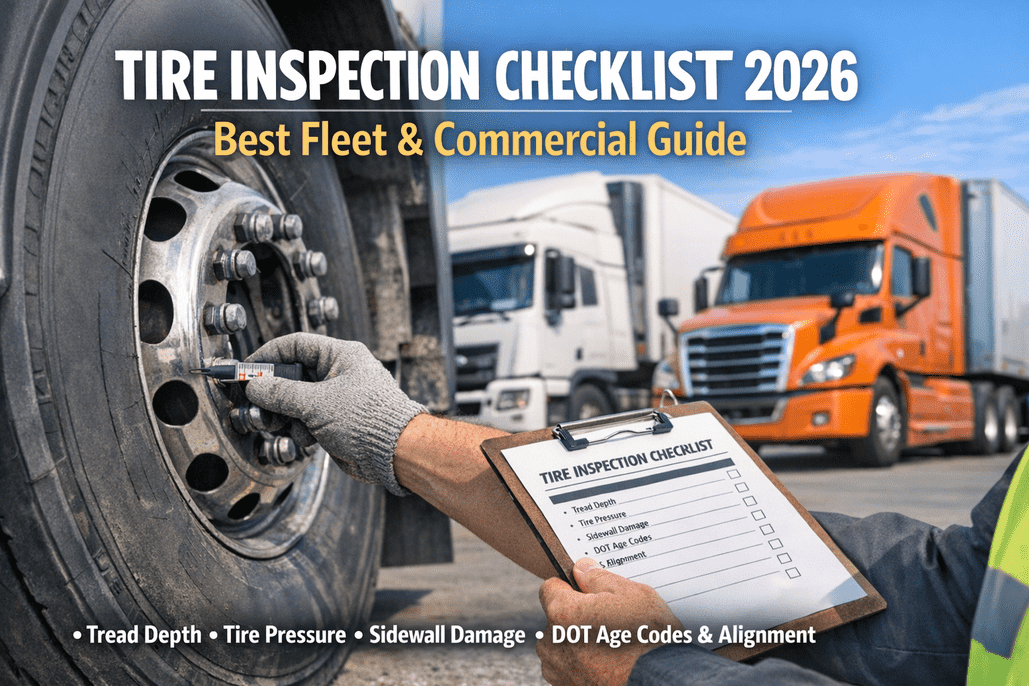
Tires account for 21.4% of all vehicle out-of-service violations on the road today — 2,899 tire OOS orders in the 2025 CVSA International Roadcheck alone, second only to brakes. For fleet maintenance managers, that means roughly one in five vehicles pulled out of service is parked because of a defect the pre-trip should have caught. The economics are unforgiving: each tire violation adds 8 severity-weighted points to the Vehicle Maintenance BASIC, multiplied by 3x for the first 6 months — effectively 24 CSA points per recent tire OOS, retained for 24 months. The roadside repair costs 4x what scheduled maintenance would have, plus towing, SLA penalties, and driver downtime. Worse, under the February 2026 CSA overhaul, tire defects a driver should have caught during walk-around now feed a separate "Vehicle Maintenance: Driver Observed" category — making pre-trip catch rate a direct, visible scoring factor. The good news is that 49 CFR 393.75 is one of the most deterministic regulations FMCSA enforces. Every OOS threshold is a measurable number — tread depth, PSI, sidewall condition. Catch them on the lot and they never become CSA hits. HVI's inspection & maintenance software turns tire inspection into a structured workflow with required PSI fields, tread-depth entry, photo verification of damage, and trend tracking that flags tires approaching OOS thresholds before they cross them.
Stop Tire OOS Violations Before They Score CSA Points
HVI catches the tire defects that cause 21.4% of vehicle OOS orders — required PSI entry, tread-depth tracking, sidewall photo evidence, and trend alerts that warn before tires cross OOS thresholds.
The 21.4% Headline — And What It Costs
Tires are not the #1 OOS category — brakes hold that title at 24.4%. But tires are a close second, and unlike brakes, almost every tire OOS is visually identifiable during a 2-minute walk-around. That is what makes tire violations so damaging: they are the most preventable category, and the most documented when missed.
21.4%
of vehicle OOS violations are tire-related
2025 CVSA Roadcheck: 2,899 tire OOS
53.5%
of all roadside breakdowns attributed to tires
FMCSA — breakdown failure analysis
8pts
CSA severity weight per tire violation
Vehicle Maintenance BASIC
24pts
effective points with 3x recency multiplier
First 6 months after violation
The 5 Tire Defects That Cause Most OOS Orders
FMCSA's 49 CFR 393.75 defines the bright-line conditions that put a vehicle out of service. Five defect categories dominate the citation data. Memorize these — they are the ones inspectors check first.
01
Tread Depth Below Minimum
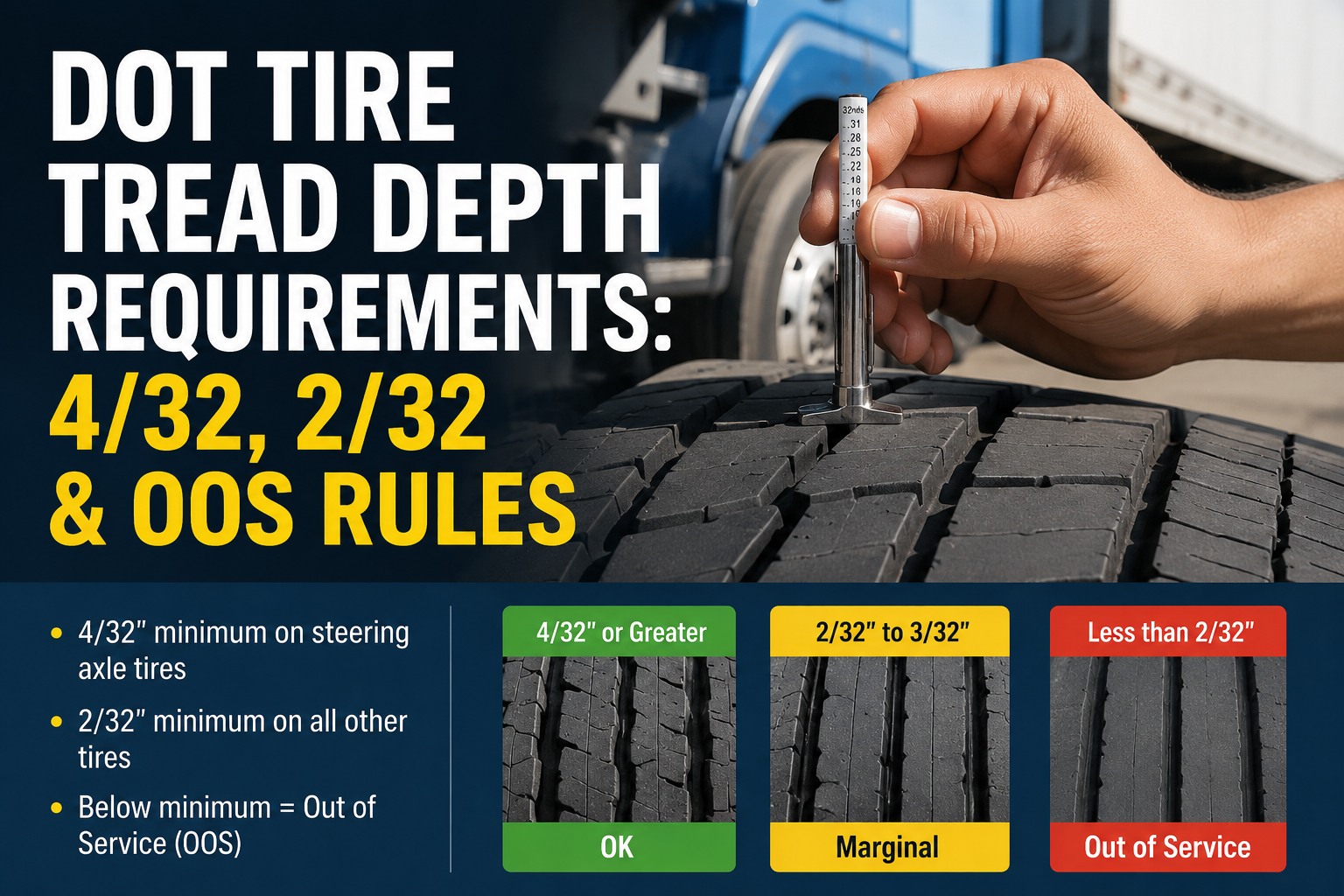
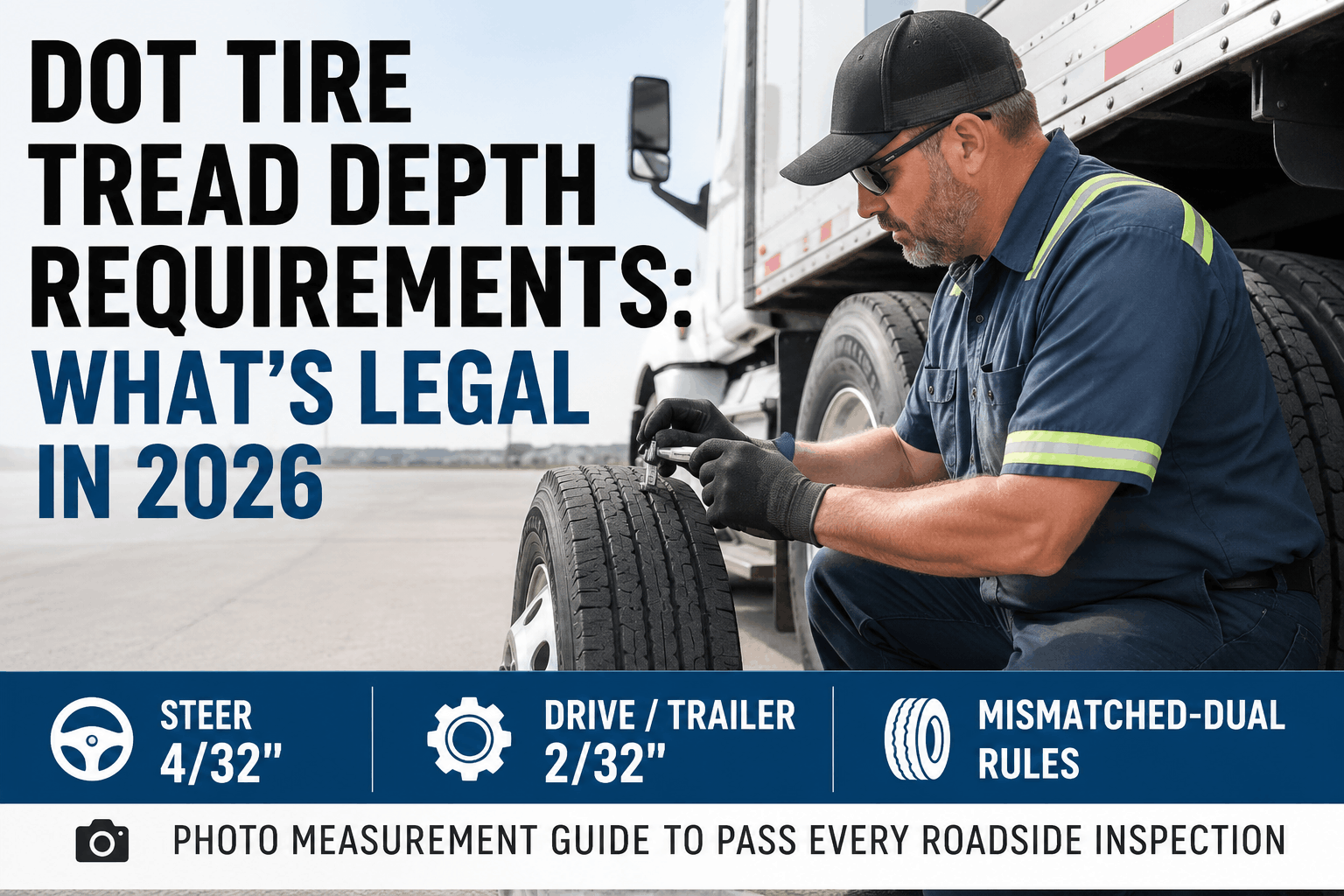
Steer axle: below 4/32" = immediate OOS
Drive & trailer axles: below 2/32" = OOS
Measure at three points across the tire — the lowest reading governs. Tread wear bars indicate 2/32" — once visible, the tire is already out.
02
Underinflation Beyond 20%
Any tire below 80% of required PSI = OOS
Internal structural damage assumed at this level
PSI is checked cold — running tires read 5–10 PSI higher and mask the violation. A 100 PSI specified tire at 79 PSI is OOS regardless of tread or visual condition.
03
Visible Sidewall or Tread Damage
Exposed cord, ply, fabric, belt material = OOS
Bulge, knot, or sidewall separation = OOS
No measurement tool needed — purely visual. Inspectors mark these in seconds. A flashlight pass on the inboard sidewall is critical because that is where most damage hides.
04
Mismatched Dual Tires Touching
Duals touching each other = OOS
More than 1/4" diameter mismatch on duals = violation
Both visible from a 2-foot crouch behind the wheel. Mismatched duals cause the larger tire to carry disproportionate load — a hidden cause of accelerated failure.
05
Retread on Steer Axle
Retreaded tire on steer axle of power unit = immediate OOS
Retreads permitted on drive and trailer only
Look for the retread cap line and any "RETREAD" or "RECAP" mold marking on the sidewall. This is one of the easiest violations for inspectors to catch — and one of the hardest to argue.
Every defect on this list is measurable or visible — meaning every one is catchable during pre-trip. HVI enforces tread depth and PSI as required entry fields, so drivers cannot submit without measuring.
Start free with HVI and close the pre-trip catch gap.
OOS Threshold Card: The Numbers Inspectors Carry
This is the reference card every fleet maintenance manager should print and post in the shop. The numbers do not change. The OOS conditions do not have grey areas. Either the tire meets these thresholds or it does not.
Tire Condition
Steer Axle
Drive & Trailer
OOS Trigger
Minimum Tread Depth
4/32"
2/32"
Below threshold = OOS
Inflation Pressure
Cold rating
Cold rating
Below 80% of PSI = OOS
Sidewall Cord Exposure
Any
Any
Visible cord = OOS
Tread Cord/Belt Exposure
Any
Any
Visible belt = OOS
Bulge or Separation
Any
Any
Visible = OOS
Retread Tire
Not permitted
Permitted
Retread on steer = OOS
Dual Tire Diameter Difference
N/A
Max 1/4"
Touching duals = OOS
The Pre-Trip Catch Rate Gap
Tires are the most catchable OOS category — and the most missed. Here is what the data shows about pre-trip inspection effectiveness on tire defects, paper versus digital.
Paper pre-trip — tire defect catch rate
Digital pre-trip without required PSI entry
HVI digital pre-trip — required PSI + tread + photo
The catch rate gap is structural, not effort-based. Paper allows "tires OK" with no measurement; HVI requires the actual numerical entry.
Book a demo to see HVI's tire inspection workflow.
The Repair-vs-Replace Decision Matrix
When a defect is found, the next decision drives the cost. Repair saves money short-term; replacement saves money over the tire's life. This matrix gives maintenance managers a structured way to decide — based on the specific defect, the axle position, and the remaining tread.
Defect
Steer Axle
Drive Axle
Trailer Axle
Nail puncture in tread, no leak structural damage
Plug + patch
Plug + patch
Plug + patch
Sidewall puncture or cut
REPLACE
REPLACE
REPLACE
Tread depth at 4/32"
REPLACE (at OOS)
Monitor weekly
Monitor weekly
Tread depth at 2/32"
Already OOS
REPLACE (at OOS)
REPLACE (at OOS)
Run-flat or under-inflation event
REPLACE
REPLACE
REPLACE
Bulge, knot, or visible separation
REPLACE
REPLACE
REPLACE
Uneven wear (cupping, feathering)
Investigate alignment
Investigate alignment
Investigate axle
Flat-spotted from skid event
REPLACE
REPLACE
REPLACE
Document every repair-or-replace decision in HVI. A pattern of repeated patches on the same tire becomes evidence of a systemic issue — and a candidate for proactive replacement before the next OOS.
Start free with HVI.
What a Single Tire OOS Actually Costs
The fine itself is rarely the largest expense. Here is the full cost stack of one tire OOS event for a typical Class 8 tractor on a loaded run.
Roadside repair / replacement
$650 – $1,400
4x scheduled-shop cost
Tow / dispatch if not repairable on-site
$400 – $1,200
Distance + lift type
Driver downtime
$250 – $600
3–6 hour event average
SLA / late delivery penalty
$500 – $5,000
Per contract terms
FMCSA fine
Up to $16,864
Per violation, per occurrence
CSA score impact (24 months)
24 effective points
Insurance premium increase
The 2026 CSA "Driver Observed" Change — Why This Hits Twice Now
Before February 2026, a tire OOS scored once in the Vehicle Maintenance BASIC. Under the new CSA framework, tire defects that a driver should have caught during walk-around now feed an additional "Vehicle Maintenance: Driver Observed" category — meaning the same violation now affects two BASIC scores instead of one.
BEFORE Feb 2026
One tire OOS = one BASIC hit
Vehicle Maintenance BASIC scored alone
Pre-trip quality not a separate factor
Single scoring stream per violation
AFTER Feb 2026
One tire OOS = two BASIC hits
Vehicle Maintenance + Driver Observed
Pre-trip catch rate directly scored
Walk-around-catchable defects penalised more
Tires Are the Most Preventable CSA Category — Treat Them That Way
Tire OOS violations make up 21.4% of all vehicle out-of-service orders, drive 53.5% of roadside breakdowns, and now hit two CSA categories under the 2026 framework. Every defect on the OOS list is either measurable (tread depth, PSI) or visible (sidewall cord, bulge, retread on steer) — meaning every one is catchable during a properly structured pre-trip. The gap between paper inspection catch rate (34%) and HVI digital inspection catch rate (91%) is not driver effort. It is whether the workflow requires the actual measurement. HVI's inspection & maintenance software enforces tread-depth entry, PSI entry, sidewall photo verification, and trend tracking that alerts maintenance when tires approach OOS thresholds — turning the 21.4% statistic into a problem your fleet does not contribute to. Combine that with the repair-vs-replace matrix above, document every decision in HVI's maintenance log, and the CSA category becomes a non-issue at audit time. Start free today or book a 30-minute demo to see HVI's tire inspection workflow live on your fleet.
Cut Tire OOS Violations to Near Zero with HVI
Required PSI entry. Tread-depth tracking. Sidewall photo verification. Trend alerts before OOS thresholds. Repair-vs-replace documentation. 3-signature chain enforced. Trusted by 25,000+ users worldwide.
Frequently Asked Questions
Q: Why do tires cause 21.4% of vehicle OOS violations?
Tires are the most visually inspectable category — meaning roadside officers can identify violations in seconds without test equipment. Combined with the deterministic thresholds in 49 CFR 393.75 (4/32" steer, 2/32" drive/trailer, 80% PSI, visible cord/bulge), nearly every tire defect produces a citable finding. The 2025 CVSA Roadcheck logged 2,899 tire OOS — second only to brakes.
Q: What is the minimum tread depth for commercial vehicle tires?
Steer axle: 4/32" — below this is immediate OOS. Drive and trailer axles: 2/32". Measure at three points across the tread; the lowest reading governs. Tread wear bars indicate 2/32" — once visible, the tire is already at the OOS limit and should not roll. HVI requires tread-depth entry per tire during inspection, so the threshold cannot be silently crossed.
Start free with HVI.
Q: How many CSA points does a tire OOS violation add?
8 severity-weighted points in the Vehicle Maintenance BASIC, multiplied by the recency factor: 3x within the first 6 months (24 effective points), 2x at 6–12 months, 1x at 12–24 months. Under the 2026 CSA framework, a walk-around-catchable defect also hits the new "Driver Observed" category — effectively scoring twice.
Book a demo.
Q: Can a punctured tire be repaired or must it be replaced?
Tread-area punctures with no structural damage to the cord or sidewall can be plug-and-patch repaired on any axle. Sidewall punctures or cuts always require replacement. Run-flat events, bulges, separations, and flat-spots from skid events always require replacement regardless of axle position. See the repair-vs-replace matrix above for the structured decision.
Q: Are retreaded tires legal on commercial vehicles?
Yes — but not on the steer axle of a power unit. Retreaded tires are permitted on drive and trailer axles. A retreaded tire on a steer axle is an immediate OOS violation and one of the easiest inspector findings — the retread cap line and "RETREAD" or "RECAP" sidewall marking make it obvious from a few feet away.
Q: How does HVI prevent tire OOS violations specifically?
HVI's tire inspection workflow makes tread depth and PSI required entry fields — drivers cannot submit "tires OK" without recording actual numbers. Sidewall damage requires photo evidence. Trend tracking flags tires approaching OOS thresholds (e.g., steer tread at 5/32" warns before it hits 4/32"). Defects auto-route to maintenance with work orders. The full audit trail satisfies 49 CFR 393.75 documentation requirements.
Start free today.