OBD-II vs J1939: Which Telematics Standard Your Fleet Actually Needs
By William Jerry on May 22, 2026
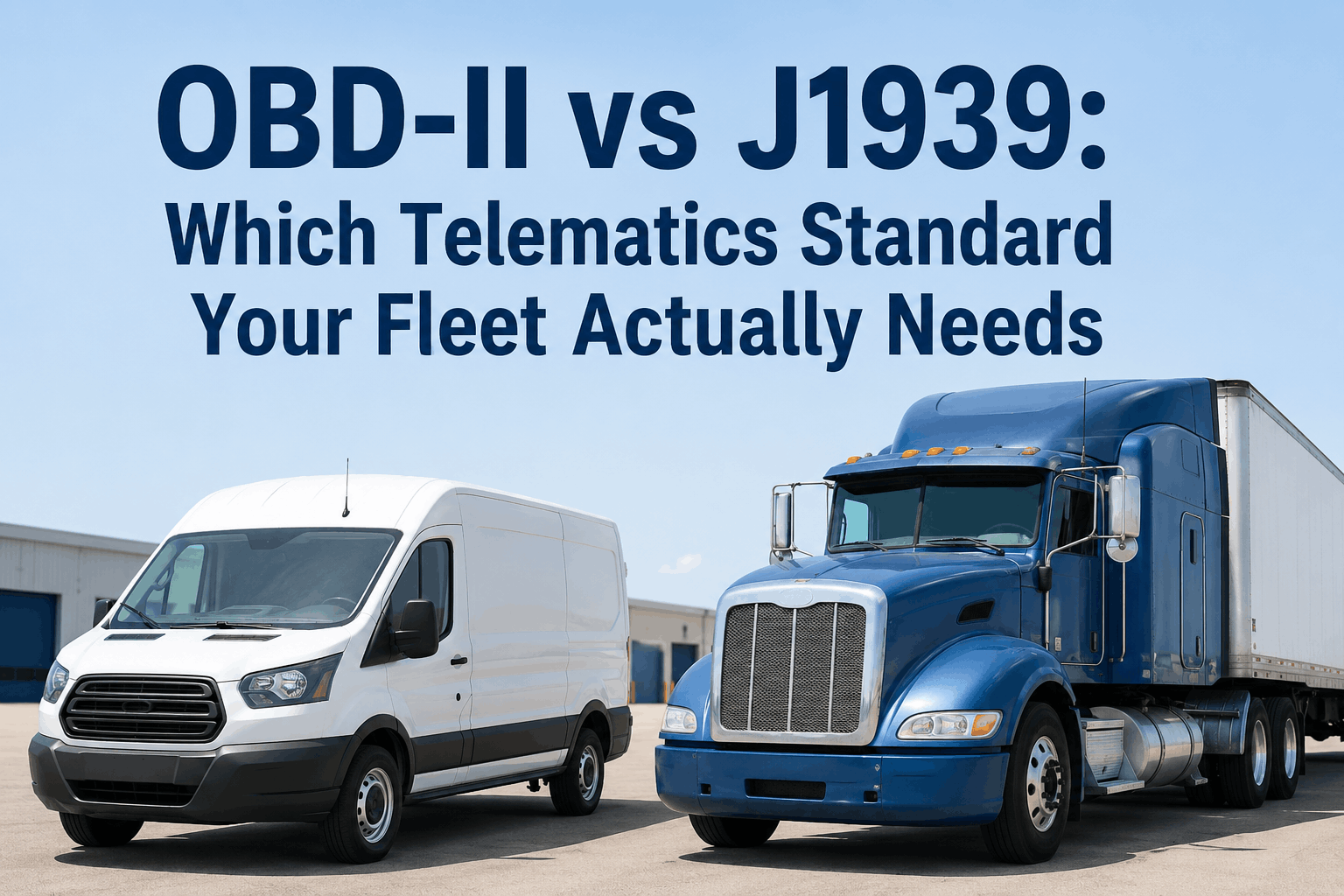
Two diagnostic protocols dominate fleet telematics, and choosing the wrong one is one of the most expensive mistakes an ops director can make. OBD-II is the 16-pin standard mandated on every passenger car and light-duty truck sold in the US since 1996 — built for emissions compliance, designed for low-cost universal access, and limited to roughly 100 standardized parameters retrieved by request-response query. J1939 is the SAE-developed 9-pin standard that runs on every Class 4–8 commercial vehicle on the road — built for real-time inter-ECU coordination, designed for harsh duty cycles, and capable of broadcasting over 8,000 standardized parameters at 250–500 kbps. They are not competing standards. They serve fundamentally different vehicle classes, different data needs, and different operational philosophies. The mistake fleet IT teams make is treating them as interchangeable — buying OBD-II dongles for a heavy-duty fleet because the per-vehicle price is lower, then discovering 90% of the data they need does not exist on that protocol. Or wiring J1939 telematics into a fleet of service vans and paying $25–55 per vehicle per month for parameters those vehicles cannot generate. This article gives fleet IT and operations directors the technical comparison, the data-richness gap, the hardware-cost math, and the decision framework for mixed-asset fleets. HVI's inspection & maintenance software ingests data from both protocols — so the protocol choice can be driven by vehicle class, not telematics platform limits.
One Platform for Mixed-Asset Fleets — OBD-II + J1939
HVI ingests diagnostic and inspection data from both light-duty (OBD-II) and heavy-duty (J1939) vehicles in one unified maintenance workflow — no separate platforms, no data silos, no integration tax.
30-Second Verdict: Which Protocol for Which Vehicle
Before the technical comparison, here is the answer most fleet IT teams want first.
OBD-II
16-pin
Use for: passenger cars, pickups, vans, light-duty service vehicles (Class 1–3)
Hardware: $50–150 + $8–15/mo
J1939
9-pin Deutsch
Use for: heavy-duty trucks, buses, semi-tractors, trailers, equipment (Class 4–8)
Hardware: $200–600 + $25–55/mo
Mixed Fleet
Both protocols
Use for: fleets with both service vans + heavy trucks, last-mile + line-haul
Hardware: per-vehicle protocol match + unified platform
Technical Comparison: Side by Side
The two protocols differ on nearly every architectural dimension — from physical connector to data philosophy. Here is the comparison that matters for telematics platform selection.
Dimension
OBD-II
J1939
Governing Standard
SAE J1962 / ISO 15031
SAE J1939 family
Vehicle Class
Class 1–3 (light-duty)
Class 4–8 (medium & heavy)
Physical Connector
16-pin trapezoid
9-pin Deutsch (round)
Communication Speed
Variable — typically 9.6–500 kbps
250 kbps standard / 500 kbps high-speed
Data Architecture
Request-response (query each PID)
Broadcast (continuous streaming)
Standardized Parameters
~100 PIDs (emissions-focused)
8,000+ PGN/SPN (full vehicle)
Federal Mandate
Yes — EPA, since 1996
No — industry consensus standard
Primary Purpose
Emissions compliance + DTCs
Real-time control + diagnostics
ECU Network Scope
Powertrain CM primarily
Engine, transmission, ABS, aftertreatment, body
Duty Cycle Design
Consumer vehicle operation
Heavy commercial — vibration, temp, EMI
The Data Richness Gap: 100 vs 8,000+ Parameters
Speed and connector pinout matter, but the real difference is what you can actually see. J1939 broadcasts roughly 80x more standardized data points than OBD-II. Here is what each protocol gives you — and what only one of them can.
OBD-II — Available Data
Engine RPM
Vehicle speed
Coolant temperature
Fuel level (where supported)
Fuel consumption (calculated)
Battery voltage
DTCs (Diagnostic Trouble Codes)
Oxygen sensor readings
MAF / MAP sensor data
Emissions readiness monitors
Throttle position
Odometer (where supported)
~100 standardized PIDs
J1939 — Everything OBD-II Has, Plus
All OBD-II parameters at higher fidelity
Engine torque (actual + demanded)
Engine hours (separate from odometer)
Transmission gear, oil temp, slip
DEF level + aftertreatment health
Brake system pressure + temp
Suspension air pressure
Trailer ABS data
PTO engagement status
Axle load distribution
Idle vs driving fuel breakdown
Harsh-event acceleration + braking
Fault codes per ECU (engine, trans, ABS, body)
Real-time CAN bus health
8,000+ standardized PGN/SPN
For heavy-duty fleets, the data on the right is what drives predictive maintenance, fuel optimization, and CSA-defending diagnostics. OBD-II simply cannot deliver these parameters — they do not exist on the protocol. Book a demo to see HVI ingest both data streams.
Hardware Cost Stack: What Each Protocol Costs to Deploy
Per-vehicle telematics cost is not just the monthly subscription. Here is the full hardware and software stack — the numbers that matter when sizing a deployment across 50, 500, or 5,000 vehicles.
OBD-II DEPLOYMENT
Device hardware (per vehicle)$50 – $150
Installation (plug-and-go)$0 – $25
Cellular / data subscription$8 – $15/mo
Platform license$5 – $20/mo
Year 1 per vehicle$206 – $595
J1939 DEPLOYMENT
Device hardware (per vehicle)$200 – $600
Installation (hard-wired)$50 – $200
Cellular / data subscription$15 – $30/mo
Platform license + J1939 decoding$10 – $25/mo
Year 1 per vehicle$550 – $1,460
J1939 costs 2–3x more per vehicle but delivers 80x the data. For Class 4–8 vehicles where one prevented breakdown saves $2,000+, the math is straightforward. For Class 1–3 service vans where the primary need is GPS and basic diagnostics, OBD-II is the right choice. Start free with HVI.
The Mixed-Fleet Reality: Most Fleets Need Both
Few fleets are pure light-duty or pure heavy-duty. Most are mixed — service vans alongside Class 8 tractors, last-mile delivery vehicles alongside line-haul trucks, sedans for sales alongside utility trucks for field crews. Here is the typical mixed-fleet breakdown and how protocol allocation actually works.
Class 1–3
Light-Duty
Sedans, pickups, service vans, light cargo vehicles. Pre-2013 medium-duty often still on OBD-II.
OBD-II
Class 4–6
Medium-Duty
Box trucks, delivery trucks, utility vehicles, refuse trucks. Some hybrid OBD-II/J1939 vehicles in older fleets.
OBD-II or J1939
Class 7–8
Heavy-Duty
Tractors, dump trucks, refuse trucks, semi-trailers, buses. All major OEMs (Freightliner, Kenworth, Peterbilt, Volvo, Mack) standardized on J1939.
J1939
The Mixed-Fleet Decision Framework
For ops directors making the deployment decision, here is the practical framework — five questions that determine the right protocol allocation for your specific fleet.
Q1
What classes are in your fleet?
Class 1–3 only → OBD-II. Class 4–8 only → J1939. Mixed → both, per vehicle.
Q2
What is the primary use case — visibility or maintenance?
Under $500 (light vehicle) → OBD-II ROI works. Over $1,500 (heavy vehicle) → J1939 ROI is straightforward in one prevented event.
Q4
Do you need ELD compliance?
Heavy-duty drivers under HOS → J1939 device required (most ELDs use J1939 directly). Light-duty exempt vehicles → not applicable.
Q5
Can your maintenance platform ingest both protocols?
If no → either you buy two platforms (data silos) or you compromise on data. HVI accepts both — protocol choice stays per-vehicle, platform stays unified.
Pick the Protocol Per Vehicle, Pick the Platform Once
OBD-II and J1939 are not competing standards — they serve different vehicle classes and different operational needs. The mistake fleet IT teams make is forcing one protocol across a mixed fleet because the telematics platform only handles one. The fix is to pick the protocol per vehicle (OBD-II for Class 1–3, J1939 for Class 4–8, evaluate Class 4–6 case by case) and pick a maintenance platform that can ingest both data streams into a unified workflow. HVI's inspection & maintenance software does exactly that — diagnostic data from light-duty OBD-II vehicles and heavy-duty J1939 vehicles flows into the same maintenance dashboard, the same work-order engine, and the same audit-ready compliance reports. Protocol choice stops being a platform constraint and starts being a per-vehicle optimization. For ops directors, that means deploying the right hardware on the right vehicle, controlling per-vehicle cost, and maintaining one source of maintenance truth across the entire fleet. Start free today or book a 30-minute demo to see HVI ingest both protocols on your fleet.
One Maintenance Platform for OBD-II + J1939 Fleets
Light-duty diagnostic data + heavy-duty telematics + structured inspections + auto-generated work orders. No data silos. No integration tax. Trusted by 25,000+ users worldwide.
Some heavy-duty trucks expose limited OBD-II data on a 16-pin connector, but the bulk of operational data — engine torque, DEF level, aftertreatment health, transmission slip, brake pressure — lives only on the J1939 CAN bus and requires a 9-pin Deutsch connection. OBD-II adapters exist for J1939 vehicles but they translate only a small subset of available parameters. Class 4–8 fleets should deploy J1939 directly.
Q: How much more data does J1939 provide than OBD-II?
Roughly 80x — OBD-II defines around 100 standardized PIDs (mostly emissions-related), while J1939 defines over 8,000 standardized PGN/SPN parameters covering every major ECU on a heavy-duty vehicle. J1939 also broadcasts continuously at 250–500 kbps versus OBD-II's request-response model. For fleet maintenance applications, the data-richness gap is decisive. Start free with HVI.
Q: What does J1939 hardware actually cost?
Hardware devices range from $200 to $600 per vehicle depending on features (cellular, GPS, accelerometer, dual-protocol support). Installation adds $50–200 because J1939 devices typically hard-wire to the 9-pin diagnostic port. Monthly subscriptions run $25–55 per vehicle for full-featured platforms. Year-one all-in cost is typically $550–$1,460 per vehicle — versus $206–$595 for OBD-II light-duty deployment.
Q: Do ELDs use OBD-II or J1939?
Most ELDs for Class 7–8 trucks use J1939 directly to pull engine hours, vehicle speed, and odometer with high accuracy. ELDs designed for light-duty fleet exemption use cases may use OBD-II. The FMCSA-registered ELD list documents which protocol each device uses. For DOT-regulated heavy-duty drivers, J1939 is effectively the standard. Book a demo for HVI's compliance workflow.
Q: Is there a single device that handles both protocols?
Some enterprise telematics devices offer dual-protocol support with adapter cables for OBD-II and J1939, but these are typically $400–$800 per device. For most mixed fleets, the cheaper path is matching the device to the vehicle (OBD-II dongle for light-duty, J1939 device for heavy-duty) and using a maintenance platform like HVI that can ingest both data streams into one unified workflow.
Q: How does HVI handle mixed-protocol fleets?
HVI's platform is protocol-agnostic on the ingestion side — light-duty OBD-II diagnostic data and heavy-duty J1939 telematics data both flow into the same maintenance dashboard, the same defect-to-work-order workflow, and the same audit-ready compliance reports. Drivers run the same mobile inspection app regardless of vehicle class, and maintenance managers see one unified view across the entire mixed fleet. Start free today.