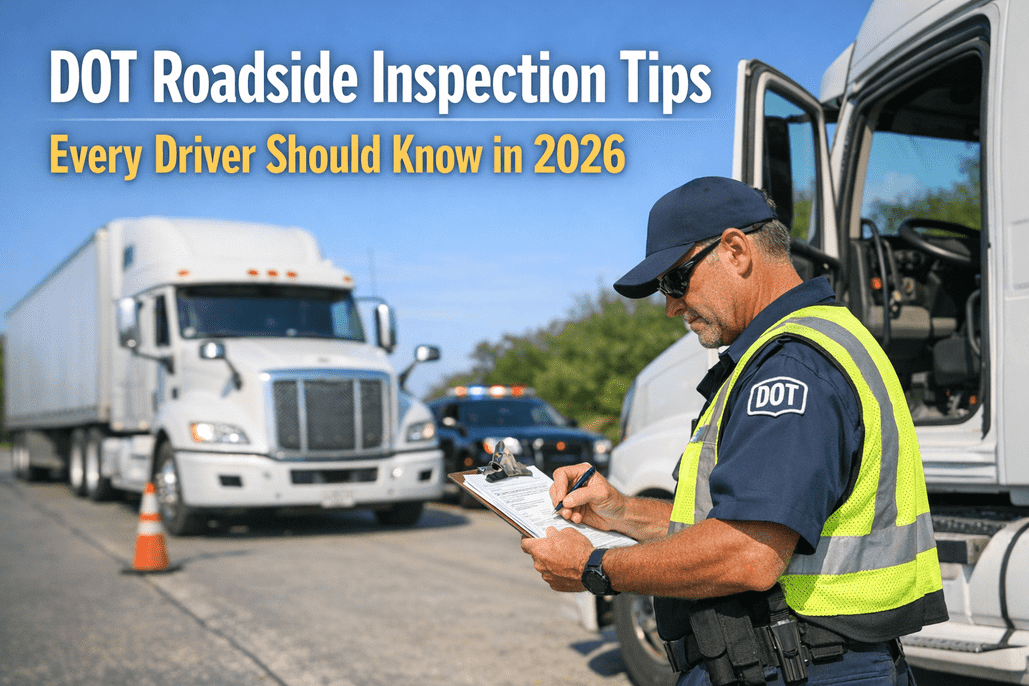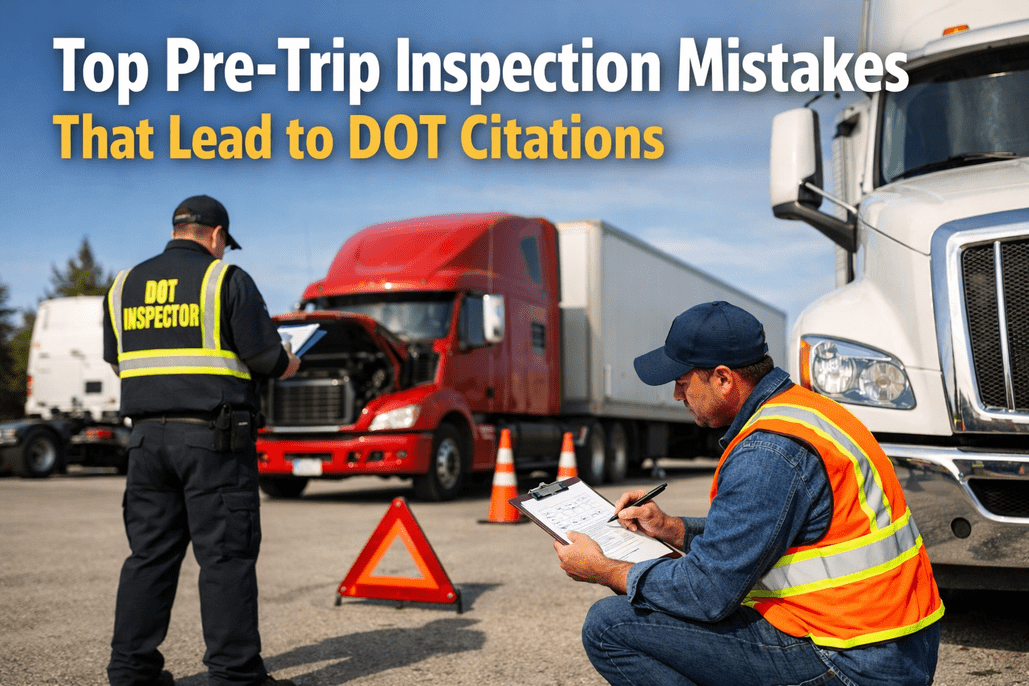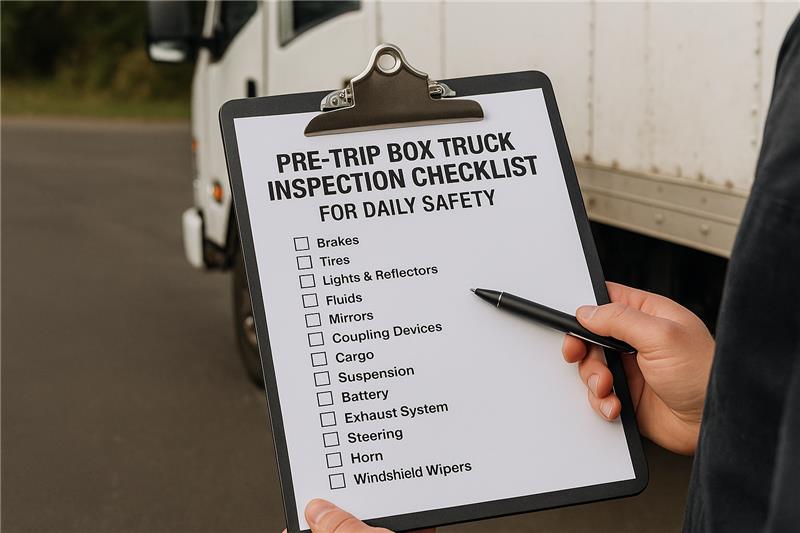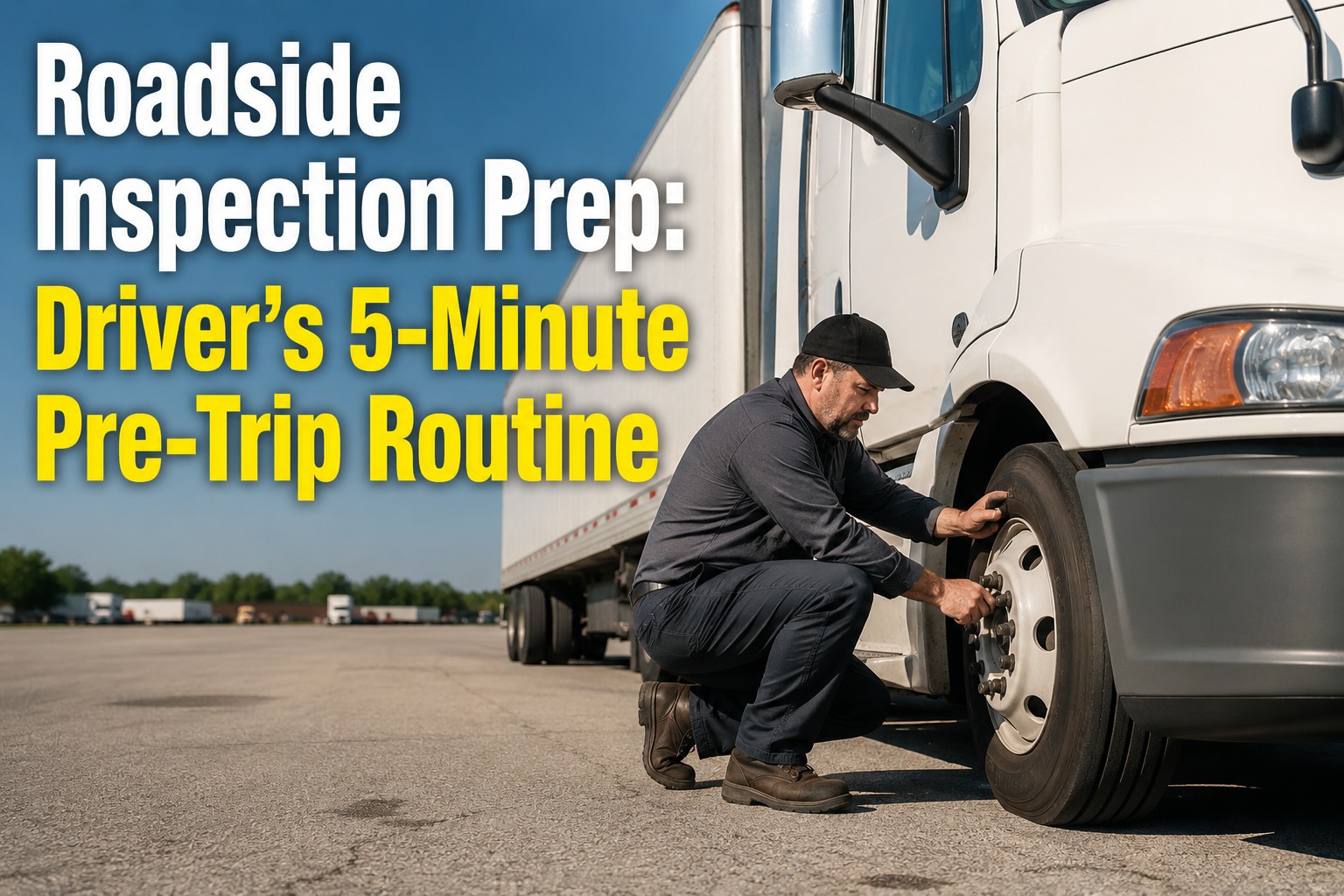
Roadside inspection prep does not require the 30-45 minute paper walkaround most training programs teach. It requires a disciplined 5-minute go/no-go routine focused on the three defect categories that produce 75% of all out-of-service orders: brakes (24.3%), tires (21.4%), and lights (14%). Do those three well plus a cargo securement scan and a DVIR review, and you catch what CVSA inspectors will catch — before you leave the yard — book a demo to see 5-minute guided digital pre-trip inspections in HVI.
Your 5-Minute Pre-Trip — What to Check, Minute By Minute
Not a replacement for the full 45-checkpoint walkaround. A prioritized go/no-go focused on the defects inspectors actually write up.
Brakes
24.3% of vehicle OOS violations
- Listen for air leaks at every glad-hand + connection
- Push-rod travel — less than 1" from parked position
- ABS light cycles on start, then turns off
- Air pressure builds to 100+ PSI within 45 seconds
Tires
21.4% of vehicle OOS violations
- Tread depth gauge (not visual): 4/32" steer, 2/32" drive/trailer
- Sidewall damage, cuts exposing cord ply
- Duals not touching; matched inflation
- Rust trails around lug nuts = loose fastener
Lights
14% of vehicle OOS violations
- Headlights (high + low), turn signals, 4-way flashers
- Clearance lamps, ID lamps, marker lights all sides
- Brake lights work (have someone check, or set trailer brake and walk)
- Reflective conspicuity tape intact, not peeled
Cargo & couplings
12.4% of vehicle OOS violations
- Load secured per weight/type — straps rated, chains at anchor points
- Fifth wheel locked, kingpin fully seated, safety latch engaged
- Landing gear fully retracted and pinned
- No load shift visible from behind trailer
DVIR + documents
§396.13 mandatory review
- Review previous DVIR — every defect repaired or "not required for safe op"
- Sign to acknowledge review
- Documents in cab: CDL + medical card + reg + insurance + IFTA sticker current
- Log any new defect found in walkaround before departing
2026 CVSA Roadcheck: 44,047 inspections, 10,350 vehicles OOS. Brakes + tires + lights + cargo securement = 75%+ of every OOS order written. A 5-minute focused walkaround catches most of them before dispatch.
The rest of this page walks the specific OOS thresholds inspectors check against for each of the top categories, the 2026 CSA overhaul that doubled the score impact of every OOS violation and added a "Driver Observed" category specifically penalizing defects a driver should have caught at pre-trip, and how digital pre-trip tools compress the 5-minute routine while producing the audit trail that protects both the driver and the fleet. Book a 30-minute demo to see guided 5-minute digital pre-trip in HVI.
The OOS thresholds — what counts as pass vs fail at roadside
Every OOS decision at roadside runs against specific numeric thresholds under the CVSA North American Standard Out-of-Service Criteria. Knowing the exact thresholds turns your 5-minute pre-trip from a visual scan into a measured check that matches what the inspector will apply. Miss the threshold by 1/32" of tread and the truck is out of service; hit it comfortably and you dispatch clean.
| Category | OOS threshold | Pre-trip target (margin) |
|---|---|---|
| Brake adjustment | 20%+ of brakes on vehicle out of adjustment = OOS | Zero out-of-adjustment; verify pushrod travel per axle |
| Brake shoe wear | Below 3/16" at friction material | Replace at 3/16"+3/16" wear margin, not at absolute minimum |
| Steer tire tread | Less than 4/32" at any major groove | Replace or rotate at 5/32" — do not run to minimum |
| Drive/trailer tire tread | Less than 2/32" at any major groove | Replace at 4/32" per fleet PM standard |
| Tire damage | Sidewall cut exposing cord ply, ply separation, air loss | Zero visible damage on any tire face |
| Lights (required) | Any required lamp inoperative = defect; multiple = OOS pattern | All lamps working, no dim/flickering, tape intact |
| Cargo securement | Insufficient tiedowns, unrated equipment, load can shift | Tiedowns rated to 50% of cargo weight minimum; no visible shift |
The 3/16" and 4/32" numbers are worth memorizing because they are where the inspector's rule comes down. Everything above threshold is a pass. Everything at or below is a fail. There is no "close enough" — measured wear at 3.5/32" on a steer tire is out of service whether the driver thought it "looked fine" or not. Digital pre-trip tools that prompt for measured values (not "check tires yes/no") produce dramatically fewer roadside failures because the measurement discipline happens in the yard where correction is possible. Book a demo to see prompted measurement-based digital pre-trip in HVI.
The 4 driver mistakes that turn a passable truck into an OOS order
Well-maintained trucks routinely fail roadside inspections because of preventable driver errors during pre-trip, not underlying equipment problems. Four specific mistakes account for the majority of OOS orders on units that were actually roadworthy. Each has a specific fix that fits inside the 5-minute routine.
Visual check instead of measured
Tires "look fine" at 3/32" but fail OOS check at 4/32". Brake linings "look good" but measure below 3/16". Visual assessment is worthless against numeric thresholds. Use a tread gauge every pre-trip on every unit — not just when tires look questionable.
Skipping the DVIR review
§396.13 requires the driver to review the previous DVIR, verify defect repairs, and sign before operating. Roadside inspectors ask for the signed acknowledgment. Missing signature = documented violation regardless of vehicle condition. Digital DVIRs make the sign-off structural.
Missing lights on rear-facing side
Drivers routinely check what they can see from the driver door. Rear-facing lights (brake lights, license plate lamp, trailer clearance) fail undetected until roadside. Walk fully around, or set trailer brakes and walk to verify brake lights actually illuminate.
Cargo assumption
Loader secured cargo yesterday; driver assumes today. Cargo securement was the 2026 CVSA Roadcheck focus area — 1,724 violations, 12.4% of all vehicle OOS. Personally verify tiedown rating, count, and anchor engagement before every departure, especially after a shift change.
The pattern connecting all four: driver-observed defects that a genuine walkaround catches, but a routine-going-through-the-motions pre-trip misses. The 2026 CSA overhaul specifically penalizes "Driver Observed" violations at 2× severity weight in the newly split Vehicle Maintenance BASIC categories — meaning a burned-out brake light caught at roadside now damages the carrier's CSA score twice as much as it did in 2024. The driver-side incentive to catch defects in the yard has never been higher. Book a demo to see the guided pre-trip that prevents Driver Observed violations in HVI.
What to do when you find a defect — the 4-step protocol
Finding a defect at pre-trip is not the problem. Not documenting it and dispatching anyway is. When your 5-minute routine catches something, four specific steps determine whether the finding protects the fleet or exposes it. This is the workflow that separates audit-defensible programs from the ones that fail their first FMCSA compliance review.
Log the defect immediately
- DVIR entry with specific component and location
- Photo evidence with time-stamp
- Do not depart until logged
- Digital tools enforce this automatically
Assess safe operation impact
- Below OOS threshold = do not dispatch
- Minor and non-safety = log + report + drive
- Uncertain = call safety supervisor, not "probably fine"
- Err toward stopping when close to threshold
Route to work order
- Every defect creates a work order automatically
- Mechanic sees the log, addresses, closes with repair notes
- Corrective action documented, driver notified
- Prevents dispatch loop where defect never gets fixed
Sign off before next trip
- Next-shift driver reviews previous DVIR
- Verifies repair documented or "not required for safe op"
- Signs to acknowledge per §396.13
- Full chain of custody preserved for audit
The 4-step protocol closes the loop that paper systems routinely break. Paper DVIR: driver reports defect, paper goes to shop, shop repairs but does not document, next driver never sees closure. Roadside inspector asks for defect-to-repair chain, finds gaps, writes up multiple recordkeeping violations on top of the underlying defect. Digital DVIRs enforce the closure structurally: no defect can be dispatched without either repair evidence or "not required" authorization, and the audit trail is inspector-ready by default. Start a free HVI trial to see automatic defect-to-work-order routing per unit.
A 28-year veteran driver on why the 5-minute routine changed his out-of-service history
28 years driving Class 8, mostly reefer, currently pulling for a 74-tractor Southeast carrier. In my first 20 years I had 4 OOS orders — three brake-related, one tire. Every single one for a defect I could have caught in the yard if I had actually looked. The last one was a slack adjuster past travel on a rear axle. Inspector found it in about 45 seconds during a Level I. I had done my "walkaround" that morning — walked around, kicked a tire, glanced at lights, done. Fine truck otherwise. OOS anyway.
Fleet went digital pre-trip in 2023 across all 74 tractors. Guided app on the phone, tread gauge required for tires (measurement value entered, not a checkbox), photo on each brake chamber, actual walk-around with rear-facing lights physically verified. Takes me about 4-5 minutes now, versus the 90 seconds my "walkaround" used to take. Feels longer at first. It isn't — you're just actually doing what the paper DVIR always claimed you were doing.
Zero OOS in 22 months across our 74 trucks. Two roadside Level Is passed clean on my truck alone, both with CVSA decals. My CSA carrier's Vehicle Maintenance percentile dropped from 68th to 22nd in that same window. The 2026 CSA overhaul that doubled OOS weight and added the Driver Observed category would have hammered us at our old numbers. The 5-minute discipline is the whole difference. Any driver who says they cannot spare 5 minutes for the truck they are about to drive 400 miles is telling on themselves.
Frequently asked questions
How long should a pre-trip inspection actually take?
A prioritized 5-minute go/no-go routine focused on the highest-frequency out-of-service categories (brakes, tires, lights, cargo securement, plus DVIR review) catches most of what roadside inspectors will find. A comprehensive 45-checkpoint walkaround under 49 CFR §392.7 covering all 11 mandatory parts and accessories takes 10-15 minutes with digital tools or 30-45 minutes with paper checklists. Both have their place. The 5-minute focused routine is appropriate for repeat trips on a well-known unit that just completed a full walkaround at start-of-shift. The comprehensive walkaround is appropriate at start-of-shift, after a driver change, after any maintenance work, or on a unit the driver has not operated recently. What is never appropriate is skipping the pre-trip entirely or doing a 30-second "kick the tire" pass and calling it done. Under §396.13, the driver must review the previous DVIR before every departure and sign to acknowledge the review; under §392.7, the driver must be satisfied that specific safety components are in good working order before the vehicle moves. Both requirements apply to every trip. The question is not whether to do a pre-trip but how to make the 5 minutes actually verify what the inspector will check — measurement over visual, rear-lamp verification, cargo securement personally checked, DVIR reviewed with signature, and defect logged if found.
What are the most common roadside inspection violations?
CVSA International Roadcheck data year over year points to a consistent top-5 pattern. Brake systems typically lead vehicle out-of-service violations at 24-25% of OOS orders, with an additional 15% for 20% defective brakes (the CVSA rule that places a vehicle OOS when 20% or more of the brakes on the vehicle are out of adjustment). Combined brake-related violations run 40-41% of all vehicle OOS orders. Tires rank second at approximately 21% of OOS violations, typically driven by insufficient tread depth (steer tires below 4/32", drive and trailer below 2/32"), sidewall damage exposing cord ply, and improper repairs. Lighting devices consistently rank third at 12-14% of OOS orders — burned-out required lamps, missing reflective conspicuity tape, and inoperative brake lights being most common. Cargo securement ranked fourth in the 2026 Roadcheck at 1,724 violations (approximately 12% of vehicle OOS), reflecting the CVSA focus area for that year. On the driver side, hours-of-service violations lead driver OOS at approximately 32%, followed by wrong class of license and expired medical certificates. All top categories are items a driver can catch in a focused pre-trip. The 2026 CSA overhaul added specific "Driver Observed" violation weighting that penalizes carriers when a defect a driver should have caught at pre-trip is written up at roadside — making pre-trip discipline more important than at any point in the CSA program's history.
What happens if I fail a roadside inspection?
Consequences depend on the specific violation and its severity under the CVSA North American Standard Out-of-Service Criteria. Minor violations (missing paperwork, non-safety defects) typically produce a written warning with a directive to correct the defect and provide proof of repair. Serious violations meeting OOS thresholds (brake adjustment 20%+ of brakes out, steer tire below 4/32", inoperative required lighting, cargo securement insufficient) produce an out-of-service order that halts the vehicle at the inspection location until the defect is repaired. A single OOS violation averages approximately $4,200 in direct penalties depending on the violation type and state jurisdiction. Beyond the direct penalty, every roadside inspection outcome (pass, warning, OOS) feeds into the carrier's Compliance, Safety, Accountability (CSA) BASIC scores that affect insurance premiums, shipper contract eligibility, and future inspection selection probability. The 2026 CSA overhaul splits Vehicle Maintenance into two separate BASIC categories including "Driver Observed" violations specifically scoring defects a driver should have caught at pre-trip, reduces the violation counting window to 12 months, and doubles the severity weight of OOS violations. A carrier that would have absorbed a single OOS event with minor CSA impact in 2024 now sees measurable percentile movement from the same event in 2026. The financial and operational compounding is why fleets are investing more heavily in pre-trip discipline than in any prior CSA period.
Do I have to do a pre-trip on every trip or just once per shift?
Under 49 CFR §396.13, before operating a commercial motor vehicle the driver must review the previous Driver Vehicle Inspection Report (DVIR), verify that any defects were repaired or the carrier certified them as not requiring repair, and sign to acknowledge the review. This requirement applies to every departure regardless of whether a comprehensive pre-trip was done at start-of-shift. Under 49 CFR §392.7, the driver must be satisfied that the 11 specific mandatory parts and accessories (service brakes including trailer brake connections, parking brake, steering, lighting devices, tires, horn, wipers, mirrors, coupling devices, wheels and rims, emergency equipment) are in good working order before the vehicle moves. Practical fleet convention: a comprehensive walkaround pre-trip at start-of-shift or after any equipment change, plus a focused 5-minute pre-trip prior to each subsequent departure covering brakes/tires/lights/cargo/DVIR review. The DVIR review-and-signature under §396.13 is not optional for any trip. If you did a full pre-trip 3 hours ago at start-of-shift and are now leaving after a rest break, the §396.13 review still applies before the vehicle moves again. Digital DVIR tools make the review-and-signature effectively frictionless (a single tap acknowledging the previous report), which is why the practical friction argument against reviewing every departure is largely gone with modern tooling. The regulatory expectation is that the driver personally verifies vehicle safety before each departure, not once per shift.
Can I refuse to drive a truck I think is unsafe?
Yes, and under 49 CFR §392.7, you are required to. The regulation states that a driver may not operate a commercial motor vehicle unless the driver is satisfied that the specific mandatory parts and accessories are in good working order. If your pre-trip inspection identifies a defect that would make the vehicle out-of-service at a roadside inspection, or that in the driver's professional judgment would affect safe operation, the driver is legally obligated to not operate the vehicle until the defect is corrected. This is not a discretionary standard — the regulation places the safety judgment on the driver, and a driver who operates a vehicle known to be unsafe can be personally liable for any resulting incident. In addition, federal whistleblower protections under the Surface Transportation Assistance Act (STAA) protect drivers from retaliation for refusing to operate a vehicle they reasonably believe is unsafe. If your fleet's policy pressures drivers to dispatch trucks with known defects, document each incident (defect found, when reported, response received, action taken) and consult with a safety-focused labor attorney or the FMCSA. From a fleet management standpoint, a culture that supports driver defect-refusals is the culture that produces the lowest CSA scores, the lowest insurance premiums, and the fewest nuclear-verdict exposures — the driver's judgment call at pre-trip is the last line of defense before the vehicle is on the road with the public.
The 5-minute discipline that keeps trucks in service and CSA scores low.
HVI turns the 5-minute pre-trip routine into a guided digital workflow: measurement prompts for brakes and tires, photo capture for lights and cargo securement, automatic DVIR signature per §396.13, and every found defect routed to a work order that prevents dispatch until closed. Drivers protect themselves. Fleets protect their CSA scores. Everyone dispatches trucks the roadside inspector will pass. Live in under two weeks.
Trusted by DOT-regulated fleet safety programs across USA & Canada · Ready on day one