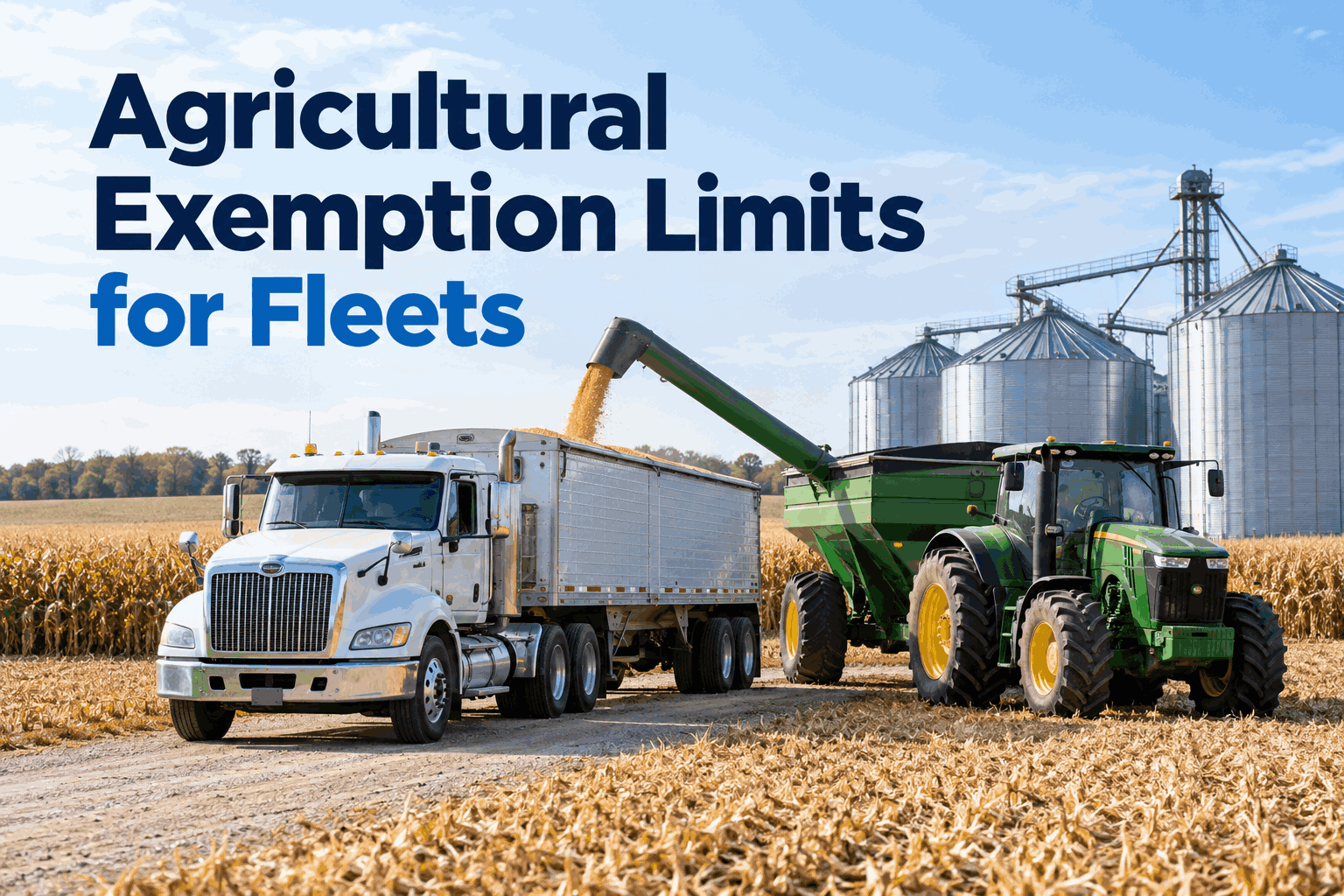
Agricultural exemption trucking rules can save your fleet real hours and paperwork — but every one of those exemptions is conditional, and the burden of proving you qualify sits with you, not the auditor. Assuming an exemption you can't document is how a "we're exempt" fleet ends up with violations. Book a demo to see exemptions tracked and documented per vehicle in HVI.
An Exemption Is a Claim You Have to Prove
Agricultural exemptions aren't automatic — they apply only while specific conditions hold, and they vanish the moment you cross a limit. The fleets that stay clean are the ones that can document exactly why each one applies.
Here's the compliance-manager view of agricultural exemption trucking — why an exemption is a claim you must substantiate, the main FMCSA exemptions and the condition that bounds each, how the 150 air-mile limit works, where fleets get it wrong, and the records that let you defend every exemption you rely on. (This guide covers US FMCSA rules; other countries have their own frameworks.)
An exemption is conditional, not permanentwhy "we're an ag operation" isn't a defense
The most expensive mistake in agricultural exemption trucking is treating an exemption as a status your fleet simply has. It isn't. Each FMCSA agricultural exemption applies only while specific conditions are met — the commodity, the distance, the season, the vehicle — and the moment a trip falls outside those conditions, standard rules apply again.
In an audit, the exemption is yours to prove — not the inspector's to disprove. If you can't show that a trip met the exemption's conditions, the safe assumption is that it didn't, and the violation stands. That's why agricultural exemption compliance is really a recordkeeping discipline: knowing which exemption applied, and holding the evidence that it did.
The main FMCSA agricultural exemptionsand the single condition that bounds each one
Several distinct agricultural exemptions exist under US FMCSA rules, and they're often lumped together as "the ag exemption" when they're really separate provisions with different triggers. Knowing which one you're relying on — and its bounding condition — is the first step to documenting it.
150 air-mile agricultural exemption
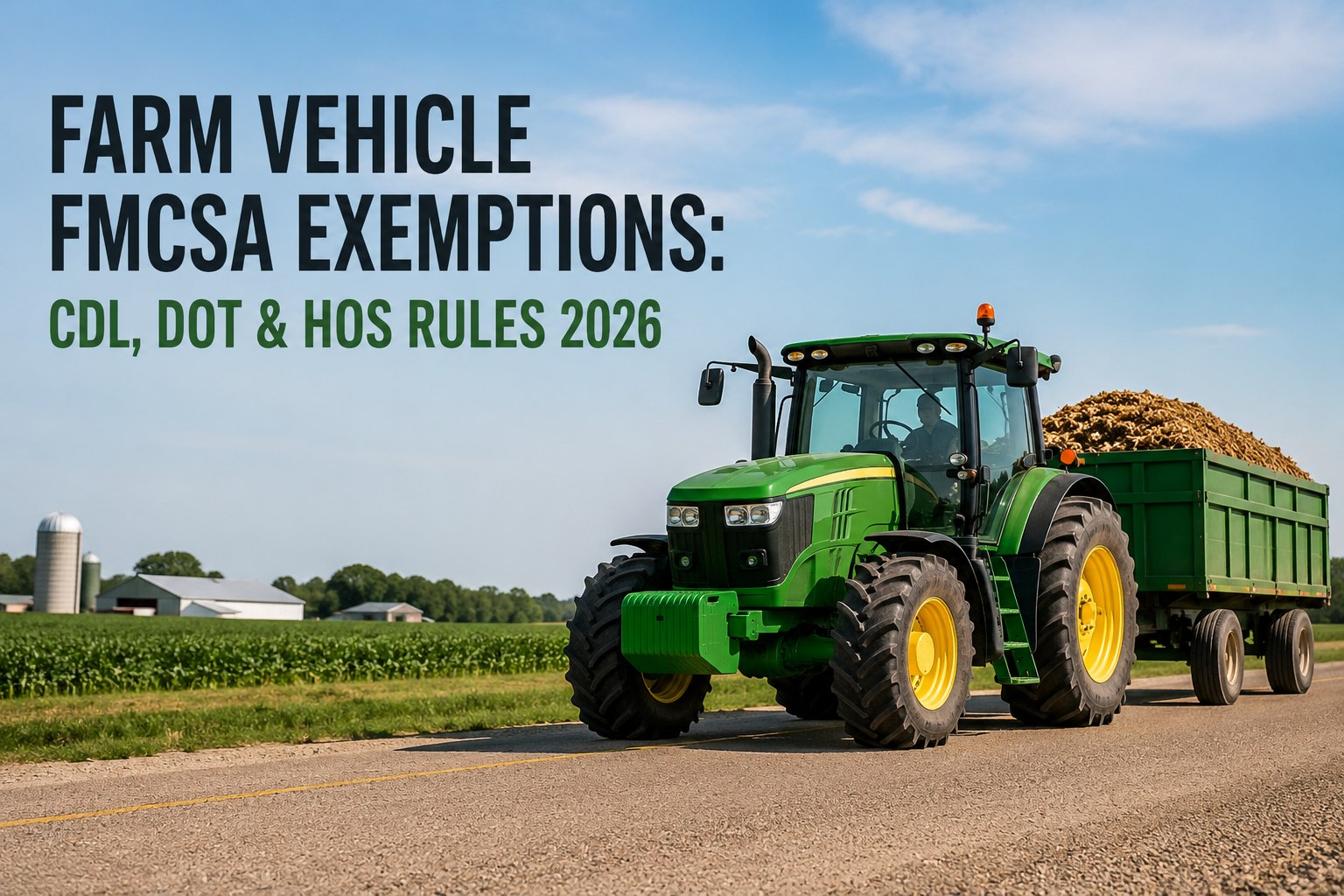
HOS rules are relaxed for the transport of agricultural commodities within a 150 air-mile radius of the source, during planting and harvest as defined by the state.
Covered farm vehicle (CFV)
Vehicles registered as farm vehicles and operated by the farm can be exempt from several requirements, with conditions that differ above and below 26,001 lbs GVWR/GCWR.
Agricultural HOS exemption
Within the exemption area and window, drivers hauling ag commodities are relieved of hours-of-service limits — but only while the trip stays inside those bounds.
Agricultural ELD exemption
A driver who qualifies for an HOS exemption on a given trip is generally not required to log it on an ELD for that trip, though the vehicle may still carry one.
Notice how they stack: the ELD relief depends on the HOS relief, which depends on the 150 air-mile window applying. Get the bounding condition of the one you rely on wrong and the whole chain falls — a driver who thinks they're ELD-exempt because "it's an ag load" is only exempt if the underlying HOS exemption actually held for that trip. Naming the specific exemption, rather than waving at "the ag exemption," is what lets you check its condition and hold the right record. The existing DOT guide for agriculture fleet operators walks through how each exemption works in more detail. Book a demo to map exemptions to your vehicles
How the 150 air-mile limit worksa radius from the source, not miles driven
The 150 air-mile agricultural exemption is the one fleets misjudge most, because "air-mile" isn't the same as road miles. It's a straight-line radius measured from the source of the commodity — so the exemption covers a circle around the origin, and a trip that stays inside that circle stays in the window regardless of the winding route.
The practical trap: a driver can run exempt all day inside the radius, then take one load beyond it and immediately fall under full HOS rules for that trip — often without realizing the line was crossed. Because it's measured from the commodity's source, a fleet hauling from several origins has a different circle for each one, and a trip's status depends on which source it started from. Knowing where that boundary sits for each source, and logging when a trip leaves it, is what keeps the exemption defensible rather than a guess made after the fact. Start free and flag when a trip crosses the exemption boundary.
Where fleets get agricultural exemptions wrongthe four assumptions that turn into violations
Almost every agricultural exemption violation traces back to an assumption that went unchecked. These four are the common ones — and each is avoidable with a clear rule and a record behind it.
The thread through all four is the gap between believing an exemption applies and being able to show it. Most fleets that get caught out weren't breaking the rules — they were entitled to the exemption but had no way to prove it when asked, and lost the benefit of the doubt. Closing that gap is less about knowing the rules better and more about capturing the right record at the right time, which is where treating compliance as documented safety management rather than institutional memory pays off. Book a demo to replace exemption assumptions with records
The records that substantiate each exemptionwhat to hold on file, exemption by exemption
An exemption you can't evidence is a violation waiting to be found. Each agricultural exemption is substantiated by a specific set of records — and knowing which records go with which exemption is what turns a claim into a defense.
The pattern is that most proof is trip-level: what was hauled, from where, how far, and when. Reconstructing that months later for an audit is nearly impossible — memories fade, drivers move on, and the load paperwork is scattered — so the record has to be captured at the point of the trip or it effectively doesn't exist. That gap between a defensible exemption and a hopeful one is the same discipline behind solid DOT audit preparation. Book a demo to attach records to each exemption
Keep it current per region and operationexemptions change with where and how you run
Agricultural exemptions aren't set once. State-defined planting and harvest seasons differ, operations shift between exempt and non-exempt work, and a vehicle moved to a new region may fall under different rules. A profile that was right in spring can be wrong by fall.
Set the profile per region
Which exemptions apply, and their conditions, configured for each vehicle and area.
Capture the records
Trip and vehicle evidence attached as work happens, not rebuilt for an audit.
Export on demand
Pull the evidence for any vehicle, exemption or period when an auditor asks.
This is exactly what region-configurable compliance is built for: profiles that reflect where and how each vehicle runs, records that travel with them, and a clean export when it's needed. It's the same principle that keeps hours-of-service compliance defensible across a mixed fleet. Start free and keep every exemption profile current.
From a compliance officer
We ran on the ag exemption for years and never thought twice about it — until an audit asked us to prove it, trip by trip, and we couldn't. We knew we'd been hauling grain inside the radius during harvest, but "we know" isn't a record. We took findings on trips that almost certainly qualified, purely because we had nothing on file to show they did. The fix wasn't learning the rules better; we knew the rules. It was capturing the commodity, the source and the distance on every exempt trip so the exemption could be proven, not just claimed. Now each vehicle has a profile that says which exemption applies and the records sit right behind it. The next audit was a non-event.
How HVI keeps agricultural exemptions defensibleconfigure, capture, export
Agricultural exemption compliance holds up when each exemption is configured per vehicle, its records are captured as work happens, and the evidence exports cleanly. HVI's region-configurable profiles, multi-interval tracking and export do exactly that — turning informal exemption assumptions into documented, audit-ready profiles.
Configure per vehicle
Set which exemption applies to each vehicle and region, with its conditions.
Capture the proof
Commodity, source, distance and season logged against each exempt trip.
Export for audit
Produce the evidence for any exemption, vehicle or period in seconds.
See how agricultural exemptions become configured, documented profiles inside HVI's safety and compliance management. Walk through your own fleet's exemption setup in a quick demo
Agricultural exemption trucking: quick answers
What is the agricultural exemption in trucking?
Under US FMCSA rules, "agricultural exemption" refers to a set of provisions that relax certain requirements — most notably hours-of-service — for the transport of agricultural commodities under specific conditions. The best-known is the 150 air-mile agricultural exemption, which relaxes HOS limits for ag-commodity transport within a 150 air-mile radius of the source during state-defined planting and harvest periods. It's not a blanket status: each exemption applies only while its conditions are met, and the carrier is responsible for proving they were.
How does the 150 air-mile agricultural exemption work?
It's a straight-line radius, not road miles. The exemption can apply to the transport of agricultural commodities within 150 air-miles measured from the source of the commodity, during the planting and harvest season as defined by the state. While a trip stays inside that radius and meets the other conditions, hours-of-service limits are relaxed; once a load goes beyond the radius, standard HOS rules apply for that trip. Because it's measured as a circle from the source, fleets need to know where that boundary falls for each origin.
What is a covered farm vehicle (CFV)?
A covered farm vehicle is a vehicle registered as a farm vehicle and operated by the farm owner, family members or employees to transport the farm's own agricultural products, machinery or supplies. Qualifying CFVs are exempt from several FMCSA requirements, with conditions that differ depending on whether the vehicle is at or below, or above, 26,001 lbs GVWR/GCWR — including distance conditions for the heavier category. As with other exemptions, the fleet has to be able to show the vehicle and its use meet the CFV definition.
Are agricultural haulers exempt from ELD requirements?
Generally, a driver operating under a valid hours-of-service exemption for a given trip is not required to log that trip on an ELD, because the ELD requirement is tied to the HOS recording obligation. In practice the ELD relief depends on qualifying for the HOS relief first — so if the trip falls outside the exemption's conditions, both the HOS rules and the logging requirement apply again. Fleets should confirm the current FMCSA requirements for their specific operation, as details can change.
What records do I need to support an agricultural exemption?
Mostly trip-level evidence that the exemption's conditions were met: the commodity hauled, the source location, the trip distance relative to the 150 air-mile radius, and the applicable state season dates. For covered farm vehicles, add farm registration, weight ratings and proof of qualifying ownership and use. The key is capturing this at the time of the trip rather than reconstructing it for an audit — an exemption you can't document is treated as one that didn't apply, so the record is what makes the exemption defensible.
Make every agricultural exemption defensible
HVI turns agricultural exemptions from informal assumptions into documented, per-vehicle profiles — the right exemption configured for each region, the records captured as trips happen, and the evidence exported the moment an auditor asks.
No credit card · US FMCSA-focused · Set your first exemption profile today
- Identify which exemption you rely on
- Confirm its bounding condition per trip
- Know your 150 air-mile boundary
- Capture the proof at the trip
- Keep it current per region & season