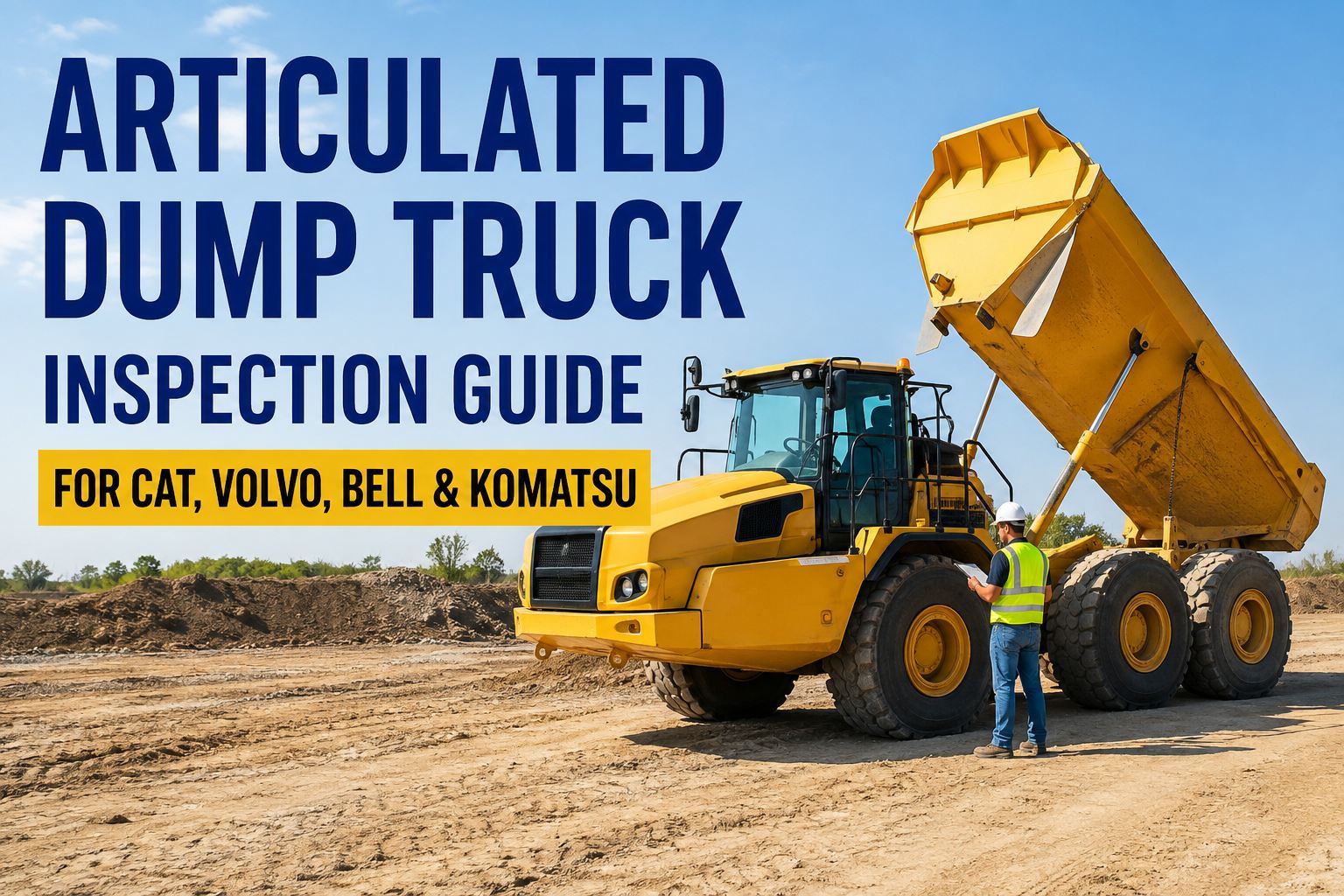
The articulation joint on a Volvo A40G moves through millions of load cycles carrying a 40-ton payload across quarry grades that would break a highway truck in a week. That single pivot is why articulated dump truck inspection is a different discipline from any other heavy equipment check. Skip the joint, skip the retarder test, or skip the rubber bushings under the A-frame, and you're inspecting a machine that can fail in ways it was designed to survive. This guide walks the 20-minute walkaround for Cat, Volvo, Bell, and Komatsu ADTs. Book a demo
Four OEMs, one inspection discipline — the systems that actually matter
Different badges, same critical components. Model families across four major manufacturers.
ADTs occupy a strange regulatory gap. They're too heavy and too off-road-specific for DOT DVIR rules, so 49 CFR 396.11 doesn't apply. But they're still under OSHA 29 CFR 1926.20 and 1926.602 on construction sites and MSHA on mine sites — both requiring pre-shift inspection. That means the inspection discipline is real, the documentation requirement is real, and the OSHA penalty exposure is real (up to $16,550 per serious violation, $165,514 for willful). What it also means: nobody's going to hand you a standardized DVIR to follow. You build the discipline yourself, or you don't have it.
The 20-minute walkaround map — six stations, one systematic path
Every walkaround should follow the same route every time. Randomly wandering around a machine is how you miss things. Six stations, roughly 3 minutes each, always in the same order — that's the discipline that catches the developing failures before they strand the machine on a haul road.
Station 3 is where most of the real risk lives. Every other station on the machine can be inspected on a highway truck too — the articulation joint is the ADT-specific component that punishes fleets that under-inspect it. Which is why it deserves its own deep-dive. Book a demo to see the walkaround digitized with photo evidence per station
The articulation joint deep-dive — four checks that catch $50K in avoided failures
The articulation joint is what makes an ADT an ADT: two rigid frames connected by a pivot that lets the machine bend in the middle while carrying full payload across grades a highway truck couldn't survive. It's also the single most under-inspected component because it looks solid until it doesn't.
Pin & bushing wear
Grasp the joint area and rock the frame. Any visible movement between the two frame halves beyond the manufacturer's spec is developing wear. Left uncaught, this compounds into steering cylinder overload and frame crack initiation.
A-frame rubber bushing
The rubber bushing at the bottom of the joint that connects to the A-arm shrinks and delaminates as it ages. Look for rubber peeling out from the sides — in severe cases, the bushing shrinks enough that the A-frame contacts the machine frame directly.
Steering cylinder rods
ADTs steer by pivoting at the joint via hydraulic cylinders. Inspect the exposed rod section for scoring, pitting, and seal weeping. A scored rod destroys the seal on the next cycle; a leaking seal starves the cylinder within days.
Articulation lock engagement
The articulation lock secures the joint for transport, service, or towing. Verify it engages fully and releases cleanly. A lock that's stiff or partial is a warning of underlying joint wear, and using the machine unlocked in service that requires the lock is a safety event.
Four checks, roughly 3 minutes total, executed every shift. That's the difference between catching wear at $2,000 to correct versus catching it after joint failure at $30,000–$60,000 plus the machine down for a week. Rubber components on ADT suspension and articulation typically need inspection at 2,000 hours and replacement around 4,000 hours — but the visual warning signs start showing well before either interval if you know what to look for. Book a demo to see the joint inspection captured with per-machine photo trend history
The 3 ADT failure patterns that cost fleets six figures — and how each one telegraphs
Every experienced ADT mechanic will tell you the same thing: catastrophic failures on these machines almost never come out of nowhere. They telegraph — for weeks or months — through specific symptoms that a disciplined walkaround catches and a rushed one misses. Here are the three that account for the majority of unplanned downtime dollars on Cat, Volvo, Bell, and Komatsu ADTs.
Hoist cylinder seal failure
The hoist cylinders that raise the body carry enormous force under load. Seals fail gradually — a small weep at the rod becomes a steady drip, then a rod scoring event, then a cylinder replacement. Ignored for 30–60 days after the first weep, the repair triples.
Retarder overheating & failure
Haul roads and grades put the retarder under continuous thermal load. Overheating events discolor fluid, degrade seals, and eventually kill the transmission. On a runaway grade, retarder failure isn't a repair — it's a fatality event. Retarder discipline is safety first, cost second.
Frame crack at drop-box mount
The drop-box and A-frame mount areas concentrate load in ways the operator never feels. Cracks initiate at welds, propagate under cyclic loading, and eventually reach a critical length that ends the machine's usable life. A hairline crack caught at week 1 is a $2,000 weld repair; the same crack at month 6 is a mainframe replacement.
All three patterns have one thing in common: they leave visual evidence weeks to months before failure, and none of that evidence gets caught reliably by paper checklists. Photo-required digital walkarounds change the equation. When the operator has to submit a picture of the hoist cylinder every morning, they actually look at the hoist cylinder. That's the mechanism — not the technology, the accountability.
The 4-OEM telematics cheat sheet — what each brand's platform actually catches
Every major ADT manufacturer runs its own telematics platform. The systems are different products with different strengths, but for inspection purposes they all do one useful thing: give you fault codes and hour-meter data before the operator does the walkaround. Cross-referencing overnight faults during morning inspection is the single biggest time-saver in the process.
All four platforms feed data via API into modern fleet-inspection software, meaning the operator opens the digital walkaround and the machine's overnight faults are pre-populated on the checklist — no manual lookup required. That's how a 20-minute walkaround becomes a 12-minute walkaround with better fault coverage. Book a demo to see VisionLink, CareTrack, and KOMTRAX feeds tied into one dashboard
The PM interval matrix — what to check when
Daily inspection is only one layer. ADT reliability comes from stacking daily walkarounds with deeper interval-based checks. Here's the pattern that consistently keeps ADT fleets running above 90% availability.
The 500-hour and 2,000-hour intervals are where fleets separate from each other. Missing a 2,000-hour rubber inspection on articulation and suspension is the setup for the 4,000-hour catastrophic failure. Stacking the intervals cleanly is what keeps ADTs earning their $180K/year revenue projection instead of eating it in downtime. Start free and get all four intervals scheduled per machine on day one
From a Maintenance Supervisor running 12 Cat 745s in an aggregate quarry
Before we moved to digital walkarounds, we averaged one articulation joint rebuild per year across the fleet. Roughly $45,000 each, plus a week of downtime. When I looked back at the maintenance logs on the last three failures, all three had visible warning signs in the 60 days before they let go — rubber peeling, pin play, or steering cylinder weeping. We just didn't have anyone required to look for them systematically.
Two years on digital inspections with photo requirements at station 3, we've had zero unplanned joint failures. Zero. The photos alone changed operator behavior — if you know you have to submit a picture of the joint every morning, you actually look at it. My VP asked me last quarter how much we saved. Rough math: three joint rebuilds not done, three weeks of production not lost, one insurance claim not filed. Well over $200,000 in a year on 12 machines.
Frequently asked questions
What is an articulated dump truck inspection and why is it different from a standard dump truck?
An articulated dump truck (ADT) inspection is a pre-shift and interval-based systematic check of an off-highway hauling machine that steers by pivoting at a central articulation joint rather than through front-wheel steering. Unlike standard dump trucks, ADTs are not subject to DOT DVIR requirements under 49 CFR 396.11 because they don't operate on public highways. Instead, they fall under OSHA 29 CFR 1926.20 and 1926.602 on construction sites and MSHA regulations on mine sites, both requiring pre-shift inspections with penalties up to $16,550 per serious violation and $165,514 for willful violations. The inspection adds several components unique to ADT design: the articulation joint (with pins, bushings, rubber bushings, and A-frame connection), steering hydraulic cylinders at the pivot, oscillation hitch, rubber-spring/oil-damper suspension system, retarder and haul-road-specific braking, and heavy-duty dump body with hoist cylinders. A thorough ADT walkaround takes 15–20 minutes and follows a six-station systematic path: cab and controls, engine bay and front, articulation joint (the highest-risk station), tires/wheels/brakes, body and hoist, and underbody/drivetrain. Because ADTs work under extreme cyclic loads on grades that would destroy highway trucks in weeks, the inspection discipline directly determines fleet availability — and typically the difference between best-in-class 90%+ availability and undermanaged 70–80% availability sits in walkaround execution.
What are the most critical inspection points on an articulated dump truck?
The articulation joint is the single most critical inspection point on any ADT, regardless of manufacturer. It's the pivot where the tractor and trailer halves meet, and it carries the full dynamic load of the machine while allowing steering through hydraulic cylinders. Four specific joint checks matter most: pin and bushing wear (rock the frame at the joint area; any visible movement beyond OEM spec is developing wear); A-frame rubber bushing degradation (look for rubber peeling or shrinkage that lets the A-frame contact the main frame); steering cylinder rod condition (scoring, pitting, seal weeping); and articulation lock engagement (must engage fully and release cleanly). Beyond the joint, high-priority points include: hoist cylinder leaks and rod scoring; rubber suspension springs and cab mounts (especially on Volvo A-series and Bell E-series where the rubber components carry 12,000–16,000 kg of dynamic axle load); tires (a single large ADT tire runs $3,000–$8,000, and a full set can exceed $25,000); brake and retarder function (haul roads are ADT territory, and retarder failure is a runaway event); hydraulic hose and fitting leaks throughout the machine; frame cracks especially at the drop-box mount area; and drive shafts with universal joints. Cross-reference these physical checks against overnight fault codes from the machine's telematics platform (Cat VisionLink, Volvo CareTrack, Bell Fleetm@tic, Komatsu KOMTRAX) to catch developing electronic and sensor-visible faults the walkaround can't see.
How often should an articulated dump truck be inspected?
ADT inspection is a stacked cadence with four intervals working together. Daily / pre-shift: the 15–20 minute six-station walkaround before the first load, plus fluid level check, fault code review from telematics, and retarder/brake test. This is required under OSHA and MSHA pre-shift rules. Weekly / 50 hours: deep tire pressure check across all six wheels (mismatched pressure kills tires fast), grease points inspection, hydraulic hose visual, body wear plate check, battery and electrical connection verification. 500 hours: full hydraulic system check with pressure test, pin and bushing measurement against wear limits, cab mount deflection check, oil sampling and filter change (per OEM specification — use S·O·S for Cat, KOWA for Komatsu, MATRIS for Volvo), retarder full function test under load. 2,000 hours: rubber component inspection at articulation joint and suspension (visual inspection at this interval, replacement typically at 4,000 hours), suspension spring evaluation, detailed frame crack inspection at drop-box mount and A-frame connection, axle and drivetrain deep analysis, full component wear measurement per OEM service manual. The 500-hour and 2,000-hour intervals are where fleets separate from each other. Missing the 2,000-hour rubber inspection is the setup for the 4,000-hour catastrophic joint failure. Skipping the 500-hour hydraulic check is how the $2,000 seal repair turns into the $30,000 cylinder replacement.
Are digital inspection checklists better than paper for ADTs?
For ADTs specifically, the answer is a clear yes for four reasons. First: the ADT-specific inspection points (articulation joint, rubber bushings, suspension springs, hoist cylinders) all benefit substantially from photo evidence, which paper checklists don't support. A photo of the articulation joint every morning creates a visual trend that shows developing rubber degradation weeks before the operator would notice by feel — the difference between a $2,000 preventive replacement and a $50,000 emergency rebuild. Second: digital inspections integrate with OEM telematics platforms (Cat VisionLink, Volvo CareTrack, Bell Fleetm@tic Global, Komatsu KOMTRAX) so overnight fault codes pre-populate the checklist before the operator starts the walkaround — typically saving 5–8 minutes per inspection and catching electronic faults that visual inspection misses. Third: paper walkarounds catch only what the operator remembers to look for; digital walkarounds require every station and photo before submission, which changes operator behavior on the first day. Fourth: OSHA and MSHA documentation requirements for pre-shift inspection are met cleanly with digital records including timestamps, GPS verification, and photo evidence — paper records with variable legibility fail audit scrutiny more often. Fleets moving from paper to digital ADT inspections typically report 25–40% unplanned downtime reduction within the first quarter and 60–80% reduction in articulation joint and hydraulic failures within the first year.
How does HVI support articulated dump truck inspection programs?
HVI ships pre-built digital inspection templates for the major ADT families — Cat 725/730/735/740/745, Volvo A25G through A60H, Bell B25E through B60E, and Komatsu HM300/HM400 — with OEM-specific inspection points, required photo capture at critical stations (articulation joint, hoist cylinders, suspension rubber), and hour-meter integration. Every inspection is tied to the specific machine, operator, and location with GPS verification and timestamped photo evidence, meeting OSHA pre-shift documentation requirements at 29 CFR 1926.602 and MSHA equivalents on mine sites. Native integration with the major OEM telematics platforms (VisionLink, CareTrack, Fleetm@tic Global, KOMTRAX) pre-populates overnight fault codes and hour-meter readings before the walkaround starts, cutting inspection time from 20 minutes to roughly 12–15 minutes while improving fault coverage. On the PM side, HVI schedules the full interval matrix (daily, weekly/50-hour, 500-hour, 2,000-hour) per machine with automatic due-date alerts, parts inventory integration, and mechanic sign-off with certification of return-to-service. Downtime typically drops 25–40% within the first quarter of rollout, and published customer data shows fleets on HVI report approximately 25% lower annual maintenance cost and typical payback around 3 months. For quarry, mining, and heavy earthmoving fleets running 5+ ADTs, the recovered downtime alone typically pays back the software within the first two months.
A photo of the articulation joint every morning is worth $50,000 a year per machine.
HVI ships pre-built ADT templates for Cat, Volvo, Bell, and Komatsu — with required photos, telematics integration, and full PM interval scheduling. Live in under two weeks. Downtime typically drops 25–40% in the first quarter.
No credit card · Cat, Volvo, Bell, Komatsu templates ready on day one