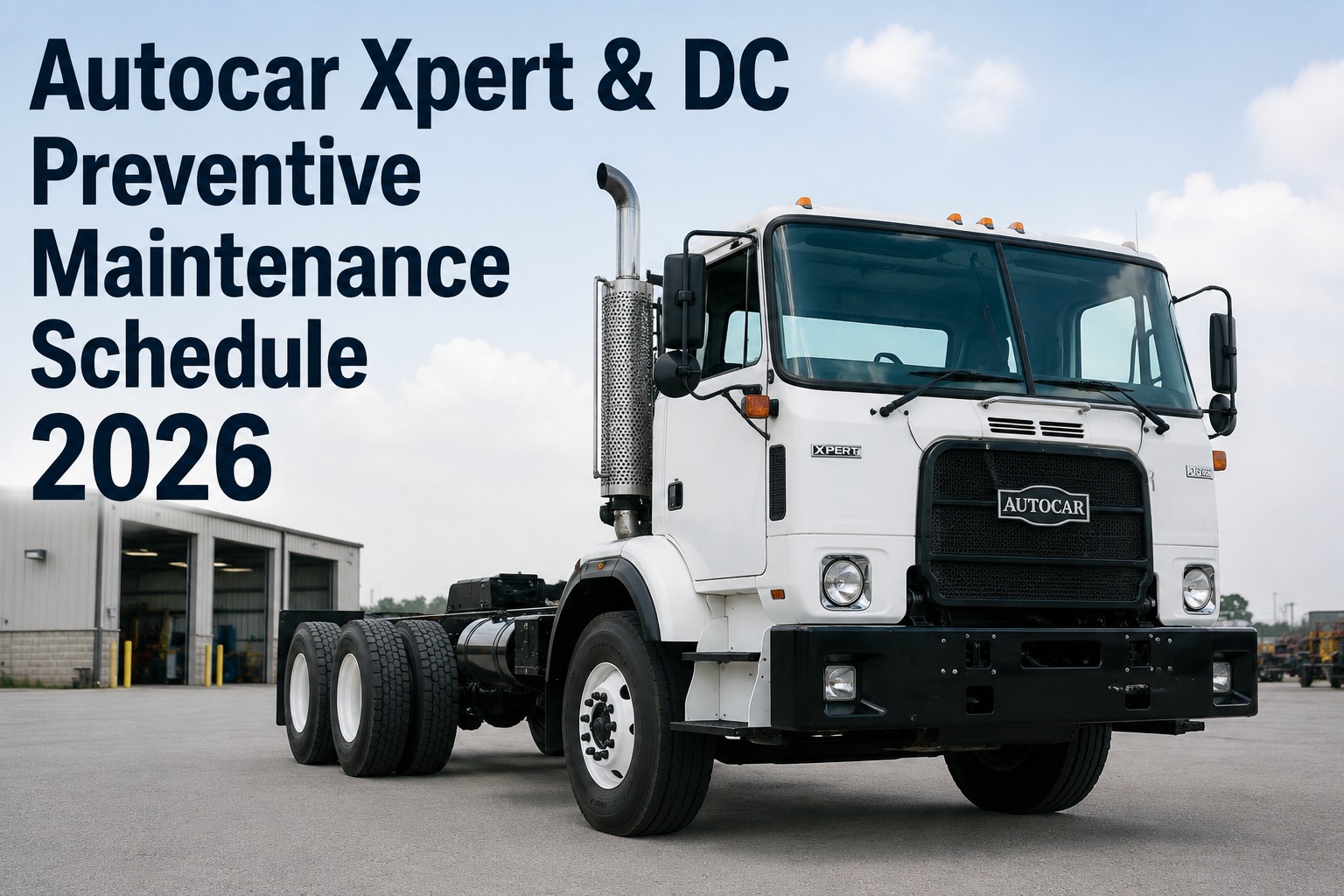
Every Autocar rolls off the line destined for severe duty — refuse collection, terminal yards, dump sites, concrete pours. These trucks don't see highway cruise; they see 200 stops a day, 40%+ idle time, constant hydraulic cycling, and operating conditions that compress PM intervals far beyond what a standard Cummins maintenance chart assumes. This is the complete Autocar Xpert and DC preventive maintenance schedule built for how these trucks actually work. Book a demo to see severe-duty PM scheduling in HVI.
Autocar Xpert & DC PM Schedule: Built for Severe Duty, Maintained for Uptime
Three platforms. One reality — every Autocar lives in the severe-duty tier.
Autocar is the oldest motor vehicle manufacturer in the United States — founded in 1899 — and the only American truck OEM focused exclusively on severe-duty vocational applications. That focus means every PM interval, every hydraulic check, and every inspection point has to account for the worst-case operating conditions as the baseline, not the exception.
Why Autocar PM Is Differentevery truck starts in the severe-duty tier
Most OEM maintenance schedules list severe duty as the exception — a shorter interval for trucks that happen to work harder. On Autocar, severe duty is the entire product line. A refuse-route Xpert ACMD makes 800 to 1,200 stops per day, runs the packer body hydraulics continuously, idles 40% or more of engine-on time, and rarely exceeds 25 MPH. A DC-64 dump truck hauls at near-GVWR on unpaved construction roads. An ACTT terminal tractor runs 16 to 24 hours a day in a yard, accumulating engine hours at a rate that dwarfs any highway truck.
Refuse trucks cycle start-stop-compact hundreds of times per shift. Brake, transmission, and hydraulic wear accelerate proportionally.
Refuse and yard trucks idle constantly. Oil degrades faster. DPF regeneration is disrupted. Engine hours accumulate far beyond mileage. Book a demo
Packer bodies, dump cylinders, roll-off hoists, and fifth wheel lifts run on separate hydraulic systems that need their own PM schedule.
Terminal tractors run multiple shifts. A two-shift ACTT accumulates 4,000+ engine hours per year on under 15,000 miles.
The Complete Autocar PM Scheduleengine intervals by platform and Cummins spec
All Autocar trucks use Cummins engines — B6.7, L9, or X12 depending on the platform. Cummins defines severe-duty as any truck averaging under 5 MPG, operating with idle time over 40%, or load factor above 55%. Every Autocar application meets at least one of those thresholds. Use the severe-duty column as your baseline.
| System / Component | Xpert ACMD (B6.7/L9) | DC-64 (L9/X12) | ACTT (B6.7) |
|---|---|---|---|
| Engine oil + filter | 25,000 mi / 500 hrs | 25,000 mi / 500 hrs | 500 hrs / 6 months |
| Fuel filter | 25,000 mi / 500 hrs | 25,000 mi / 500 hrs | 500 hrs / 6 months |
| Air cleaner element | By restriction / every oil | By restriction / every oil | Every oil service |
| Coolant | Test twice/year · Full drain per Cummins CES14603 | ||
| Allison trans fluid + filter | 25,000–50,000 mi | 25,000–50,000 mi | 1,000 hrs or annually |
| Chassis lubrication | 10,000 mi or monthly | 10,000 mi | Monthly / 250 hrs |
| Brake inspection | 10,000 mi or monthly | 10,000–15,000 mi | Monthly / 250 hrs |
| DPF ash cleaning | By check engine light — return to Cummins authorized location | ||
| Body hydraulic system | 500 hrs / monthly | 500 hrs / monthly | 250 hrs / monthly |
Scroll right on mobile · ACTT intervals are hours-based due to low-mile / high-hour operation
The ACTT terminal tractor is the extreme case: a two-shift yard truck running 16 hours a day, 6 days a week, accumulates over 4,000 engine hours per year — but may only register 10,000 to 15,000 odometer miles. Tracking PM by mileage on a terminal tractor means servicing once a year when the engine needs service every 6 to 8 weeks. Engine hours must be the primary trigger on every ACTT. Start free — set hours-based PM triggers for yard trucks in HVI
Body Equipment PMthe hydraulic systems most shops under-track
On every Autocar, the body equipment — packer body, dump cylinder, roll-off hoist, or fifth wheel lift — runs on a hydraulic system that operates independently from the engine drivetrain. This hydraulic system has its own fluid, filters, cylinders, hoses, and wear items that need a completely separate PM schedule.
Hydraulic fluid and filter change every 500 hours or monthly. Inspect packer blade, tailgate cylinders, hopper, and ejector mechanism at every service. Check packer cycle time — slow cycles indicate internal hydraulic bypass or pump wear. A packer that cycles 800 times per shift accumulates wear equivalent to months of normal hydraulic use in a single week.
Hydraulic hoist cylinder and hose inspection at every engine PM. Check dump body pivot pins, tailgate latches, and body-to-frame mounting bolts. Roll-off units need cable or chain inspection, sheave wear check, and winch drum inspection. PTO engagement and disengagement should be smooth and complete. Book a demo — track body equipment PM separately in HVI
Hydraulic lift cylinder, fifth wheel plate, and jaw lock mechanism need inspection every 250 hours on terminal tractors. The coupling and uncoupling cycle happens dozens of times per shift. Worn jaw locks cause trailer drop — one of the most dangerous yard incidents. Grease the fifth wheel plate at every chassis lube service.
5 Autocar PM Mistakesthe errors that cost severe-duty fleets the most
An ACTT running two shifts accumulates 4,000+ engine hours on 10,000 to 15,000 miles. A 25,000-mile oil interval means the engine runs 8,000+ hours between services — roughly 16 times longer than the 500-hour severe-duty spec. Hours-only triggers are mandatory on yard trucks.
Packer body, dump hoist, and fifth wheel lift hydraulics run on separate systems with different fluids, filters, and wear patterns. They need their own PM schedule — not a line item tacked onto the engine service.
Every Autocar operates in the Cummins "severe" tier by definition. Applying the 35,000-mile L9 "normal" interval to a refuse truck averaging 3.5 MPG means running 10,000 miles past the correct oil change. Book a demo — HVI defaults Autocar trucks to severe-duty intervals
An Allison RDS transmission in a refuse truck shifts thousands of times per day under heavy load. The fluid and filter interval on severe-duty Allison applications can be as short as 25,000 miles — not the 50,000-mile "normal" spec.
Refuse and yard trucks rarely reach sustained highway speed, which means passive DPF regeneration almost never completes. Active regen requests increase. Operators defer parked regens because they take 20 to 40 minutes during route time. Track regen frequency per truck — increasing regens signal approaching DPF service.
From a refuse fleet manager running 28 Autocar Xpert units
We switched from a highway-truck maintenance shop to Autocar Solutions for our 28 Xpert rear-loaders, and the first thing they changed was the PM schedule. Our old shop had us on a 35,000-mile oil interval because that's what Cummins says for the L9. Autocar's recommendation for refuse was 25,000 miles or 500 hours — and our trucks were hitting 500 hours at about 18,000 miles because of the idle and stop-start pattern.
The bigger fix was separating the packer body hydraulics from the engine PM. We'd been checking hydraulic fluid when the engine got serviced, but the packer needed attention every 500 hours — roughly every 3 to 4 weeks on a heavy residential route. Once we split those schedules, our packer-related breakdowns dropped by about 40% in the first quarter.
Frequently asked questions
What is the oil change interval for an Autocar Xpert refuse truck?
The oil change interval for an Autocar Xpert ACMD refuse truck is 25,000 miles or 500 engine hours, whichever comes first, based on Cummins severe-duty specifications. Most refuse-route Xpert trucks hit the 500-hour threshold well before 25,000 miles because of the high-idle, stop-start operating pattern. A typical residential refuse route produces 40% or more idle time, which means engine hours accumulate roughly 60% faster than miles would suggest. For this reason, engine hours should be the primary PM trigger on refuse-application Autocars, with mileage as a secondary backstop.
How often should the packer body hydraulics be serviced on a refuse truck?
Packer body hydraulic systems on Autocar refuse trucks should be serviced every 500 engine hours or monthly, whichever comes first. This includes hydraulic fluid level and condition check, filter replacement, inspection of all hoses and cylinders for leaks and wear, packer blade condition, tailgate cylinder operation, and ejector mechanism inspection. The packer body hydraulic system is separate from the engine drivetrain and needs its own PM schedule. A refuse packer that cycles 800 or more times per shift accumulates hydraulic wear at a rate that far exceeds the engine's service interval, which is why monthly hydraulic checks are recommended even between engine PM services.
How should terminal tractor PM be different from route trucks?
Terminal tractor PM must be entirely hours-based rather than mileage-based. An Autocar ACTT running two shifts (16 hours per day, 6 days per week) accumulates over 4,000 engine hours per year but may only register 10,000 to 15,000 odometer miles. At the 500-hour severe-duty oil interval, that means oil changes roughly every 6 to 8 weeks. Fifth wheel lift mechanisms need inspection every 250 hours because of the constant coupling and uncoupling cycle. Chassis lubrication should be monthly or every 250 hours. Brake inspection follows the same monthly schedule because yard operation produces constant low-speed braking stress. Using a CMMS that triggers PM by engine hours is essential for terminal tractors.
What engines does Autocar use and what are the PM implications?
All Autocar trucks use Cummins engines exclusively. The Xpert ACMD offers the Cummins B6.7 (200 to 260 HP) and Cummins L9 (330 to 360 HP) with CNG options available. The DC-64 uses the Cummins L9 and Cummins X12 (up to 500 HP). The ACTT terminal tractor uses the Cummins B6.7 (146 to 260 HP). All engines are paired with Allison automatic transmissions. Because every Autocar application qualifies as Cummins severe-duty, all should use the shortest Cummins-defined oil interval for their respective engine: 25,000 miles or 500 hours for the B6.7 and L9, and equivalent severe-duty intervals for the X12. Any Cummins-authorized shop can perform engine service on Autocar trucks.
Can I use a CMMS to automate Autocar PM scheduling?
Yes, and for severe-duty fleets running Autocar trucks, a CMMS is essential because of the complexity of tracking engine PM, body equipment PM, and transmission PM on separate schedules. A platform like HVI (Heavy Vehicle Inspection) lets you configure hours-based triggers for terminal tractors, mileage-plus-hours triggers for route trucks, and monthly triggers for hydraulic systems, all tied to the same vehicle record. Separate PM schedules for engine, Allison transmission, and body equipment (packer, dump hoist, fifth wheel) run independently so nothing gets missed. Digital inspection checklists, automatic work order generation, parts tracking, and fleet-wide PM dashboards are included, with records accessible for Autocar Solutions, Cummins warranty, and DOT compliance.
Every Autocar in your fleet — refuse, dump, yard — on the right schedule
Configure PM by platform and vocation. Track engine hours, body equipment hours, and mileage. Separate engine, transmission, and hydraulic schedules. Auto-generate work orders. Keep digital records for Autocar Solutions and Cummins. Live in under two weeks.
No credit card · No hardware required · Works with Autocar Advanced Telematics