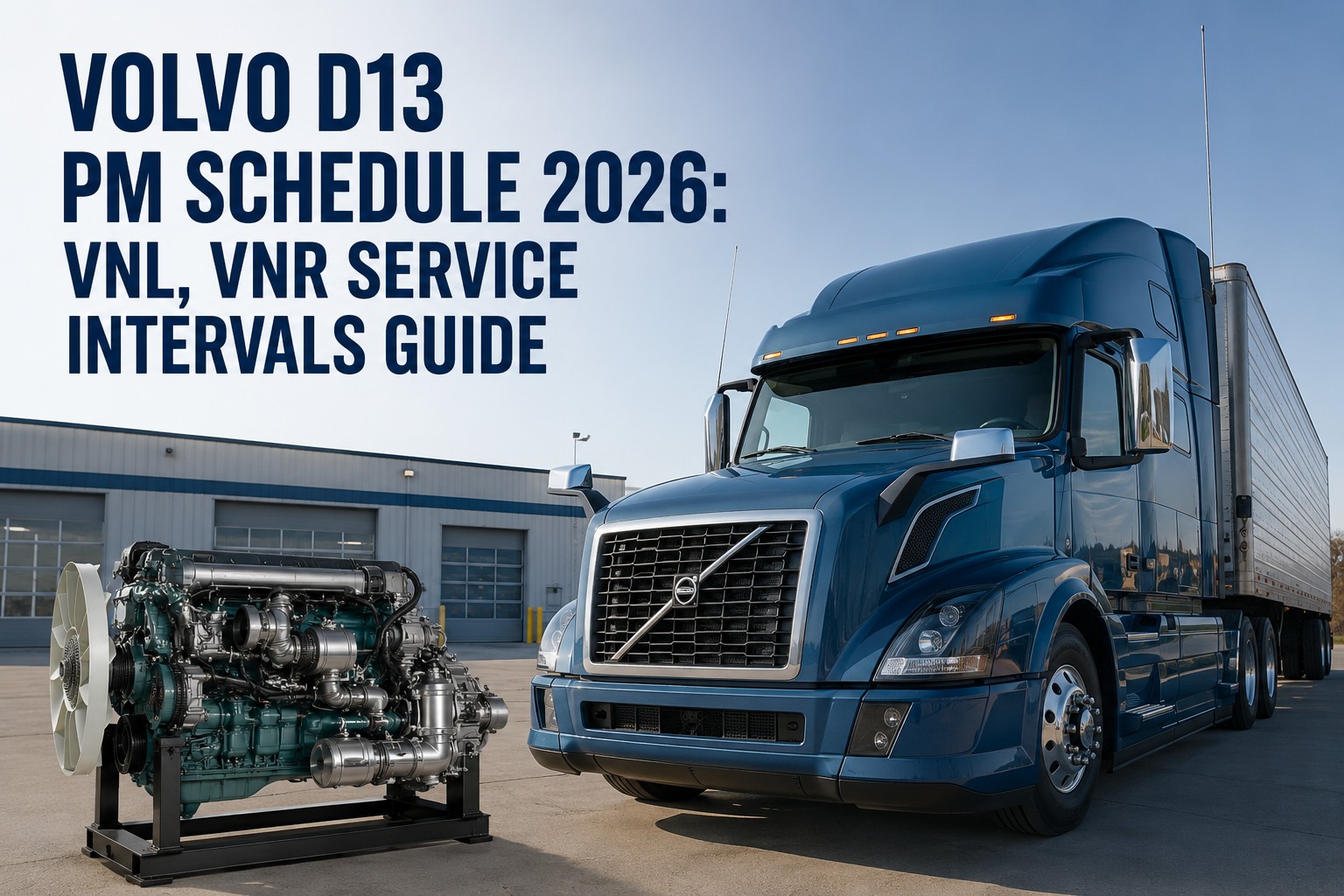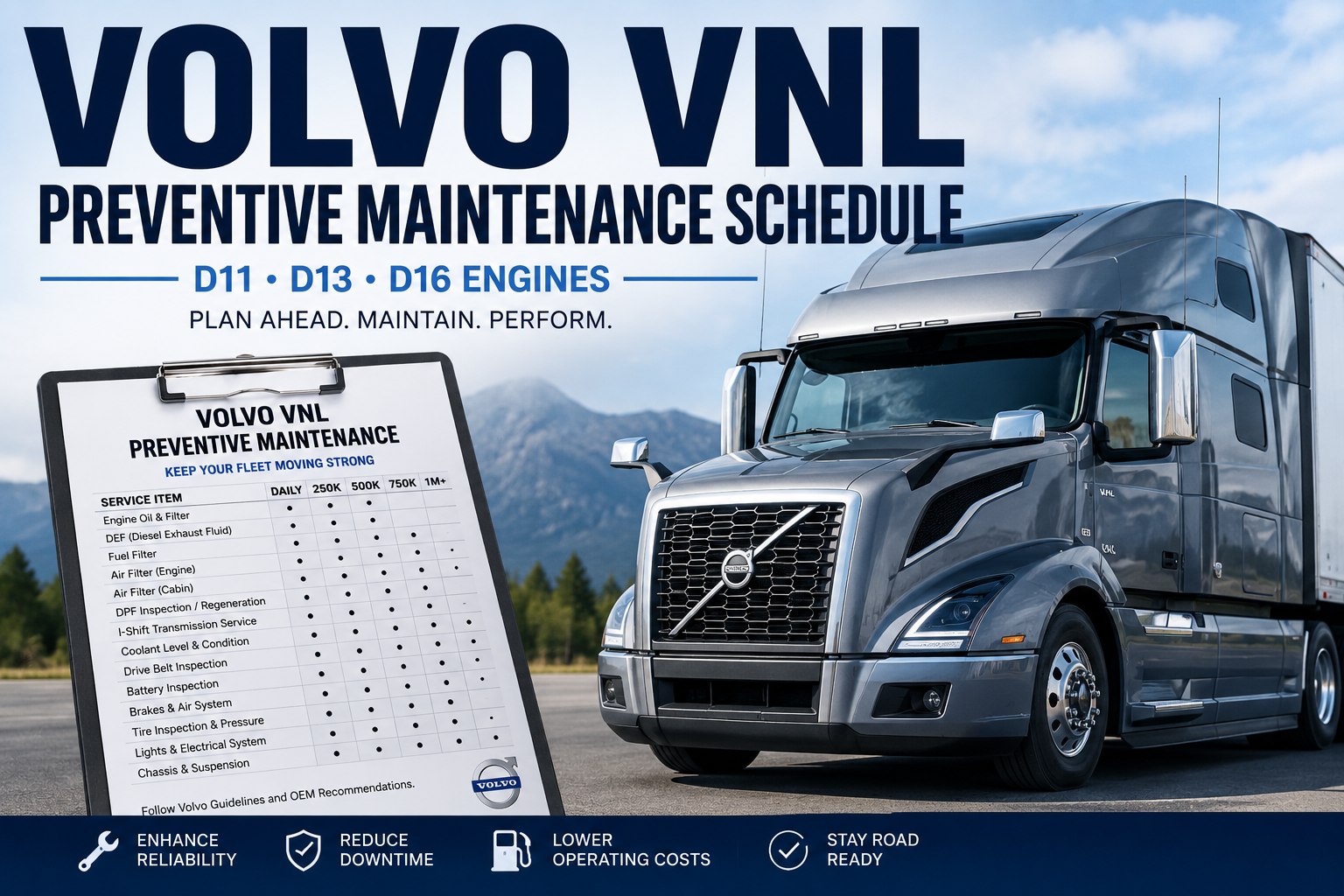
Volvo VNL preventive maintenance schedule intervals depend on three variables working together: engine model (D11, D13, or D16), duty cycle (long haul, regional, or heavy haul), and idle percentage. A D13 running long haul on Volvo VDS-4.5 oil goes 60,000 miles between drains. That same D13 in heavy-haul dump service running 35% idle goes 25,000. Miss the distinction and you either overspend on unnecessary services or ruin an engine early. Book an HVI demo to deploy Volvo-spec templates on your fleet.
Three duty cycles. Three engine options. One correct interval.
Volvo defines PM intervals by duty cycle before engine model. Get the duty cycle wrong and every interval on the truck is wrong — whether you're running a D11, D13, or D16.
Highway operation, 90%+ cruise, low fuel-per-mile. Predictable duty cycle. Full VDS-4.5 interval unlocked.
Mixed highway + urban, moderate stops, medium fuel-per-mile. The default classification for most VNL fleets.
Dump, logging, construction, low-mile/high-load. High fuel-per-mile drops all intervals significantly.
If engine idle time exceeds 30% of engine-on hours, drop to the next shorter drain interval regardless of duty cycle. Long haul at 32% idle becomes regional haul intervals. Regional at 32% becomes heavy haul intervals. Idle contaminates oil in ways mileage alone doesn't capture — Volvo's PM math corrects for that.
Why duty cycle drives every Volvo VNL PM interval
Most fleet managers instinctively organize PM intervals around mileage — and for lightweight duty patterns that's fine. Volvo VNL PM intervals are organized differently. Volvo starts from fuel-consumption-per-mile as the leading indicator of engine load, then derives interval from there. A truck burning 6.5 MPG going 60,000 miles has consumed the same fuel — and therefore stressed the engine the same amount — as a truck burning 4.5 MPG going 42,000 miles. The mileage differs; the wear doesn't.
This is why Volvo's three duty cycles aren't arbitrary. Long haul (60,000 mi) assumes cruise-heavy operation at 6.5-7.0 MPG typical. Regional haul (45,000 mi) assumes mixed operation at 5.5-6.5 MPG typical. Heavy haul (35,000 mi) assumes low-MPG/high-load operation at 4.0-5.5 MPG typical. Miscategorize the duty cycle and the interval is off by 15,000-25,000 miles — either wasting oil or ruining an engine early.
A VNL running highway at 6.8 MPG and a VNL running construction at 4.2 MPG are two entirely different maintenance patterns. Fleet MPG per truck is the input Volvo intervals depend on.
The 30% idle rule shifts intervals by an entire duty cycle. A truck running long-haul routes but idling at truck stops overnight can effectively be running regional-haul intervals. Track idle percentage against engine hours — not against dispatch time.
D11, D13, and D16 share the same duty cycle intervals for oil, filters, and most systems. The main engine-specific difference is oil pan capacity (42L standard vs 52L D16 heavy option). Duty cycle drives interval; engine chooses oil quantity.
Volvo VDS-4.5 Premium oil delivers the published intervals. VDS-4 (older spec) requires shorter intervals: 55,000 / 40,000 / 30,000 miles across the three duty cycles. Non-Volvo-approved oil voids warranty and forces the shortest interval.
Book an HVI demo to see per-truck duty cycle assignment automated from telematics
Engine oil & filter intervals — D11, D13, D16 across all duty cycles
Engine oil is where Volvo's duty cycle math shows up most clearly. The intervals below assume Volvo VDS-4.5 Premium oil — the current premium spec. Other Volvo-approved VDS-4.5 oils earn slightly shorter intervals (see second column). Non-approved oils void warranty coverage and are not published intervals.
- Long Haul: 60,000 mi (Premium) / 55,000 mi (Other approved)
- Regional Haul: 45,000 mi / 40,000 mi
- Heavy Haul: 35,000 mi / 30,000 mi
- Hours: 1,700 / 1,300 / 825 respectively
- Idle rule: if >30% idle, drop to next shorter interval
- Long Haul: extended interval per Volvo spec
- Regional Haul: extended interval per Volvo spec
- Heavy Haul: extended interval per Volvo spec
- Common in: heavy-haul dump, logging, construction VNX
- Same idle rule: >30% drops interval one duty cycle
Fuel filter replacement happens at every oil service. Volvo requires genuine Volvo filters or approved-equivalent for warranty. The oil analysis history from each drain builds the trend data that catches developing issues (fuel dilution, coolant intrusion, wear metals) months before symptoms appear at the dashboard. Try HVI free to deploy Volvo-spec oil analysis tracking per truck.
DPF, DEF & aftertreatment maintenance
Volvo's aftertreatment system on 2011+ VNL trucks with D11/D13/D16 engines uses a diesel particulate filter (DPF), aftertreatment hydrocarbon injector (AHI), and selective catalytic reduction (SCR) with diesel exhaust fluid (DEF). Each has its own maintenance interval, and each drives its own failure mode when missed.
Extended to 400,000 miles for long-haul and regional-haul applications on 2011+ D11/D13/D16 engines — up from the previous 250,000-mile interval. Heavy-haul applications get shorter intervals due to higher soot loading. Volvo cleaning process removes accumulated ash; delaying causes back-pressure that reduces MPG and eventually stalls the engine at highway speed.
The AHI injects small quantities of diesel fuel into the exhaust stream to raise DPF temperature during regeneration. Nozzle cleaning and injector inspection required at Volvo-specified intervals. AHI failures produce incomplete regeneration and accelerated DPF ash accumulation.
The DEF (Diesel Exhaust Fluid) system requires filter replacement at Volvo-specified intervals. Tank filler neck filter prevents contamination; failures cause DEF quality faults and SCR performance degradation. DEF crystallizes at cold temperatures; garage-heated storage helps in cold climates.
The SCR catalyst is generally maintenance-free for the life of the truck, but NOx sensors (upstream and downstream) degrade and require replacement based on diagnostic codes. Volvo diagnostic tools identify sensor drift before the engine derates from EPA-mandated NOx violations.
Missing aftertreatment maintenance produces the classic Volvo failure sequence: reduced MPG (first 5%), power derate warning (typically 25% loss), engine derate to 55 MPH (per EPA), and finally engine shutdown on the shoulder. All preventable with scheduled aftertreatment PM.
I-Shift transmission maintenance
The I-Shift automated manual transmission is Volvo's signature drivetrain component. Unlike an automatic transmission, I-Shift is a manual transmission with electronic shift actuation — meaning its maintenance profile is closer to a manual than an Allison. Fluid intervals, clutch inspection, and firmware version tracking all matter.
Volvo I-Shift transmission oil intervals are duty-cycle dependent: long haul stretches further than heavy haul. Use only Volvo-approved transmission fluid; wrong fluid produces shift quality degradation and clutch pack wear. Oil analysis on drain samples surfaces internal wear before drivability suffers.
I-Shift uses a dry clutch that engages/disengages electronically. Clutch wear is inspection-based — monitored through diagnostic parameters accessible via Volvo Premium Tech Tool. Replacement typically at 700,000-1,200,000 miles depending on driver behavior and duty cycle.
Volvo periodically releases I-Shift firmware updates addressing shift quality, driver comfort, or specific fault codes. Fleets running 5+ VNLs should track firmware version per unit — inconsistent firmware across a fleet causes driver-reported issues that disappear when versions align.
The I-Shift is where careful maintenance pays back most in resale value. A VNL with clean I-Shift diagnostic history and current firmware commands significantly higher trade-in than one with unresolved diagnostic codes and stale firmware. Start a free trial to deploy I-Shift firmware tracking across your fleet.
Coolant, belts, chassis & ancillary systems
Beyond the engine, aftertreatment, and I-Shift, Volvo VNL PM covers the systems most fleets learn about only after failure. Coolant and belts are the two most-often-neglected items on published Volvo intervals.
- Volvo Extended Life Coolant: extended interval
- Fully Formulated Coolant: shorter interval
- Long-life coolant filter (no additives type)
- Chemical additive filter (fully formulated type)
- Coolant analysis annually to verify condition
- Fan belt inspection at every oil service
- Accessory drive belt tension & condition
- Belt replacement at Volvo-specified intervals
- Alternator, A/C compressor drive verification
- Tensioner & idler pulley inspection
- Chassis lubrication at every oil service
- Front axle alignment: annual verification
- Rear axle differential fluid: per interval
- Power steering fluid: check & top-off
- Electrical corrosion protection annually
Severe service adjustments — when intervals shorten
Volvo defines severe service as any operation exceeding normal duty cycle stress. Fleets running trucks in severe service conditions must shorten intervals to prevent premature wear.
Sustained ambient above 100°F or below -20°F. Cold-weather stresses coolant, batteries, and DEF system. Hot-weather stresses oil and cooling capacity. Adjust interval to next shorter duty cycle when >30 days annually at extremes.
Sustained operation above 6,000 feet altitude increases engine load, DPF regeneration frequency, and cooling system stress. Rocky Mountain and Andean operations should shorten intervals one duty cycle.
Beyond the standard 30% idle rule, fleets running 40%+ idle (common in reefer, PTO, or dispatch-hold operations) should drop TWO duty cycles — not one. Long haul at 42% idle = heavy haul intervals.
Dump, logging, construction, mining hauls. Even short-mileage trucks running these patterns accumulate wear equivalent to long-haul distance. Heavy-haul intervals are the floor; consider even shorter for extreme conditions.
Severe service adjustments are where fleet-wide PM software pays back most. Manual tracking of "which trucks got which adjustment" is where fleets lose their PM discipline. Book an HVI demo to see severe-service overrides automated per truck.
From a fleet maintenance manager running 92 Volvo VNLs
We ran every VNL on the same 45,000-mile drain interval regardless of what the truck actually did. Long-haul lanes, regional, some construction spot work — all treated the same. Two years ago Volvo dealer told us we were leaving oil-change dollars on the table for the long-haul units and running the heavy-haul units too long. Both true.
Migrated to duty-cycle-based intervals with HVI templates. Long haul: 60K. Regional: 45K. Heavy haul: 35K. Idle rule triggered automatically from telematics for the ones running above 30%. First year: oil spend down 18%. Second year: warranty claim on a D13 approved because our records showed we'd been on Volvo intervals with VDS-4.5 the whole way. Duty-cycle PM isn't a nice-to-have; it's the Volvo spec.
Frequently asked questions
What is the Volvo VNL oil change interval for D11, D13, and D16 engines?
Volvo VNL trucks with D11, D13, or D16 engines from model year 2011 and newer follow a duty-cycle-based oil change interval when using Volvo VDS-4.5 Premium oil. Long haul: 60,000 miles or 1,700 hours. Regional haul: 45,000 miles or 1,300 hours. Heavy haul: 35,000 miles or 825 hours. Other Volvo-approved VDS-4.5 oils get slightly shorter intervals: 55,000 / 40,000 / 30,000 miles respectively. Non-Volvo-approved oils are not published intervals and void warranty coverage. Duty cycle is defined by fuel consumption per mile: long haul assumes cruise-heavy operation at 6.5-7.0 MPG; regional assumes mixed operation at 5.5-6.5 MPG; heavy haul assumes low-MPG/high-load at 4.0-5.5 MPG. The 30% idle rule shifts the interval down one duty cycle regardless of route: a long-haul truck idling 32% of engine-on hours effectively runs regional-haul intervals. Fuel filter replacement happens at every oil service; the coolant filter, air filter, and other filters follow their own intervals. D16 engines with the larger 52L oil pan option (versus the standard 42L pan) qualify for extended intervals per Volvo spec — check the Service at a Glance for your specific configuration. All published intervals require genuine Volvo filters or approved equivalents to preserve warranty.
How do I determine my Volvo VNL duty cycle?
Duty cycle is determined by fuel consumption per mile and load pattern, not by lane length or route type alone. Long haul applies to trucks running predominantly highway operation with cruise-heavy duty cycles and typical fuel economy of 6.5-7.0 MPG. Most over-the-road VNL long-haul tractors fall here. Regional haul applies to trucks running mixed highway and urban operation with moderate stops and typical fuel economy of 5.5-6.5 MPG. This is the default classification for most LTL, food-service, and general freight VNL fleets. Heavy haul applies to trucks running low-mile/high-load duty cycles: dump, logging, construction, mining, oilfield. Fuel economy typically 4.0-5.5 MPG. Also applies to any truck with sustained PTO operation. The correct assignment often surprises fleet managers: a regional carrier running 40,000-mile-per-year trucks in mixed urban duty is regional haul, not heavy haul, despite the lower annual mileage. Conversely, a long-haul dedicated lane running 130,000+ annual miles at 6.9 MPG is genuinely long haul. Modern telematics systems can report per-truck fuel economy, allowing duty cycle assignment to be automated rather than guessed. When in doubt, verify by fuel per mile: less than 5.5 MPG averaged over 30 days signals heavy haul territory regardless of what the dispatch pattern looks like.
When does the Volvo VNL DPF need cleaning?
Volvo extended DPF cleaning intervals substantially for 2011+ VNL trucks with D11/D13/D16 engines. Long-haul and regional-haul applications: 400,000 miles between DPF cleaning or replacement, up from the previous 250,000-mile interval. Heavy-haul applications: shorter interval due to higher soot loading from high-load duty cycles — check Volvo Service at a Glance for the specific mileage for your engine and duty cycle. The extended interval reflects improved combustion efficiency and reduced particulate output on EPA 2010-compliant engines. Beyond the mileage-based interval, DPF cleaning may be triggered earlier by diagnostic indicators: dashboard warning lights signaling elevated back-pressure, MPG decline of 5%+ that doesn't recover after driver behavior adjustments, or repeated regeneration cycles that fail to complete. The AHI (aftertreatment hydrocarbon injector) supports DPF regeneration; failing AHI produces incomplete regen and accelerated DPF loading. Fleets that ignore DPF cleaning intervals experience the classic Volvo aftertreatment failure sequence: MPG drops 5%, then a power derate warning, then engine derate to 55 MPH (per EPA rules), and finally engine shutdown. The 400,000-mile extended interval usually means one DPF service in a typical 600,000-mile truck life, versus two on older engines — a meaningful savings for high-mileage fleets that track it.
How often does the Volvo I-Shift transmission need service?
The Volvo I-Shift automated manual transmission requires periodic fluid changes, clutch inspection, and firmware tracking. Transmission oil and filter change intervals are duty-cycle dependent following the same long-haul / regional / heavy-haul framework as engine oil, though the mileages differ. Consult Volvo's Service at a Glance for your model year and configuration for the exact I-Shift fluid interval. Use only Volvo-approved transmission fluid; wrong fluid produces shift quality degradation and premature clutch pack wear. Clutch inspection is monitored via diagnostic parameters accessible through Volvo Premium Tech Tool rather than physical inspection at each service. Clutch replacement typically at 700,000 to 1,200,000 miles depending on driver behavior (heavy left-foot use, aggressive launches from stop) and duty cycle. Firmware version tracking is often overlooked but important for fleets. Volvo periodically releases I-Shift firmware updates addressing shift quality, driver comfort, or specific fault codes. Fleets running five or more VNLs should track firmware version per unit — inconsistent firmware across a fleet creates driver-reported issues (harsh shifts, delayed responses, unusual behavior in specific conditions) that disappear when versions align across the fleet. Modern fleet maintenance software can track I-Shift firmware alongside PM intervals as part of the complete unit maintenance record.
Can digital PM software replace paper Volvo VNL service records?
Yes — and digital PM tracking is now the operational standard for any fleet running more than a handful of Volvo VNLs. Paper Volvo service records have three structural limitations that digital platforms eliminate. First, paper systems can't automate duty cycle assignment. Manually classifying 20-100 trucks by duty cycle and updating classifications as routes change is exactly the operational overhead that gets abandoned within six months. Digital platforms integrated with telematics assign duty cycle from per-truck fuel economy automatically. Second, paper systems can't trigger the 30% idle rule at scale. Manually tracking idle percentage on every truck and adjusting individual intervals is impractical past 5-10 units. Digital platforms surface the idle percentage per truck and adjust interval scheduling accordingly. Third, paper systems can't track warranty-relevant details. When a D13 fails at 400,000 miles and Volvo asks whether you used VDS-4.5 oil, at what intervals, with genuine Volvo filters, and whether idle percentage was tracked — paper systems require days of file cabinet searches to compile the answer. Digital platforms produce the complete warranty defense record in seconds. Fleets transitioning from paper to digital PM tracking on Volvo VNLs typically report oil spend reductions of 15-20% (from correctly stretching long-haul intervals) and warranty claim acceptance rates increasing significantly (from documented compliance with Volvo intervals). Deployment for a Volvo-heavy fleet typically completes in 5-7 days.
Volvo VNL PM schedules against your telematics — live in one week.
HVI ships with pre-built Volvo VNL PM templates for D11, D13, and D16 engines across all three duty cycles. Per-truck duty cycle auto-assigned from telematics MPG data. Idle percentage tracked automatically with 30% rule triggering interval adjustment. VDS-4.5 vs VDS-4 tracked per unit. I-Shift firmware version tracked fleet-wide. Live for your fleet in 5-7 days.
Volvo-spec aligned · VDS-4.5 & VDS-4 tracked · Warranty-defense records · SOC 2 Type II