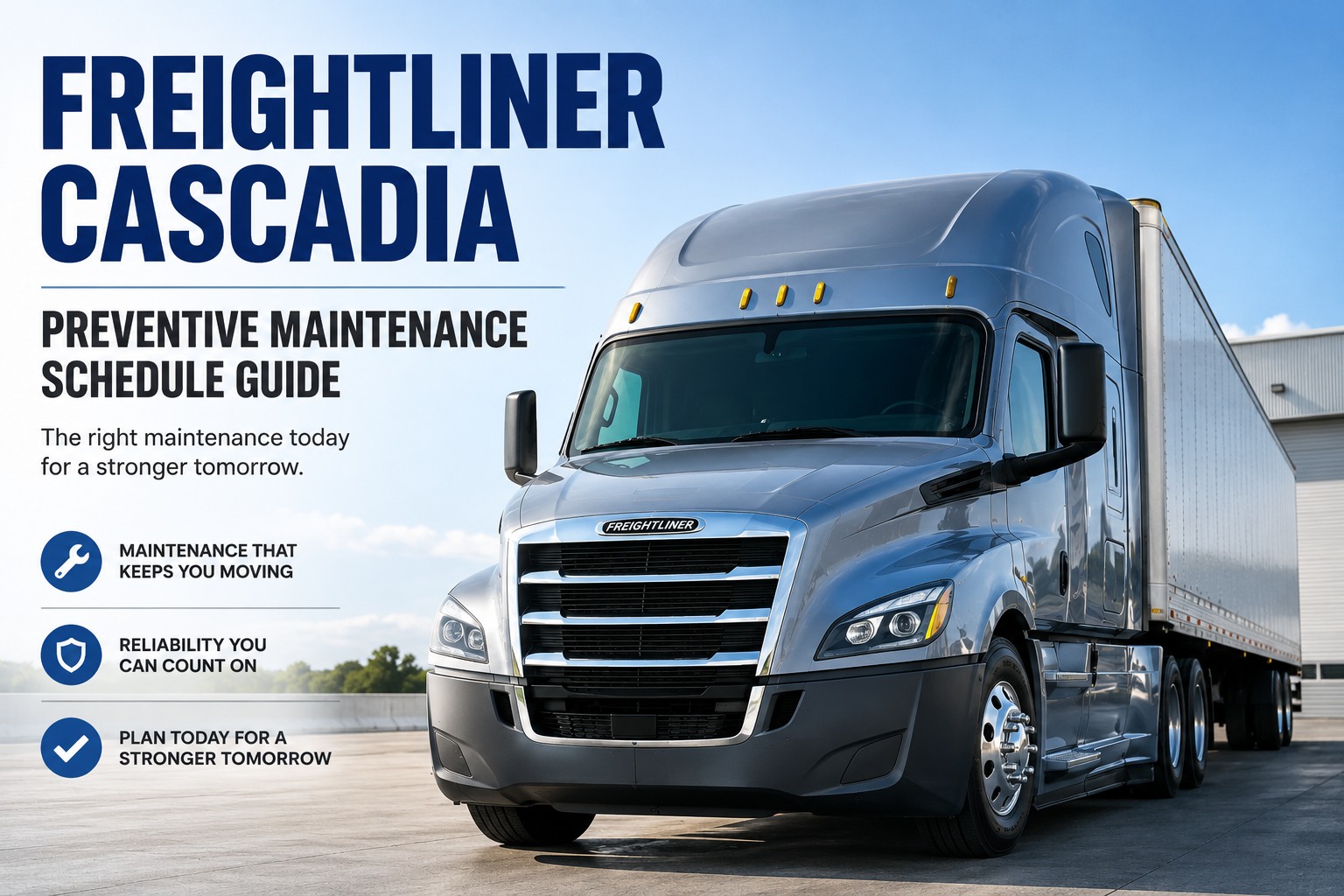
A Freightliner Cascadia preventive maintenance schedule is duty-cycle-indexed, not tier-indexed like Cat PM1-PM4. Detroit Diesel publishes four service profiles — Severe (up to 30K mi/yr), Short-Haul (30-60K mi/yr), Long-Haul (60K+ mi/yr at 6-6.9 MPG), and Efficient Long-Haul (60K+ mi/yr at 7+ MPG). Each profile has different oil, filter, and aftertreatment intervals across the DD13, DD15, and DD16 engines. Book an HVI demo for Cascadia PM automation.
Four duty profiles. Three engines. One correct schedule per truck.
Detroit Diesel indexes PM intervals on measured duty cycle — not on tier terminology. Match the truck's actual annual miles and fuel economy to the correct column and the oil change interval reveals itself.
Why Cascadia PM is duty-cycle-indexed, not tier-indexed
Most equipment PM schedules (Cat's PM1-PM4, Volvo's CareTrack tiers, Deere's PowerTech schedules) index intervals on engine hours or a fixed mileage. Detroit Diesel takes a different approach for the DD-series engines that power the Freightliner Cascadia: intervals are calibrated to the truck's actual operating profile, measured by two variables Detroit knows correlate with wear.
A truck running 100,000 mi/yr in linehaul distributes wear across highway conditions. A truck running 25,000 mi/yr in vocational applications concentrates wear into shorter, harsher cycles with more starts, stops, and idle time. Same odometer reading, very different engine stress.
MPG under 5 signals heavy-load or high-idle operation. MPG above 7 signals steady-state cruise. Same engine at 5 MPG works dramatically harder per mile than at 7 MPG — oil breakdown, fuel dilution, and soot loading accelerate accordingly.
A DD13 (12.8L) running at 90% load and a DD16 (15.6L) running at 70% load produce similar output — but the DD13 wears components faster per mile. Detroit's duty-cycle matrix accounts for this by compressing DD16 intervals differently than DD13/DD15.
DPF regeneration frequency, DEF consumption, and DOC coating life all correlate with duty cycle. A severe-duty Cascadia regenerates its DPF far more often than an efficient long-haul unit — and the ash service interval compresses correspondingly. PM must account for aftertreatment, not just fluids.
The four variables together explain why Detroit publishes a matrix rather than a single schedule. Following the wrong column costs money either way — over-servicing wastes oil and shop time; under-servicing accelerates wear and voids warranty coverage. Book an HVI demo to auto-classify Cascadia duty cycles from telematics data
The 4 Detroit Diesel duty cycle profiles — measurable definitions
Detroit's four duty categories are defined by explicit measurements, not subjective assessments. Every Cascadia in a fleet falls into exactly one category based on annual mileage and fleet-average fuel economy. Only one condition triggers the classification.
Long steady-state highway operation with minimal city stop-and-go. The engine runs at optimal RPM band for the majority of hours. Oil breakdown and soot loading progress slowly. Longest PM intervals in the Detroit schedule.
The most common Cascadia duty profile. Long-distance transport with typical geography and driver behavior. Moderate load, moderate wind resistance, moderate stop frequency. Detroit's baseline interval structure.
Regional operation with more transient loads, urban traffic, and start-stop cycles than long-haul. Engine wear accelerates from thermal cycling. Oil interval compresses by 33% versus long-haul.
Concentrated wear from heavy loads, extended idle, extreme starts/stops, or off-highway operation. Only one condition (mileage OR fuel economy OR conditions) needs to be met to trigger severe classification. Shortest intervals in the schedule.
Duty cycle classification happens at fleet enrollment and is re-evaluated annually based on measured data from Detroit Connect telematics. Fleets running mixed duty cycles across the same tractor pool need per-truck classification rather than fleet-wide assumptions. Book an HVI demo to see per-truck duty classification synced from Detroit Connect
The 3 Detroit engines — DD13, DD15, DD16 specifications and PM specifics
The Freightliner Cascadia ships with one of three Detroit Diesel engine platforms depending on the intended application. All three follow the same duty-cycle-indexed schedule structure, but engine displacement affects interval compression and aftertreatment scope.
Engine-specific quirks compound the duty-cycle framework. A DD15 in efficient long-haul lasts differently than a DD16 in the same profile — and both differ from a DD13 in short-haul. Templates need to account for engine displacement, not just duty cycle. Try HVI free to configure engine-specific PM templates for mixed Cascadia rosters.
Aftertreatment PM — DPF, DEF, SCR, DOC (the 4 items OEM tables assume you know)
Modern Detroit Diesel engines route exhaust through a 4-stage aftertreatment system that requires its own PM schedule alongside engine service. Aftertreatment neglect is one of the top drivers of unplanned Cascadia downtime and can trigger derate mode within 24 hours of a warning ignored.
- Passive regen: continuous during highway operation (no service required)
- Active regen: 400-1200°F cycle triggered every 500-800 mi typical
- Manual (parked) regen: driver-initiated when soot loading exceeds threshold
- Ash service interval: 300,000-500,000 mi depending on duty cycle
- Cost of missed ash service: $2,500-$4,500 for DPF cleaning; $8,000-$12,000 for replacement
- DEF consumption: ~2-3% of diesel volume; typically 3-5 gal per 100 mi
- DEF quality check: verify API-licensed source, no additives, use within shelf life
- DEF filter replacement: 200,000 mi or per Detroit maintenance schedule
- DEF tank heater function check at every winter pre-trip (freezes at 12°F)
- DEF pump filter replacement at DPF service interval
- SCR catalyst life: 400,000-500,000 mi typical
- Fault code monitoring at every PM (SPN 3364, 3556, 4363 common patterns)
- NOx sensor pre/post SCR — typical life 300,000-400,000 mi
- DEF injector cleaning at PM3-equivalent interval
- SCR system inspection integrated with DPF ash service visit
- DOC life: typically 400,000-600,000 mi with proper fuel and oil chemistry
- Sulfated fuel or oil ash contamination shortens life dramatically
- Inspection at every DPF ash service visit
- Replacement typically bundled with DPF for cost efficiency
- Cost: $2,000-$3,500 for DOC replacement if needed independently
Aftertreatment PM is the invisible half of the Cascadia maintenance schedule — the engine schedule references filters and fluids, but aftertreatment components have their own life curves that compound with duty cycle. Skip aftertreatment PM and a $150 filter service becomes a $12,000 DPF replacement. Start a free trial to configure aftertreatment PM tracking alongside your Detroit engine schedule.
The 5 Cascadia-specific PM issues fleet mechanics should know
Beyond the standard duty-cycle-indexed schedule, five Cascadia-specific issues drive most preventable service events. Every one is preventable with disciplined per-truck PM tracking.
The DD15's aluminum rocker assembly houses the camshaft without discrete cam bearings — Detroit considers the housing a wear item. Under-lubricated or contaminated oil accelerates housing wear. Cost: $1,600 for housing plus $2,000-$4,000 if cam replacement needed. Prevention: Inspect cam journals at every oil change; verify oil spec compliance.
DD15's ACR fuel system operates at pressures above 30,000 PSI, making it sensitive to fuel contamination and low-quality fuel. Injector tip deposits reduce performance and can trigger derate. Cost: $800-$2,500 per injector for cleaning or replacement. Prevention: Fuel filter service at scheduled interval; verify fuel supplier quality; consider fuel additive on suspect fuel.
Cascadias with the Detroit oneBox integrated aftertreatment concentrate DPF ash service into a single unit. Missing the ash service interval triggers derate mode and eventually forces roadside DPF cleaning. Cost: $2,500-$4,500 for scheduled cleaning; $8,000+ for reactive replacement. Prevention: Track ash service interval per truck; schedule before derate threshold.
Exhaust gas recirculation cooler restrictions from soot buildup reduce cooling efficiency and can compromise engine emissions. Cost: $1,500-$3,500 for EGR cooler service. Prevention: EGR cooler inspection at PM3-equivalent interval; monitor exhaust temp and DPF regen frequency.
Variable geometry turbo actuator carbon buildup causes sluggish throttle response and boost pressure issues. Cost: $600-$1,500 for actuator service or replacement. Prevention: Use Detroit-approved oil (93K222/93K223) only; extended idle avoidance where possible; turbo actuator function check at every PM.
Every failure mode on the list is either directly preventable through PM discipline or dramatically reduced in frequency with proper maintenance intervals. The economics compound: skipping a $200 filter service to save shop time costs $8,000-$25,000 in reactive repair. Book an HVI demo to model Cascadia PM economics for your fleet
From a Fleet Maintenance Manager running 340 Cascadias across long-haul and regional
We run 340 Cascadias split between coast-to-coast long-haul (about 220 trucks running 130,000 mi/yr) and dedicated regional (about 120 trucks running 55,000 mi/yr, short-haul cycles). For years we ran a single fleet PM schedule for all 340 trucks — oil at 40,000 miles, DPF ash at 400,000 miles — because our old CMMS couldn't handle per-truck duty cycles.
We were over-servicing the long-haul trucks (they could have gone 60,000 mi on oil comfortably) and under-servicing the regional trucks (they needed the 25,000-mi severe interval at their duty cycle). When we moved to duty-cycle-classified PM per truck, we cut PM labor 22% on long-haul and cut regional breakdowns 46% simultaneously. The unit economics went both directions at once. Same fleet, same drivers, correct PM schedule — that's where the money is on a Cascadia fleet.
Frequently asked questions
What are the Freightliner Cascadia oil change intervals for DD13, DD15, and DD16?
Oil change intervals depend on Detroit Diesel's four duty-cycle classifications, not on engine displacement alone. For DD13 (12.8L) and DD15 (14.8L): Efficient Long-Haul (>7 MPG, 60,000+ annual miles): 75,000 miles between oil changes. Long-Haul (6.0-6.9 MPG, 60,000+ annual miles): 60,000 miles. Short-Haul (5.1-5.9 MPG, 30,000-60,000 annual miles): 40,000 miles. Severe (<5 MPG or under 30,000 annual miles or severe conditions): 25,000 miles. For DD16 (15.6L, heavy-haul): Efficient Long-Haul: 60,000 miles. Long-Haul: 50,000 miles. Short-Haul: 35,000 miles. Severe: 20,000 miles. The DD16 intervals compress relative to DD13/DD15 because heavy-haul applications concentrate wear even at similar fuel economy. All intervals assume Detroit-approved 93K222 (CK-4) or 93K223 (FA-4) oil with ULSD fuel — substituting non-approved oil or higher-sulfur fuel invalidates the schedule and can void warranty. Fleet maintenance planners should classify each truck's duty cycle annually based on actual telematics data (annual mileage plus running-fleet MPG) rather than assuming fleet-wide uniformity. Running mixed-duty fleets on a single schedule either over-services long-haul units (wasting oil and shop time) or under-services short-haul/severe units (accelerating wear and voiding warranty).
How is Detroit Diesel's schedule different from Cat's PM1-PM4?
Cat's PM1-PM4 system is engine-hour-indexed with fixed tier intervals (PM1 = 250 hours, PM2 = 500 hours, PM3 = 1000 hours, PM4 = 2000 hours). Every Cat machine in that PM system follows the same tier progression regardless of duty cycle, with duty-cycle adjustments applied as compression multipliers on top of the base tier structure. Detroit Diesel's system for DD-series engines in Freightliner Cascadias is duty-cycle-indexed with mileage intervals. Detroit publishes four duty-cycle categories (Efficient Long-Haul, Long-Haul, Short-Haul, Severe) defined by measurable annual mileage and fuel economy thresholds. Each duty cycle has its own base interval set — no separate "PM tier" progression. The philosophical difference: Cat's structure assumes the tier progression is the schedule and duty cycle modifies it; Detroit's structure treats duty cycle as the schedule and engine displacement modifies it. Both approaches are valid; neither is objectively better. What matters practically for fleet maintenance planners is knowing which OEM uses which system and building PM templates accordingly. Digital PM platforms that ship with Detroit-specific templates alongside Cat-specific templates handle this transparently; single-approach CMMS systems tend to force one OEM's philosophy onto the other, which creates edge cases and compliance risk.
How often does the DPF need service on a Cascadia?
DPF service on a Freightliner Cascadia happens at three different frequencies for three different functions. Passive regeneration: continuous during highway operation whenever exhaust temperatures are high enough (typically above 400°F). No service action required; the DPF cleans itself. Active regeneration: initiated automatically by the ECM when soot loading exceeds threshold, typically every 500-800 miles of typical operation. Exhaust temperatures rise to 400-1200°F for 20-40 minutes to burn accumulated soot. No service action required unless the regen cycle fails. Manual (parked) regeneration: driver-initiated when the truck's parked-regen indicator triggers. Requires the truck to be stationary in a safe location for 30-45 minutes with the driver monitoring the process. No shop visit required, but the driver must be trained to execute it. Ash service (physical cleaning): every 300,000-500,000 miles depending on duty cycle. Ash is the non-combustible residue from engine oil consumption and fuel additives that accumulates over time in the DPF — regen doesn't remove it. Requires shop visit and specialized cleaning equipment; cost typically $2,500-$4,500. Missing ash service triggers DPF derate mode within a few hundred miles of the warning threshold and can escalate to full DPF replacement at $8,000-$12,000. Fleet maintenance programs need to track ash service interval per truck, not just per fleet, because duty cycle dramatically affects the interval. Severe-duty Cascadias may need ash service every 300,000 miles; efficient long-haul units may run to 500,000+ miles.
What oil does a Cascadia DD13/DD15 use?
Detroit Diesel Gen 5 DD13 and DD15 engines require oil meeting one of two Detroit fluid specifications: 93K222 (API CK-4 category) — standard heavy-duty diesel engine oil for CK-4-compliant applications; or 93K223 (API FA-4 category) — fuel-economy-optimized oil for FA-4-compliant applications. FA-4 offers approximately 0.4-0.5% fuel economy improvement over CK-4 in typical duty cycles but requires OEM approval for the specific engine and application. Both specifications must carry a viscosity grade appropriate for expected operating temperatures — typically 5W-30 or 5W-40 for cold climates, 15W-40 for temperate operations. Detroit publishes the approved oils list; substituting non-approved oil invalidates the maintenance interval schedule and can void warranty. For DD16 heavy-haul applications, most fleets use 93K222 CK-4 oil rather than FA-4 due to higher load and heat requirements. Oil selection also affects the maintenance schedule: Detroit's published intervals assume compliant oil; using older CJ-4-only oil or non-Detroit-approved oil forces the fleet back to shorter (severe-duty) intervals even if operating profile would otherwise support long-haul intervals. Verify oil specification at every PM by checking the invoice or barrel label — this is one of the top warranty findings during Detroit dealer inspections.
How do I classify duty cycle correctly across a mixed Cascadia fleet?
Duty cycle classification must be per-truck, not per-fleet, and re-evaluated annually based on measured data. Step 1: Pull each truck's annual mileage from telematics or fuel-card data. Step 2: Pull each truck's actual running-average fuel economy over the same period. Step 3: Apply Detroit's classification rule — only one condition needs to be met to categorize a truck at the more-severe classification. So a truck running 80,000 miles at 5.5 MPG is Short-Haul (fuel economy triggers it), even though the mileage alone would suggest Long-Haul. Step 4: Verify operating conditions — a truck at 80,000 miles and 7.2 MPG might still classify Severe if it operates in extreme climates, extended high-altitude operation, or extended idle exceeding 8 hours per shift. Step 5: Document the classification and revisit annually. Trucks change duty cycles as they move between customer routes, driver assignments, and seasonal patterns. Step 6: Build PM templates that map to duty classification, not to fleet averages. A fleet with 340 Cascadias might have 220 in Long-Haul, 80 in Short-Haul, 40 in Severe, and 0 in Efficient Long-Haul — and applying the wrong template to the wrong truck either wastes money on over-servicing or accelerates wear through under-servicing. Digital PM platforms that pull duty-cycle data from Detroit Connect telematics and auto-classify per truck eliminate the manual overhead of this process and make the annual re-evaluation continuous rather than a once-a-year cleanup.
Every Cascadia. Every duty cycle. Every Detroit interval — automated.
HVI's preventive maintenance module ships with Detroit Diesel PM templates for DD13, DD15, and DD16 platforms pre-configured for all four duty cycle profiles. Detroit Connect telematics data classifies each truck's actual duty cycle from measured annual mileage and running-average fuel economy. PM intervals auto-adjust from OEM base to duty-calibrated schedule. Work orders generate at each milestone with the correct scope for the engine and tier. Live for your fleet in under two weeks — typical result: 20-30% reduction in unplanned Cascadia downtime and 15-25% reduction in PM labor within the first quarter.
Detroit Connect integrated · oneBox aftertreatment tracking · 93K222/93K223 oil verification · DPF ash service scheduling