If you're planning truck purchases past 2027, the rulebook is about to change — and the changes are going to reshape how fleets spec, buy, and maintain Class 7 and 8 tractors for the next decade. Here's what the current proposal actually says, when it's likely to hit, and what fleet directors should be doing right now to stay ahead of it. Book a demo
The automatic emergency braking rule for trucks — what fleet directors need to know
Factory-installed AEB and electronic stability control on new heavy-duty trucks. Proposed compliance start: 2027. Supplemental rule expected early 2026.
Rules that hit new trucks always show up in fleet spend two ways — on the invoice for every unit you buy after the effective date, and on the maintenance line for every one of those units across its service life. AEB will be no different. Getting ahead of it means understanding three things: what the rule actually requires, when it lands, and how the technology changes your inspection and maintenance program. Here's each in order.
The current status of the rule — where things actually stand
This is the piece most fleet planning gets wrong. The AEB rule for heavy trucks is not final. It has been proposed, pulled back, and is now scheduled for a supplemental proposal round in early 2026. That timing matters because it pushes any realistic compliance-mandated production year to 2027 at the earliest — and gives fleets a real window to plan around, not react to.
NHTSA announces intent to require AEB and ESC on Class 7 and Class 8 trucks. Comment period opens; industry response mixed.
Separate rule finalized for cars and light trucks under 10,000 lbs GVWR, effective September 2029. Heavy-duty rule kept moving separately.
Expected finalization slipped. Agencies decide to develop a revised proposal rather than finalize the original.
Joint FMCSA (RIN 2126-AC49) + NHTSA (RIN 2127-AM36) rulemaking. New round of comments before final adoption.
Original proposal targeted new Class 7 and 8 trucks starting 2027. Medium-duty vehicles would follow in 2028.
Two takeaways for planning. First: the rule is a "when," not an "if." The Bipartisan Infrastructure Law mandated this rulemaking, and the underlying policy direction hasn't changed even through the pause. Second: your 2026 model-year procurement decisions are largely unaffected, but every purchase from 2027 forward will likely need AEB and ESC as factory-installed equipment. That's the planning horizon. Book a demo to see how HVI tracks vehicle specifications across your fleet
What AEB actually does — and what the rule would require
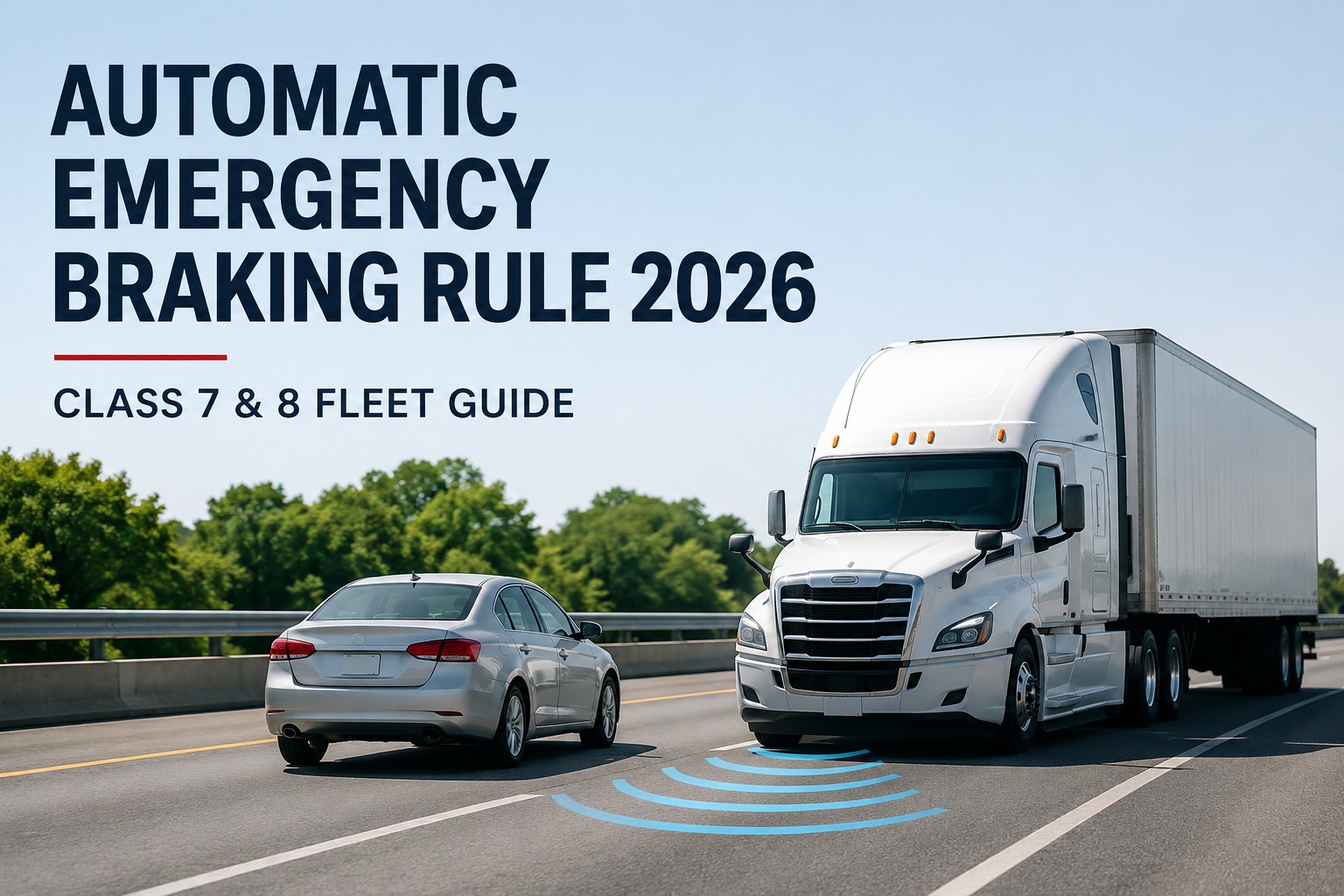
An AEB system on a heavy truck uses a stack of forward-facing sensors — typically radar plus camera — to detect the vehicle in front and estimate closing speed. If a rear-end collision becomes likely and the driver hasn't reacted, the system automatically applies the service brakes. The proposed rule sets performance thresholds, not hardware specs, but the practical result is the same: every new Class 7 and 8 truck comes off the line with a working collision-mitigation stack.
Forward collision detection
Radar + camera sensor fusion continuously monitors the roadway ahead. System calculates closing rate to any detected vehicle in the lane of travel.
Forward collision warning
Audible, visual and often haptic alert to the driver when a collision becomes probable. Warning fires before AEB acts, giving the driver the chance to intervene.
Automatic braking application
If driver doesn't respond in time, system applies service brakes. Proposed rule targets full-stop performance from 6 to 62 mph and impact-speed reduction above.
Electronic stability control
Rule also requires ESC to be on during operation. Detects loss of control and independently modulates brakes to help prevent rollover and jackknife.
Two design points fleet directors should understand up front. One: the rule sets performance standards, not a single approved technology — different OEMs will meet the same spec with slightly different sensor architectures and software behavior. Two: neither AEB nor ESC is user-serviceable in the traditional sense. Sensors get calibrated, software gets updated, and diagnostic codes get read. That is a real change to how your shop plans work. Start free and get vehicle-level ADAS records tied to every work order
What the rule changes for spec & procurement
Procurement teams typically lock next-year builds 12 to 18 months in advance. If the rule finalizes as expected in 2026 with 2027 compliance, that means order sheets going out in mid to late 2026 for early 2027 delivery will be the first affected. Here's the practical shift.
- AEB and ESC are optional or bundled into premium safety packages
- Some OEMs offer them standard, others as $2,000–$5,000 add-ons
- Fleet decides spec tier by lane risk profile and insurer preference
- Aftermarket collision-mitigation retrofits still a common path
- Driver training on ADAS varies widely by fleet
- Factory-installed AEB + ESC on every new Class 7 and 8 truck
- Base price rises industry-wide; premium safety package differentiation shrinks
- Spec choice shifts to sensor generation, warranty terms and OTA update support
- Aftermarket retrofit market pivots to legacy fleet compliance and older equipment
- Driver training on ADAS becomes a baseline onboarding requirement
Two decisions worth making before the supplemental proposal hits. First, if you were already planning to spec AEB on your 2026 orders, keep going — you're aligning with where the market is heading. Second, if you run older units that will still be in service post-2027, decide now whether an aftermarket retrofit makes financial sense against replacement timing. Both decisions get easier when your vehicle spec data isn't scattered across three spreadsheets and a supplier portal.
The maintenance side no one talks about enough
The rule is written as a vehicle-manufacturing standard, but its real operating impact lands in the shop. AEB and ESC are safety-critical systems — when they degrade or fail, the vehicle's real-world crash risk changes. That's why the proposed rulemaking explicitly includes "motor carrier maintenance requirements for vehicles equipped with such technology." Here's what changes for maintenance managers.
Sensor calibration becomes a scheduled task
Radar and camera sensors on forward-facing ADAS need periodic calibration and any time the windshield or front-end sheet metal is disturbed. Miss the calibration after a windshield replacement, and the system may fail silently. Every calibration event needs a documented, time-stamped record.
DVIR items expand
Pre-trip inspections will need to cover forward-collision-warning function checks, ADAS fault indicator status, and any "system unavailable" messages on the dash. Your DVIR template has to reflect that — a paper form built for a 2018 tractor won't cut it on a 2027 build.
Diagnostic trouble codes need routing
ADAS fault codes surfaced by telematics or a driver-flagged warning shouldn't disappear into an inbox. Each needs a work order opened against the unit, worked to resolution, and closed with the fix documented — the same discipline you already apply to brake and engine faults.
False-activation events need investigation
NHTSA has an open engineering analysis into false AEB activations. Every fleet running the technology will see them occasionally. Treat each as a defect report: capture the event, log conditions, and follow up with the OEM or supplier if a pattern develops.
Compliance records must be pull-ready
If a rule-mandated safety system was inoperative or improperly maintained at the time of an incident, the liability and CSA exposure escalates fast. Your ability to show maintained-good-order documentation for every ADAS component becomes an active risk-management line.
None of these are exotic tasks. They're the exact same maintenance disciplines you already run on brakes, tires and hours of service — just applied to a new system. The fleets that already run a proper digital DVIR and CMMS will absorb the change in weeks. Fleets still on paper are looking at a rougher transition. Book a demo to see AEB and ESC checkpoints built into every inspection template
What fleet directors should be doing in 2026 — not 2027
The temptation with a not-yet-final rule is to wait. The fleets that will land softest do the opposite: they use the pre-mandate window to build the operational muscle that mandate compliance will demand anyway. Six moves worth making this year.
Audit current AEB/ESC coverage
Pull a full inventory: which units already have AEB, which have ESC only, which have neither. This tells you the true replacement or retrofit exposure across the fleet.
Model procurement scenarios for 2027
Run two build plans for early 2027 delivery: one assuming rule finalization, one assuming further delay. Lock the common spec decisions now, flag the ones that shift by outcome.
Upgrade DVIR templates now
Add ADAS status, forward-collision-warning function check and sensor-fault items to your inspection templates for units that already have the tech. Working out the process on 30 trucks is easier than on 300.
Standardize driver ADAS training
Roll out mandatory ADAS orientation for any driver assigned to an AEB-equipped tractor. Cover false activations, override behavior and escalation path when something feels wrong.
Track calibration events per unit
Every windshield replacement, front-end repair or reported ADAS fault needs a documented calibration record. Start tracking now so the compliance file is already three years deep when it matters.
Submit comments on the supplemental proposal
When the supplemental notice hits the Federal Register in 2026, the comment window is your last chance to influence the operating-cost implications. Fleet operator input in this round genuinely matters.
From a fleet safety manager who's already run 200,000 miles on AEB
We started spec'ing AEB on our long-haul builds two years before anyone made us. The insurance angle paid for it in year one — our rear-end frequency dropped enough that our renewal moved. The maintenance surprises were manageable but real. Windshields cost more because of the sensor calibration. Drivers had to be trained to trust the system without becoming complacent behind it.
My honest advice to any director watching this rule: don't wait for the mandate to build the process around the technology. The trucks are ready. Most shops aren't. Get your DVIR, your calibration tracking and your driver onboarding in shape now, and the mandate becomes a paperwork exercise instead of a scramble.
Frequently asked questions
Is the automatic emergency braking rule for trucks final?
Not yet. The original proposal from NHTSA and FMCSA to mandate automatic emergency braking and electronic stability control on new Class 7 and Class 8 heavy-duty trucks was expected to be finalized in early 2025, but the agencies decided to pause and develop a revised approach. According to the 2026 federal regulatory agenda, a joint supplemental notice of proposed rulemaking is expected in early 2026. That opens a new public comment window before the rule can be finalized. Once finalized, the original proposal targeted new Class 7 and 8 trucks starting in 2027, with medium-duty vehicles following in 2028. The rule for light vehicles (cars and light trucks under 10,000 lbs GVWR), FMVSS No. 127, was finalized separately in 2024 with a September 2029 effective date, but that light-vehicle rule is being reviewed and is legally distinct from the heavy-truck rulemaking.
Which trucks would the AEB rule apply to?
The proposed heavy-duty AEB rule applies to new Class 7 and Class 8 trucks — meaning vehicles with a gross vehicle weight rating (GVWR) above 26,000 pounds. That covers most single-unit dumps and box trucks in Class 7 and virtually all combination tractor-trailers in Class 8. The proposal also indicated that requirements for medium-duty vehicles (Class 6, GVWR 19,501 to 26,000 lbs) would follow in 2028. Importantly, the rule as proposed is a manufacturing standard — it applies to new vehicles produced after the effective date, not to existing units already in service. Older trucks in your fleet would not need retrofit under this rule as currently drafted, though separate customer, insurer, or state-level requirements may push toward retrofits over time. The rule also includes motor carrier maintenance requirements for vehicles equipped with the technology, so operators of AEB-equipped trucks will have specific upkeep obligations regardless of build year.
What performance level would the rule require from AEB systems?
Under NHTSA's proposed heavy-duty AEB rule, systems would need to fully stop the vehicle and completely avoid contact with a lead vehicle across a speed range of approximately 6 mph up to 62 mph. Above that speed, the requirement shifts to significant impact-speed reduction rather than full crash avoidance — the goal being to convert what would have been a severe crash into a less severe one. The proposal also requires electronic stability control (ESC) to be active during vehicle operation. NHTSA estimated that once all covered vehicles are equipped, the combined AEB and ESC requirement would prevent an estimated 19,118 crashes, save 155 lives, and reduce 8,814 non-fatal injuries annually, and would eliminate an additional 24,828 property-damage-only crashes each year. The exact test procedures and performance thresholds will be re-specified in the supplemental proposal expected in 2026, and may differ from the original proposal.
Will AEB rule compliance increase truck maintenance costs?
Yes, modestly — and the increase is real but manageable if the fleet is prepared. AEB and ESC add sensors, software and control modules that need upkeep. Practical cost drivers include forward-radar and camera sensor calibration, which is required after windshield replacements, front-end body work, or any impact that could shift sensor alignment. Diagnostic trouble code work on ADAS faults becomes a routine work order category rather than an exception. Windshield replacement itself costs more on AEB-equipped tractors because of the calibration step. Driver-facing display and OTA software update infrastructure has a small but ongoing service tail. The offsetting savings, according to industry data on fleets that have already voluntarily deployed AEB, come from reduced rear-end collision frequency and severity, which directly affects insurance renewal pricing and claim exposure. Fleets that already run a proper CMMS with digital inspections and work-order tracking absorb the added tasks with minimal process change; fleets still on paper feel the change more.
Should fleets spec AEB on new trucks before the rule is finalized?
For most heavy-duty fleets in the US, yes — and the case gets stronger every year regardless of the regulatory timeline. Insurance carriers already look favorably on AEB and ESC coverage in underwriting; several major shippers now include collision-mitigation technology preferences in RFP scoring; and the underlying crash-reduction math is solid enough that voluntary adoption has been climbing since 2016, when 20 major manufacturers voluntarily agreed to standardize AEB on light vehicles. For heavy trucks, spec'ing AEB on 2026 model-year builds gives your maintenance team, drivers and shop network real-world exposure to the technology before the mandate arrives — which is a meaningful operational advantage compared to fleets that wait. The main reasons a fleet might defer are duty cycles where forward-facing sensors face known reliability challenges (heavy off-road, extreme dust, certain vocational applications), or capital constraints that force prioritizing other spec upgrades in the near term. For over-the-road, LTL and regional operations, the pre-mandate spec decision is increasingly straightforward.
The fleets that will land softest on the AEB rule already run their compliance program digitally
HVI holds every vehicle's spec sheet, inspection history, calibration record, work order and PM schedule in one connected platform — so when a new safety mandate lands, you already know which units are compliant, which need attention, and how to prove it. Fleets on HVI report ~25% lower annual maintenance cost and a ~3-month payback. Live in under two weeks.
No credit card · No hardware · Compliance dashboard ready on day one