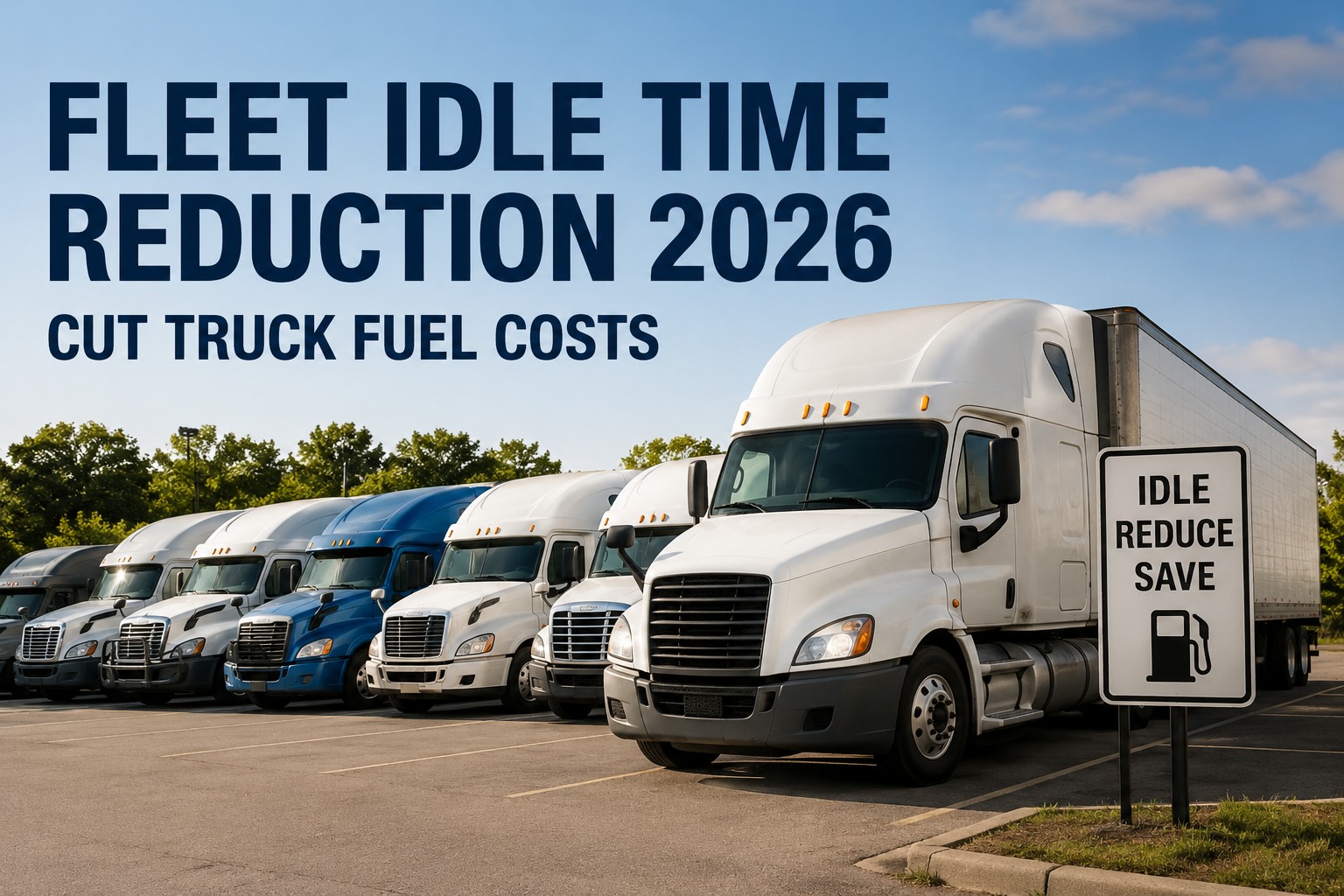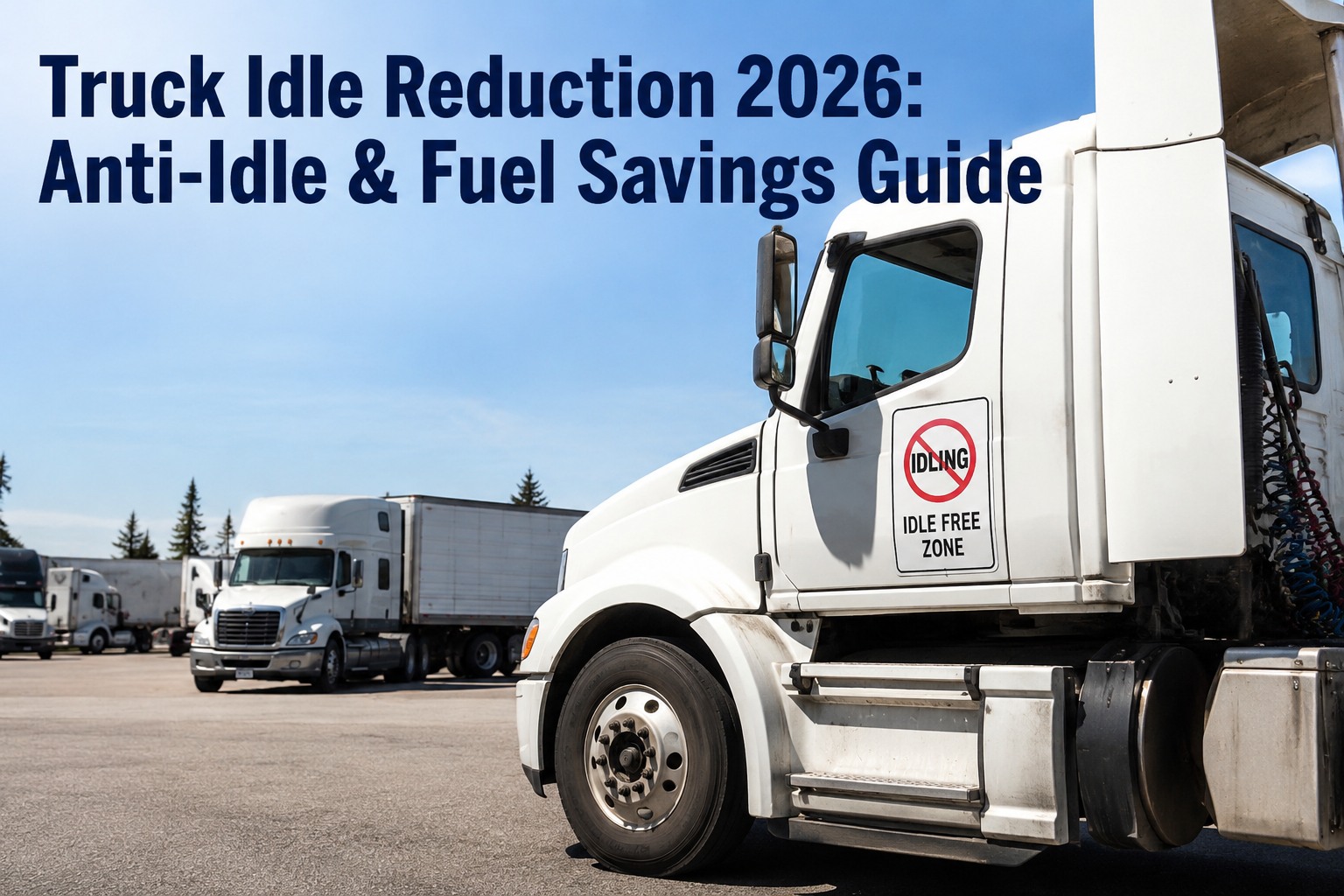
Truck idle reduction is now both a fuel-cost program and a compliance program. California's CARB rule caps diesel commercial idling at 5 minutes with $300-$1,000 fines. New York City enforces 3 minutes (1 near schools), fines $350-$2,000, and issues 10,000+ tickets annually. Illinois, Alabama, and Idaho prohibit idling entirely. Twenty-plus states enforce 3-15 minute limits. This playbook walks the state-by-state map, exemptions that hold up at roadside, and the fleet program producing both fuel savings and regulatory defense — book a demo to track fleet idle time in HVI.
US Anti-Idle Regulatory Map — 4 Enforcement Tiers Every Fleet Must Know
Same 10-minute idle. Ticket in NYC. Warning in Georgia. Nothing in Wyoming. The map is fragmented, enforcement is uneven, and fleets crossing state lines carry the entire mosaic in one truck.
Remaining states (TX, WY, MT, OK, AR, MS, LA, TN, KY, IN, OH, WV, MI, WI, IA, NE, KS, SD, NM, UT, AK, ME) have no statewide statute but may have local ordinances. Even in these states, individual cities and DOT weigh stations may enforce municipal idle rules.
The rest of this page walks the exemptions that hold up at roadside (5 categories, with the paperwork each requires), APU and auxiliary heater qualification for anti-idle exemption, the driver-alert cadence that prevents violations before they happen, the compliance documentation CVSA inspectors ask for, and how to run a fleet program that produces both fuel savings and defensible compliance records. Book a 30-minute demo to see per-truck idle tracking with compliance evidence capture in HVI.
5 exemptions that hold up at roadside — and the paperwork each requires
Every anti-idle statute includes exemptions. The exemptions are broad, but they only protect the driver if the operational circumstances actually match the exemption definition and the fleet can produce documentation. A driver claiming an exemption at the roadside without supporting evidence typically pays the ticket. A driver whose fleet has the compliance records ready to produce typically walks. The evidence gap is what separates a compliance program from an aspiration.
| Exemption category | What it covers | Documentation needed |
|---|---|---|
| Certified APU / auxiliary heater | Sleeper berth cab climate, engine off. CARB-certified units exempt from CA rule; EPA SmartWay for federal. | Unit certification label, install invoice, model list on fleet records |
| Active PTO / work function | Concrete pumping, hydraulic tools, refrigeration compressor engagement, boom operation | PTO engagement logged; work order or route stop matching the time window |
| Traffic conditions | Signals, congestion, queuing at pickup/delivery, weigh station | GPS log showing stationary in traffic pattern; typically self-evident |
| Extreme weather (state-specific) | Cabin climate when temperature below or above defined threshold (varies: some states <40F or >75F, some none) | Weather record for time/location; only valid in states where explicitly allowed |
| Safety inspection / diagnostics | Pre-trip inspection, warm-up per OEM spec, diagnostic troubleshooting | Time-stamped inspection record, DVIR, service work order |
Two important limits on exemptions. First, "extreme weather" exemptions vary widely by state. California has no temperature exemption for trucks with functional APUs or no-idle systems, meaning drivers with those systems installed are not permitted to idle regardless of temperature. Second, sleeper berth idling in California requires the truck to be more than 100 feet from restricted areas (homes, schools, hospitals, child care facilities); within 100 feet, even sleeper idling is limited to 5 minutes. Fleets running compliance programs should train drivers on the specific state rules for the lanes they run and equip trucks with documentation to prove exemption qualification. Book a demo to see per-trip exemption evidence capture in HVI.
The 4-tier fleet program that stops violations before they happen
Anti-idle compliance is not a report generated after violations occur. It is a live-monitoring and driver-alert program that intervenes in the 5-minute window before the ticket becomes possible. Effective programs stack four tiers: written policy, real-time driver alert, dispatch escalation, and monthly attribution. Each tier catches a different failure mode; skipping any one leaves gaps.
Written idle policy
Documented 5-minute idle policy signed by every driver, with exceptions defined (HVAC, PTO, DPF regen, sleeper >100 ft from restricted area). Establishes disciplinary framework and legal basis for enforcement. Zero cost, foundational.
Real-time driver alert
ECM-triggered in-cab alert at 4 minutes stationary with engine on. Driver has 60 seconds to shut off or engage exemption logging. Prevents 90% of violations that would otherwise occur through inattention rather than intent.
Dispatch escalation
If driver alert not resolved within 60 seconds, notification to dispatch. Dispatcher can radio driver directly, override for legitimate exemption, or note incident for coaching. Handles the exceptions the driver alert alone misses.
Monthly attribution + coaching
Per-driver idle percentage trended, bottom quartile coached weekly, exemption logs audited for pattern misuse. Ties the fuel-savings metric back to the compliance metric and closes the loop. Culture shift happens by week 8-12.
Fleets running all four tiers routinely move idle percentages from 25-40% baseline to under 10% within 90 days. On a 100-truck fleet the fuel savings alone typically reach $150,000-$225,000 annually. The compliance benefit is harder to quantify because it prevents fines that would otherwise be issued — but on cross-country fleets that regularly cross Tier 1 zones (NYC, LA, NJ, CT), avoided fines commonly reach $10,000-$30,000 per year separate from fuel savings. Book a demo to see the 4-tier program running per unit in HVI.
APU, aux heater, and battery HVAC — the hardware stack that ends the tradeoff
Anti-idle policy and driver coaching can move idle percentages to 15-20% on their own, but going below that threshold usually requires anti-idle hardware. The tradeoff without hardware is real: drivers need cab climate during overnight rest and DOT-mandated breaks, and the only way to provide it without an APU or aux heater is to run the main engine. Hardware ends the tradeoff, produces the sub-10% idle numbers, and preserves anti-idle exemption in most states.
Diesel APU
- Full climate: heat, A/C, 110V for appliances
- Fuel burn 0.2-0.3 gal/hr vs 0.8-1.0 idle
- Cost $8K-$12K installed, 24-36 mo payback
- CARB certification preserves CA exemption
Auxiliary bunk heater
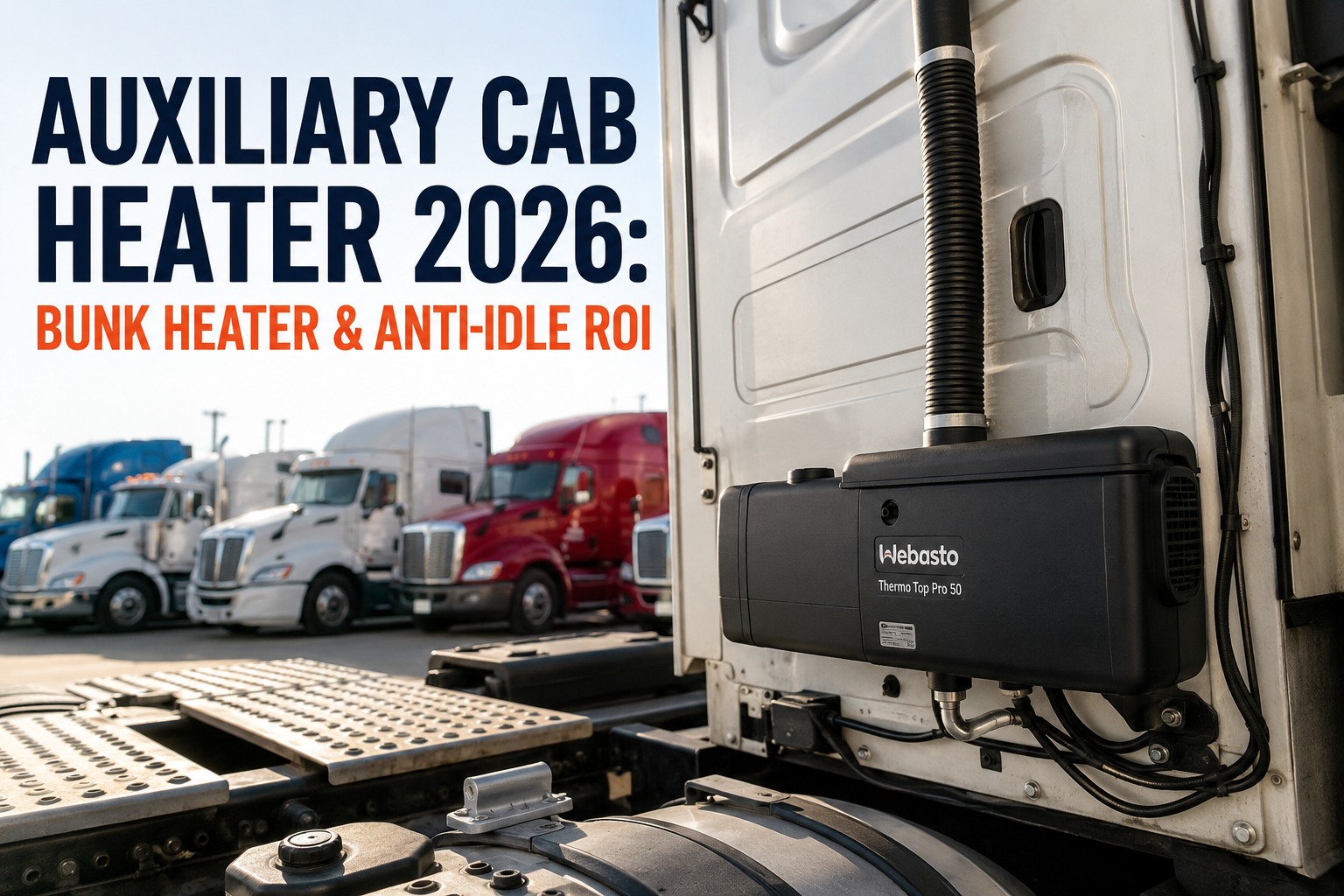
- Heat only: Espar D2/D4, Webasto Air Top
- Fuel burn 0.05-0.15 gal/hr
- Cost $1,600-$2,500 installed, 6-12 mo payback
- Best for northern winter fleets
Battery-electric HVAC
- Bergstrom NITE, Idle-Free EnviroDock
- Zero fuel burn during operation
- Cost $4K-$8K, requires aux battery bank
- Full anti-idle exemption in all states
Shore power / IdleAire
- 110V grid connection at equipped truck stops
- Zero fuel burn, most environmentally friendly
- Cost $2-3/hour connection fee
- Availability limits use to specific corridors
Best-in-class Class 8 long-haul fleets increasingly spec APU or aux heater as standard on new tractors and retrofit older units on a rolling schedule. On a 100-truck fleet with 60 sleeper units the hardware investment runs $200K-$500K depending on choice, but the combined fuel savings plus fine avoidance plus DPF protection plus driver-retention benefit typically produces sub-24-month payback. Fleets that skip hardware and try to compliance-manage through policy alone can hit 15% idle but rarely single digits. Start a free HVI trial to track APU runtime and idle-reduction ROI per unit.
A compliance manager on running the program across 12 states of overlap
We're a 96-tractor over-the-road carrier running lanes across the Northeast corridor — DC to Boston with heavy Newark, NYC, and Hartford density. That means every truck crosses at least 3 Tier 1 or Tier 2 anti-idle zones every week. Prior to 2024 we were paying $18K-$25K a year in NYC idle tickets alone, plus the CSA impact and the customer-side reputation hit with our compliance-conscious shippers who audited our tickets.
Deployed real-time driver alerts + policy + dispatch escalation in Q2 2024. First month NYC tickets dropped from 6 to 1. Second month zero, and we've held zero-to-one tickets per month since. Fleet idle percentage moved from 31% to 12% inside 90 days, then continued to 9% by month 8 after we added APUs on 22 sleeper tractors. Annual fuel savings measured tank-to-tank against prior year: $198K on a $2.1M diesel spend. Ticket avoidance conservatively $22K. Combined recovery north of $220K on program investment of about $85K first year.
The piece most fleets miss is the exemption evidence. Every legitimate idle event on our fleet now logs the reason with time-stamped GPS, PTO engagement status, ambient temperature, and driver override note. When a CVSA officer questions an idle observation at a weigh station our driver produces the record on the tablet in 15 seconds. We haven't lost a challenged exemption in 18 months.
Frequently asked questions
What are the truck anti-idle laws in the United States?
Anti-idle laws are fragmented across US states and municipalities with wildly different limits and fine structures. California's CARB regulation (13 CCR 2485) caps diesel commercial vehicle idling at 5 minutes statewide for vehicles over 10,000 lbs GVWR, with fines of $300-$1,000 per violation. The South Coast Air Quality Management District enforces a stricter 2-minute limit in greater Los Angeles. New York State limits idling to 5 minutes with fines $500-$18,000, and New York City enforces 3 minutes (1 minute near schools) with fines $350-$2,000 — NYC issues over 10,000 idling tickets annually. New Jersey, Connecticut, Massachusetts, Maryland, Virginia, DC, Delaware, Pennsylvania, Colorado, Minnesota, New Hampshire, Rhode Island, and Vermont all enforce 3-5 minute limits. Arizona, Oregon, North Dakota, Florida, North Carolina enforce 5 minutes. Nevada and Georgia allow 15 minutes. South Carolina allows 10. Illinois, Alabama, and Idaho prohibit commercial vehicle idling entirely with broad exemptions. Approximately 22 states have no statewide statute but may have local municipal ordinances (Denver, Salt Lake City, Houston, Dallas run active local enforcement). Canadian cities including Toronto, Vancouver, and Winnipeg enforce 3-minute municipal bylaws with fines up to $500. Fleets running multi-state operations must comply with the strictest rule for the specific location where the truck sits.
How much fuel does truck idle reduction actually save?
A heavy-duty diesel Class 8 truck at idle burns 0.8-1.0 gallons per hour depending on engine size, accessory load (heat, A/C, PTO), and outside temperature. Multiplied across typical undermanaged fleet idle patterns (25-40% of engine-on time), the annual fuel waste per truck routinely reaches $2,400-$3,600. Cutting fleet idle from 30% to under 10% recovers roughly 1.5 MPG effective on the fleet-wide average, which translates to 15-20% total fuel-cost reduction. On a 100-truck fleet with $1M annual diesel spend, that's $150,000-$200,000 in recoverable fuel savings per year. Best-in-class fleets combining policy, driver coaching, telematics alerts, and anti-idle hardware (APUs, aux heaters) commonly reach sub-10% idle and produce 20-25% total fuel-cost reduction. The savings compound with additional benefits: reduced engine wear (ATA estimates each idle hour equals roughly 25 miles of wear), DPF regeneration completion (avoiding $4,000-$8,000 aftertreatment service events), extended engine service life (15-20% longer useful life on low-idle fleets), and driver retention (quieter, more consistent cab climate improves sleep quality on overnight rest). Combined program economics on a 100-truck fleet typically reach $200,000-$400,000 first-year net recovery against $50,000-$150,000 program investment.
Are there exemptions to anti-idle laws for trucks?
Yes, most anti-idle statutes include exemptions, but they only protect the driver if operational circumstances actually match the exemption definition and the fleet can produce documentation. Common exemptions across US states include certified APU or auxiliary heater operation (CARB-certified for California, EPA SmartWay for federal programs), active PTO work (concrete pumping, hydraulic tools, refrigeration compressor engagement, boom operation), traffic conditions (signals, congestion, queuing at pickup/delivery, weigh stations), extreme weather cabin climate (varies by state; California has no temperature exemption for trucks with functional APUs), and safety inspection or diagnostics (pre-trip inspection, OEM-spec warm-up, mechanical troubleshooting). California's rule also requires sleeper-berth idle to occur more than 100 feet from restricted areas (homes, schools, hospitals, child care facilities); within 100 feet, even sleeper idling is limited to 5 minutes regardless of exemption. To claim exemption at roadside requires supporting documentation: unit certification labels and install invoices for APUs and aux heaters, PTO engagement logs for work exemptions, GPS records for traffic conditions, time-stamped inspection records for safety exemptions. A driver claiming exemption without evidence typically pays the ticket. Fleets running compliance programs equip trucks with real-time exemption logging and produce documentation on-demand for CVSA inspector challenges.
Do APUs qualify a truck for anti-idle exemption?
CARB-certified auxiliary power units (APUs) qualify for California anti-idle exemption and provide equivalent exemption in most other US states with anti-idle rules. The exemption applies because the APU provides cab climate control (heat, A/C) and 12V/110V electrical power for driver appliances without running the main diesel engine, eliminating the fuel waste, emissions, and noise that anti-idle rules are designed to prevent. APU fuel burn runs 0.2-0.3 gallons per hour versus 0.8-1.0 gallons per hour for main engine idle, plus zero engine wear during operation and no impact on DPF regeneration cycles. To preserve the exemption, the APU must be a CARB-certified unit for California operation, professionally installed per manufacturer instructions, and paired with certification labels and install invoices kept in the truck for CVSA inspector verification. Non-certified APUs or improperly installed units may not preserve the exemption. Similar exemption applies to CARB-certified auxiliary diesel-fired bunk heaters (Espar, Webasto) for heat-only applications, and to battery-electric HVAC systems (Bergstrom NITE, Idle-Free EnviroDock) for full-climate no-fuel operation. Shore power connections at IdleAire-equipped truck stops also qualify. Fleets running Northern winter routes typically prefer aux heaters for cost efficiency; long-haul fleets requiring year-round cab climate typically spec APUs or battery HVAC.
How does telematics reduce truck idle time?
Telematics reduces truck idle time through four mechanisms working together: real-time driver alerts that intervene before violations occur, per-truck idle tracking that surfaces the highest-idle units and drivers, dispatch-level escalation that catches exceptions driver alerts alone miss, and monthly attribution reporting that funds ongoing coaching. The most consequential mechanism is the real-time in-cab alert at 4 minutes stationary with engine on. The driver has 60 seconds to shut off the engine or log an exemption reason (HVAC, PTO, DPF regen, sleeper >100 ft from restricted area). This alerting alone prevents 90% of violations that would otherwise occur through inattention rather than intent — most drivers do not intend to idle, they simply forget. Per-truck idle percentage tracking reveals which drivers and which lanes produce the most waste; bottom-quartile drivers receive weekly coaching, top-quartile drivers receive recognition, and lane-specific patterns (customer sites with slow loading, weigh stations, hot corridors) get operational fixes. Monthly attribution shows the CFO exactly how much fuel was saved by the program vs baseline and what the next-lever investment would return. Fleets running the 4-mechanism telematics program routinely move idle from 25-40% baseline to under 10% within 90 days — roughly 15-20% fuel-cost reduction on the same route mix and load pattern.
Cut idle. Avoid fines. Prove compliance across every state you cross.
HVI captures per-truck idle hours from ECM, triggers driver alerts before the 5-minute threshold, logs exemption evidence with time-stamped GPS and PTO context, and produces monthly compliance reports for CVSA inspection defense. Idle percentage trends per driver, per lane, per Tier 1-4 zone. Fleets typically move idle from 25-40% baseline to under 10% within 90 days and avoid $10,000-$30,000 in fines per year on cross-country operations. Live in under two weeks. No hardware. No credit card.
Trusted by fleet idle-reduction & anti-idle compliance programs across USA, Canada & EU · Ready on day one