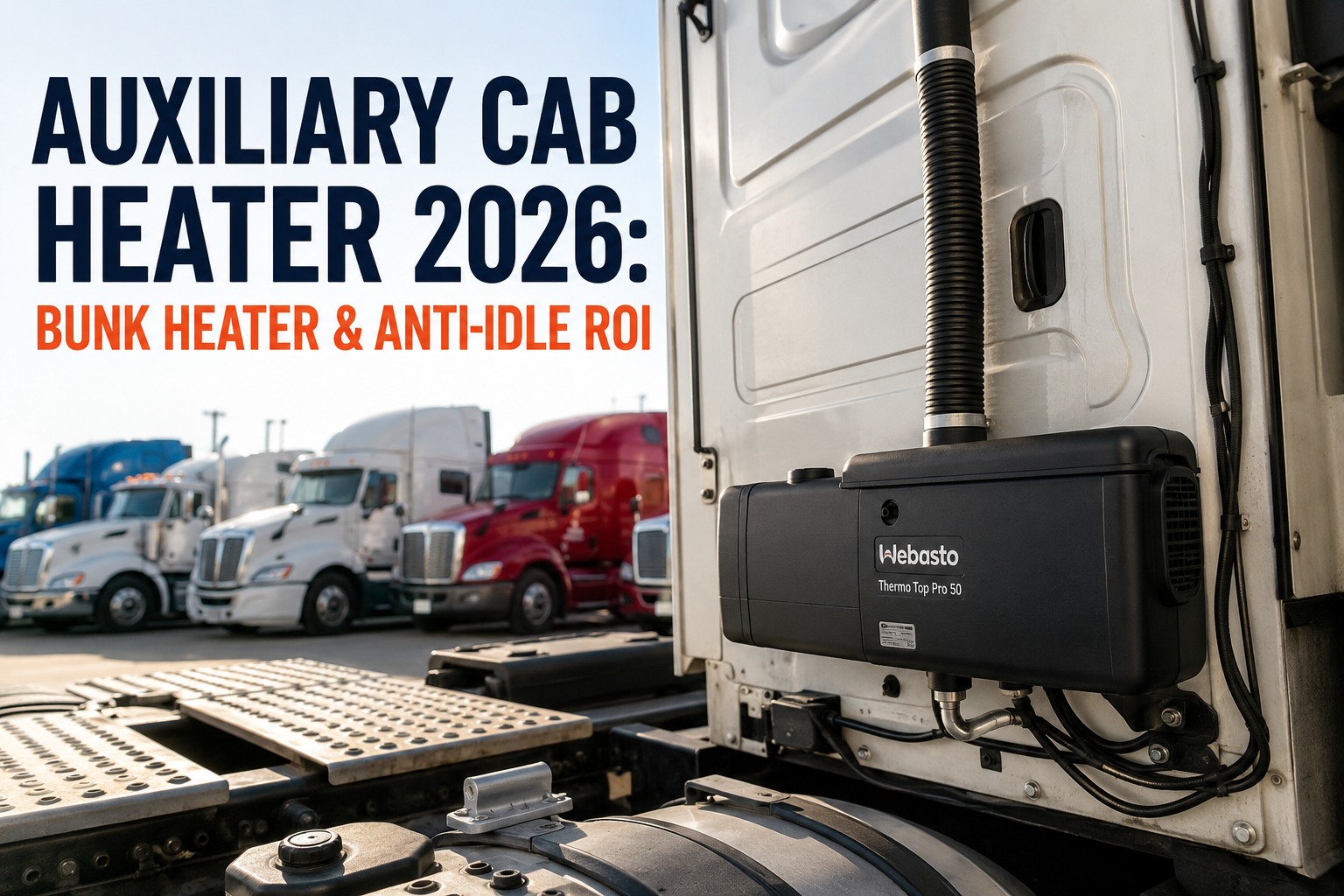
An auxiliary cab heater burns 0.1-0.2 gallons of diesel per hour to keep the sleeper warm overnight — versus 0.8-1.0 gallons per hour if the main engine idles. Over a 10-hour rest that's 6-8 gallons saved per truck per night, roughly $23-$31 at current pump prices. Across 200-250 cold nights per year, an Espar or Webasto bunk heater installed for $1,800-$2,500 typically pays back in 6-12 months and returns $3,000+ per truck annually thereafter. Book a demo to track bunk heater fuel savings per unit in HVI.
Auxiliary Cab Heater vs Idling — The Math That Pays Back in Months
Same warm sleeper. Different fuel bill. Different engine wear. Different fine at the CARB weigh station. Here is the head-to-head.
Numbers use conservative assumptions: 0.75 gal/hr idle rate, 0.15 gal/hr aux heater, $3.85/gal, 200 cold nights/year, $2,000 pro install.
The rest of this page walks the Espar vs Webasto brand comparison, installation costs and time, the DPF and engine-life benefit that turns 6-month fuel payback into a bigger multi-year win, the anti-idle regulation compliance angle, and how to spec the right heater for cab volume & climate. Book a 30-minute demo to see per-truck idle-hour and heater-runtime tracking in HVI.
Espar vs Webasto — head-to-head brand comparison
Two brands dominate the North American diesel-fired auxiliary cab heater market: Espar (also branded Eberspacher) and Webasto. Both are German-engineered, both are certified for anti-idle exemption in most states, both mount in similar locations under the sleeper bunk. The practical differences show up in heat output, maintenance cost, parts availability, and controller sophistication — and matter more on some fleets than others.
| Attribute | Espar Airtronic D2 / D4 | Webasto Air Top 2000 / EVO 40 |
|---|---|---|
| Heat output | 2.2 kW (D2) / 4 kW (D4) | 2 kW (2000) / 4 kW (EVO 40) |
| Fuel consumption | 0.06-0.15 gal/hr | 0.05-0.13 gal/hr |
| 12V current draw | 18A startup, 1.4A running | 16A startup, 1.2A running |
| Field feedback | Higher heat output; shop-preferred in extreme cold | Lower maintenance cost; more sensitive to air intake dust |
| Controller | EasyStart Pro / Digital timer | SmarTemp Control 2.0 (programmable start) |
| Typical install cost | $1,800-$2,500 pro install | $1,600-$2,300 pro install |
| Service life | 8-12 years with monthly runs | 8-10 years with regular use |
| Dealer network | Wide, Kenworth OEM option | Wide, Freightliner OEM option |
Real-world fleet feedback tends to split geographically. Northern-tier and Canadian fleets often prefer Espar for the higher heat output in -30°C conditions; regional and mid-latitude fleets often prefer Webasto for lower parts cost per service event. Both brands require an air intake filter check every 6 months — Webasto specifically has a documented tendency to throttle back or fault when dust plugs the intake sensor. Either way, monthly test-run cycles (5 minutes with heater on) prevent gum-up during summer months when the heater sits idle. Book a demo to track heater runtime and service intervals per unit in HVI.
Why the fuel savings are only half the payback
The 6-month fuel payback is the headline number, but three additional benefits stack on top and are underweighted in most ROI models. Together they can double or triple the true return.
DPF regeneration protection
Sustained idle prevents diesel particulate filter regeneration cycles from completing at proper temperature, producing soot buildup that eventually requires $4,000-$8,000 aftertreatment service. Cutting overnight idle removes the largest source of incomplete regen events.
Engine wear reduction
American Trucking Associations estimates every hour of idle equals roughly 25 miles of engine wear. A truck idling 8 hours per night 200 nights per year adds 40,000 miles of wear annually — equivalent to shortening the engine's useful life by roughly 15-20% over a 5-year duty cycle.
Anti-idle law compliance
Certified aux heaters are explicitly exempt from anti-idle restrictions in CA, NY, NJ, MA, CT, IL, CO and most municipalities including NYC (3-min limit) and Salt Lake City. CARB fines up to $300 per idle violation on repeat findings. A single fine covers 15% of heater install cost.
Driver comfort & retention
Quiet, consistent overnight heat improves sleep quality, which correlates with driver retention and safety scores. Owner-operator surveys routinely rank aux heater as a top-5 spec priority. Fleet spec sheets that include aux heater see measurably better driver-side quit rates within 90 days of onboarding.
Stack the four benefits and the aux heater stops being a fuel-savings device and becomes a fleet-cost-structure improvement. On a 100-truck fleet cycling through northern winters, the combined annual savings routinely exceed $400,000 — before counting DPF service avoidance and driver-retention wins that are harder to quantify but genuinely large. Start a free HVI trial to track fleet-wide idle reduction and heater ROI per unit.
Installation cost, time, and specifying the right heater
Professional installation runs $1,600-$2,500 depending on brand, mounting complexity, and shop labour rate. Typical bay time is 6-8 hours. The heater itself accounts for roughly $900-$1,400 of that; the rest is labour, fuel line taps, exhaust routing, and battery isolation wiring. DIY installs are possible on straight trucks but not recommended on sleeper cabs where fuel-line integrity and exhaust venting have to meet FMVSS certification for the anti-idle exemption to hold.
Match kW to cab volume
- Day cab / small sleeper: 2 kW (D2 / Air Top 2000)
- Standard sleeper: 2-4 kW
- Extended / condo sleeper: 4 kW (D4 / EVO 40)
- Extreme cold (-30°C+): step up one size
Fuel line spec
- Draws from main diesel tank via dedicated line
- Standpipe stops draw at ~1/4 tank (won't strand truck)
- Metering pump measured in ml/hr, not gph
- Winter diesel or #1/#2 blend required below -20°C
Battery isolation critical
- 18A startup draw drops on 12V system
- Never wire directly to starter batteries
- Auxiliary battery bank required for reliable use
- Bergstrom no-idle A/C compatible for full climate
Certification for anti-idle exemption
- CARB certification required for CA exemption
- EPA SmartWay designation for federal programs
- Install by certified installer preserves exemption
- Keep install invoice in truck — CVSA inspector proof
Two spec mistakes cost fleets money. Under-sizing (a 2 kW heater in a 4 kW cab in northern climate) produces slow warm-up and driver complaints, defeating the retention benefit. Over-sizing (a 4 kW heater in a small day cab) produces short-cycle running that shortens heater life and burns more fuel than necessary. The right size for the specific cab volume and climate delivers the ROI numbers; wrong size delivers a warm sleeper and a longer payback. Book a demo to see spec-tracking per unit in HVI for warranty and service scheduling.
A fleet spec manager on measuring the actual ROI on 47 heaters
We're a 120-tractor regional carrier, mixed reefer and dry van, based in Wisconsin. Spec'd Espar D2 heaters on 47 sleepers over 2024 winter at roughly $2,100 installed each — total investment $98,700. Instrumented every install through our fleet system so we could measure actual runtime and fuel against baseline.
Winter of 2025 measured data: aux heater average runtime 4.8 hours per night, main engine idle hours down 71% on those 47 units versus prior winter, fuel savings $3,180 per truck first year, DPF service events on those units down from 8 total to 1 in the same period. Payback per unit hit at month 8. Year-two run: net $3,000+ per truck per year, no additional install spend, plus we started using heater-equipped tractors for driver recruiting — sleeper comfort is on the top-5 list on every driver survey we run.
What surprised me most wasn't the fuel savings; it was the DPF number. We'd been spending $6,000-$9,000 per aftertreatment service and doing 2-3 per year on high-idle units. That line item alone is now trending toward one-third of what it was. The heater ROI model missed most of the real return.
Frequently asked questions
How much fuel does an auxiliary cab heater save?
A heavy-duty diesel truck idling for cab heat burns 0.8-1.0 gallons per hour. A properly-sized diesel-fired auxiliary bunk heater (Espar or Webasto) delivering the same cab warmth burns 0.05-0.20 gallons per hour depending on model, thermostat setpoint, and outside temperature. Over a 10-hour rest break that difference works out to 6-8 gallons of diesel saved per truck per night, roughly $23-$31 in fuel at current pump prices around $3.85/gal. Multiplied across 200-250 cold nights per year, per-truck annual fuel savings typically land in the $4,600-$7,700 range. Real-world fleet data on 47-tractor installations has shown savings averaging $3,180 per truck in year one at more conservative use assumptions. Installation cost of $1,600-$2,500 professionally installed produces payback in 6-12 months on typical duty cycles, and net savings of $3,000-$6,000 per truck per year thereafter for the 8-12 year service life of the heater. Fleets in northern climates and Canadian operations produce the largest savings; year-round southern operations produce smaller savings but still payback within one winter season.
Espar or Webasto — which is better for trucks?
Both are premium German-engineered diesel-fired auxiliary heaters certified for anti-idle exemption in most US states, and both dominate the North American market with 8-12 year service life on either brand. Practical differences: Espar Airtronic D2/D4 typically delivers slightly higher heat output at the same nominal kW rating, is shop-preferred in extreme cold conditions (-25°C and below), and is a Kenworth OEM option; higher initial install cost around $1,800-$2,500. Webasto Air Top 2000/EVO 40 has slightly lower fuel consumption, lower documented parts cost per service event, is a Freightliner OEM option, and features the SmarTemp Control 2.0 programmable-start controller; installation cost typically $1,600-$2,300. Real-world fleet feedback splits geographically: northern-tier and Canadian carriers often prefer Espar for maximum heat output; regional and mid-latitude fleets often prefer Webasto for lower total cost of ownership. Both require an air intake filter check every 6 months; Webasto specifically has a documented tendency to throttle back or fault when dust plugs the intake sensor. Choice depends on climate severity, existing dealer network in operating region, and whether OEM install through Kenworth or Freightliner is available at spec time.
Are bunk heaters exempt from anti-idle laws?
Yes, in most US states with anti-idle regulations. Certified auxiliary heating systems (CARB-certified for California, EPA SmartWay designated for federal programs) are explicitly exempt from anti-idle restrictions in California, New York, New Jersey, Massachusetts, Connecticut, Illinois, Colorado, and most major municipalities including New York City (3-minute idle limit), Salt Lake City, Denver, and many others. The exemption applies because the aux heater eliminates the fundamental problem anti-idle laws are trying to solve: fuel waste, emissions, and noise from a running engine at a stationary vehicle. California CARB fines can reach $300 per commercial vehicle violation on repeat findings; a single fine covers roughly 15% of typical aux heater install cost. To preserve the anti-idle exemption legally, the heater must be a certified unit (not a shop-fabricated solution), installed by a certified installer or per manufacturer instructions, and the install invoice/certification paperwork should be kept in the truck for inspector verification.
Will a bunk heater drain the truck's batteries overnight?
Not if installed correctly. Modern diesel-fired auxiliary heaters draw 16-18 amps at 12V at startup (for a few seconds while the glow plug ignites the fuel), then drop to a running current of only 1.2-1.4 amps for the fan, fuel pump, and control electronics. Over an 8-hour overnight run that's roughly 12 amp-hours of battery capacity — well within the reserve capacity of a healthy commercial truck starter battery bank. The problem arises when drivers add other overnight loads: TV, gaming console, CPAP machine, crock pot, laptop charging, and inverter-fed appliances stack on top of the heater draw and can pull the starter batteries below cranking voltage by morning. Best practice: install a dedicated auxiliary battery bank isolated from the starter batteries via a battery isolator or intelligent charge relay. All cab electrical loads (heater, appliances, inverter) run off the aux bank; starter batteries stay reserved for engine cranking only.
How long does an auxiliary cab heater last?
Espar and Webasto diesel-fired auxiliary heaters typically last 8-12 years with regular use and routine maintenance. Field reports of 9+ years on original units are common; 12+ years is achievable with disciplined servicing. Key life-extending practices: monthly 5-minute test runs during summer months when the heater sits idle (prevents fuel-system gum-up and confirms glow plug function), air intake filter check every 6 months (particularly important on Webasto units), annual servicing including glow plug/screen replacement roughly every 2,000-3,000 running hours per manufacturer schedule, and use of winter-spec diesel (#1/#2 blend) in extreme cold to prevent fuel gelling. Common failure modes: fouled glow plug (single most common, low-cost service item), plugged intake screen, worn metering pump, degraded flame sensor. All are serviceable at the dealer; complete heater replacement is rarely needed within the design service life.
Prove the payback per truck. Scale the spec to the next 50 with confidence.
HVI captures per-truck idle hours, tracks aux heater runtime from ECM and fuel logs, trends month-over-month fuel consumption per unit, surfaces which trucks are producing the largest anti-idle savings, and shows the DPF regeneration completion rate against baseline. Prove the ROI on the first cohort before spec-ing fleet-wide. Live in under two weeks. No hardware. No credit card.
Trusted by fleets running anti-idle ROI tracking across USA, Canada, EU & Nordic regions · Ready on day one