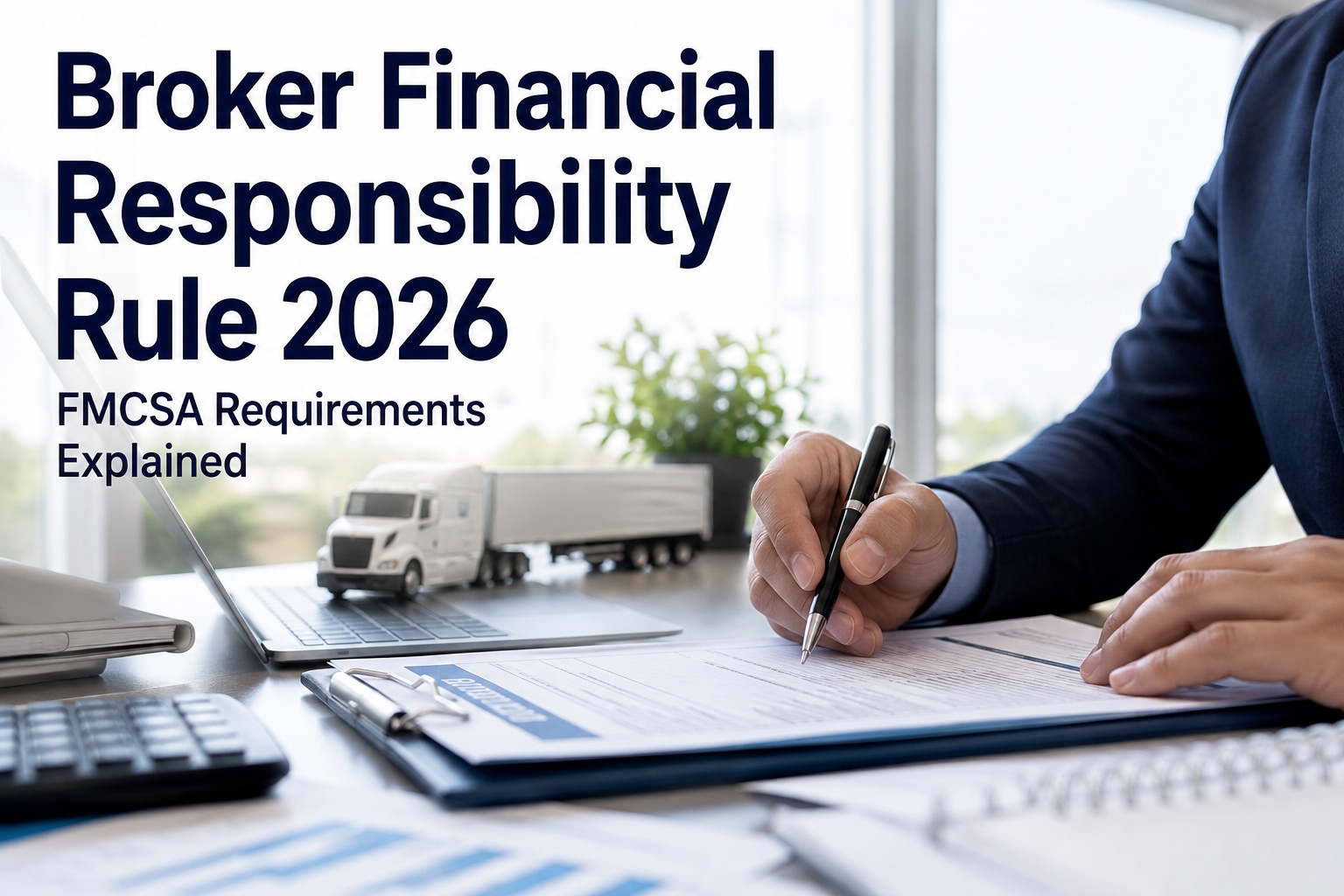
A broker who goes broke owes your fleet money you'll probably never see. That was the quiet reality of freight brokerage for a decade — and it just changed. The FMCSA Broker Financial Responsibility Rule took full effect January 16, 2026, closing loopholes that let brokers operate with depleted bonds while carriers ate losses. This guide walks through what changed in the broker financial responsibility rule 2026, how brokers now get suspended in 7 days, and the carrier-side playbook for vetting brokers and protecting receivables. Book a demo
What actually changed on January 16, 2026 — a decade of paper compliance ends
Same $75,000 headline number. Completely different enforcement mechanics. Here's the honest before-and-after.
For carriers, the rule cuts both ways. The good news: the brokers most likely to stiff you now get flushed out of the system within days, not months. The bad news: when a broker gets suspended mid-load, the carrier still hauling their freight is the one exposed. The financial responsibility rule 2026 is more about broker turnover velocity than broker safety — and the carriers who thrive under it are the ones who vet, monitor, and diversify their broker relationships as disciplined operational work, not as an afterthought.
The 7-day suspension cascade — how a broker goes from booking loads to lights-out
Understanding the timing is what turns broker risk from theoretical to manageable. Every step in the cascade has a specific FMCSA trigger, a specific notification, and a specific consequence. When a broker enters the cascade, carriers hauling their freight have limited time to react.
-
Day 0Bond or trust dips below $75,000
A claim, drawdown, or fund depletion drops the broker's available financial security below the mandatory floor. Under the old rule this could sit uncorrected for weeks. Under the 2026 rule the surety or trustee must electronically notify FMCSA of the drawdown.
-
Day 0–2Surety or trustee notifies FMCSA
Sureties and trustees must notify FMCSA within a defined window of drawdown, insolvency, or financial failure. FMCSA reviews and issues formal written notification to the broker. The clock officially starts.
-
Days 1–77-day replenishment window opens
The broker has 7 business days to restore the bond or trust to $75,000 in qualifying assets (cash, U.S. Treasuries, or FDIC-insured letters of credit). Loan and finance companies are no longer eligible — brokers relying on them must switch providers entirely.
-
Day 8Operating authority suspended if not replenished
If the broker fails to replenish, FMCSA issues automatic suspension of operating authority. Brokers cannot legally book loads. Any carrier hauling for a suspended broker faces receivable risk. Factoring companies typically block suspended brokers within hours of the FMCSA action.
-
Day 8+Broker reinstatement or exit
Reinstatement requires proof of restored $75K in qualifying assets and confirmation from a compliant surety or trustee. Brokers who can't restore typically exit the market. Under the old rule they'd re-register under a new name — the 2026 rule has enough teeth to make that considerably harder.
The compressed timing is the whole point. Under the old regime, a broker could be effectively insolvent for weeks while continuing to book new loads and rack up carrier receivables. Under the 2026 rule the window closes in 8 days from initial drawdown. That's much better for the industry as a whole — but only if carriers are actually watching. Book a demo to see broker-load exposure tracked against operational cost per load
BMC-84 vs BMC-85 — which broker's more likely to stay compliant?
Brokers can meet the financial responsibility requirement two ways: a BMC-84 surety bond or a BMC-85 trust fund. The two structures behave differently under the 2026 rule, and knowing which type your broker uses is a useful signal about their operational stability.
Neither form makes a broker automatically safer — a well-run BMC-85 broker with qualifying assets and a compliant trustee is just as reliable as a BMC-84 broker. But the population-level signal matters. Brokers who couldn't get bonded historically defaulted to trust fund arrangements; the 2026 rule now stress-tests every one of those arrangements. Verifying which type your major brokers use is a five-minute exercise with outsized value. Book a demo to see broker relationships surfaced alongside operational and financial performance data
The carrier's 5-move risk-reduction playbook
The rule change gives carriers real tools for the first time in a decade — but only if the tools get used. Here are the five moves that separate carriers who thrive under the new rule from those who keep taking losses because their broker vetting stopped at "they showed up on DAT."
Before dispatching against a broker's load, verify their FMCSA operating authority is active and their bond or trust filing shows current compliance. FMCSA's SAFER portal is free and instant. Under the 2026 rule, a broker's authority status can flip within days; monthly checks are no longer sufficient.
No single broker should represent more than 15–25% of your fleet's monthly revenue, even if they're a Tier 1 name. Concentration risk cuts both ways: when a broker gets suspended mid-quarter, over-exposed carriers face an outsized cash-flow gap. Diversify book-of-business proactively.
Factoring companies see broker suspensions within hours of FMCSA action — often before the broker's own carriers know. Working with an established factor gives you a first-alert channel: when they block a broker, that's your signal to stop dispatching against them immediately, regardless of load-board postings that may still be active.
When a bond claim becomes necessary, the case rests on documentary evidence: signed rate confirmations, BOLs with timestamps, delivery signatures, driver logs matching hours-of-service records, and unit assignment tied to the specific load. Paper-based fleets consistently lose bond claims to weak evidence. Digital documentation wins.
Newly established broker relationships carry higher receivable risk under the 2026 rule — less operating history, less signal on financial stability. Quick-pay (2–3% factor discount for 3–5 day payment) trades margin for exposure reduction on new brokers. After 90 days of clean payment history the terms can normalize.
None of these five moves individually protects a carrier from broker default. Together they form a defense-in-depth strategy that consistently reduces receivable losses even in a broker market where 2026 enforcement is actively flushing out weaker operators. The carriers who lose money under the new rule aren't the ones who used to lose money under the old rule — they're the ones who assumed the rule would protect them without carrier-side discipline. Book a demo to see broker exposure tracked per unit and per lane or start free and get the digital documentation infrastructure on day one
From a Transportation Operations Manager who lost $52K on a broker default in 2024 and hasn't lost a dollar since
We had a broker owe us $52,000 across 14 loads when they went under in the spring of 2024. The bond was already depleted by the time we filed. We got maybe $4,800 back. That was the last quarter I ever ran broker vetting on gut feel.
Now we verify authority through SAFER before dispatch on every unknown broker, no exceptions. Every load is digitally documented end-to-end. No broker gets past 20% of our monthly revenue. And we quick-pay every new broker for the first 90 days. The 2026 rule helps — brokers get flushed faster now — but the real fix was carrier-side discipline, not waiting for regulators to save us. Zero broker losses in the last 22 months.
Frequently asked questions
What is the FMCSA Broker Financial Responsibility Rule and what changed in 2026?
The FMCSA Broker and Freight Forwarder Financial Responsibility Rule (codified at 49 CFR 387.307) requires every property broker and domestic freight forwarder to maintain $75,000 in financial security at all times — either through a BMC-84 surety bond or a BMC-85 trust fund. The rule dates back to MAP-21 (2012), but full enforcement was repeatedly delayed and the $75,000 threshold was often treated as a paper requirement. The 2026 update, which took full effect on January 16, 2026, closes the enforcement gaps that let non-compliant brokers keep operating. The key changes: (1) if a broker's available financial security drops below $75,000, they have exactly 7 business days to replenish or FMCSA automatically suspends their operating authority; (2) sureties and trustees must now electronically notify FMCSA within a defined window when a broker's account drops below threshold or the broker shows signs of insolvency; (3) loan companies and finance companies are no longer eligible to serve as BMC-85 trust providers — approximately 90% of former trustees don't qualify under the new eligibility rules; (4) trust assets must be held in cash, U.S. Treasury bonds, or FDIC-insured irrevocable letters of credit, and must be liquid within 7 calendar days. The net effect: brokers who couldn't previously meet the requirement can no longer hide behind non-qualifying trustees, and the entire market is under tighter enforcement.
What's the difference between a BMC-84 surety bond and a BMC-85 trust fund?
Both are FMCSA-prescribed forms proving a broker holds the required $75,000 in financial security, but they work very differently. The BMC-84 surety bond is an insurance-style arrangement: the broker pays an annual premium (typically 1–10% of the $75,000, depending on credit) to a surety company that agrees to cover unpaid carrier claims up to the $75,000 limit. Underwriting is credit-based, so brokers with weak credit or short operating history often can't get bonded. Under the 2026 rule, BMC-84 brokers experience minimal structural change — sureties simply add the required drawdown-notification workflow. The BMC-85 trust fund is a different structure: the broker (or a trustee on their behalf) actually holds the full $75,000 in qualifying assets, available to pay carrier claims. Under the old rule, trust fund arrangements were often used by brokers who couldn't get bonded, and eligibility rules on trustees were loose. The 2026 rule dramatically tightens trust fund compliance: trust assets must now be cash, U.S. Treasuries, or FDIC-insured letters of credit; loan and finance companies are no longer eligible trustees (approximately 90% of former trustees no longer qualify); assets must be liquid within 7 calendar days. For carriers, the practical implication is that BMC-84 brokers pass a de facto credit check by getting bonded; BMC-85 brokers require more direct verification of trustee compliance under the new rule.
How can carriers verify a broker's compliance under the 2026 rule?
Two primary verification channels are freely available and should be checked before dispatching against any new broker load, ideally daily for major broker relationships. Channel one is FMCSA's SAFER portal (safer.fmcsa.dot.gov). Enter the broker's MC number to pull their carrier snapshot, which displays Authority Status (must be "Authorized For Property"), Insurance information including their BMC-84 or BMC-85 filing status, and any recent authority actions. If Authority Status shows "Not Authorized" or an insurance filing shows "No" or missing information, do not haul for that broker until the issue is resolved. Channel two is your factoring company. Factors monitor broker credit and compliance in real time; when a broker gets suspended or shows warning signs, factors typically block them within hours — often before the broker's own carriers are aware. Establishing a factoring relationship early gives carriers this first-alert channel even if they don't factor every invoice. Beyond the two free channels, established credit-report services (RTS, Compass, DAT Onboarding, TruckStop Credit Reports) provide deeper broker-side risk indicators including payment history, days-to-pay trends, and industry credit scores. For carriers with meaningful broker exposure ($50K+ receivables outstanding at any time), a subscription-based credit service typically pays for itself in avoided losses within the first quarter. Do not rely on load-board presence as verification — brokers can remain visible on load boards for days after formal suspension.
What should carriers do if they're already hauling for a broker whose authority gets suspended?
The response depends on where the load is in its lifecycle. If the load hasn't been picked up yet, stop dispatching immediately — a broker without active authority cannot legally tender freight, and hauling their load after suspension creates cargo, insurance, and payment exposure with limited recourse. If the load is in-transit but hasn't been delivered, complete delivery on the original consignee's terms (they still expect their freight), document everything digitally end-to-end (rate confirmation, BOL, delivery signature, driver log, unit assignment), and immediately file a claim against the broker's bond or trust. If the load has been delivered but hasn't been paid, act fast — the $75,000 bond or trust is a pooled fund that pays claimants in order received, and multiple carriers may be filing against the same fund. File the claim immediately with complete documentation. In all three scenarios, notify your factoring company (they may already have the broker flagged), notify your insurance broker (some policies include unpaid-freight coverage), and preserve all digital documentation for 5+ years. The bond or trust is capped at $75,000 total for all carrier claims combined, so early filing with complete documentation has a materially better recovery rate than late filing with weak paperwork. Fleets running digital documentation infrastructure consistently recover meaningfully more per dollar owed than paper-based fleets in these scenarios.
How does HVI help fleets navigate broker financial responsibility risk?
HVI supports the documentation and operational-discipline side of broker risk management, which is where bond claims and receivable recoveries are actually won or lost. When a broker default triggers a claim on their BMC-84 bond or BMC-85 trust, the recovery case rests on the carrier's ability to produce clean, timestamped, defensible operational evidence: signed rate confirmations, digital BOLs with delivery timestamps, driver hours-of-service records matching the load lane and dispatch time, unit assignment tying a specific tractor and trailer to the specific load, DVIRs showing the equipment was in service and inspected, and inspection response documentation for any roadside events during the haul. HVI holds all of this on one platform with 5-year retention and single-export audit packages ready for factoring companies, bond surety claims, or court proceedings. On the proactive side, HVI's analytics surface broker-concentration exposure (which brokers make up what percentage of your monthly revenue), receivable aging by broker, and cost-per-mile trends per broker relationship — the operational signals that reveal where your risk actually sits before a suspension notice arrives. Fleets running paper documentation consistently underperform in bond claim recoveries because they can't produce the evidence trail the surety or trustee requires. Digital documentation isn't just an operational upgrade — it's the difference between recovering 60–80% of a defaulted receivable and recovering pennies on the dollar. Published customer data shows fleets on HVI report approximately 25% lower annual maintenance cost and typical payback around 3 months, and the documentation discipline delivers even larger value when broker events occur.
When a broker's bond gets tapped, the fleet with clean digital documentation gets paid first
HVI holds signed BOLs, rate confirmations, delivery timestamps, driver logs, and unit assignment records per load with 5-year retention. When a broker default triggers a claim, your case is one export away — not a three-week scramble across paper files. Recover meaningfully more per dollar owed by being audit-ready before the event.
No credit card · Digital load documentation live on day one