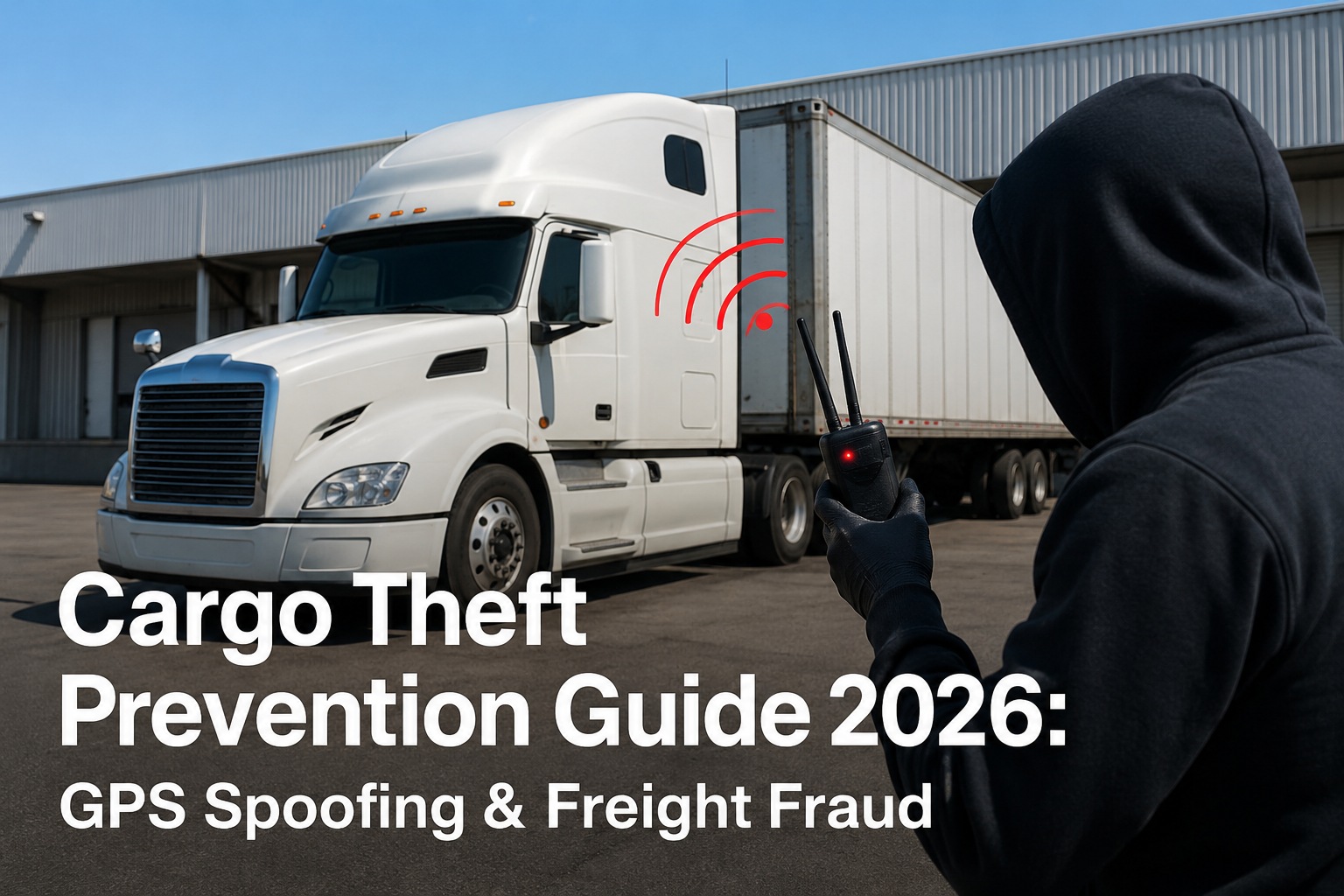
Cargo Theft Prevention Guide 2026: GPS Spoofing & Freight Fraud

By Riley Quinn on July 30, 2026

cargo-theft-prevention-guide

The email looked exactly like every other carrier confirmation your dispatcher gets on a Tuesday. Same broker logo, same rate confirmation format, same signed BOL. Twelve hours later the $340,000 electronics load never arrived, the "carrier" doesn't exist in FMCSA's database, and your shipper is on the phone. That's the modern face of cargo theft. This cargo theft prevention guide covers how organized crews now use AI phishing, GPS spoofing and fictitious pickups — and the six-layer defense that stops them. Book a 15-min HVI demo.

CARGO THEFT PREVENTION · 2026 EDITION · FMCSA-ALIGNED

Your Freight Has Four Attack Surfaces. Guard All of Them.

Physical theft still happens. But deception, digital fraud, and hybrid attacks are where the six-figure losses are hiding — and they're growing at 1,475%.

YOUR FLEET
PHYSICAL
Trailer & yard theft
DECEPTION
+1,475% since '22
DIGITAL
GPS spoofing, AI phishing
HYBRID
Cyber recon → physical theft
$6.6B
North American losses in 2025 (Geotab)
$18M
Stolen every single day
$202K
Average value per successful theft
+60%
YoY loss increase (fewer thefts, higher value)
30-SEC BRIEF The 2026 Cargo Theft Reality

If your security posture still centers on trailer locks and yard cameras, you're defending against 2018-era criminals. Here's what the actual 2026 threat looks like.

DOMINANT THREAT
Fictitious Pickups
Rose from 66/year (2012-2022 avg) to 576 events in 2023. Up 31% in Q1 2026 alone.
FASTEST GROWING
AI Phishing
~2 million fraudulent emails hit transport operators in 2025 (+117% YoY). Deepfakes now fake broker voice verification.
GEOGRAPHIC SHIFT
Illinois & New Jersey
Illinois surged 6% → 13% of national incidents. New Jersey up 119%. California + Texas still lead at 53% combined.
REGULATORY MOVE
FMCSA Fraud Alert
January 2026 alert warns carriers about phishing impersonating federal officials to steal MC numbers and re-route freight.

Why the Padlock Isn't Enough Anymore

For years, cargo theft was a physical problem with a physical solution: better locks, brighter yards, more cameras, dedicated escorts on high-value routes. That world hasn't disappeared — a trailer left in an unsecured yard on a holiday weekend is still a target — but it's no longer where the fastest-growing losses come from. The fastest-growing losses in 2026 don't involve bolt cutters at all. They involve email spoofing, stolen MC numbers, AI-generated documents, and criminals who never touch the trailer until the shipper has already handed it over voluntarily.

The numbers tell the story bluntly. Strategic theft — the deception-based category — grew 1,475% between 2022 and 2024. Fictitious pickups went from a rounding-error problem to a top-line threat: 66 events per year on average across 2012-2022, then 576 events in 2023 alone. Overall industry losses hit $6.6 billion in 2025 with fewer total incidents than 2024, meaning criminals are targeting higher-value freight with more precision. Start a free HVI trial to see how digital audit trails close the identity-verification gaps that GPS alone can't cover.

The 5 Modern Cargo Theft Threats Every Fleet Director Must Understand

Cargo theft in 2026 isn't one thing. It's a stack of five distinct attack patterns, each with its own operational signature and its own defense. Ranked here by growth rate and dollar impact across US and Canadian operations.

01
Fictitious Pickups
Criminals pose as a legitimate carrier — using cloned trucks with correct colors and logos, forged FMCSA credentials, and rate confirmations copied from prior legitimate loads. The shipper loads the freight willingly. By the time the discrepancy surfaces, the load is gone and the "carrier" never existed. Rose from 1% of cargo thefts in 2022 to 17% in 2023.
Growth: +1,475% strategic theft category (2022–2024)
02
AI-Powered Phishing & Deepfake Voice Verification
AI now generates convincing fake broker emails, rate confirmations, and even carrier websites in minutes. When a dispatcher calls the number on the confirmation to verify, deepfake voice tech impersonates the legitimate broker. FMCSA issued a January 2026 fraud alert specifically warning carriers about scammers impersonating federal officials to phish for MC numbers.
Volume: ~2M fraudulent emails in 2025, +117% YoY
03
GPS Spoofing & Location Fraud
Criminals broadcast false GPS signals to make a stolen trailer appear stationary at its expected location while it moves to an offload site. Overhaul's 2026 case files include a $128,000 electronics theft in which the driver submitted a fraudulent proof-of-delivery while GPS spoofing masked the actual truck location. Trailer GPS alone can't detect this — you need corroborating data from multiple sensors.
Detection: requires layered sensor + video verification
04
Broker Identity Theft & Double Brokering
Scammers hijack a legitimate broker's identity (or purchase FMCSA PINs and file MCS-150 changes to redirect contact info in the SAFER database), then book loads under stolen credentials. The real carrier hauls the freight, never gets paid, and the shipper is left with liability exposure. Losses run $500–$700 million annually in double-brokering alone.
Total exposure: $10B+ drained by bad brokers, 2022–2025
05
Cyber-Enabled Physical Theft
Phishing emails install malware on a broker's or carrier's TMS. The attackers exfiltrate sensitive shipment data — routes, timing, driver names, load values — and use it to plan a physical theft (or a fictitious pickup) with insider-level intelligence. The cyber attack itself may leave no visible footprint until the freight disappears.
Signal: unexplained TMS access or credential resets

Anatomy of a Fictitious Pickup: The 4-Stage Attack

Understanding how the highest-growth threat actually unfolds is the first defense. Here's the operational timeline that criminals follow — and the checkpoint at each stage where a fleet can catch them.

1
RECONNAISSANCE (Days – Weeks)
Target Selection
Criminals scrape load boards, monitor broker patterns, identify high-value commodities on predictable routes. Sometimes purchased data from an earlier phishing breach. Target profile: electronics, pharma, apparel, food/beverage on established lanes.
2
IDENTITY BUILDING (Hours – Days)
Carrier Impersonation
Cloned MC number, spoofed email domain (@abclogistics-inc.com vs @abclogistics.com), AI-generated rate confirmation matching the real broker's format, FMCSA SAFER record updates via stolen PIN. All the paperwork appears legitimate under casual inspection.
3
EXECUTION (Hours)
The Pickup
The cloned truck arrives at the shipper's dock during a busy loading window, presents matching paperwork, driver ID, and BOL. If the dock team's verification is a signature check and a photo of the license, the freight loads without friction. Total dock time: under an hour.
4
DISAPPEARANCE (24–48 hours)
Disposal
Load rerouted to an offload site in a warehouse district, freight broken down and sold through fencing networks or shipped internationally. GPS spoofing (if the truck had a tracker) masks the deviation. By the time the shipper calls asking where the load is, it's already been fenced.

You Can't Physically Guard Every Load. But You Can Verify Every Handoff.

HVI captures driver identity at pickup, timestamps every asset movement, and builds an immutable audit log that catches fictitious pickups before the freight leaves your dock. See the workflow that stopped $128K in electronics losses this year.

Where Cargo Theft Is Actually Happening in 2026

Geography still matters, but the map is shifting fast. California and Texas remain the dominant loss zones, but Illinois has surged into the top three, New Jersey's activity jumped 119%, and Tennessee is climbing. Traditional "safe" states are no longer safe.

36%
California
Southern CA warehouse districts dominate
17%
Texas
DFW & Houston port corridors
13%
Illinois
Surged from 6% in Q1 2025 · 45% electronics
12%
Tennessee
Up from 9% · distribution hub target

These four states account for 78% of Q1 2026 cargo theft incidents by CargoNet and Overhaul reporting. Rising outside these hotspots: New Jersey (+119%), Georgia, Florida (Miami port corridor), Arizona. Regional fleets that historically operated below the "cargo theft radar" now face the same risk profile as national carriers.

What Criminals Are Actually Targeting

The commodity mix reveals the strategy. Criminals aren't opportunistic anymore — they're selective, targeting freight that fences fast and traces slowly.

24%

Electronics
Highest per-unit value; fast to fence internationally
22%

Food & Beverage
Nearly impossible to trace; strong local resale demand
14%

Apparel & Footwear
Brand-name goods with active gray-market channels
11%

Pharmaceuticals
High-value per pound; specialized black-market chain
9%

Spirits & Alcohol
High markup; regional resale via unlicensed venues

The 6-Layer Cargo Theft Prevention Framework

No single defense stops modern cargo theft. The fleets with the strongest security postures in 2026 layer six operational controls on top of each other — each catches what the layer below misses.

01
Carrier & Broker Identity Verification
Multi-factor verification at tender: FMCSA MC number cross-check against SAFER, phone verification using the number listed on FMCSA (not the number in the email), email domain match with the carrier's actual website, credit check on DAT or Truckstop. Set up FMCSA account monitoring alerts (FreightValidate's SAFERWatch is free) to catch unauthorized MCS-150 changes within hours.
02
Driver Identity Confirmation at Pickup
Video, photo, or biometric verification of the driver at the shipper's dock, matched against the carrier's roster on file. This is the single control that stops fictitious pickups — a criminal with cloned paperwork can't fake a live video match against a pre-registered driver profile.
03
Layered Asset Tracking
Trailer GPS alone is insufficient — organized crews sweep for and jam devices. Layer trailer GPS with covert in-freight trackers (small, battery-powered) and geofencing alerts for route deviation. When one layer is jammed or spoofed, the others still report.
04
Digital Inspection & BOL Audit Trail
Every pickup, seal, driver ID check, and cargo condition documented in a digital DVIR with timestamps and photo evidence. When a shipment is disputed — whether stolen or misdirected — the audit trail is the difference between a covered insurance claim and a denied one.
05
Cybersecurity Fundamentals
Multi-factor authentication on TMS, dispatch, and broker portals. Email domain protection (SPF, DKIM, DMARC) to block spoofed sender addresses. Regular phishing training for dispatchers. Immediate password resets when a phishing click is confirmed. Restricted access to sensitive shipment data on a need-to-know basis.
06
Contractual & Insurance Discipline
Ban unauthorized re-brokering in every broker-carrier agreement. Review cargo insurance for fictitious-pickup coverage — many policies treat it as a fraud loss, not a theft loss, with different limits. Consider all-risk coverage over carrier liability for high-value freight. Document your vetting SOP for FMCSA compliance.

What a Single Successful Theft Actually Costs

The direct freight loss is only the first line on the invoice. The cascade of secondary costs is what breaks fleet operating budgets.

Direct Freight Loss
$202K – $336K
Industry average per successful theft. High-value electronics/pharma loads exceed $500K.
Insurance Deductible
$5K – $50K
Even covered claims cost the fleet the deductible plus rate impact on next renewal.
Shipper Relationship
$1M+ per contract
One fraudulent incident can lead to immediate termination of a multi-million-dollar shipper contract.
FMCSA Authority Risk
Existential
Consistent unauthorized carrier use or documentation failures can put your broker authority itself at risk in 2026.

6 Warning Signs Every Dispatcher Should Recognize Immediately

Most fictitious pickups follow a pattern. Train dispatchers to escalate any load booking that shows two or more of these signals.

Gmail or Yahoo email instead of a company domain. Legitimate brokers use their own email domain matching their website.
Phone number doesn't match FMCSA records for the listed MC. Call the number on FMCSA, not the one in the email.
Aggressive urgency to move immediately. "Pickup in 90 minutes, no time for verification" is a red flag.
Prefers WhatsApp or text over official broker communication channels. Avoids audit-trail-generating platforms.
Rate confirmation has typos, off-brand fonts, or amateurish formatting. AI-generated docs are getting better but still leak.
Rate 20-30% below market to win the booking, then surprise charges or ghost after pickup.

How HVI Strengthens Your Fleet's Security Posture

Cargo theft prevention isn't a single tool — it's an operational discipline that requires identity verification, audit trails, and asset visibility working together. HVI closes the gaps that GPS-only and paper-based fleets can't cover.

Driver Identity Verification
Photo capture and driver credential match at pickup, stored in the tamper-proof audit log. Fictitious carriers can fake paperwork but can't fake a live driver ID check against your pre-registered roster.
Immutable Audit Trail
Every inspection, BOL sign-off, seal check, and asset movement timestamped and archived for 3+ years. When an insurance claim or FMCSA investigation happens, the audit trail is your defense.
Security Anomaly Alerts
Automated alerts for route deviations, unexpected dwell time at unknown locations, failed identity checks, and unauthorized asset access. Catch anomalies in real time, not after the freight is gone.
FMCSA Compliance Documentation
Structured records of driver identity, carrier vetting, and inspection SOP compliance ready for FMCSA audit. In 2026's tightening regulatory environment, documentation isn't optional — it's your operating authority.

Frequently Asked Questions

What is a fictitious pickup and why is it growing so fast?

A fictitious pickup is a cargo theft in which criminals impersonate a legitimate carrier — using cloned trucks, forged FMCSA credentials, and AI-generated rate confirmations — to voluntarily collect freight from a shipper's dock. The shipper hands over the load thinking the pickup is legitimate. By the time the fraud is discovered, the freight is gone and the "carrier" doesn't exist. Fictitious pickups grew from an average of 66 per year (2012–2022) to 576 events in 2023, and rose an additional 31% in Q1 2026. They now account for roughly 17% of all cargo thefts, up from just 1% in 2022. AI tools have dramatically lowered the effort required to build a convincing fake identity, which is the primary driver of the surge.

How does GPS spoofing work in cargo theft?

GPS spoofing broadcasts false GPS signals stronger than the real satellite signals in the vicinity of the target device. The device accepts the spoofed coordinates as authentic, so a trailer that's actually moving to an offload site appears — on your fleet dashboard — to be sitting stationary at its expected location. Overhaul documented a 2026 case involving a $128,000 electronics load in which the driver submitted a fraudulent proof-of-delivery while GPS spoofing masked the truck's actual location. Trailer GPS alone cannot detect spoofing. The defense is layered sensing: trailer GPS plus covert in-freight trackers plus corroborating data (door sensors, dwell-time anomalies, video verification at handoff).

What is the FMCSA doing about cargo theft and freight fraud?

The FMCSA has taken several enforcement and regulatory actions. In January 2026, FMCSA issued a fraud alert warning carriers in Texas, Georgia, Louisiana, Florida, and other states about phishing scams impersonating federal officials to steal MC numbers. Between 2022 and 2025, FMCSA revoked approximately 15,419 broker operating authorities — nearly 59% of active authorities, though most reflected bond and compliance issues, not all were fraud-related. FMCSA has acknowledged its registration system is outdated and needs an overhaul. In parallel, FMCSA finalized broker financial responsibility rules in November 2023 designed to push out under-capitalized bad actors, and broker liability standards continue to tighten in 2026. Carriers and brokers should enroll in FMCSA account monitoring (FreightValidate's SAFERWatch is free) to catch unauthorized MCS-150 changes within hours.

What are the top red flags that a broker or carrier might be fraudulent?

Six patterns dominate the fraud-signal list: (1) Gmail, Yahoo, or free-email domain instead of a company domain matching the broker's website; (2) phone number that doesn't match the number listed on FMCSA for the given MC; (3) aggressive urgency ("must pick up in 90 minutes, no time for verification"); (4) preference for WhatsApp or text over official email channels that generate audit trails; (5) rate confirmations with typos, off-brand fonts, or amateurish formatting; (6) rates 20-30% below market to win the booking followed by surprise charges or ghosting after pickup. Any single signal is a caution flag; two or more signals should trigger escalation before the load is dispatched.

Does cargo insurance cover fictitious pickup losses?

Not automatically. Many cargo policies distinguish between theft (physical taking) and fraud (deception-based losses), with different coverage limits and different documentation requirements. Some policies exclude fictitious pickup entirely under standard theft coverage, treating it instead as a fraud loss with separate (often lower) limits. Fleets should review their policies specifically for: (a) whether fictitious pickup is a covered peril or excluded, (b) coverage limits for fraud-based losses vs physical theft, (c) documentation requirements for a claim (driver ID verification, BOL audit trail, carrier vetting SOP), and (d) exclusions for theft from unattended vehicles. All-risk cargo coverage typically provides broader protection than carrier liability alone. Given the growth curve of strategic theft, this policy review is not optional in 2026.

CARGO THEFT PREVENTION · DIGITAL AUDIT · ONE PLATFORM

Stop Fictitious Pickups Before the Freight Leaves Your Dock

Driver identity capture, immutable audit logs, layered asset tracking, and security anomaly alerts — all in one workflow that dispatchers, drivers, and shippers actually use. HVI closes the identity-verification gaps that GPS-only defenses can't cover. Live in under 30 minutes.

No credit card · No hardware · Live in under 30 minutes

Share This Story, Choose Your Platform!

Start Free Trial Book a Demo