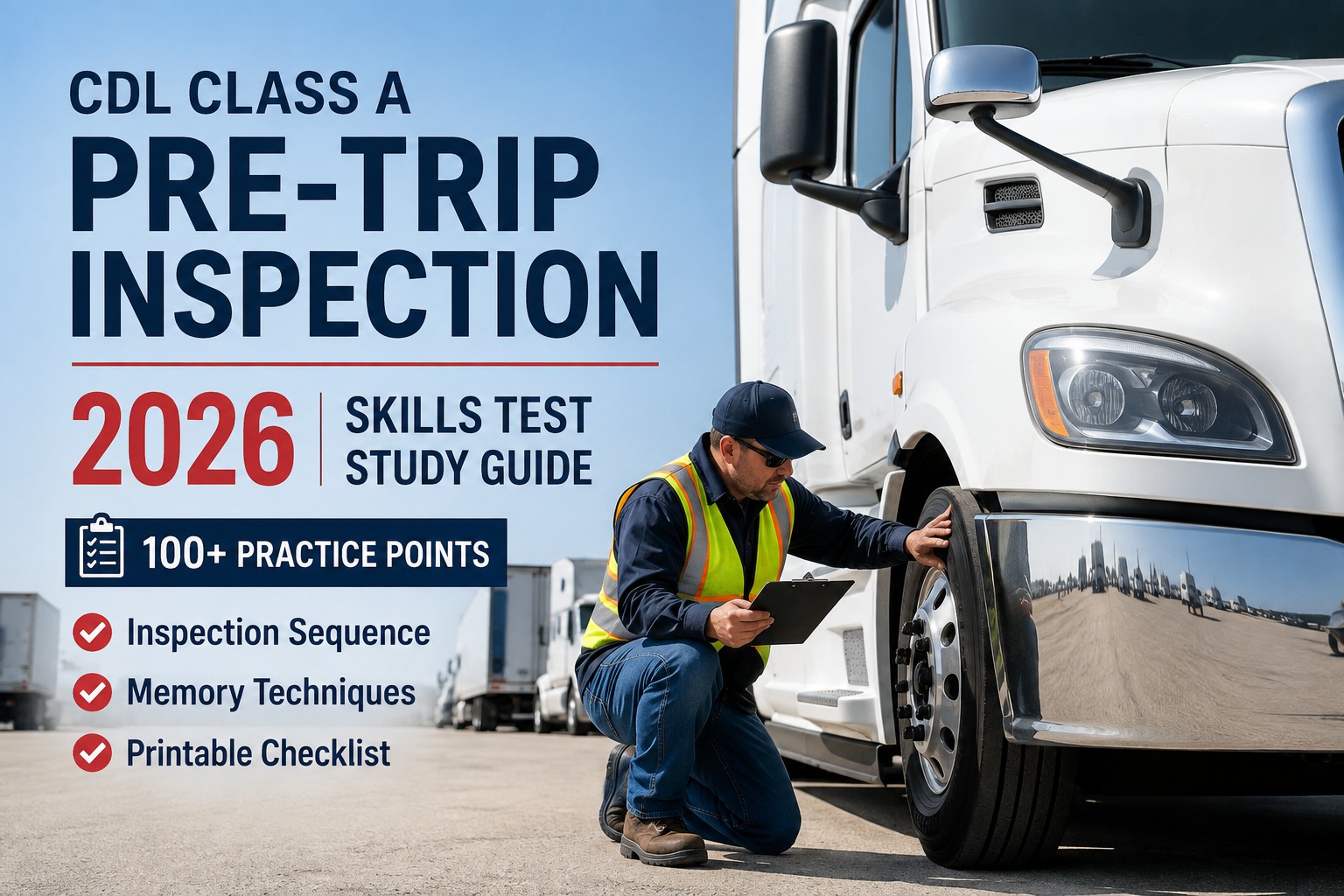
The CDL pre-trip inspection is not a mechanical knowledge test. It's a memory-and-discipline test disguised as one. The examiner isn't asking whether you can rebuild an alternator; they're asking whether you can point at 100+ parts on a Class A rig from memory, touch each one, and say two specific things about it — in 30 to 45 minutes without a checklist. This CDL skills test pre-trip inspection study guide walks the 7-step method, the 3 universal mantras, the L.A.B. air brake test, and the 6 patterns that cause most first-attempt fails. Book a demo
The 7 steps — from engine start to air brake test
Learn zone-by-zone. The walk-around flow is what keeps 100+ items organized under exam pressure.
Approach vehicle. Check for leaks under truck. Look for damage, leaning, obvious hazards. Set parking brake, chock wheels if needed.
Oil, coolant, power steering, belts, hoses, alternator, water pump, air compressor, steering box. ~15 parts.
5-5-Safe Start-5-5 formula. Safety equipment, controls, gauges. Start engine safely.
Steer axle, wheels/tires, brakes, suspension, mirrors, fuel tank, drive axles. ~20 parts.
Fifth wheel, kingpin, air lines (red/blue), electric line, landing gear. Class A specific — ~10 critical parts.
Trailer wheels/tires/brakes, doors, lights, splash guards, reflectors, mudflaps. ~20 parts.
Lights & signals check. L.A.B. air brake sequence — the #1 cause of instant failure if skipped.
The pre-trip inspection is where most CDL candidates lose points, and often it's where they fail outright. The critical realization is that the examiner is not testing mechanical expertise. They're testing whether the candidate can demonstrate systematic discipline on a real truck — the same discipline they'll need to run pre-trip inspections professionally under 49 CFR 396.11 for the rest of their driving career.
The 3 mantras that cover 80% of the pre-trip inspection
The most efficient study insight for pre-trip inspection: you don't need to invent unique descriptions for 100+ parts. You need three memorized phrases — and one of the three applies to almost every component on the vehicle. Learn the three, repeat them consistently, and half the memorization work is done.
The mantras cover 80% of the parts on the walkaround. What remains is the mechanical items with specific functions — alternator, water pump, air compressor, steering box, brake chambers — and each of those has a specific phrase to memorize. But the base rule stands: when in doubt on a metal part, run the metal mantra. When in doubt on rubber, run the rubber mantra. This is what turns 100+ items from an impossible memorization task into a manageable pattern. Book a demo to see the mantra system built into fleet pre-trip templates for professional drivers
The in-cab formula — 5-5-Safe Start-5-5
Step 3 (in-cab inspection) has its own memorization structure. The 5-5-Safe Start-5-5 pattern breaks the in-cab portion into five predictable groups. Every one has to be verbalized on the skills test.
Safety items
In-cab items
Safe start procedure
Gauges
Brake check & controls
Verbalize each group as you complete it. Examiners are trained to listen for the sequence — skipping a group or scrambling the order gets flagged. And the "Safe Start" middle piece is what confirms to the examiner that the candidate understands operational safety, not just item identification. Book a demo to see the in-cab formula built into fleet driver training workflows
The L.A.B. air brake test — where most CDL fails happen
The L.A.B. air brake test is a distinct sub-procedure within the pre-trip inspection — and it's the single most common cause of instant failure on the CDL skills test. Skipping any of the three checks fails the whole inspection. The mechanics are simple; the discipline is what candidates lose under pressure.
Two operational rules that lose candidates who technically know the procedure. First: engine OFF during the whole L.A.B. sequence. Running the engine defeats the entire test because the compressor replaces lost pressure and no meaningful reading gets made. Second: verbalize every step as you do it — "engine off, key on, wheels chocked, parking brake released, applying service brake, holding one minute, watching primary gauge for pressure loss." The examiner needs to hear the discipline as much as see the actions.
The Class A coupling system — 5 checks that separate combination endorsement
The coupling system inspection is what makes a Class A pre-trip different from Class B. Five specific checks apply to every combination vehicle inspection. Miss one and the coupling section fails even if everything else is perfect.
Air lines (Red + Blue)
Red (Emergency) + Blue (Service): Both properly seated in glad hands. No leaks at connection point. Rubber seals soft and intact. Safety clips locked. No cuts, bulges, or chafing along the length.
Electric line (Green)
Green line plugged in firmly, safety latch locked. No exposed wire. Connections clean. All trailer lights functional when tested from cab.
Fifth wheel skid plate
Properly greased (visible film, not dry, not hardened). Securely mounted to the frame. No missing bolts. Plate free of cracks. No metal shavings around mounting.
Kingpin & locking jaws
Kingpin visible through fifth wheel opening. Locking jaws fully closed around kingpin. Release handle in locked position. No visible gap between kingpin and jaws.
Landing gear
Fully raised (not touching ground, no drag). Crank handle secured (not swinging free). No visible damage to legs. Retraction mechanism functional.
All five need to be verbalized and physically pointed to during the inspection. The examiner may specifically ask "what would fail this coupling?" — being able to state what a defect looks like on each component is what turns identification into competence. Book a demo to see coupling inspection built into professional daily workflow
The 6 reasons candidates fail the pre-trip — and how to avoid them
Every CDL school and examiner sees the same failure patterns week after week. Understanding what causes failure lets a candidate study specifically against those patterns instead of memorizing more parts.
Skipping the L.A.B. air brake test
Most common instant fail. Candidate remembers all 100+ parts but forgets one of the three L.A.B. steps. Fix: run L.A.B. verbally at end of every practice session — make it automatic.
Not physically touching parts
Naming a part without pointing/touching loses points. Examiners score contact plus verbalization together. Fix: exaggerate the touch during every practice run so it becomes muscle memory.
Not verbalizing / speaking too quietly
Silent inspection or mumbled explanations fail even when technically correct. Fix: practice out loud at conversational volume. Examiners can't score what they can't hear.
Missing critical safety systems
Steering components, brake system, tires, air lines — these are the "must not skip" categories. Fix: prioritize memorization of these categories over less-critical ones.
Not stating 2+ things per part
"That's the alternator" is not enough. "The alternator is securely mounted, not cracked, and connected properly" satisfies. Fix: use the 3 mantras consistently — each provides 3 things.
Freezing under pressure
Not a memorization issue — a practice issue. Candidate knows the material but locks up. Fix: 10+ full practice runs on a real truck before test day. Muscle memory beats mental recall under pressure.
Practice on a real truck is what builds the discipline that survives exam pressure. Reading a checklist is preparation; walking a physical truck is training. CDL schools that produce high pass rates put students on actual equipment 10-15 times before test day — and that pattern extends into professional driving. The workflow the driver learned in school becomes the workflow they run for 30 years. Start free and get a pre-trip workflow that matches CDL training patterns
From a CDL trainer with 12 years of instruction and a 94% first-attempt pass rate
Every year I get students who walk in convinced the pre-trip is impossible — 100 parts, 45 minutes, verbal, from memory. And every year I show them the same three phrases and the L.A.B. sequence, and by week two they're running it in 25 minutes. It's not a mechanical test; it's a discipline test.
What changed my program was mapping the CDL pre-trip structure directly onto the fleet workflow my graduates would use professionally. When they leave school, they're running the same zone-by-zone flow, using the same mantras, hitting the L.A.B. sequence, and doing it on a digital template with photo evidence. First-year OOS violations on my graduates are about 40% below the industry average. The pattern they learn on the CDL skills test becomes the pattern that keeps them out of trouble at the roadside for the rest of their career.
Frequently asked questions
What is the CDL Class A pre-trip inspection skills test?
The CDL Class A pre-trip inspection is a verbal, from-memory portion of the CDL skills test where the candidate must identify 100+ parts on a combination vehicle (tractor + trailer), physically point to or touch each item, and state at least two specific things about each — typically what they are checking and what defects they are looking for. The test runs 30 to 45 minutes, uses no reference materials, and follows the standard 7-step method: vehicle overview and approach, engine compartment, in-cab inspection, driver-side walkaround, coupling and trailer front, rear and passenger-side walkaround, and signal/L.A.B. air brake test. The examiner scores on completeness (did the candidate cover every zone), technical accuracy (did they say the right things), verbalization (did they speak clearly enough to be heard), and physical contact (did they touch or point to each item). Failing the pre-trip fails the entire CDL skills test. The regulatory basis for the pre-trip inspection extends beyond the CDL skills test into professional driving under 49 CFR 396.11 (DVIR requirements) and 49 CFR 396.13 (driver pre-trip inspection). Understanding the connection matters: the pre-trip discipline learned for the CDL test is the same discipline required daily throughout a driving career. Candidates who study the pre-trip as a memorization exercise miss this; candidates who study it as a professional workflow build the habit that keeps them out of roadside violations and out-of-service orders throughout their career.
What are the 7 steps of the CDL pre-trip inspection?
The 7-step CDL pre-trip inspection follows a zone-by-zone walk-around flow designed to cover 100+ parts systematically. Step 1: Vehicle overview and approach (2-3 minutes) — approach the vehicle, check for leaks under truck, look for damage, obvious hazards, leaning; set parking brake and chock wheels if needed. Step 2: Engine compartment (5-7 minutes) — oil level, coolant level, power steering fluid, belts, hoses, alternator, water pump, air compressor, steering box, and approximately 15 total parts. Step 3: In-cab inspection and start engine (3-4 minutes) — use the 5-5-Safe Start-5-5 formula: 5 safety items (seat belt, horns, fire extinguisher, warning triangles, spare fuses), 5 in-cab items (steering, pedals, windshield, mirrors, emergency equipment), safe start procedure, 5 gauges (oil pressure, air pressure, voltmeter, coolant temp, fuel), 5-step brake check. Step 4: Driver-side walkaround (6-8 minutes) — steer axle, wheels and tires, brakes, suspension, mirrors, fuel tank, drive axles, approximately 20 parts. Step 5: Coupling and trailer front (4-6 minutes) — Class A specific: fifth wheel, kingpin, air lines (red emergency and blue service), electric line (green), landing gear. Step 6: Rear and passenger-side walkaround (6-8 minutes) — trailer wheels/tires/brakes, doors, lights, splash guards, reflectors, mudflaps, approximately 20 parts. Step 7: Signal and L.A.B. air brake test (4-5 minutes) — lights and signals check, L.A.B. air brake sequence (Leaks, Alarm, Button). The order isn't rigid across every state CDL manual, but zone-by-zone flow (front-to-back, driver-side to passenger-side) is universal. Practice the sequence 10+ times before test day.
What is the L.A.B. air brake test?
The L.A.B. air brake test is a 3-step sub-procedure within the CDL pre-trip inspection that verifies the air brake system's ability to hold pressure, warn on pressure loss, and engage spring brakes at the correct threshold. Skipping any of the three steps fails the entire skills test. L stands for Leaks: engine OFF, key ON, wheels chocked; release parking brake; fully apply service brake and hold for 1 minute; Class A pass criteria is maximum 4 psi loss in 1 minute (Class B is 3 psi max). A stands for Alarm: continue fanning service brake to reduce pressure; low air warning light AND buzzer must activate before pressure drops below 60 psi per 49 CFR 393.52. B stands for Button: continue fanning to further reduce pressure; tractor protection valve and trailer air supply valve buttons must pop between 20-45 psi (typically 20-40 psi per manufacturer spec). Two operational rules cause failures among candidates who technically know the procedure. First: engine OFF during the entire L.A.B. sequence. Running the engine defeats the test because the compressor replaces lost pressure continuously, and no meaningful reading gets made. Second: verbalize every step as you perform it — "engine off, key on, wheels chocked, parking brake released, applying service brake, holding one minute, watching primary gauge for pressure loss." The examiner needs to hear the discipline as much as see the actions. The L.A.B. test is the single most common cause of instant CDL skills test failure. Making it automatic through repeated verbal practice is what separates candidates who pass first attempt from candidates who need a retest.
How should I study for the CDL pre-trip inspection?
Effective CDL pre-trip inspection study combines four approaches. First: learn the 3 universal mantras that cover 80% of parts. Metal parts: "not cracked, bent, or broken and securely mounted." Rubber/plastic/hose: "no leaks, no cuts, no bulges and properly connected." Lights and reflectors: "clean, correct color, not broken or missing." When in doubt on any part, run the appropriate mantra — each provides the 2+ specific things examiners require. Second: memorize the zone-by-zone flow. Engine compartment then in-cab then driver-side then coupling then trailer/passenger side then signal/brake test. This is the walk-around order the examiner expects, and following the flow prevents skipping zones. Third: master the specialized memorization tools — the 5-5-Safe Start-5-5 in-cab formula and the L.A.B. air brake sequence. These structured patterns handle the parts that don't fit the mantras. Fourth and most important: practice on a real truck. Reading a checklist is preparation, but muscle memory only develops through physical repetition on actual equipment. CDL schools that produce high pass rates put students on real trucks 10-15 times before test day. Additional study techniques: practice out loud at conversational volume (examiners can't score what they can't hear), exaggerate touching and pointing during every practice run (physical contact is scored), record yourself on practice runs and review for missed items, run the L.A.B. sequence at the end of every practice session so it becomes automatic, and study your specific state's CDL manual because procedures vary somewhat by state.
How does HVI help fleets train new CDL drivers on pre-trip discipline?
HVI runs pre-trip inspections built on the same zone-by-zone flow CDL candidates study during skills test preparation — engine compartment, in-cab, driver-side walkaround, coupling and trailer front, rear and passenger-side, and signal/L.A.B. air brake test. This matters for fleets training new CDL drivers because the workflow they learn on the platform matches the discipline they built for the skills test, creating continuity between school and professional operation. Digital pre-trip templates configured per vehicle type (Class A tractor-trailer, Class B straight truck, tanker, hazmat, doubles/triples) capture the specific components required for each. Photo evidence at critical stations (L.A.B. warning light activation, coupling verification, tire condition) provides audit trail for 49 CFR 396.11 compliance. GPS location and timestamp preserve every pre-trip record. Fleet trainers see driver acknowledgment currency, refresher training completion, and inspection performance over time — enabling coaching conversations grounded in specific inspection history rather than general safety training. For CDL trainers like Miguel G., mapping the skills test structure directly onto the fleet workflow produced a 40% below-industry-average OOS violation rate on his graduates in their first year of professional driving. That's the value of continuity between how CDL drivers learn to inspect and how they inspect professionally. Published customer data shows fleets on HVI report approximately 25% lower annual maintenance cost with typical payback around 3 months; for fleets running high driver turnover, the training continuity value alone typically justifies the software within the first driver onboarding cycle.
The workflow you learn for the CDL test is the workflow you run for the next 30 years. Match them and OOS violations drop.
HVI runs pre-trip inspections in the zone-by-zone flow CDL candidates study — with photo evidence, digital sign-off, and 49 CFR 396.11 audit trail. Live in under two weeks; graduates from CDL schools using this workflow report ~40% below industry-average OOS in year one.
No credit card · Pre-trip templates ready on day one