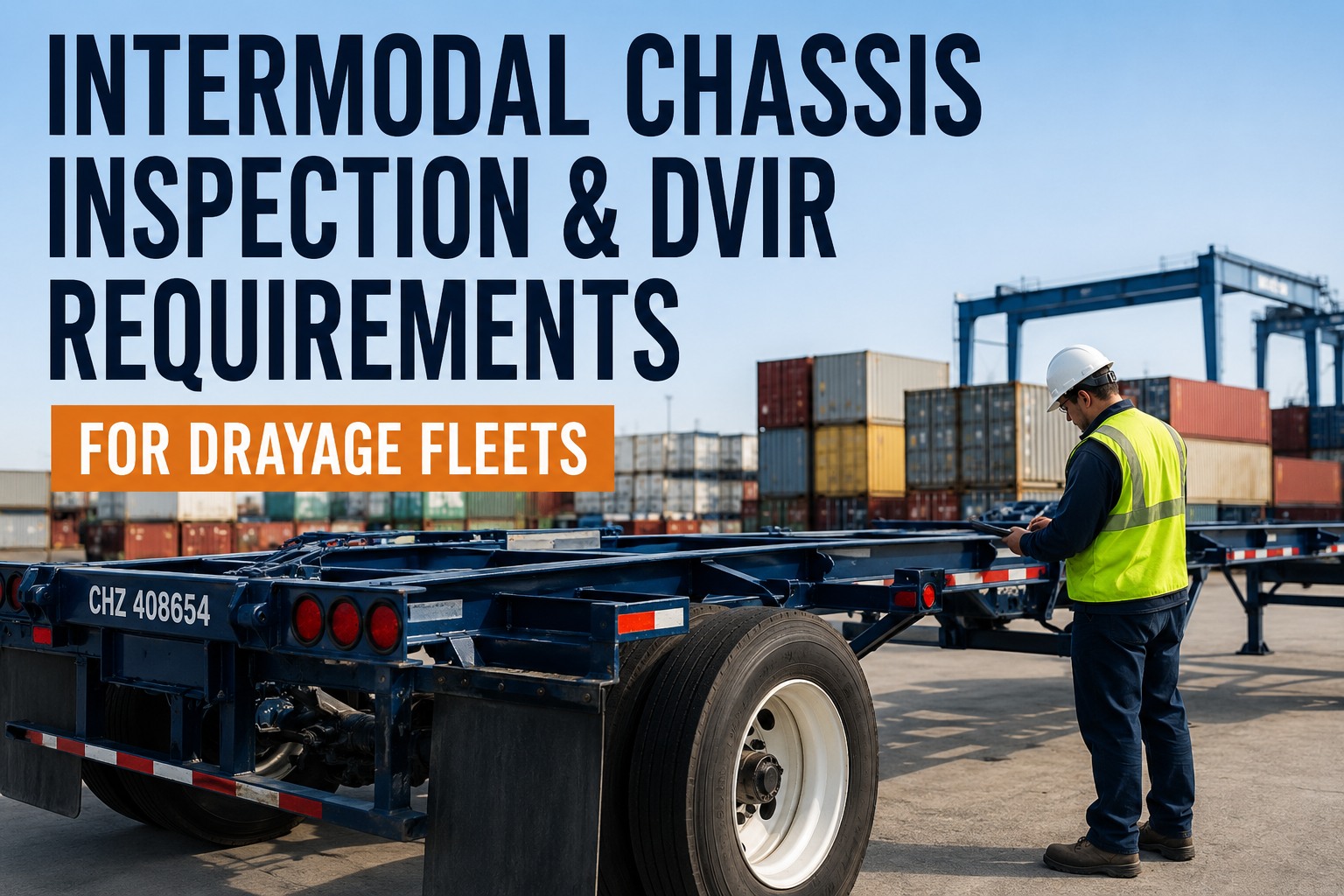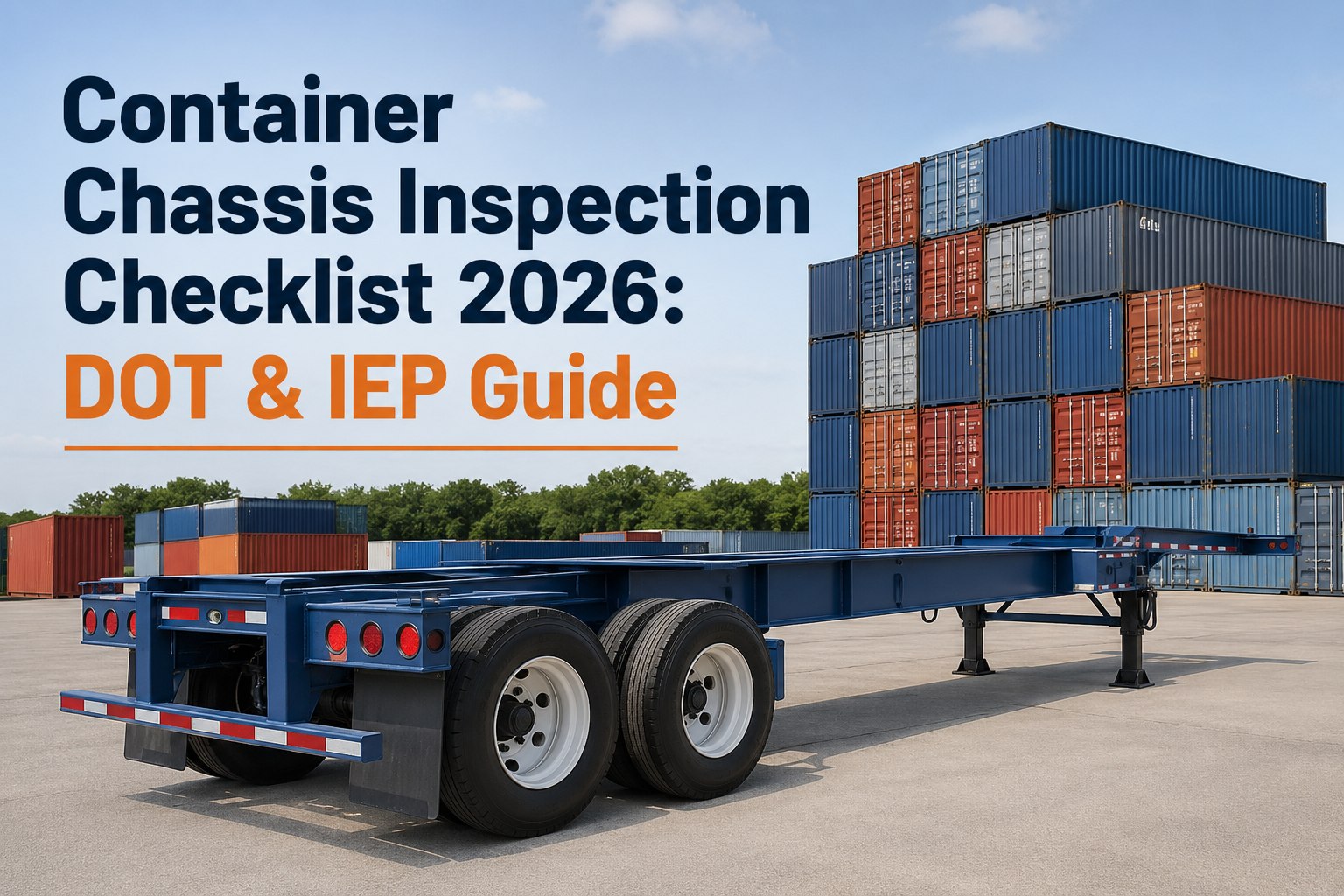
A container chassis passes through more hands in a month than most trailers do in a year. Pulled from an IEP pool, interchanged to a carrier, driven to a rail ramp, swapped to a different carrier, returned to a different IEP location. Every handoff is a potential defect handoff — and the driver at the wheel when the crack shows is the one who gets the violation. This container chassis inspection checklist covers the 49 CFR 396.12 pre-trip and the IEP responsibility split. Book a demo
The chassis under your container was inspected by someone. The question is who, when, and against what standard.
49 CFR 396.12 makes the driver the last line of defense on every interchange. FMCSA roadability rules make the IEP responsible for the pool. The gap between those two — the handoff moment at the ramp gate — is where violations live and where digital inspection records earn their cost multiple times over.
The interchange chain — where defect responsibility hands off (and where it gets lost)
A container chassis isn't like a trailer that stays with one carrier. It moves through a chain of custody where each link has different responsibility. Understanding the chain is what separates carriers who eat the violation from carriers who document their way clear of it.
Chassis staged for interchange
IEP marks the chassis per 49 CFR 390.21 (name + DOT number). Systematic inspection/repair program per 396.3(a). Space provided for driver pre-trip per 390.40(h).
Driver pre-trip at the gate
The critical moment. Driver runs the 396.12 inspection on 7 categories. Any defect found is reported to the IEP; equipment must be repaired or swapped before the driver accepts. Once accepted, driver is deemed to have confirmed condition.
Motor carrier operates the chassis
Motor carrier is responsible for safe operating condition during use. Any defect discovered during the trip is documented per 396.11 DVIR and reported to the IEP on return.
Chassis returned to IEP or next carrier
Damage/defect report per 396.11(b) filed with the IEP at return. Includes motor carrier USDOT, IEP USDOT, chassis unique ID, and all defects discovered during operation. IEP repairs before next interchange.
Every interchange resets the clock. The IEP's annual inspection cycle keeps the chassis roadable in principle; the driver's pre-trip is what proves it at the moment the wheels turn. Book a demo to see interchange-timestamped inspections tied to chassis unique ID
The 7 driver inspection categories — what 49 CFR 396.12 actually requires
FMCSA's driver pre-trip requirement for intermodal equipment isn't the full annual inspection. It's a specific visual check on 7 categories the driver can inspect without going under the vehicle. Every driver operating IME must be satisfied these are in good working order before the equipment moves.
The 7-category walk takes 5-8 minutes on a well-marked chassis at a proper interchange facility. The paper trail it creates protects the driver, the motor carrier, and the IEP in every direction — and prevents the acceptance of a chassis with a documented defect at the gate. Start free and get the 7-category chassis pre-trip template running this week
The top violation categories — what actually gets cited at the scale
FMCSA's own violation frequency data shows chassis defects cluster in a predictable pattern. Fleets that build their pre-trip templates around the actual violation frequency catch the most-cited items before the scale does.
| FMCSR | Violation | Severity weight |
|---|---|---|
| 393.75(a)Flat tire or fabric exposed | Tire flat or with fabric exposed — OOS trigger | 8 (OOS) |
| 393.75(a)(1)Tire ply/belt exposed | Tire ply or belt material exposed — OOS trigger | 8 (OOS) |
| 392.7B-DMissed pre-trip on IME | Driver failed to conduct pre-trip inspection of intermodal equipment | 4 |
| 393.55ABS malfunction lamp defective | Air brake ABS malfunction lamp defective on trailers post-March 1998 | 4 |
| 393.45B2-BAir brake hose/tubing | Air brake hose or tubing damaged or not secured | 4 |
| 393.126B-CIMContainer securement | Improper securement of intermodal containers on chassis | 1 |
| 393.201A-FRWCFrame siderail crack | Cracked siderail web at least 1-1/2 inches toward bottom flange | 2 |
The math is simple: a documented pre-trip on 7 categories prevents 5 of the top 7 violation types. The remaining two are structural findings the IEP's annual inspection should have caught — and the interchange defect report is what escalates them for repair. Book a demo to see the top-violation categories built into the chassis template
From an intermodal fleet manager running 34 drivers pulling from 4 different chassis pools
We pull chassis from four different IEP pools across the port — sometimes three of them in the same week depending on which steamship line's box we're moving. The pools all have their own maintenance programs and their own defect-reporting systems, and none of them talk to each other. For years our defect trail was whatever the driver wrote on a paper sheet at the gate, which mostly meant nothing got written unless the chassis was obviously broken.
What changed the game was moving the 396.12 pre-trip into the mobile app with photo capture on every category. Every chassis interchange starts with a scan of the IEP DOT number and chassis ID, then the 7-category walk with photos, then the driver's signed timestamp. When a defect is found the report goes to the IEP electronically and the chassis doesn't move until we get repair confirmation or a swap. Twelve months in: our chassis-related OOS at roadside dropped from 8-10 per year to two. And when an IEP tried to bill us $2,400 for damage that our records showed was already present when we picked the chassis up, one email with the timestamped photo closed the dispute in an hour.
Frequently asked questions
What does a container chassis inspection checklist cover?
A complete container chassis inspection covers the seven categories required by 49 CFR 396.12 for driver pre-trip on intermodal equipment. Service brake components visible without going under the vehicle (brake chambers, slack adjusters, drums, hoses, and trailer brake connection). Lighting devices and reflectors (7-way plug, wiring harness, all lights and reflectors functional, ABS malfunction lamp on trailers post-March 1998). Tires (tread depth adequate, no exposed ply or belt material per 393.75, no flats, proper inflation — the single highest violation category on chassis inspections). Wheels and rims (no cracks, no missing or loose lug nuts, no bent studs, proper torque). Coupling devices and king pin (twist locks, push pins, handles, safety devices with no cracked welds, worn, bent, broken, or missing parts, and king pin visible and undamaged). Landing gear (operates smoothly in both directions, no cracked welds, no broken or loose parts). Frame and tandem slider (main rails, bolsters, crossmembers, ICC bumper, light boxes, mudflap hangers with no cracked welds or bends affecting container mating, slider stops undamaged, no elongated slider-lock apertures). The pre-trip is a visual and auditory check the driver can perform without physically going under the vehicle; it takes 5-8 minutes on a well-marked chassis and creates the documentation that protects the motor carrier at every subsequent inspection point.
Who is responsible for chassis defects — the driver, motor carrier, or IEP?
Responsibility for intermodal chassis defects is split across the interchange chain under 49 CFR Parts 390, 392, and 396. The Intermodal Equipment Provider (IEP) is responsible for maintaining a systematic inspection, repair, and maintenance program per 396.3(a) that keeps every chassis in the pool in safe operating condition. The IEP must register with FMCSA (Form MCS-150C), mark every chassis with the IEP name and DOT number per 390.21, provide sufficient space for driver pre-trip per 390.40(h), and maintain a process to receive driver defect reports and respond with repair. The motor carrier and driver are responsible for the 396.12 driver pre-trip inspection at the gate before accepting the chassis. Once the driver accepts the equipment and operates over the road, the driver is deemed to have confirmed the inspected components were in good working order, so any subsequent finding on those components typically falls to the motor carrier. Defects discovered during transport are reported to the IEP per 396.11(b) at return, and the report must include motor carrier USDOT, IEP USDOT, chassis unique ID, and all damage or defects observed. The critical documentation point is the handoff: a driver who accepts the chassis without a documented inspection cannot later claim a defect was pre-existing, while a driver with timestamped photo-verified pre-trip records has evidence of condition at acceptance that protects the carrier throughout the interchange chain.
What are the most common container chassis violations at roadside?
FMCSA violation frequency data shows chassis-related citations cluster in a predictable pattern. Tire defects are the top category by a wide margin: 393.75(a) flat tire or fabric exposed and 393.75(a)(1) tire ply or belt material exposed are both severity-weight 8 out-of-service violations that shut the rig down until the tire is replaced. 392.7B-D catches drivers who failed to conduct the required pre-trip inspection of intermodal equipment — a severity-4 violation that documents the paperwork failure regardless of whether an underlying mechanical defect was present. 393.55 ABS malfunction lamp defective on trailers manufactured after March 1998 is another frequent finding. 393.45B2-B covers air brake hose or tubing damaged or not secured. 393.126B-CIM cites improper securement of intermodal containers on chassis (typically twist lock issues). 393.201A-FRWC catches cracked siderail webs of at least 1-1/2 inches toward the bottom flange — a structural finding that usually shows up during a detailed inspection rather than at a scale. Fleets that build their pre-trip templates around the actual top-violation categories catch the most-cited items before the roadside inspector does. A documented pre-trip that covers the 7 driver categories per 396.12 prevents 5 of the top 7 violation types outright and creates the paperwork evidence that defends against 392.7B-D.
How long must chassis inspection records be kept?
49 CFR 396.12 and related IEP regulations set specific record retention windows for intermodal chassis. Intermodal Equipment Providers must maintain inspection, repair, and maintenance records for each unit of intermodal equipment they tender or intend to tender to a motor carrier for one year, or for six months after the equipment leaves the IEP's control — whichever is longer. This includes systematic inspection records, repair records, maintenance actions, and driver-submitted defect reports. The annual inspection report required under 396.17 must be kept where the equipment is maintained and be available on demand of authorized federal, state, or local officials. For the motor carrier's side of the chain, DVIR records under 396.11 for defects reported to the IEP must be maintained in the motor carrier's records. When a motor carrier or IEP did not perform the last annual inspection on equipment intended for interchange, the party currently responsible is required to obtain the original or a copy of the last annual inspection report on demand. Digital record-keeping is the practical solution here: paper defect reports at the ramp gate get lost, unread, or attributed to the wrong chassis; digital records tied to chassis unique ID travel with the equipment across interchanges and survive the multiple hand-offs the retention rules assume happen.
How does HVI support container chassis inspection and IEP compliance?
HVI's chassis module runs the 49 CFR 396.12 driver pre-trip in the mobile app with all 7 mandatory categories (service brakes visible, lighting and reflectors, tires, wheels and rims, coupling devices and king pin, landing gear, frame and tandem slider) as prompted photo-capture steps. Every inspection ties to the chassis unique ID scanned from the IEP marking, the IEP name and USDOT, and the motor carrier's USDOT so the interchange chain is documented from the gate. Timestamped photos of every category create the evidence pack that proves condition at handoff regardless of what shows up later. Defects found during pre-trip generate a report to the IEP electronically per 396.11(b) with all required elements (motor carrier USDOT, IEP USDOT, chassis unique ID, defect description, photo), and the driver is prevented from accepting the chassis in-app until the IEP responds with repair confirmation or a swap. Over-the-road DVIRs and end-of-trip defect reports follow the same workflow. Records archive per chassis (searchable by unique ID) and per motor carrier (for the carrier's own retention), meeting the 1-year IEP retention plus 6-months-post-control requirement in one system. For intermodal fleet managers like Miguel V. running port drayage against 4 different IEP pools, the typical outcome is chassis OOS at roadside cut by 70-80% within the first year and elimination of damage-billing disputes with photographic timestamp evidence. Book a demo to see the chassis interchange workflow running live.
Every chassis interchange is a documentation moment. Miss it and it's your violation.
HVI runs the 396.12 pre-trip with photo capture, ties every inspection to the chassis unique ID and IEP DOT number, routes defect reports to the IEP automatically, and archives the whole chain per chassis and per motor carrier. Live in under two weeks; typical result is chassis roadside OOS cut 70-80% and elimination of damage-billing disputes.